Hot Coffee Conversation with artist and art activist Jamie Martinez and indepedent curator Emireth Herrera Valdés

Published Thursday, October 17, 2025
Curator Emireth Herrera Valdés and artist Jamie Martinez are independent art practitioners who create a unique segment within the artistic landscape of New York. As the founder of the independent space The Border in Brooklyn, Martinez was able to bring in and support many artists with their first shows; some of them have since developed full-scale artistic careers. He is a practicing artist himself.
Emireth Herrera Valdés is an independent curator and writer based in New York. She has curated exhibitions including Invisible Hands at 601Artspace, S.T.E.P. at the Queens Museum, Whispers at Spring/Break 2023, Tongue Tide, and 3459’ at Flux Factory. In collaboration with the Border Gallery, she co-curated Invisible Bodies at Pennsylvania State University, and with the Institute for Studies on Latin American Art (ISLAA), she co-curated Grilo/Fernández-Muro at the Institute of Fine Arts, NYU. Herrera has contributed to educational initiatives between the MARCO Museum (Monterrey, Mexico) and the Autonomous University of Coahuila. Her project, From Vulnerable Territory to Utopia, was presented at ARoS Museum in Aarhus, Denmark, and at The Museum for All People: Art, Accessibility, and Social Inclusion, part of the MUSACCES Consortium at Complutense University of Madrid. Currently, she serves as Associate Curator and Community Outreach Coordinator in the Arts in Medicine department at NYC Health + Hospitals. Ghostmashine, an independent art space co-founded by Martinez on the Lower East Side, is currently hosting a group exhibition titled Inherited Labor. I caught up with Emireth and Jamie to ask a few questions about the show and their respective practices.
Nina: Imagine you are in your favorite coffee or tea spot. Where is it? What are you drinking? What are the three things you see right now?
JM: I enjoy spending time at Ludlow Coffee Supply on 176 Ludlow Street. Their cappuccino and Bourbon Vanilla latte are my favorites. I sit surrounded by paintings, watching people come and go, thinking about what to do next.
EHV: The Coffee Spot is one of my favorite places, just a couple of train stops from Brighton Beach. I start with a cappuccino, look through their antiques, and then head to the beach.
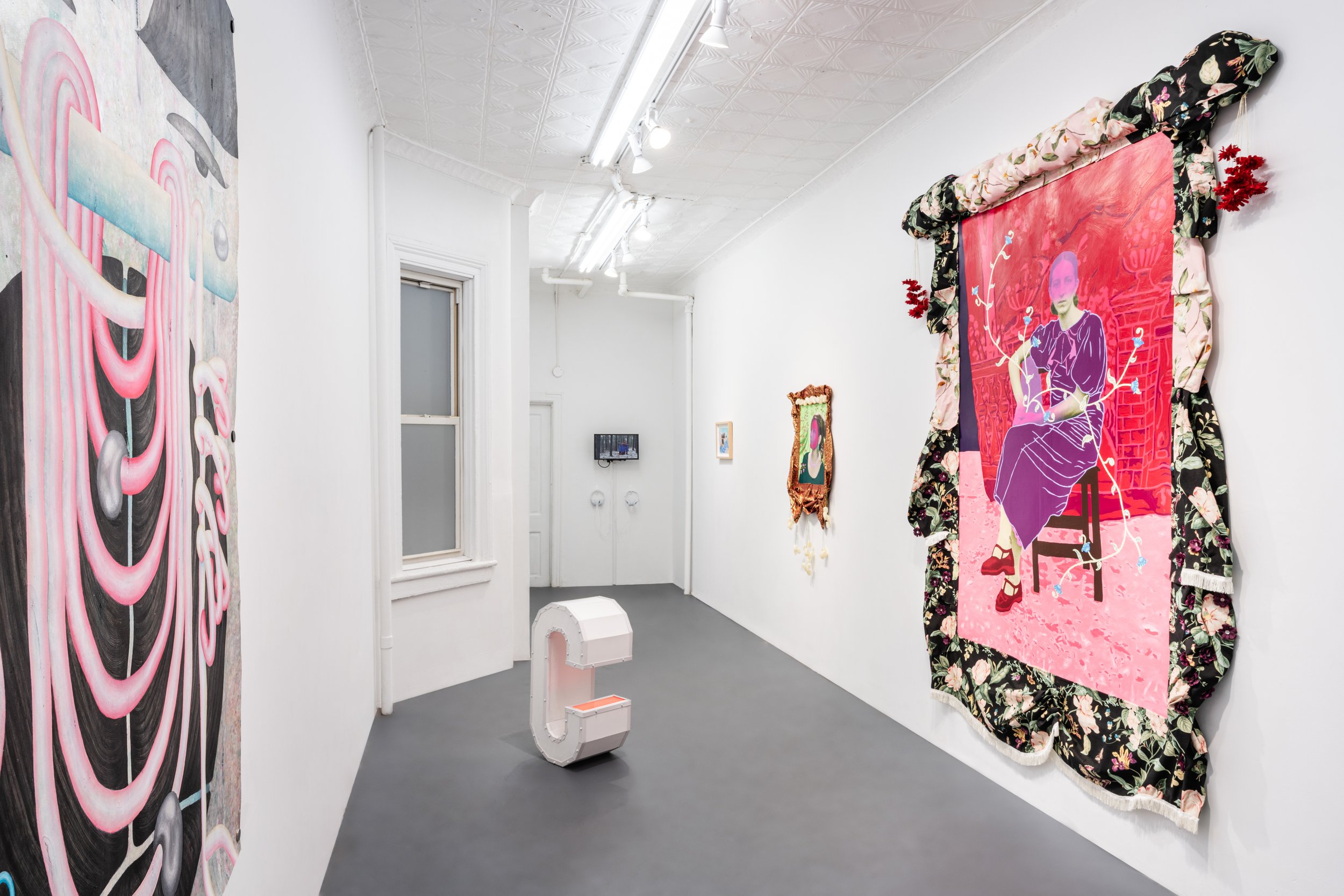
Inherited Labor" Daisy Patton, Jen Liu, Zac Hacmon, Gabino A. Castelán, and Anna Fabricius, curated by Emireth Herrera Valdés. Photo courtesy of Ghostmachine.
Nina: Please tell us more about your ongoing collaboration between Border and Ghostmachine, a group exhibition titled Inherited Labor. What is the concept of this show? Is it the first time you are collaborating? What is different about this collaboration?
JM: Yes, this is our first time collaborating. What makes this partnership unique is the way our roles complement one another — Emireth Herrera Valdés, representing The Border, takes the lead as curator, while Ghostmachine provides the physical space and atmosphere to host the exhibition. It’s a collaboration built on shared values and mutual respect, bringing together two independent platforms with a common goal: to support artists and curators in putting together unique shows.
EHV: My first exhibition addressing labor, Invisible Hands, took place at 601Artspace and focused on domestic work. I have previously collaborated with Jamie Martínez and The Border Gallery—our first project together was Invisible Bodies at Penn State University (2022–2024), which explored different forms of labor often carried out by immigrants in the United States. Inherited Labor at The Border, in collaboration with Ghostmachine, is my third exhibition on the subject, this time examining reproductive labor: work performed by both men and women through repetitive patterns, gestures, and routines. Reproductive labor emerges here as a site of creativity, persistence, resistance, memory, and transformation. The exhibition reveals how these acts carry legacies of care and honor those who sustain and eternalize them.
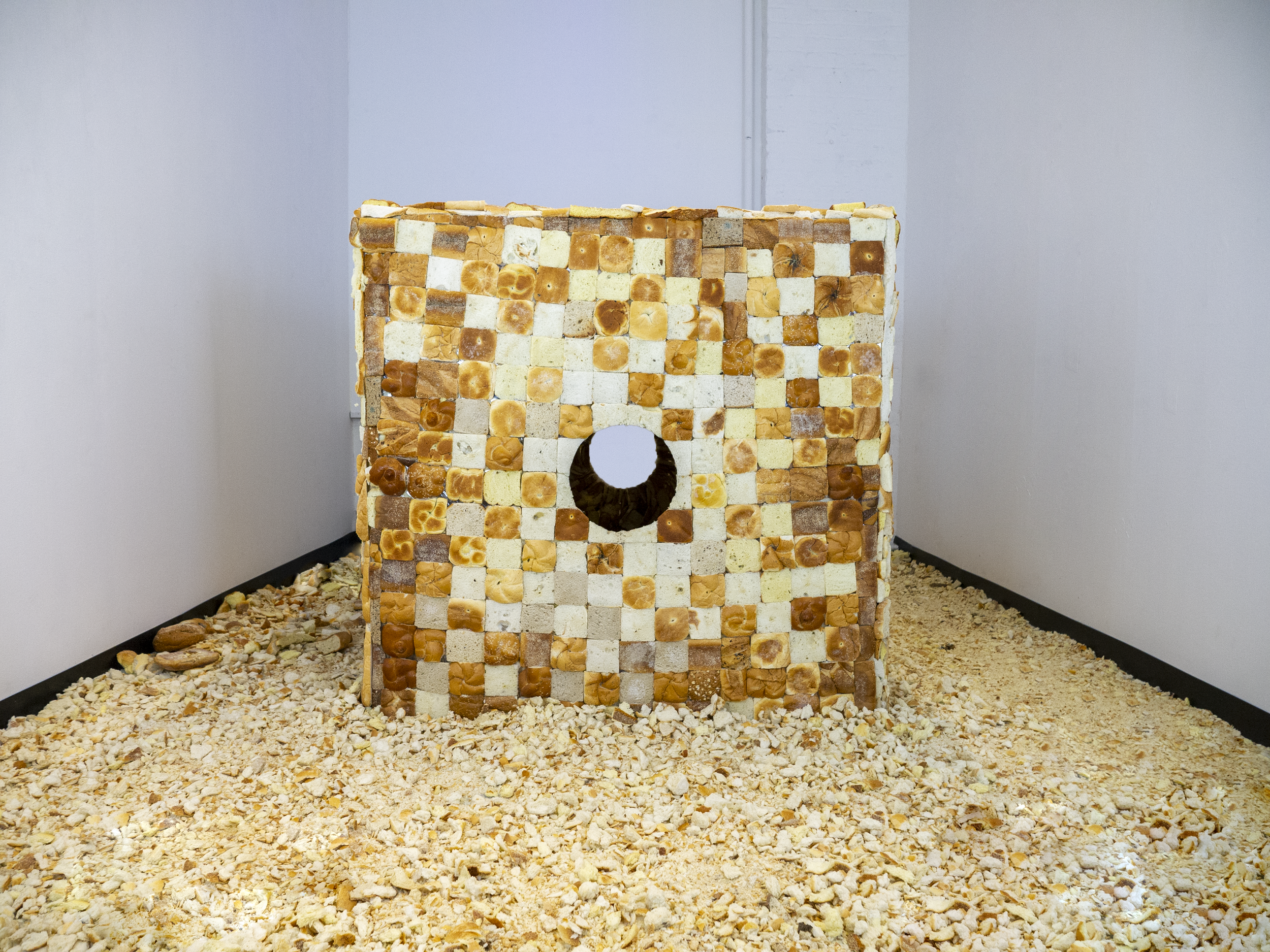
Bianca Abdi-Boragi: The Heel of the Loaf curated by Jamie Martinez | Oct 23 - Nov 14, 2020. Photo courtesy of The Border.
Nina: Please tell us more about The Border and the Ghostmachine. Both of these practices have been working with many artists, championing them from early on. When did you start these spaces? How? Why? How do you see yourself continuing?
JM: Yes, The Border is a space I founded in 2018, back when the president at the time — whose name I prefer not to mention — began publicly attacking immigrants. I felt compelled to respond by creating a space in Bushwick that would celebrate immigrant artists and the diverse communities they represent. I decided to pause The Border in 2023 to focus on my own art projects and exhibitions. I still curate outside projects under the Border and its philosophy. The Border Gallery is a community-oriented art space that prioritizes showcasing a mixture of talented immigrant and American artists by creating an open dialogue between different cultures through art. We aim to foster a level playing field by showcasing a range of diverse voices and backgrounds.
Ghostmachine, on the other hand, is a collaborative curatorial space I’m part of—composed of artists and curators who share similar values and a commitment to supporting underrepresented voices. After discussing it with the group, we decided to host at least two immigrant-focused exhibitions here: this one, and another planned for next year, continuing our effort to create spaces where art and lived experience intersect meaningfully.

Bel Falleiros: To Ripple With Water curated by Jamie Martinez | May 22 - June 12, 2021. Photo courtesy of The Border.
Nina: Throughout the years, we have seen the changes in the New York art scene. Where do you think it is going now?
JM: I believe we’re entering more of a survival state, as galleries continue to struggle to stay alive. This is why artists and independent curatorial spaces are essential—they keep the dialogue vibrant and alive when institutions falter. It’s equally important to keep creating unconventional exhibitions that bring together different voices, ideas, and communities, reminding us why art still matters.
EHV: It seems that building communities has become an organic strategy, where artists, curators, educators, and other arts professionals partner and collaborate, strengthening their connections.

Peregrination, Elisa Pritzker, Nyugen E. Smith, Lina Puerta curated by Jamie Martinez | Nov 2 - Dec 2, 2018. Photo courtesy of The Border.
Nina: What is the most exciting upcoming project for you in 2025/2026 in any of these diverse cultural capacities?
JM: I have a few exciting projects on the horizon—one in Europe and several here in 2026. I prefer not to reveal too much yet, as the current political climate has made it increasingly common for meaningful exhibitions to be censored or shut down entirely. One show already faced that fate in 2025.
EHV: I have a few exciting projects coming up in 2026, each exploring different ideas and collaborations.