CFGNY Puddles into Pond at Amant, New York
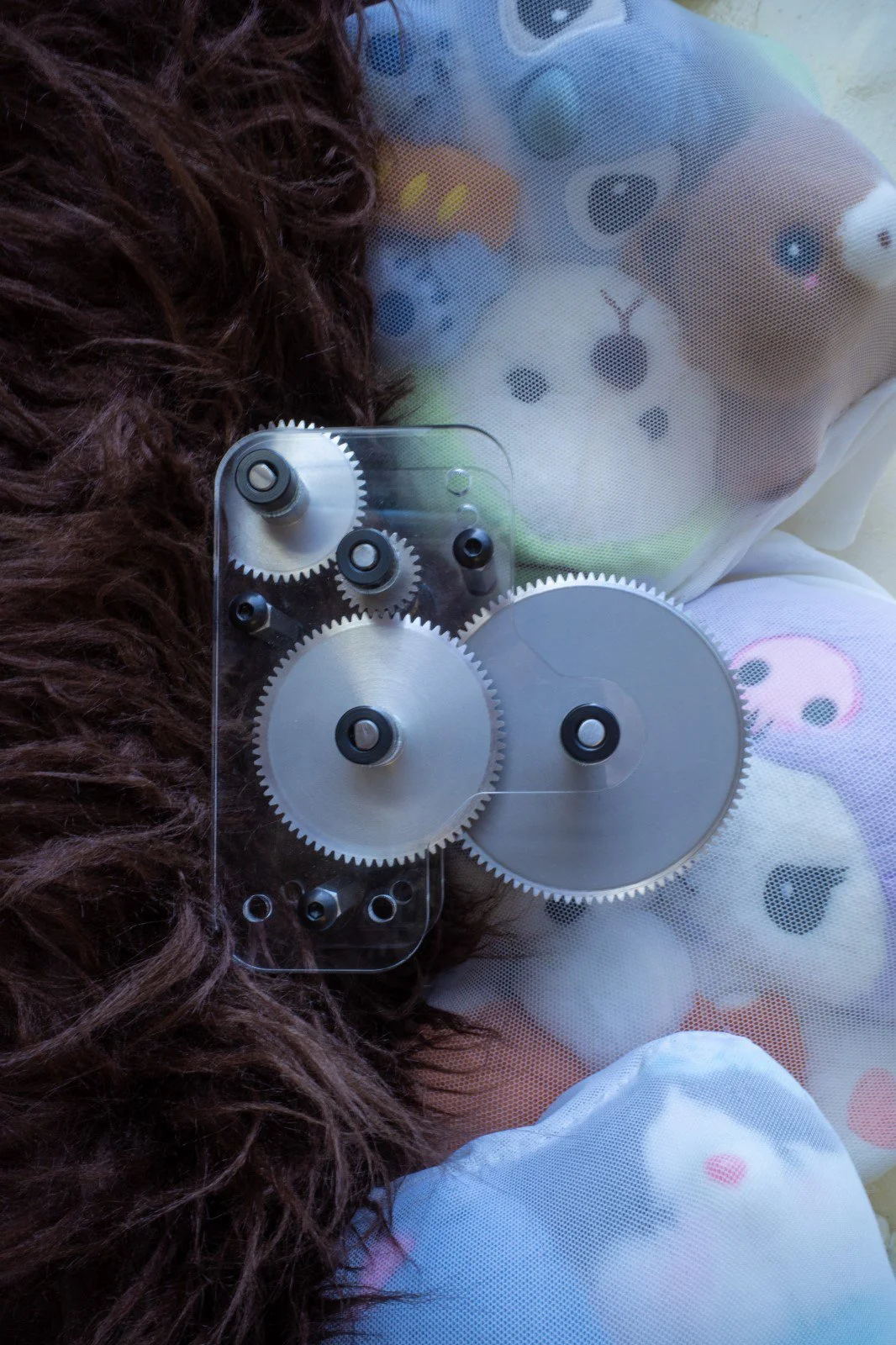
Image courtesy of the artists.
Author: Kun Sok
Published Thursday, July 2, 2026
CFGNY’s Puddles into Pond at Amant begins before one fully enters the gallery. Near the reception area, a separate showroom is filled with garments, racks, mirrors, and walls patterned with small stuffed-animal images. At first, the space feels playful, almost like a dressing room or a temporary shop inserted into the institution. But the clothes are not props. They are for sale, priced between $250 and $350, and this changes the atmosphere. The exhibition does not begin with a pure image of collaboration. It begins with things that can be worn, priced, purchased, reflected in a mirror, and carried away.
This entrance is not incidental. CFGNY is often discussed through the lens of fashion, collaboration, queerness, and “vaguely Asian” identity, but at Amant these ideas arrive through material conditions rather than abstract statements. Racks, hangers, mirrors, price tags, fabric, display structures, and the possibility of use all become part of the work’s logic. The showroom suggests that a collective image is never outside circulation. It is made through bodies, labor, taste, money, and movement between art and commerce. In this sense, the group’s “vaguely Asian” position is not a separate theme added to the exhibition, but part of its structure: identity is entangled with garments, surfaces, production, circulation, and display.
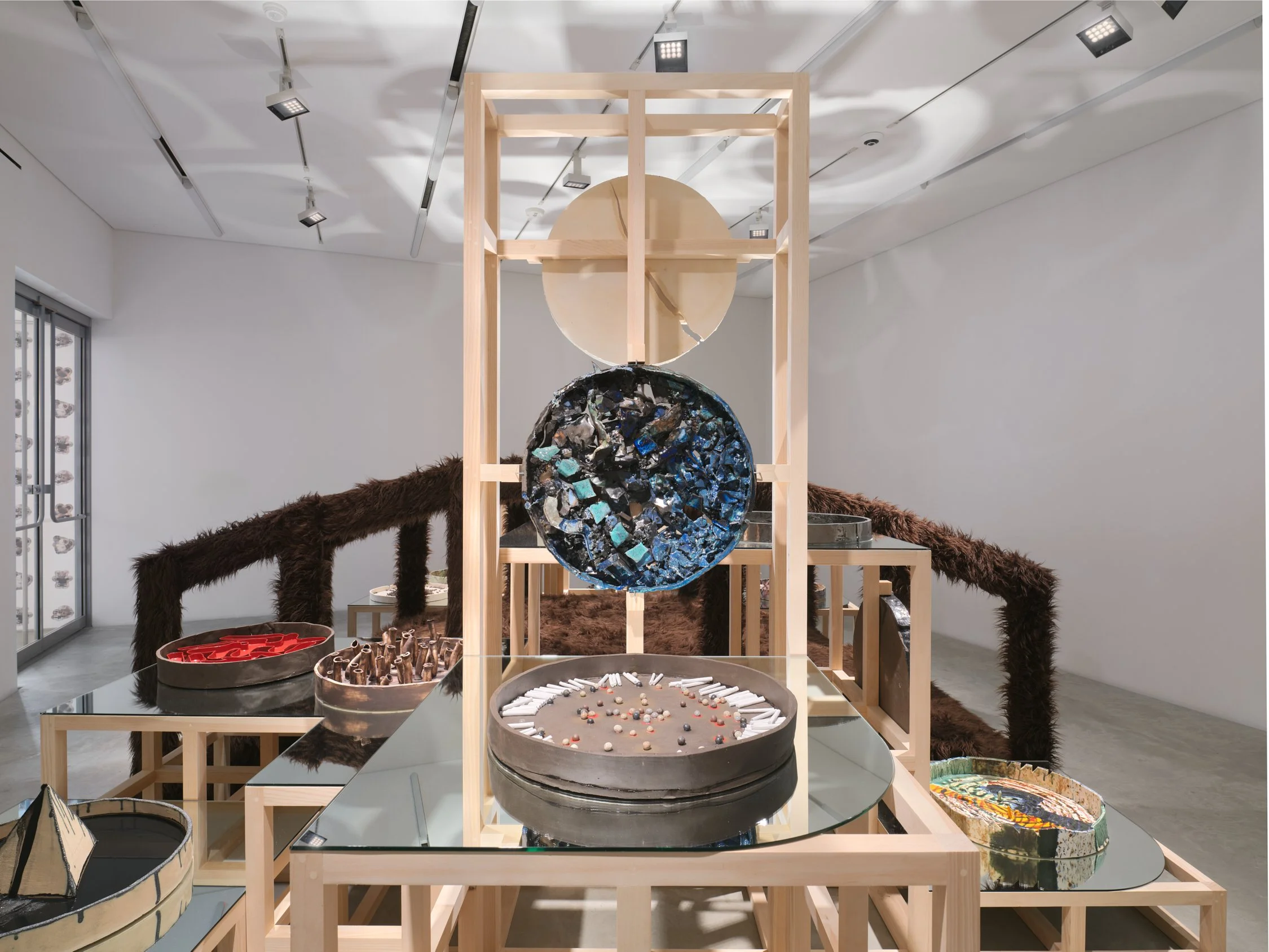
Inside the gallery, the exhibition continues to ask what allows separate things to be held together. In the central installation, circular ceramic works are arranged on glass and mirrored surfaces supported by pale wooden frames. The title invites us to see them as ponds, but the experience is not literal. Only one contains actual water. The others are dry, solid, and varied: a dark basin with a pyramid-like form, a red sign-like shape, small pipe-like forms, pale flowers, architectural fragments, gate-like bars, glazed surfaces, and marks that seem closer to private symbols than shared language.
Installation view of CFGNY Puddles into Pond, Amant, Brooklyn, NY. Photo: New Document.
What makes these works “ponds” is not simply their appearance, but the way the exhibition frames them. They are gathered under a shared name, placed on related supports, and connected by the viewer’s movement through the room. A pond here is not only a body of water. It is a proposal for how unlike things might occupy the same field without becoming the same. The ceramic works do not merge into one image. Instead, what holds them together is visible: glass, mirror, wood, frame, floor, title, and path. CFGNY shows that togetherness is not a natural condition. It has to be arranged, named, supported, and entered.
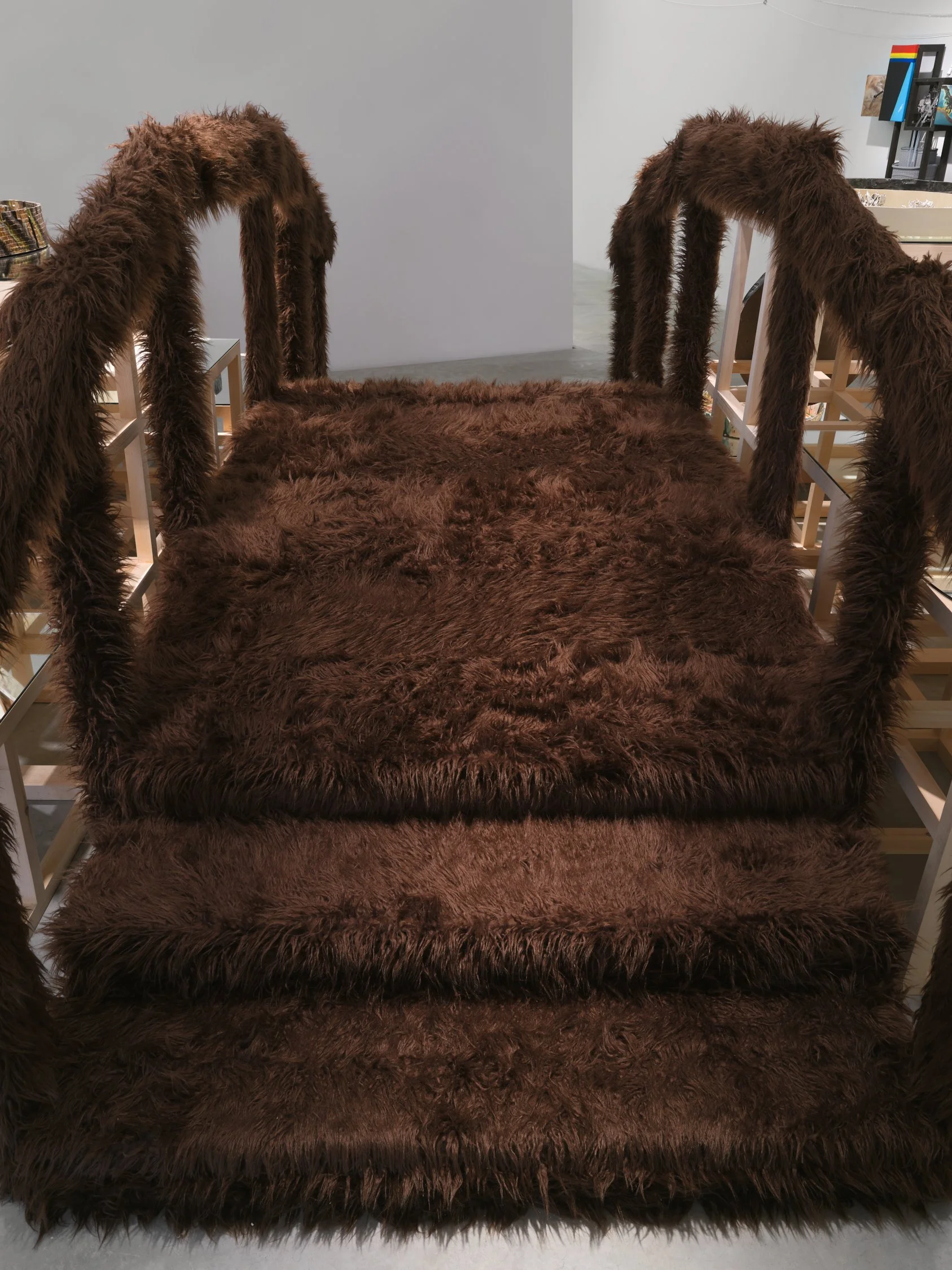
The furry bridge makes this question physical. Seen from a distance, it appears soft and comic, almost animal-like. It seems to offer a playful passage through the installation. But walking across it produces a more uncertain feeling. Beneath the fur, the wooden structure remains present. The gaps between the boards can be felt underfoot. The bridge connects parts of the installation, but it also makes the body aware of what connection requires: weight, balance, trust, and support. Softness, in this exhibition, is never only soft. It often covers something more structural.
Installation view of CFGNY Puddles into Pond, Amant, Brooklyn, NY. Photo: New Document.
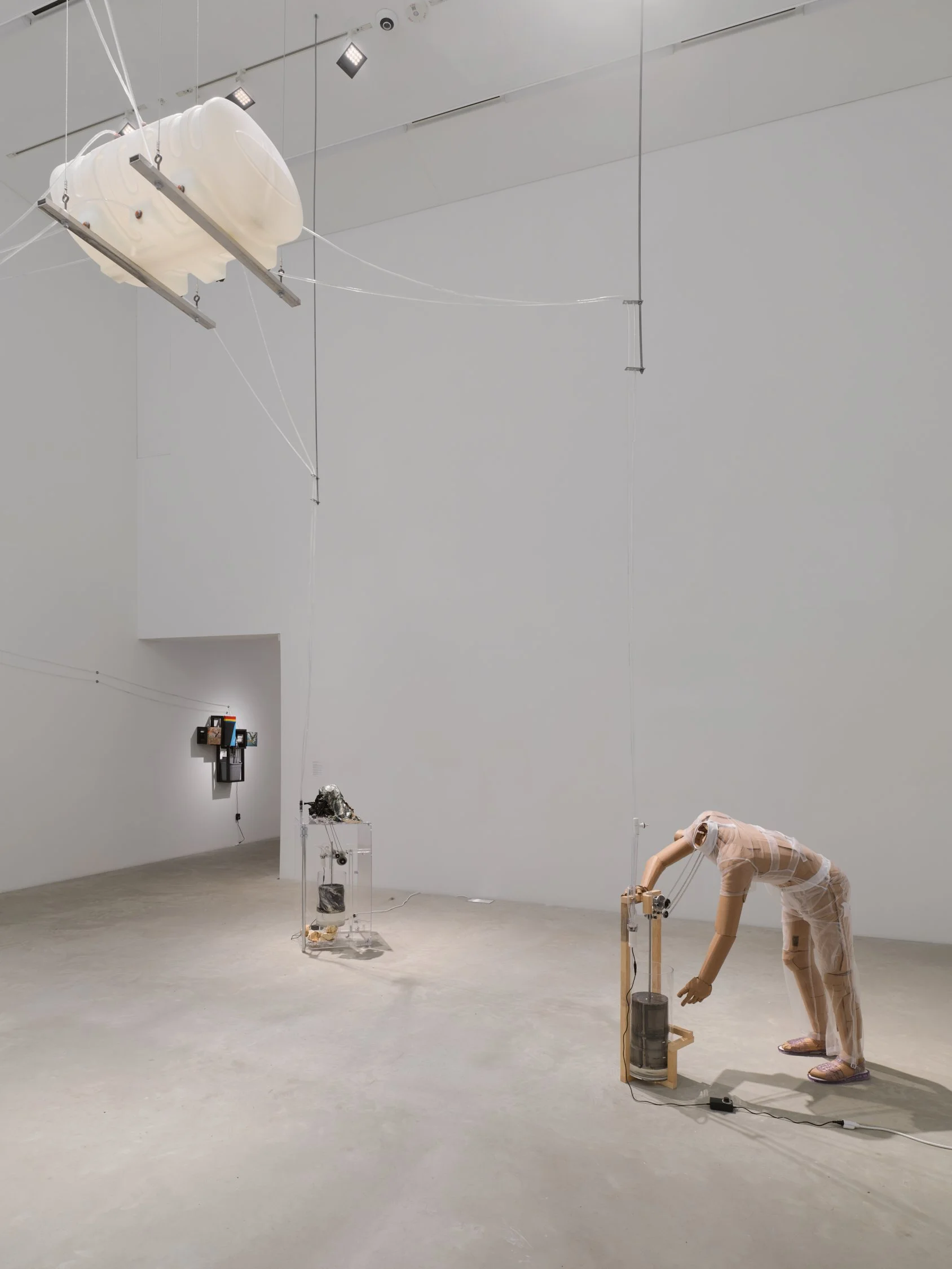
In the rear gallery, System (Five Times) makes support and maintenance even more explicit. A suspended plastic tank feeds water into five clock-like structures through clear tubes. The room is quieter and more mechanical than the central gallery. Here, connection becomes tubing, pressure, gravity, dripping, and sound. Some parts produce a gentle trickling noise. Others appear almost dry or silent. The system is not hidden behind the work; the system is the work. Water has to move. Tubes have to remain attached. The tank has to supply the system.
The objects depend on circulation, but they do not become identical. Each keeps its own form while the whole installation depends on a shared mechanism. This is not a romantic image of community. It is a practical one.
Seen together, the showroom, ceramic installation, bridge, and water-clock room suggest that togetherness is not something that simply appears when people gather. It needs infrastructure. It needs places to meet, surfaces to carry marks, objects to circulate, frames to support them, bridges to cross, and systems that can keep functioning over time. At Amant, CFGNY does not define collectivity as a finished ideal. Instead, the group shows the conditions that allow a collective image to appear at all.
What remains in Puddles into Pond is not only collaboration, but the material work of holding things together. The exhibition’s strongest moments come when it lets that work show: the price of a garment, the mirror of a showroom, the wooden frame beneath glass, the dry ceramic called a pond, the fur covering a bridge, the tube carrying water from one part to another. CFGNY’s exhibition suggests that togetherness is not found. It is built, staged, supported, crossed, circulated, and maintained.
Installation view of CFGNY Puddles into Pond, Amant, Brooklyn, NY. Photo: New Document
CFGNY Puddles into Pond is on view at Amant, New York, through August 16, 2026.
About the author: About the author: Kun Sok is a Brooklyn-based visual artist and writer interested in relationships and collaboration. She creates rule-based participatory projects that invite non-artists to participate in making through small, direct encounters. Her writing has appeared in Two Coats of Paint and Tussle Magazine.