Inhabiting Spaces That Do Not Quite Belong
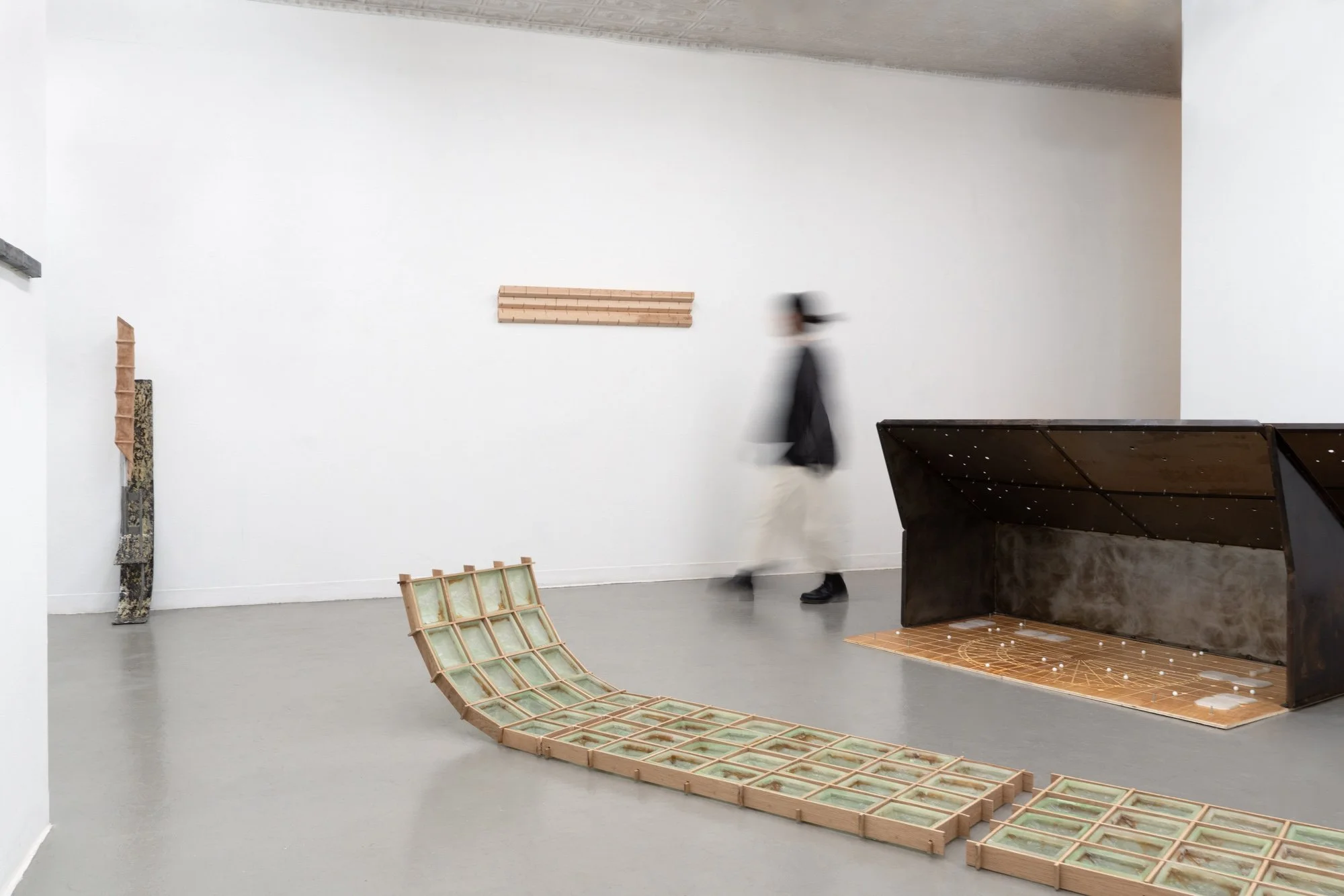
Installation view of susurrus, Gallery 456, New York, 2026. Photography by Zhu Gaocanyue.
by Faith Waller
As a society, we are met with the reality that each system sits in parallel with another that seeks to complete the same function. The industrial systems we built with the belief that they would triumph over the pre-existing natural ones have fallen short of their intended function, with glitches arising each day. How do we navigate a system that is failing us without losing what we have accomplished through industrialization? susurrus at Gallery 456 forces us to confront these questions, with answers guided by Leah Liu Yutong’s sculptural works and Vu Thien An (Thea) Nguyen’s curatorial practice.
Through Leah’s work, she presents us with a solution: allowing space for them to act, unfold, and be seen. “I think of glitches as in-between spaces that do not quite belong,” Leah states, “They are moments of failure or misalignment that reveal how even strong, seemingly stable systems can collapse with surprising ease. A glitch exposes the system from within. In this way, glitches prompt us to question the paradigms, structures, and beliefs we often take for granted.” It guides not only her practice, but also her communication between materials and the viewers. Although it is not that nature is without fault. In Tandem, with fiberglass cavities frequently mistaken for jade, gestures toward this complexity. This emerging association with the natural from the viewer leaves space for another layer to unfold. Industrial fabrication achieves beauty, precision, and repetition, yet it is never fully divorced from the natural; the echo of nature remains, in surface, in form, in presence. It is both proof and reminder: imitation cannot erase origin, but it can provoke new understanding.
The show is constructed around absence as much as presence, allowing the materials and voids they create to operate together. Through hollow chambers, perforations, and misalignment, the spaces become just as important, if not more important, than the form itself. They insist that perception extends beyond sight and touch into something slower, more attentive. “When I make work, I think about how these forces can be activated rather than represented. How things lean, are pulled toward the ground, or settle into balance. These gestures and movements emerge within the situations that I set up. I am less interested in forcing an outcome than in giving objects a condition or stage to act on their own. I feel empathy toward the sheer beingness of these objects, allowing them to exist, respond, and find their own posture within the space,” Leah describes. Each hollow, each misalignment, each moment of incompletion is a site of negotiation: what does this space demand, and how do we respond without violating it? In this, small glitches form in micro systems that do not exist on a macro, systemically supported scale. These are the moments where intuition is necessary, where creation emerges as a response to absence rather than imposition.
The materials composing these works, such as fiberglass, epoxy, wax, stoneware, metal, and wood, do not compete, but do not fully harmonize either. While developing the dialogue these forms produce, Leah asks herself, “What does [it] need?” With this exploration, her works demand attention to their differences and to the spaces between them. Natural and industrial, soft and rigid, reflective and opaque: dualities that are not resolved, but complement one another. Leah’s practice does not attempt to smooth the edges of these worlds; it treats their friction as productive, as generative. Intuition is the bridge, the method through which negotiation occurs.
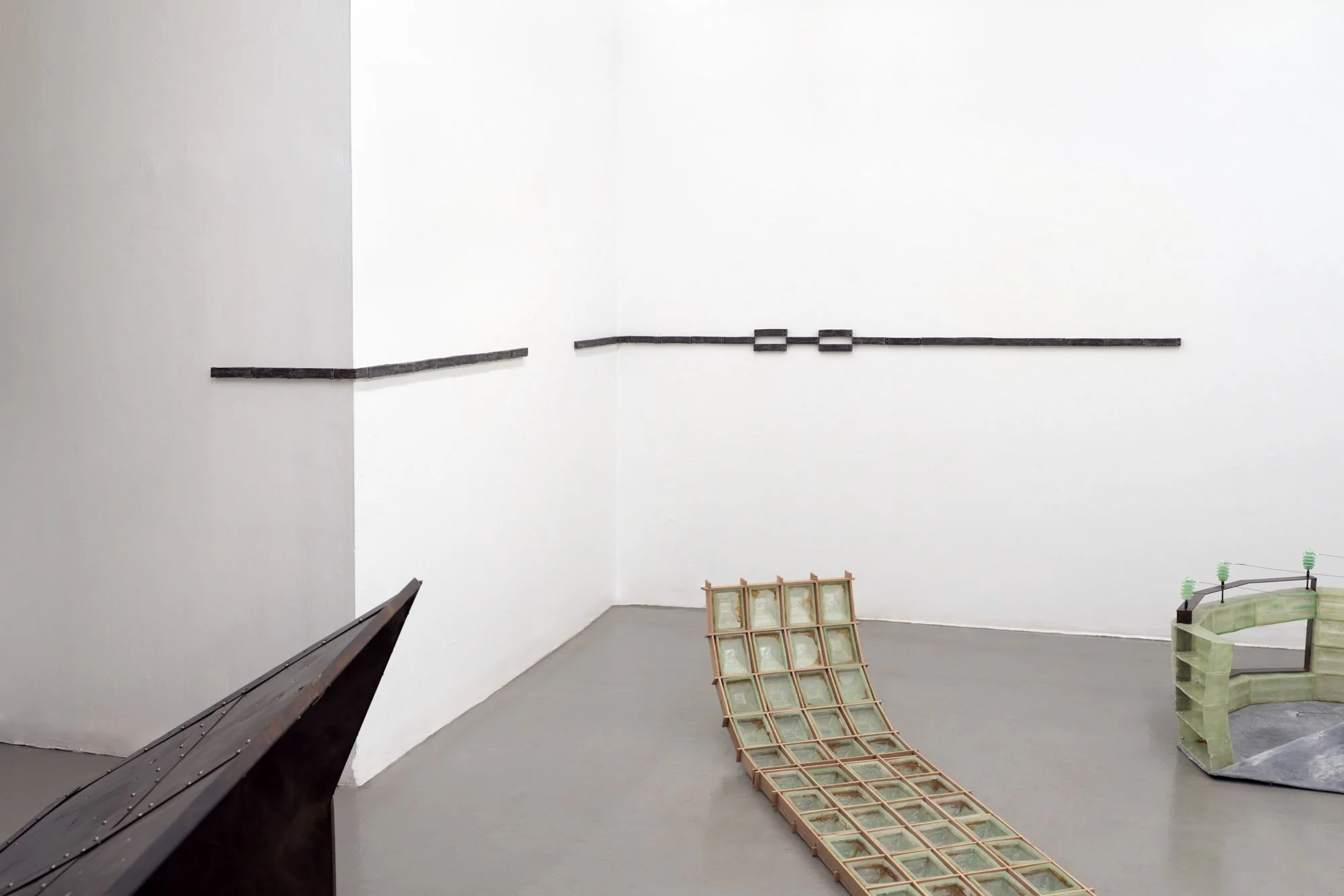
Installation view of susurrus, Gallery 456, New York, 2026. Photography by Zhu Gaocanyue.
Thea’s curatorial choices extend this logic into movement, only emphasizing the ethos of Leah’s work. “For Leah’s exhibition, space is something to listen to rather than fill. Her practice sees hollowness, hollow chambers, and empty spaces as sites of potential rather than absence; with that being said, my curatorial approach focuses on emptiness and enclosures as active forms. I think about the Tao Te Ching line we included in the statement ‘Knead clay in order to make a vessel…’ The usefulness of the vessel lies in its emptiness.”
The S-shaped navigation of the space allows the experience to transcend the visual senses, translating these ideas into movement. Leading this movement is the intuition of the viewer, one that Thea ensures guides one to weave through the space. “When working on curatorial approaches for this show, I did not aim to maximize occupancy but allow works to hold space and create moments of pause in between them,” she states.
At the sightline (or mouthline), rests Sussuration, weaving between pieces to provide grounding. The notion of sound and language is what drives this connection, with its relational qualities drawing the viewer into its rhythms. One is compelled to adjust one's own body and movement to its cues. What is being communicated here, and to whom? Is it a message, or a condition, or both? “In Leah’s exhibition, language guided the pacing of the viewer’s engagement, from the Taoist reference to the more reflective phrasing that encouraged viewers to experience absence as generative,” Thea explains. The forms suggest that the two are inseparable, that listening is not passive, and that inhabiting a space is a form of comprehension.
In susurrus, creation and absence cannot be separated. Spaces that resist, that withhold, are as generative as the forms themselves. The works do not offer resolution or closure, and they do not demand it. They ask only that one remain present, attentive, and responsive. Leah’s practice almost forces the viewer to take this stance. “I am interested in how sound itself can communicate and produce meaning without needing to be fully translated into linguistic systems. How resonance, voice, and breath carry their own forms of sense making, and how they can be treated as tactile material that speaks beyond the assigned meaning of words,” Leah explains.
Here, industrial and natural are not reconciled into harmony, but held in conversation; they are systems in tension, systems that require engagement rather than interpretation. The exhibition is not about seeing, hearing, or understanding in isolation; it is about inhabiting these systems, observing the fractures, tracing the forms, moving through the spaces, and letting intuition guide the process of interaction with these spaces.
Leah Liu Yutong (b. 2002, Beijing) is a New York–based artist whose practice spans sculpture and sound. She received her B.F.A. in Sculpture from the Rhode Island School of Design (RISD) in 2025. Through cast hollow chambers and modular assemblages, Liu probes absence and deviation to destabilize the coherence of structural systems. Her practice unfolds through seriality and misalignment, from which gaps emerge as sites of potential. At the core of this approach is an investment in absence–an understanding that emptiness is not a lack but a condition that enables new forms of use, resonance, and modulation. Liu’s assemblages resist closure and stability, allowing form to fracture, to shift and to reorganize. Liu’s work has been exhibited widely in the United States and China, including Rhode Island School of Design (RISD), Providence (2023); Field Projects, New York (2026); Gelman Gallery, Providence (2025); Woods-Gerry Gallery, Providence (2025); Acentric Space Gallery, Shanghai (2024); and 6 DeFore Place, Providence (2025). She has participated in residencies at the NARS Foundation International Residency, New York (2026); Haystack Mountain School of Crafts, Maine (2025); Arts Letters & Numbers, Averill Park (2024); and Acentric Space, Shanghai (2024). Upcoming residencies include the GlogauAIR Art Residency in Berlin, Radio28CS in Mexico City, and AIR 3331 in Tokyo.
Vu Thien An (Thea) Nguyen (b. 2004, Hanoi, Vietnam) is an emerging curator and art researcher based between New York (United States) and Hanoi (Vietnam). She is pursuing a Bachelor of Fine Arts in Design History and Practice (Art History) at Parsons School of Design, The New School (Class of 2026). Her research considers how art mediates cultural translation, with a growing interest in Southeast Asian and diasporic contexts. Recently, Thien An curated “Tin Vịt 6 Giờ (Six O’Clock Duck News)” at Vin Gallery (Ho Chi Minh City), a group exhibition examining satire, distortion, and performativity in mass media through works by artists from the United States, Vietnam, and Hong Kong, and co-curated “Dạ Lửa – Womb of Fire”, a traveling exhibition and accompanying publication project featuring 100 works by Vietnamese and diasporic Vietnamese women and non-binary artists.
Her previous experiences include working at Eli Klein Gallery, island gallery, Cohart in New York, as well as Hanoi Grapevine, Chau & Co Gallery in Hanoi. She is currently engaged with Judith Hughes Day Vietnamese Contemporary Fine Art (New York), gmtc.nyc (New York), and Nguyen Wahed (New York and London). Thien An works as a Course Assistant at Parsons School of Design Sustainable Systems Department, integrating sustainability into art and design education.
Faith Waller (b. 2004, New Jersey, USA) is an emerging writer and curator based in New York City. She is pursuing a Bachelor of Fine Arts in Design History and Practice at Parsons School of Design (Class of 2026). Her writing, rooted in systemic critical theory and philosophy, examines how language, media, and culture shape perception and social structures, advocating reflective engagement with contemporary narratives in art and society. Faith explores how individual conscious perception impacts and creates the collective spaces that we inhabit, seeking to communicate the connectedness individuals experience and foster through the collective, their creations, and the systems surrounding. She is the founder and co-director of The Curators Collective at The New School, a student-led exhibition initiative that supports emerging artists and museum professionals, where her writer's philosophy extends into curatorial works. She recently co-curated and wrote on “First Things: Almost, Always” at Anna-Maria and Stephen Kellen Gallery (New York, NY), an exhibition with 124 pieces highlighting the care and exploration that define the work of emerging artists.