From A to Z and the Bodies in Between
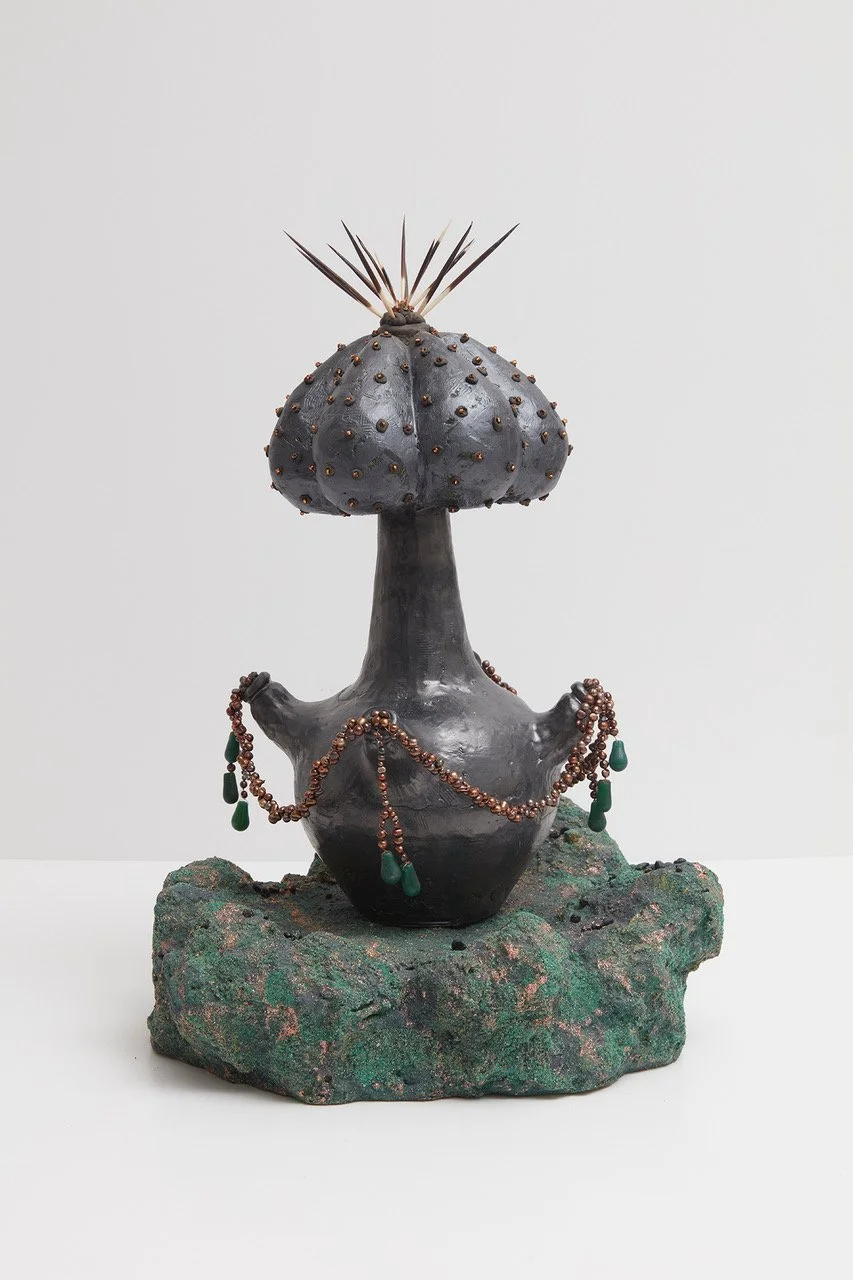
Nancy Bowen, SENTINEL, 2024, 26 x 20 x 16 inches, ceramic, beads , porcupine quills and mixed media
by Nancy Bowen
The work in my current exhibition, From A to Z and the Bodies in Between, at Nunu Fine Art (June 5- July 25, 2026), is comprised of two separate but related bodies of work. The collages arise from poetic and visually discursive investigations of antique dictionaries. The sculptures emerged as a group of shapeshifters alluding to corporal, botanical, and architectural form.
SHAPESHIFTERS
When I begin a sculpture, I have no idea where it will end up. It’s like I have an itch I have to scratch, so I do. I tend to work in series, and the parameters for this recent one have been about making pieces that straddle figuration and abstraction. Forty years ago, I made a sculpture that addressed the questions “what would an image of a woman made by a woman look like? How could we escape the much-talked-about “male gaze?” Since that time, I have internalized my responses to those questions. They are second nature to me now. This series asked a more complex set of questions. What is the least amount of figuration that will make the viewer feel the presence of the body without actually describing it? I generally start with a clay form that evokes a gesture or fragment of a body. An intuition then guides me to create a mood or attitude, using certain materials in contrast to the clay form. Sculpture is good at making viewers feel things viscerally, whether they are aware of it or not. This is done through the manipulation of scale, the use of materials, and the juxtaposition of forms to create pressure or discomfort or simply identification. Seduction is a tool. I like to pull the viewer in with some glitter or bling, but then give them an uneasy feeling by locating those materials near what could be a butt crack or other body part. That uneasiness reflects my experience of being a human. Everything changes, and nothing is stable. I have a wide repertoire of materials that I use repeatedly in my sculpture. Some of the materials I use have a history that is related to feminism in their traditional use in a decorative art form. I first learned about beading from my grandmother, who made beaded purses that were popular in Victorian times and into the first half of the last century. As a young feminist, I was interested in the fact that artistic women of her generation mostly did not make art but were relegated to crafts like beading and embroidery. In another era, my grandmother might have become an artist. Instead, she made craft objects for church fairs. When she died, I inherited her beads. That coincided with my introduction to Pattern and Decoration painting, and I began to use them as structural elements instead of decorative elements. Now I move back and forth between those two positions. These pieces have developed through a call-and-response process between the parts of the sculpture. They are Frankensteined together to create a hybrid object that I think of as carrying a kind of spirit. I am interested in mystery and a state of not knowing. The belief in the unknown underlying most spiritual practices and many mythologies is what draws me to those systems of information. I think that attitude is reflected in my work.
THE SPECULATIVE ARCHIVE
I made this series of collages from antique dictionaries that I deconstructed and then reconfigured into visually dense layers of text and imagery. The layers create new associations, often pointing at our current cultural and political predicaments. The collages are adorned with ornamental and structural elements that add a personal touch with a feminist inflection.
I began these pieces when I found a trove of antique reference books in my parents’ home when they died. The first batch of altered book collages that I made was overtly feminist. I was responding visually to the patriarchal biases found in many of the reference books. For instance, a book on 1000 great scientists included exactly one female scientist. A book called Great Americans included zero women. It was easy and fun to make visual incursions that pointed out the inequities found in these texts.
When I first started using antique dictionaries, I was intrigued by the incredible lithographic images that illustrated certain words. I began my pieces by accentuating those images. I then applied arbitrary visual rules (like color coding nouns/verbs/adjectives and so on) to create patterns on the pages. These patterns emphasized certain aspects of the dictionary and sometimes simply created a pleasurable abstract viewing experience. My process in general is a combination of making rules to guide the composition and then knowing when to break them and follow my intuition. I sometimes add imagery on top of the text that offers another reading of the text. I also became interested in particular words found on the pages and began to combine them into phrases, which I highlighted to create brief poetic phrases across the lines of the pages. The phrases often reflect the dire situations in our current cultural climate. I have been making these collages for a few years, and their meaning changed for me when the current administration scrubbed words from governmental websites for being “too woke”. The dictionary became more than a list of words; some words became dangerous or threatening. I began to focus on some of those words and highlight them with color or borders. The historical dictionary became a vehicle to accentuate current problems and speculate about the future. I purposefully chose to highlight words like vagina or make phrases like dictatorial egoist – all found on the page but emphasized for provocation.
Visually, the collages are highly colored and densely textured. A viewer can simply enjoy the visual cacophony of the collages or spend more time with them, analyzing my intentions. The collages read like puzzles to be deciphered and played with. Text remains visible, but images prevail. Hierarchies are upended, and established textual rules don’t really work. Perhaps it is time for a new order.
EPILOGUE
These are the things that have taken root in my brain and my hands for the last few years.
In the way that waking from a dream leaves one with an incomplete sense of narrative, I feel there is more to do here. Fragments collide and settle into new forms, and I will continue to follow the mystery.
About the author: Nancy Bowen is a mixed media artist known for her eclectic mixtures of imagery and materials in both two and three dimensions. Her sculpture and drawing exist in an in -between zone of form and idea, of abstraction and representation. Her work offers a poetic commentary on our quickly changing material culture. Like an artistic archeologist in this age of globalization and post-industrialization, she salvages (often disappearing) ornament and craft traditions and incorporates them into sculpture and drawings.
Bowen has had solo exhibitions throughout the United States and Europe, including the Provincetown Arts Museum, Lesley Heller Gallery, and Annina Nosei Gallery in NYC, Galerie Farideh Cadot in Paris, the Betsy Rosenfield Gallery in Chicago, and the James Gallery in Houston. She has been included in group shows in various museums around the country. Her work has been reviewed widely in such journals as Art in America, Artforum, Glass Magazine, Sculpture Magazine, and a host of newspapers. She has won awards from Anonymous Was a Woman, the National Endowment for the Arts, the New York Foundation for the Arts, The MacDowell Colony, Yaddo, The Brown Foundation at the Dora Maar House in Menerbes, France, The Jentel Foundation, and the European Ceramic Work Center, among others. She received a BFA from the School of the Art Institute of Chicago and an MFA from Hunter College (CUNY). She has taught at Columbia University, Bard College, Sarah Lawrence College, and R.I.S.D. She is an Emerita Professor of Sculpture at Purchase College, S.U.N.Y., where she taught from 2001 to 2024. Bowen maintains a studio in the Brooklyn Navy Yard. She is represented by Nunu Fine Art, NYC, and Taipei.
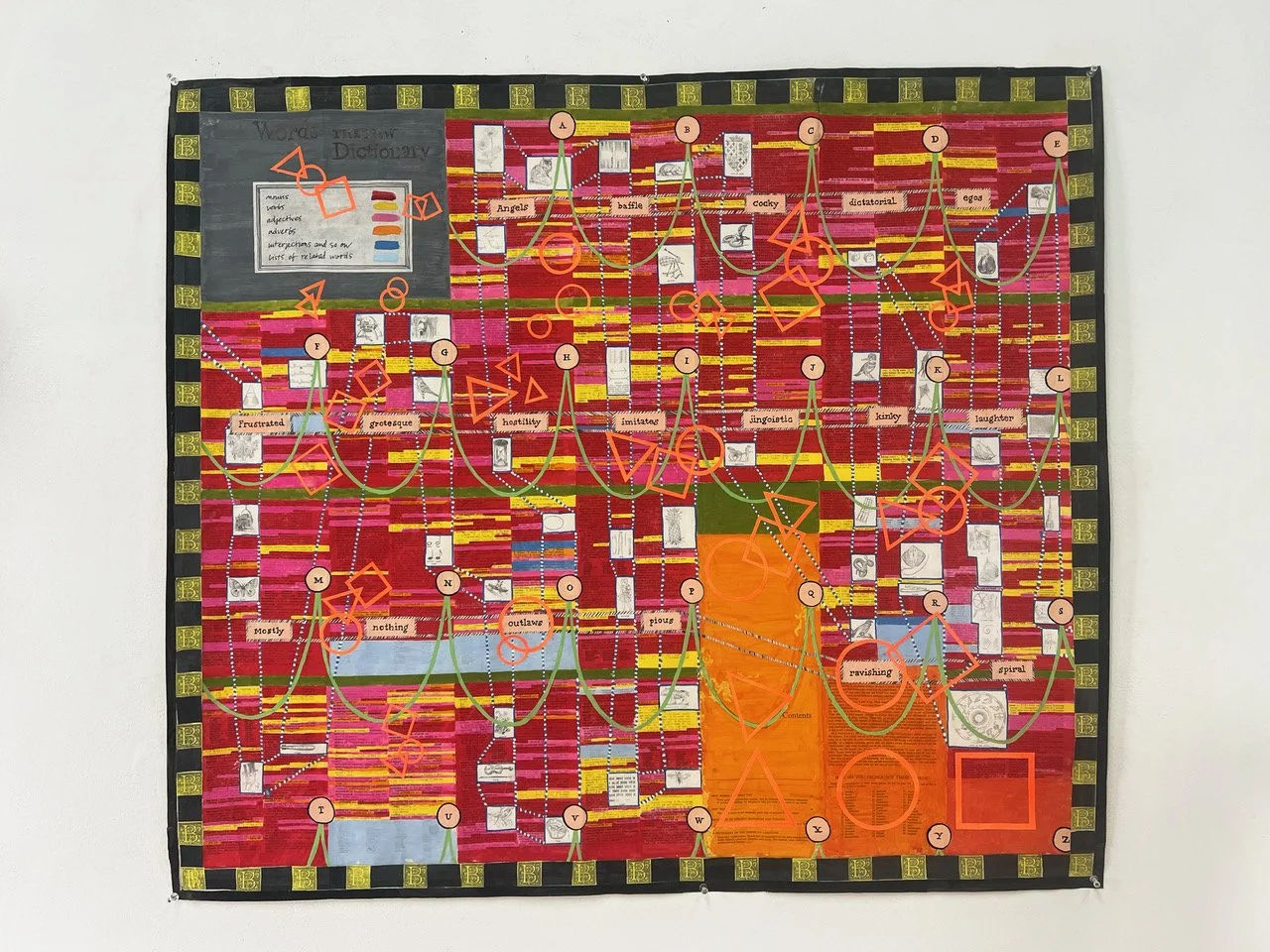
Nancy Bowen, RAVISHING SPIRAL, 2024, 35.5 x 40 inches, collage, gouache, and found books on rice paper