Hot Coffee Conversation with curator Julia Marchand
Published Tuesday, May 5, 2026
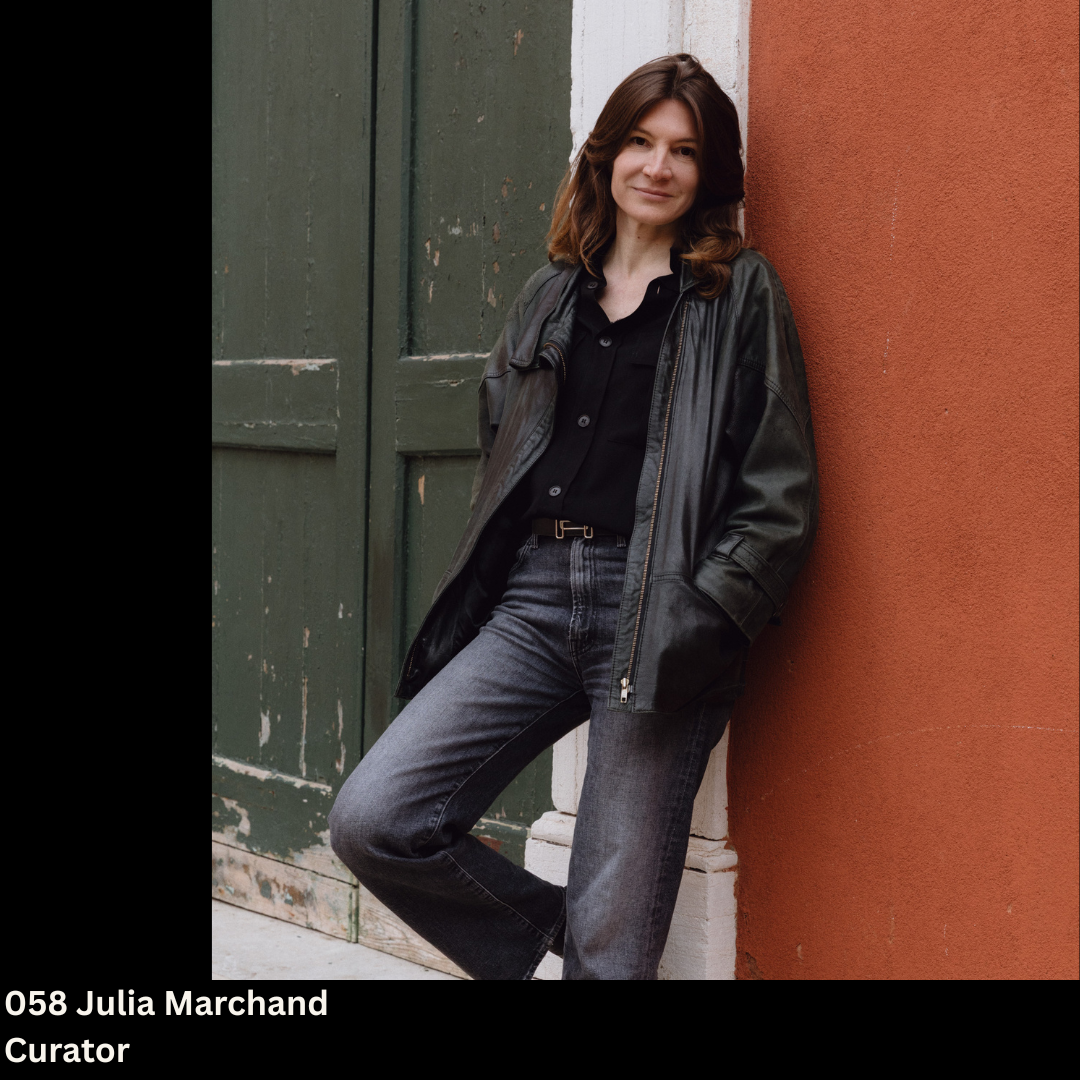
Julia Marchand is a Venice-based curator, researcher, and editor whose work explores the carnivalesque, adolescent aesthetics in visual art, and the editorial and poetic practice of Ilia Zdanevich (Iliazd). She curated the Georgian Pavilion at the 60th International Art Exhibition – La Biennale di Venezia, bringing renewed attention to Iliazd’s legacy, and serves as rapporteur for Xie Lei in the Marcel Duchamp Prize. From 2015 to 2023, she was curator at the Fondation Vincent van Gogh Arles, where she co-curated, with Bice Curiger, major exhibitions including Action / Gesture / Painting: Women in Abstraction, 1940–1970 (2023) and Laura Owens and Vincent van Gogh (2021), Dark Centuries: Alexander Kluge & James Ensor (2019).
Since 2016, she has led Extramentale, a program and a platform dedicated to adolescence in visual art, collaborating with artists such as Mohamed Bourouissa,Tohé Commaret and Lisa Yuskavage across off spaces and institutions including the Centre Pompidou, Les Rencontres d’Arles or David Zwirner. Her recent projects include an exhibition on Iliazd and Marcel Duchamp’s Boîte-en-Valise at the Fondazione Antonio Dalle Nogare, alongside ongoing lecturing on painters such as Frank Bowling and Joan Mitchell. This month, Marchand published a book titled I Am The F****** Subject: Art & Adolescence(Lenz Press, Milan). Adolescence in contemporary art is increasingly understood not as a transitional phase, but as a sustained condition—a state of mind that dissolves the traditional markers of adulthood. It emerges as both a mode of existence and a subtle critique of a world that itself resists stability. This spring, Marchand also co-curates an exhibition titled ADOLESCENCE, opening at Zachęta – National Gallery of Art in Warsaw. All of these topics piqued my interest in Marchand’s practice for years, and I am very glad we were finally able to do an interview.
Nina Chkareuli: Imagine you are in your favorite coffee or tea spot. Where is it? What are you drinking? What are the three things you see right now?
Julia Marchand: So, it's clearly Rosa Salva on Compo San Giovanni e Paolo in Venice, which is sitting in front of the basilica and the hospital. And it's not usually the place that gets the most sun in wintertime or springtime. This is a place I've been going to when I was working on the Georgian pavilion two years ago. And this is also what I love to do, which is to drink cappuccino because the foam is so nice and delicate together with a pizzetta and a bottle of sparkling water, which, for most Italians, is absolutely disgusting to mix a few of them. Next to the café is Ospedale Civile SS. Giovanni e Paolo, with its exquisite 18th-century façade, where I had to go for a shoulder injection.
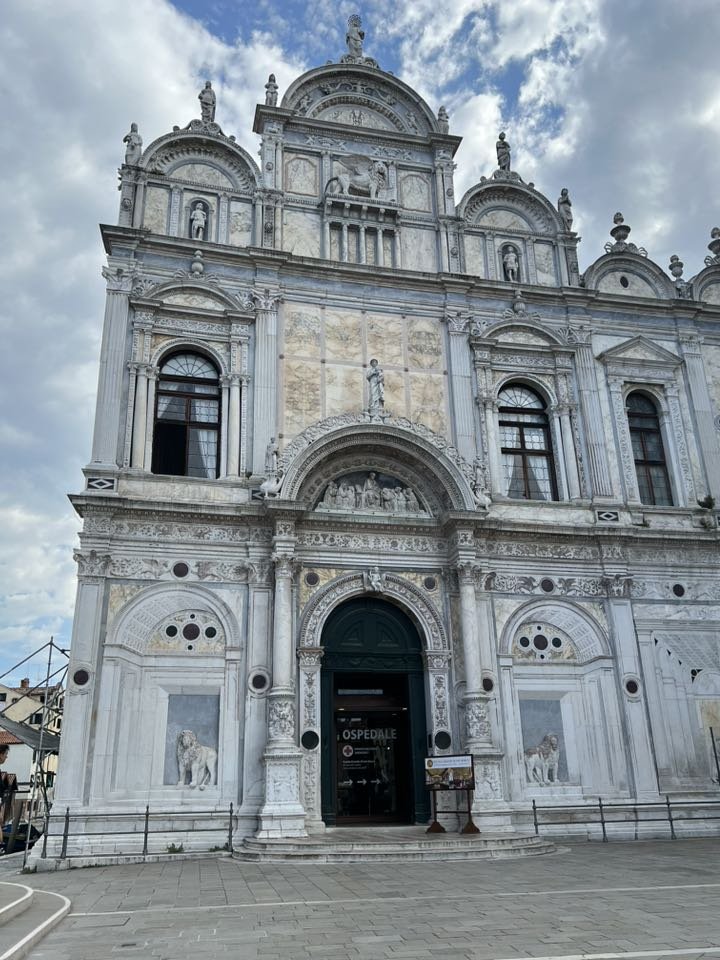
Ospedale Civile SS. Giovanni e Paolo.
NC: What is the single cultural or artistic event that started you on the current curatorial path?
JM: I mean, one moment was when I was maybe 13. I remember catching a glimpse—just a quick peek—through an open door into the installation of an exhibition at Guggenheim Bilbao. I could see people unpacking, placing works, and building something on the walls. I was there with my family, and I was just a teenager, but I loved the sense of action unfolding around those paintings. I almost placed myself inside that scene. Then, later, the godfather of my brother—who is a sculptor, though from a very different art scene—had a show in New York, in another circuit of galleries. I was 19, and I went with him to help set it up.
But it was only at 26 that I realized I wanted to be a curator. It’s funny because the idea of being a curator carries this sense of privilege, even elitism. I don’t come from a poor background, but I always thought curators had to be extremely intellectual, or somehow exceptional. So, I did different MAs, and at Goldsmiths I spent time with the curatorial students simply because I liked them—but I didn’t feel legitimate myself.
At the same time, I had this strong desire to work with objects, to install things, to shape exhibitions physically. One of the students asked me why I wasn’t studying with them, and I said, “Do you really think I could do that too?” And he said, “Of course—you’re always looking at exhibitions, always responding to them.” That shifted something for me. I realized maybe I could be legitimate. So, I applied for the MFA in Curating at Goldsmiths. But it really happened almost accidentally—through a mix of childhood desire and the gradual process of putting myself out there as an adult and finally allowing myself to feel legitimate in that role. It took me time, but at 26, I understood clearly: I wanted to be a curator.
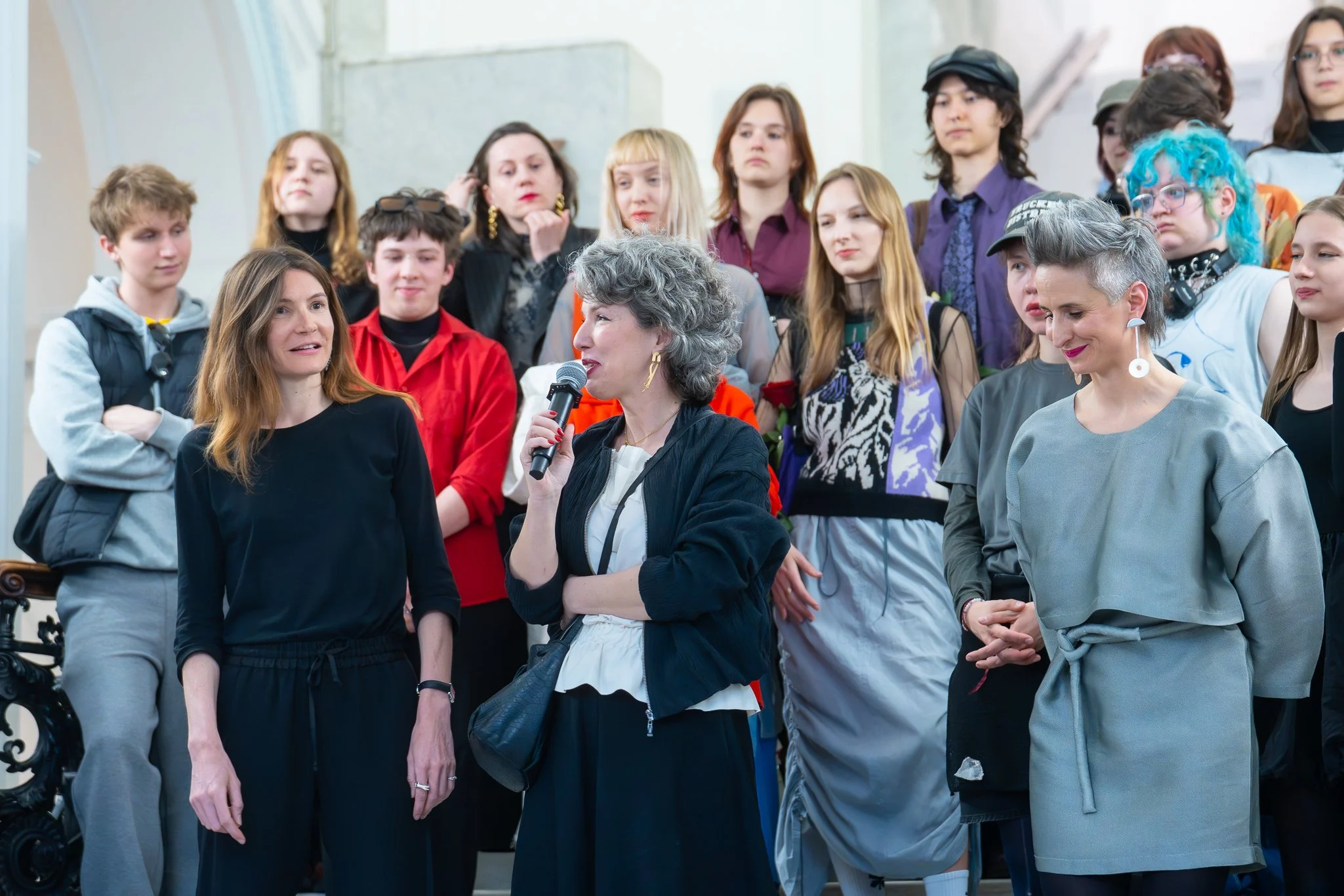
Adolescence, view of the exhibition at Zacheta National Gallery in Warsaw, curated by Katarzyna Kołodziej-Podsiadło, Joanna Kordjak, and Julia Marchand. Image courtesy of Julia Marchand.
NC: What does adolescence mean to you today? Is it defined by age and generation, or is it more of a mental state?
JM: It’s a fairly global condition. I still think there are parts of the world where it’s not the case—where you cannot remain a teenager, where you’re not allowed to linger in that state. Society simply doesn’t permit it. But what’s interesting is that, overall, it has become a global condition—a deeply (post) postmodern, contemporary one. It’s very clear, and yet no one really names it. No one fully acknowledges that the society we live in behaves like a teenager. It’s unsteady, difficult to stabilize. Society itself is in constant flux—turmoil after turmoil. When you look at what has happened since 2019, and where we are now just five or six years later, it becomes almost impossible to establish any kind of stable ground. At the same time, society has effectively made us perpetual adolescents, or at least prolonged that state of post-adolescence. Sociological studies even suggest that adolescence now extends into the early thirties—32 or 33—which is something that is slowly becoming recognized in research and which is also defined by precarious conditions and the transformation of traditional markers of adulthood. But for me, what is striking is this kind of omertà—this silence around it. No one quite says it directly, even though adolescence has become a cultural atmosphere, an ongoing state of unsettledness.
Adolescence can also be seen as a recent history. The purpose of the book is to go beyond the narrative of the 90s, where the artist-adolescent first came out, and to go beyond the figures of youth we see in visual art and cinema. I wanted to focus more on a very, very recent art history that looks at the decade 2010s, when « late » millennials became young adults with a specific internet. There is a shift in that period that redefines what a teenager refuge-refusal means and how artworks carry the promises of a lingering states. A few days ago, I was talking with Julie Ackerman, one of the contributors of my book and the writer of Hyperpop, about the difficulty of pinning down this adolescence symptoms in the arts. The adolescent aesthetic is tipping on the edge of invisibility as it deals with an internal (corporeal) revolution, hypersensitivity, dissociation, and intermediate states of consciousness.
Adolescent symptoms such as rotting in bed, dissociation are framed and discussed by those who experience them, including me, Matthias Garcia, Velvet Aubry, Tohé-Commaret, or Anhar Salem, for instance.
So it is also about defining this recent history through the lens of those who experience those symptoms. Here, I am part of this equation (hence the title, I Am The F***** Subject). I am the subject of this post-adolescent phenomenon. I always felt dissociated. I always felt lingering in the adolescence-post-adolescence state, trying to revisit other ways of « adulting ». But the question remains: is it simply doable to ungrow and hold our ground?
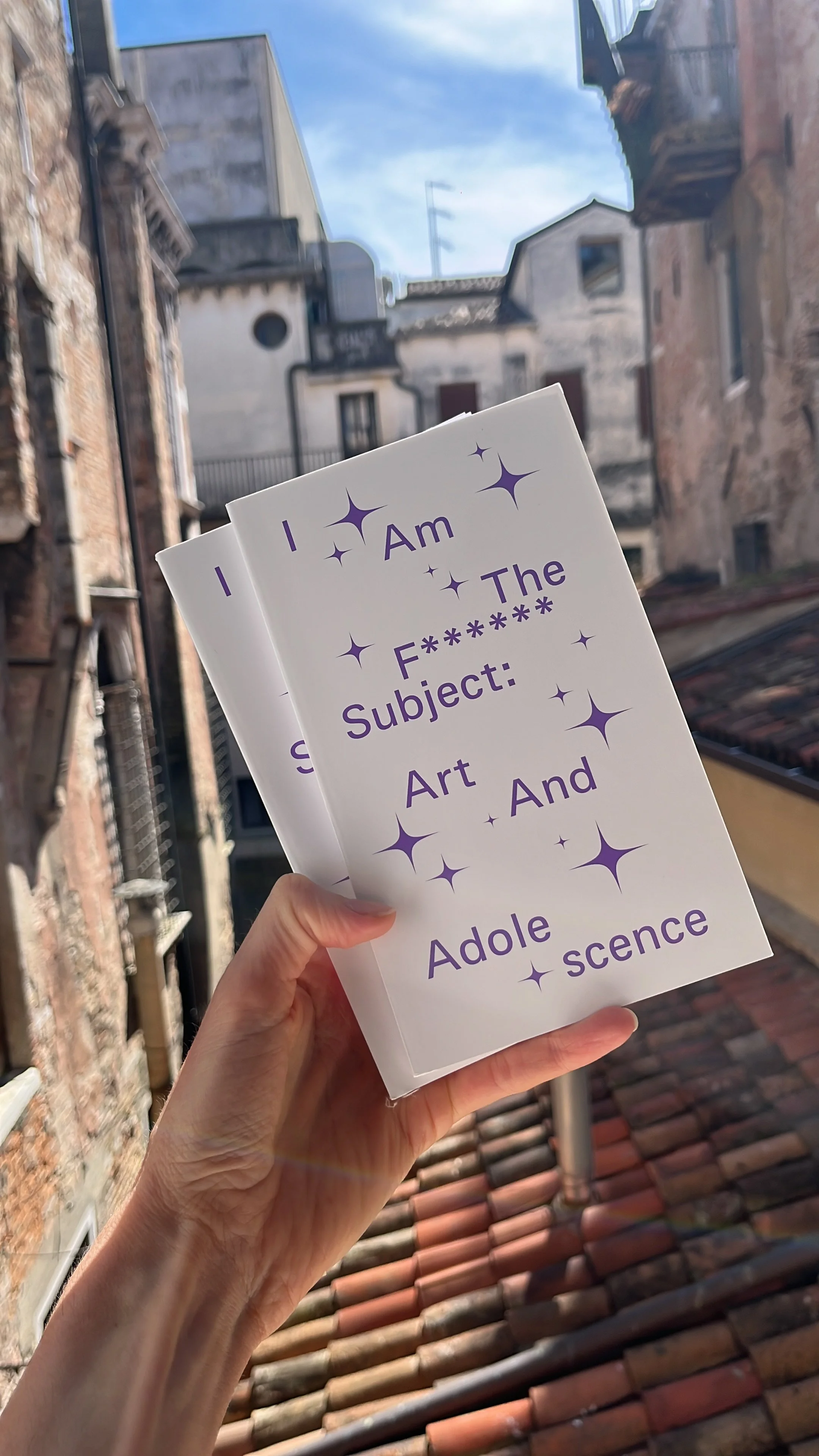
I Am The F***** Subject in Venice, image courtesy of Julia Marchand.
NC: Yeah, it’s the same for me as well. And, you know, coming from Georgia, which is still quite traditional—even though I’ve lived here for 23 years, those values remain. They still influence me, even when I try to resist them. And honestly, when I look at some of those values, I wouldn’t say they’re bad at all. In many ways, it’s better to have them than to exist in this kind of chaos. I look at people growing up here, and there’s a sense of disconnection. From kindergarten, children are taught to be on their own, to function independently, almost in isolation. That’s something embedded very early on in this country. So, you grow up with this mentality that it’s just you. And then I wonder—where does the sense of community come from? Where do values like exchange, goodwill, or doing something beyond yourself develop? Without that, everything becomes a zero-sum game. It’s very much like Leviathan—that idea of society as competition, as survival—and in many ways, that’s exactly what we’re experiencing.
JM: Yeah, it’s kind of crazy. But at the same time, there’s also a very strong desire for communal building—for collective life, for communities. Still, I remain quite skeptical about what’s going to happen next—not so much in terms of the generation above us influencing those below, but more broadly about where this is all heading. I’m not sure if I’m fully answering your question, but for me, the importance of the book was also quite personal. I kept thinking—I wish I had a book like this ten years ago. Not because it provides answers, but because it at least outlines something and generates discussions. It gives a space to a kind of societal pathology that has turned us into prolonged, dysfunctional adolescents rather than stable adults. I know it doesn’t resolve everything, and I’m hoping to continue this work—whether through another book or through different formats over the next five or ten years—to address some of the questions that remain open. But for now, it’s a starting point, and the events associated with the launch of the books are important.
NC: Extramentale focuses on artists aged 20–30—how do you avoid reinforcing the same age-based categorization you critique?
JM: Let me put in that way: Extramentale was born in 2016. In a way, it first invited artists who were in their early 20s, so people who entered post-adolescence at the turn of the 2010s. Late millennials, in short. It is also the first generation that had grown up with the internet and experienced its disillusionment. So, from the outset, they were a bit of anti-machine at stake: a counter-tradition as a response to the post-internet that was giving off its last flames. Adolescence is also about embracing the naturalization of contradictions, so actually there isn’t about pro or anti. Just nuanced to explore as we attempt to nuance the mal-être. As I moved on with the project, the artist (and I) aged biologically, but some of the themes and tropes remained. Also, I never really wanted to celebrate a specific age, so some of my last projects were done with established artists such as Lisa Yuskavage, Mohamed Bourouissa, or Sophie Crumb, the daughter of Robert Crumb. Then, if you look at the entire website, you would also get the feeling that extramental escapes this age-based categorization. This is something that eludes you: a form, an age. But there is a spirit, a mood. In this sense, it has kept its autonomy over time and avoided the pigeonholing.
NC: Yes, the book stands out for its signature minimalist design in white and purple. What made you decide on this color?
JM: I mean, clearly, it’s not blue, it’s not pink—it’s in between. It’s also non-gendered, which I think is important when we speak about bodily and even molecular transformations, both as teenagers and as post-adolescents. It also touches on LGBTQ+ questions—ways of thinking about gender, about trans identity, without explicitly naming it. Luca Frati once said to me that the hormonal transformations can happen at various stages of life outside of the strict “adolescence/puberty growth”. In that sense, we can experienced adolescences throughout our lives.
So for the purple, I suppose it’s the one that is easiest to grasp and to blend into—as a kind of fluid presence. And I mean fluid not only in terms of gender—I’m very cis—but in terms of the fluidity of that age, which I wanted to express through color. I think it conveys what I was trying to articulate: something open.
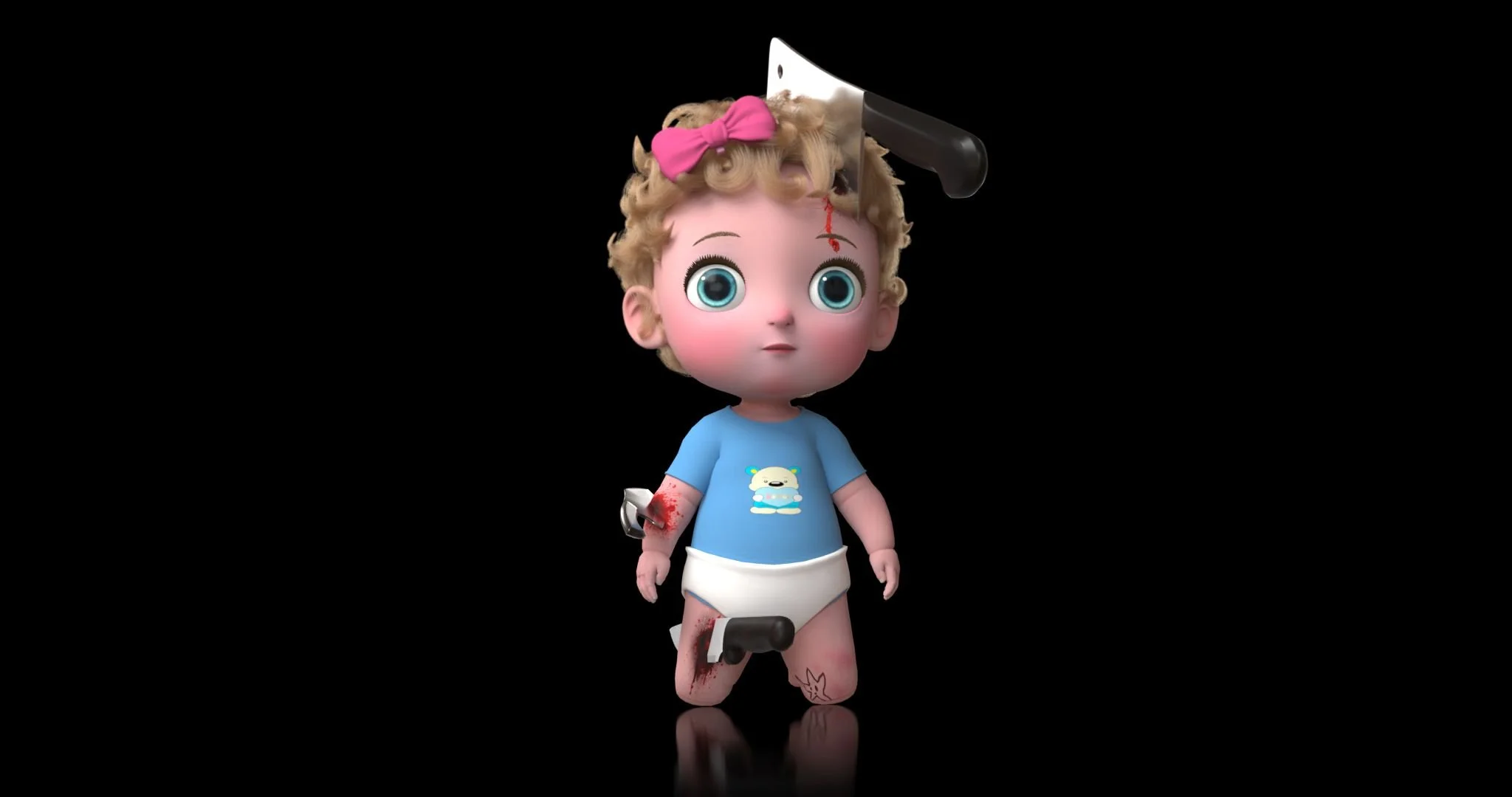
Caroline Poggi and Jonathan Vinel, Bébé Colère, 2020. Image courtesy of the artists and Julia Marchand.
NC: A kind of fluidity, an open-endedness, right? Because that’s really the essence of adolescence. It’s the one thing we don’t fully understand until much later—that it actually offers total freedom. But in the moment, it doesn’t feel that way. I remember it as a time when you’re trying to define yourself, to fix your identity in one way or another. And only later do you realize—why define yourself at all? That’s exactly the moment when you shouldn’t. You should try everything—within reason, of course, not recklessly—but really experience life as fully as possible, because that kind of freedom doesn’t come back. Yet at the time, you crave stability. You want to feel grounded. You’re dealing with relationships, insecurities, all of that. And that sense of grounding is, in a way, an illusion too—you have to move through it. It’s a very vulnerable age. I see it now with my own children—my son is 13, my daughter is 11 and a half. I watch how they’re changing, how they push against me, how these once very sweet children begin to assert themselves, even against each other. It’s an intense, volatile moment. And, that’s why what you’re doing is important—paying attention to it, giving it form, bringing it into focus.
JM: Thank you, but I don't have kids. The baseline of it, as you could imagine, I am the fucking subject. Like restarting with yourself as a subject, you don't look at a teenager's body to understand adolescence. That's also very important.
NC: Okay, so in terms of the website, I wanted to ask you, what does it mean practically to give space to adolescence rather than resolve its contradictions within the exhibition format? And it also relates to your upcoming exhibition in Warsaw.
JM: Well, if you resolve the contradiction, then it’s no longer adolescence. And I guess the website was also about that: putting side by side various materials that generate both wander and sweet chaos. It is erratic and structured, mature and infantile, ugly and sexy. Making a book was so painful, because I had to give a sense to the contradictions that were at the core of my program for ten years. You know what I mean? I mean, the website has this very open, lively, hectic aesthetic, which I love. The program was very much like this as well. And, you know, it’s really like a mall—you never know what’s going to pop up. And the book, I’m very happy with it, because I also feel it gives a sense, but at the same time, it doesn’t really conclude on anything. Each other comes with their voice, although my text is very much in line with the one by Julie Ackermann of the dissolution of the self and hypersensitivity. Anya Harrisson is dealing more with the moral panics and literary extremity in a time when society’s fetishization of adolescence continues to generate intense debates (including the series of Netflix, but in her essay, she is more looking at Dennis Cooper, Gisele Vienne, Karl Andersson, Michael Salerno..). I came to her to commission that kind of text: she had to be the bad cop. Giulia Mariachiara Galiano tackles the very contemporary subjectivities of the Girl Online (but also its limits). So, you see, not a single-headed direction!
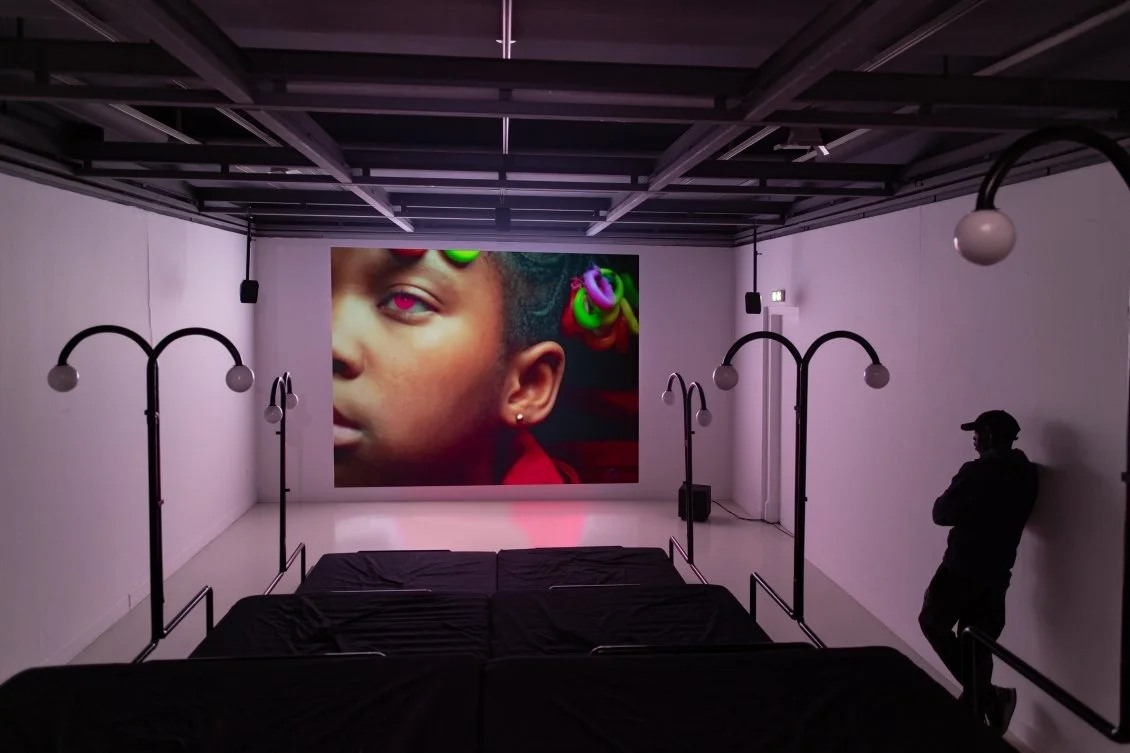
Tohé Commaret, 8 (Huit), film, 22'', 2022 et Konstantinos Kyriakopoulos, Elephant, 2022, acier, peinture, lampes, verre, câbles, matelas, draps, bois. 150x300x800 cm
(c) Margot Montigny.
NC: Looking back over 10 years, did you notice a shift in how artists themselves relate to adolescence as identity, condition, or aesthetic language?
JM: Yes, I think there was something that could not be named when I started, and that vagueness could feel like a kind of pure violence—you know what I mean? It could also be something generic. What I realized over the course of those ten years is that it became more precise, more specific about the kind of violence that was at stake. I drew the off-frame back in the conversation. Adolescence is a political subject, or political subjectivities that also embrace an ideological versatility. I must admit that my 2018-2019 years, hanging out with Paul B. Preciado and Mohamed Bourouissa, made me look at adolescence differently.
To make it short, the first exhibition “How To Grow Young with Cruelty” is very far from the solo exhibitions I made with Tohé Commaret and Saradibiza, where there is a strong sense of “lore” and “constructive hypersensitivity”: the first shows were dead ends, the latest ones were platforms. I would say that the filmic journey of Caroline Poggi and Jonathan Vinel follows a similar journey: look at “Jessica Forever” and “Eat the Night”: the (social, racial) reality creeps in, yet the “lore” plays a role if holding various states of realities. Today, I could even say that the Netflix series “Adolescence” could be a part of my program simply because it depicts a severe issue of murder while suspending morality. It was facing a moralistic ambiguity.
NC: It’s very hard to judge, very hard to judge that boy, and you’re confronted with this kind of cultured alienation. I was telling you before, it’s something you can already see in schools: from very early on, kids are inundated with the idea that as long as they follow the rules, they can blend in, that connection isn’t necessary, and that everyone is special. But that’s not true—we’re not born with the same abilities or the same outcomes. There’s this almost Gatsby-like archetype—don’t judge someone who wasn’t born with your advantages—but at the same time, you’re told you are special, which creates a contradiction. So, this topic is fascinating, and in the U.S., especially, you see how deep the issue is with disconnected teenagers and adolescents, also across racial, social, and political lines. And then there are the hormones, which make everything so violent, so aggressive, so potent—it can be healthy or very unhealthy, but it’s an extremely volatile period.
JM: That’s why I think it’s very difficult to judge teenagers; you must zoom out and look at the structures, the society in which they grow up, and reflect on where we stand ourselves, not entirely outside of that teenage condition. What I found compelling with Extramentale was that it started from looking at mass shootings and trying to understand them without having answers, engaging with this rhetoric of violence without direction. But over time, through the program, it became clear—as you said—that there was a need to address racial and economic contexts, to take a political stance, though not through activism or declarative language, but through more subtle, subdued forms.
For example, thinking about Tohé Commaret, she was born in the suburbs of Paris, with a family history marked by exile from the Chilean dictatorship. There’s a whole lineage that could have kept her confined to that context, or to certain representations of the suburb, which we tend to depict as bleak, grey, without a future—much like how we depict teenagers as pure outbursts of anger tied to hopelessness. What I find powerful in her work is how she blends a hyper-realistic, almost documentary approach with elements of collage and magic realism—perhaps influenced by South America or filmmakers she is looking at—introducing slight shifts in perspective that open a distorted reality. It doesn’t necessarily offer a clear future, but it creates a space to reconfigure the reality you inhabit. For me, that’s a political stance without explicitly claiming to be one: it deprives us of fixed representations and allows for new ways of interacting with them. More broadly, the artists I’ve been working with important issues in a very poetic and subtle way, often rooted in their place of origin, in questions of mental health, and in taking responsibility for representation. Anhar Salem works through a similarly distorted sense of self whilst dissociating. Over these ten years, what was once unnamed has gradually become nameable, partly because we are living in a society that is confronting more of its issues. The MeToo movement, for example, really opened a path—it gave a kind of license to speak about subjects that previously felt inaccessible, and now, even with things like the Epstein files, we see how that shift continues to unfold.
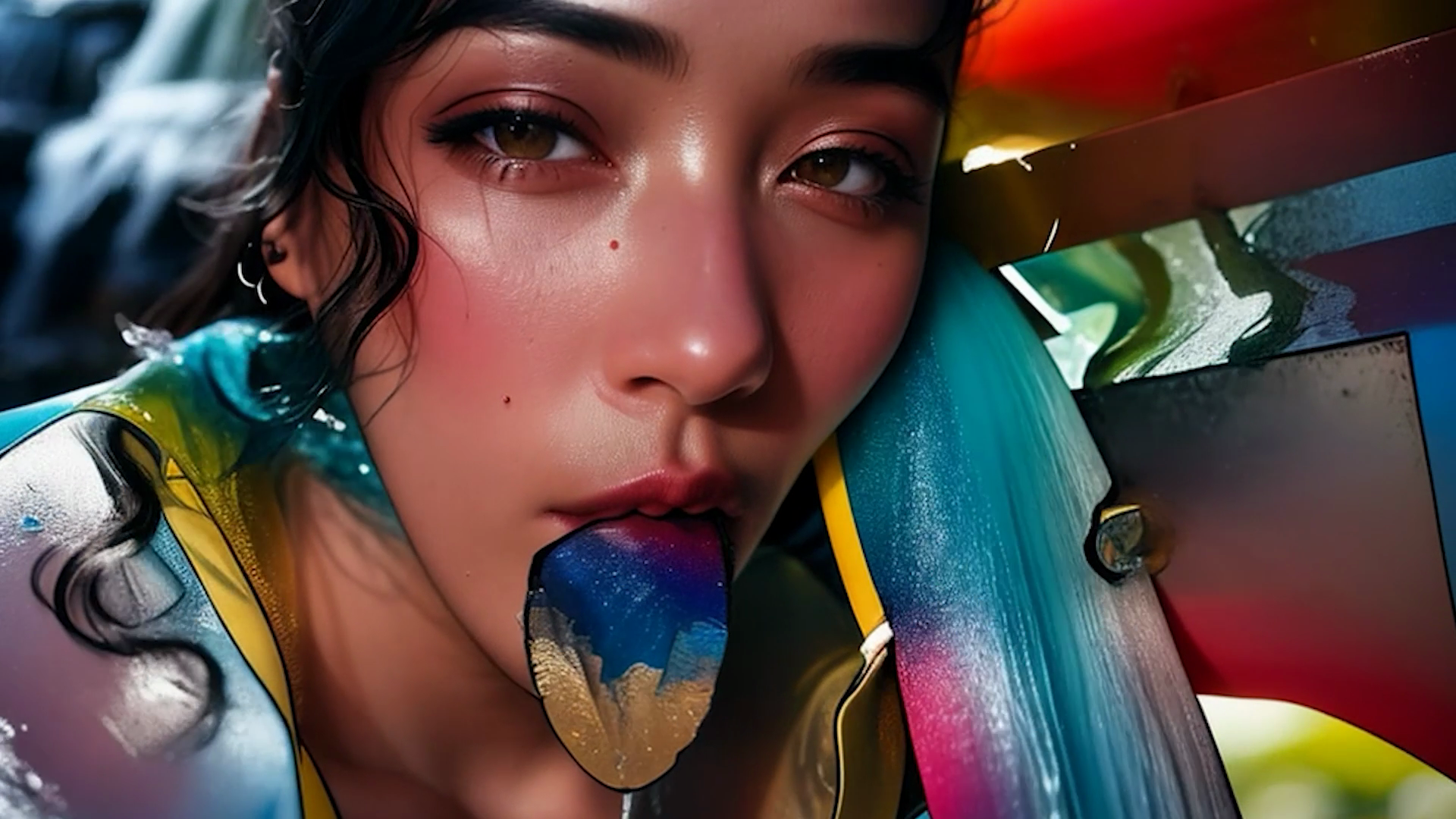
Anhar Salem, Corporating/discorporating (2025), video still. Courtesy of the artist.
NC: So, if adolescence is defined by doubt and becoming, how can institutions—often built on stability—hold space for it without neutralizing it? And in the context of your exhibition in Warsaw, I’d also like to connect this question to what’s coming up.
JM: Well, it’s very interesting, because for me the question is how this translates into a curatorial gesture. It means accepting that the artists you invite are inhabiting a space of contradiction, right? And I love—actually, in an interview I did with Michal Novotny, who is organizing the “Gen Z All at Once!” exhibition at the MO Museum in Vilnius—we spoke about how not resolving those contradictions and the right to remain obsolete is precisely the point; We live in a kind of post-contradiction condition, and that’s the air we breathe. So rather than resolving tensions, we embrace them. In curatorial terms, it’s very important for me not to expect clear answers from the artists I work with.
For the show at Zacheta National Gallery in Warsaw, for instance, this becomes very concrete. We’ve had many discussions with my co-curators about participation—what participation with adolescents means. One approach would be to involve teenagers through educational workshops. Due to their position as institutional curators, my co-curators, Katarzyna Kolodziej-Podsiadlo and Joanna Kordjak, are advocating this. My understanding is different: it’s about inviting, let’s say, a 28-year-old artist to engage with tactility, speed, and disappearance—conditions that shape both images today and our experience of the material works—and translating those into sculpture. Participation, for me, doesn’t come from an urge to simply include people, but from creating a space that is conducive to acts that embody those conditions. What interests me is precisely the tension between things that don’t easily align: how do you bring together touch deprivation and physical participation, age of impatience and remains? They’re fundamentally contradictory that coexist. You can construct an image from Instagram, of course, but how do you extract a sense of touch from it? Some artists are working through these contradictions in painting and participatory formats, and that’s what I’m trying to foreground. We’re three curators, but in my section of the exhibition, this is what I want to articulate.
In terms of how we divided the artists, it was quite intuitive—we all shared a similar vision for the show. We agreed, for example, not to represent teenagers literally in the works, but to focus on a condition of adolescence: drifting, association, shared energies, even violence. At the same time, because it’s a public museum, there’s an expectation of workshops and educational programming, and those components will be part of the exhibition, which, in turn will feed my future.
In fact, this is something I want to explore further in my future work. After the book and the closing of Extramentale, I’d like to develop a more specialized approach to engaging teenagers with art, because I don’t think we’re doing it well now. It’s something that also feels personally important to me—thinking ahead, even in terms of motherhood, about how we “mother” ourselves and artists, participants, or audiences. I think those structures are often misguided, and it’s something I’d like to rethink more seriously. It goes surely beyond paternalization.
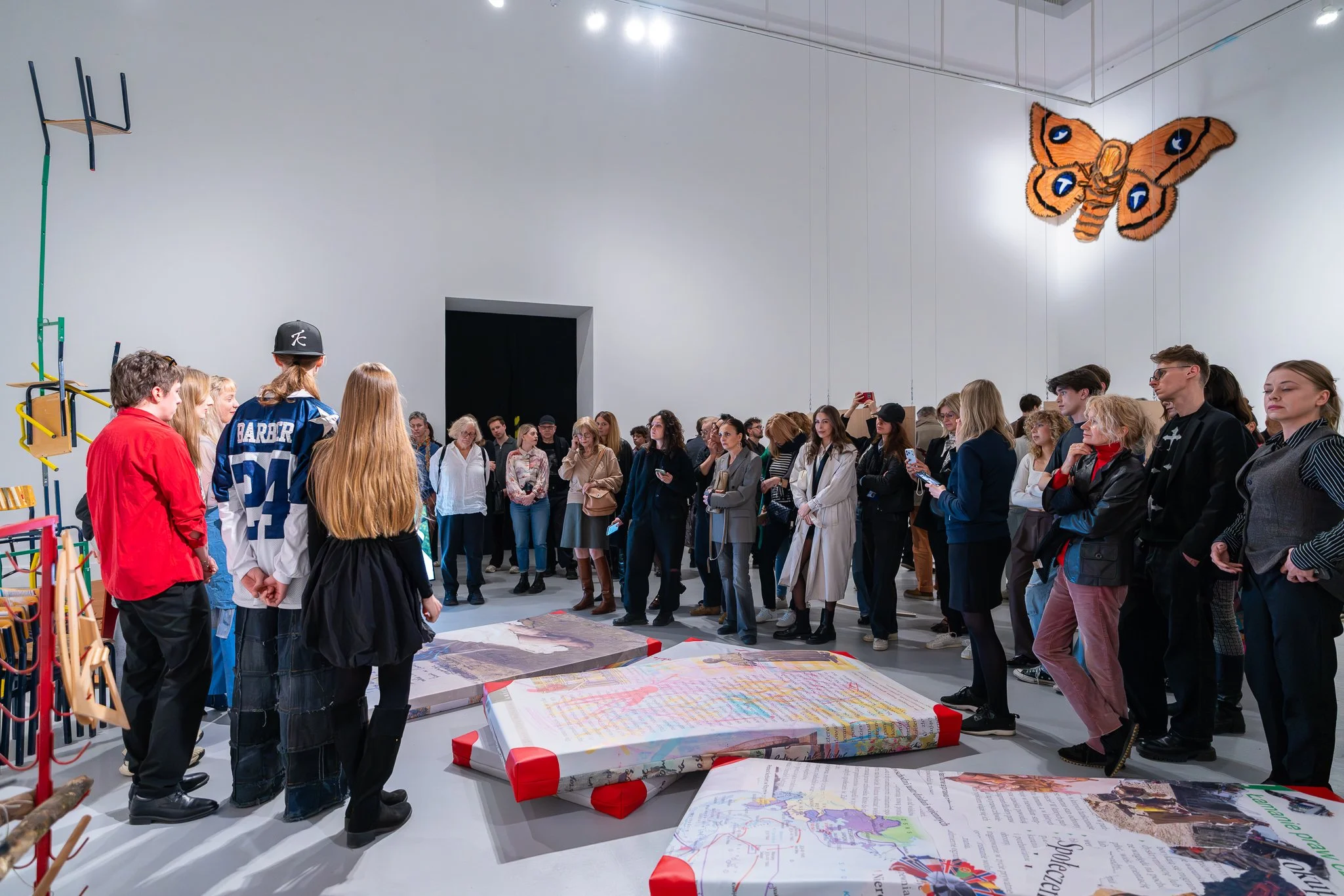
Adolescence, view of the exhibition at Zacheta National Gallery in Warsaw, curated by Katarzyna Kołodziej-Podsiadło, Joanna Kordjak and Julia Marchand.Image courtesy of Julia Marchand.
NC: So now I want to ask you about Georgia and your connection to it. So, what brought you there in the first place?
JM: Well, two things. Elene Abashidze and I—we’ve lived together in London, and we studied together, so we’ve been close since around 2012. It’s a personal relationship; she’s a friend. But I would say the moment when everything really became obvious—when it got under my skin, when Georgia became almost like a second country for me, alongside Italy—was the exhibition of Niko Pirosmani that I worked on at the Van Gogh Foundation. I was assistant curator to Bice Curiger on that show in 2019. That was really my first deep cultural involvement. I went into the research, and through that I discovered Iliazd, because, as you know, he wrote about Pirosmani. Then Elene invited me to do a show right after that exhibition, so I did a small Extramentale project at her place, and from there, everything unfolded.
I came across archives, started digging further, and it just kept expanding. I met Andro Eradze, then Lisa from LC Queisser, and so many other people, and it kept growing alongside my own work. I continued researching Iliazd more. Before Venice, I had already been invited to work in Georgia, including at Salome Palace, where I did an exhibition on Iliazd and French artists at the Orbeliani Palace for a festival. So, I had already done maybe five projects in Georgia—screenings, small exhibitions—and I had also been consistently inviting Georgian artists into my own exhibitions, including through Extramentale.
Then the Georgian Pavilion happened. They knew I had access to the archive, and I was approached to work on the proposal. At first, I declined—I had just left my job. But then I was invited to Venice to come to Palazzo Palumbo Fossati, where my exhibition could have taken place in case of success. Seeing the space and knowing Iliazd’s work so well made it impossible to refuse. I submitted a proposal and began working on the pavilion, although the collaborator who initially brought me in eventually dropped out completely. It was also a very difficult political moment with the government, so overall it wasn’t the easiest experience. But what the exhibition ultimately brought to Venice was significant. It was widely seen as one of the strongest pavilions of the 2024 edition, and I think that’s because we—meaning the artists and I, across French and Georgian contexts—managed to translate the vision of Maximiliana, this idea of naked-eye stargazing, into the exhibition itself. I worked on it intensely, and I’m proud of what it became. It also led to further opportunities: I received funding from a Swiss foundation to produce a book on the pavilion. I see the book not just as documentation, but as a new platform to bring together younger voices working on Iliazd into a single publication.
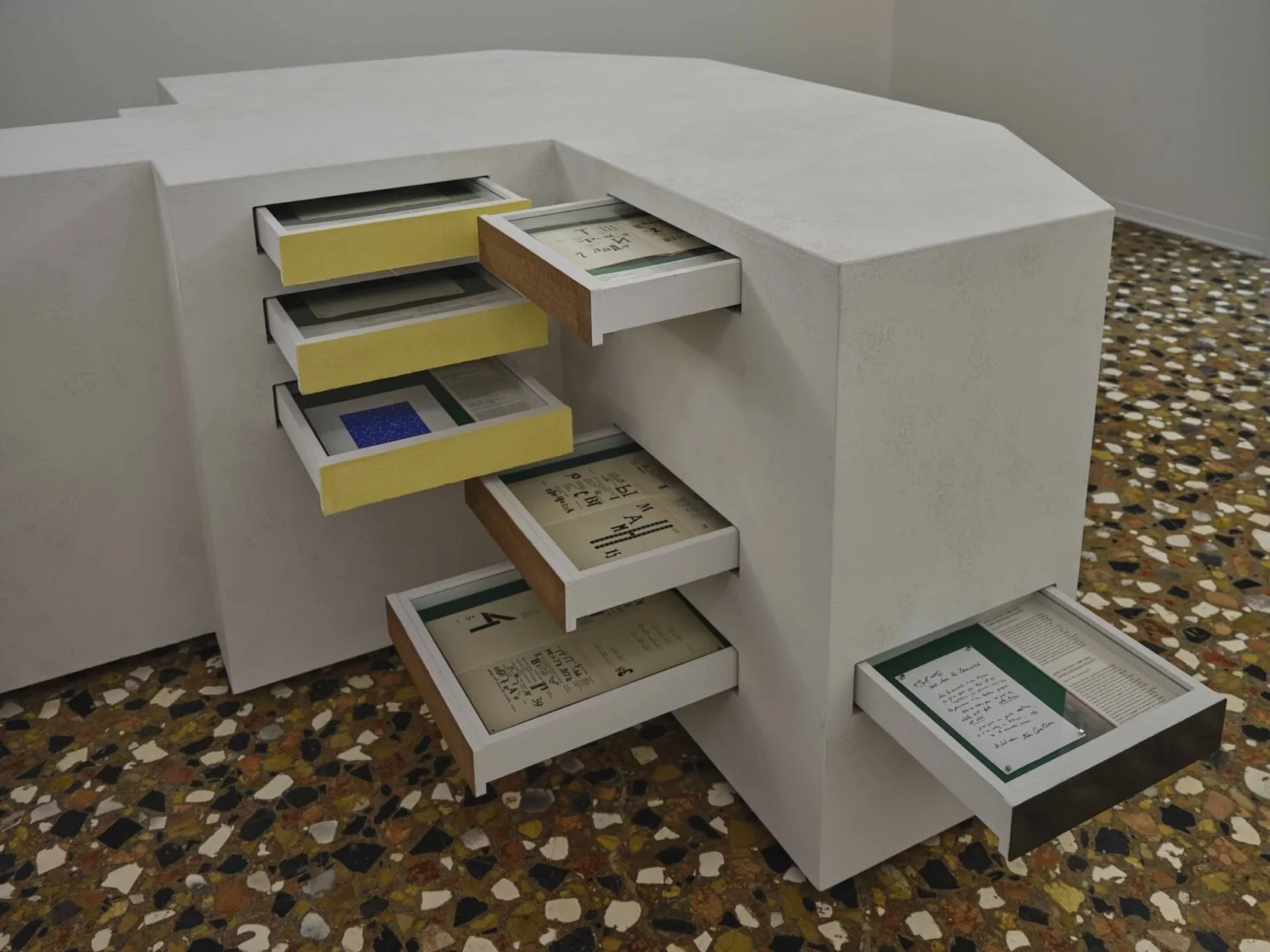
Georgian Pavilion at the 60th International Art Exhibition – La Biennale di Venezia. Typographic Cabinet by Juliette George et Rodrigue de Ferluc with a page of Lidantiu faram. (Ledentu le phare.) Paris: 41°, 1923 (also known as Zaoum Poetry) with a stellar-shaped textile design pattern for Coco Chanel (late 1920s). Credit: Fonds Iliazd and photo credit: Grégoire d’Ablon.
NC: What do you think is the role of a curator today?
JM: I’ve been asking myself this over the past five years, and I’m still curious. I’m a slow person, so I know I’ll probably arrive at an answer in two or three years. But it stays with me—I’m almost obsessed with it. I don’t yet know how to take the next step. I know it’s coming, but it will come slowly. I need to close different chapters; I’m in the process of closing one now. And I think this is really what I’m doing as a creator: asking myself what I need, what I can bring, why it matters, and how I can change the things that need to be changed.
Portrait of Julia Marchand by Matteo de Mayda ©