Hot Coffee Conversation with Inga Lāce, Chief Curator at the Almaty Museum of Arts, Kazakhstan
Published Tuesday, April 21, 2026
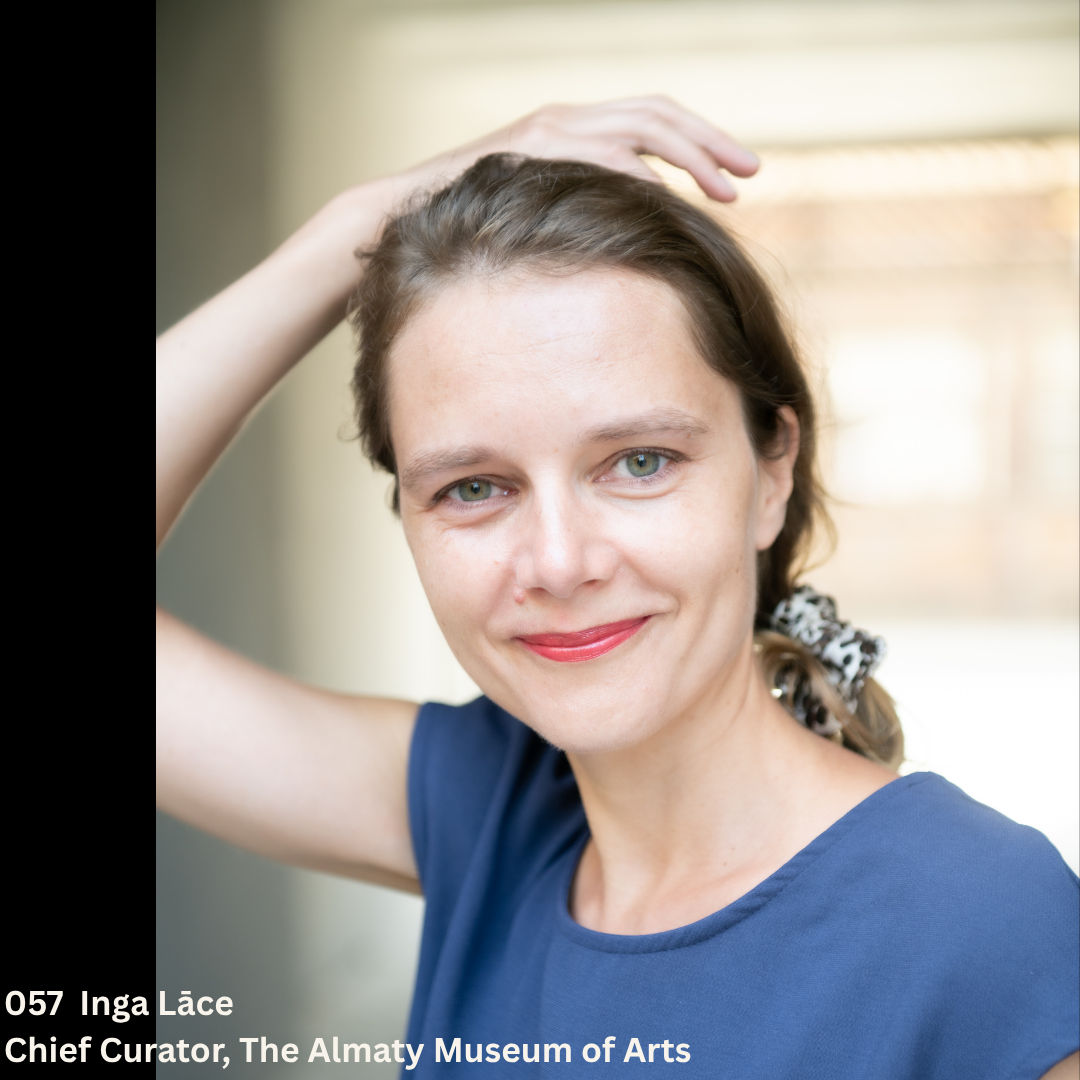
Inga Lāce is a curator and writer whose practice focuses on post-socialist art histories, migration, and decolonial perspectives across Eastern Europe and Central Asia. She is currently the Curator at the Almaty Museum of Arts, where she leads collection development and curates research-driven exhibitions that position Kazakh and Central Asian art within broader international dialogues. Working across institutional and biennial contexts, Lāce has co-curated the Latvian Pavilion at the Venice Biennale and continues to shape projects that foreground alternative narratives of internationalism, informed by histories of displacement and cultural exchange. Her work often brings together artists, archives, and scholars to rethink inherited frameworks and to build new platforms for art historical discourse. I first met Inga in New York when she was the C-MAP Central and Eastern Europe Fellow at MoMA. Her leadership role at the Museum and upcoming co-curation of the Latvian pavilion this spring in Venice made a perfect reason for us to catch up over Zoom.
Nina Chkareuli: Imagine you are in your favorite coffee or tea spot. Where is it? What are you drinking? What are the three things you see right now?
Inga Lāce: I am at FIKA in Almaty, and I’m drinking a café latte with oat milk, which I always have. And I’m seeing the city view from the window, a very beautiful interior design by local designers, and a lot of people I know.
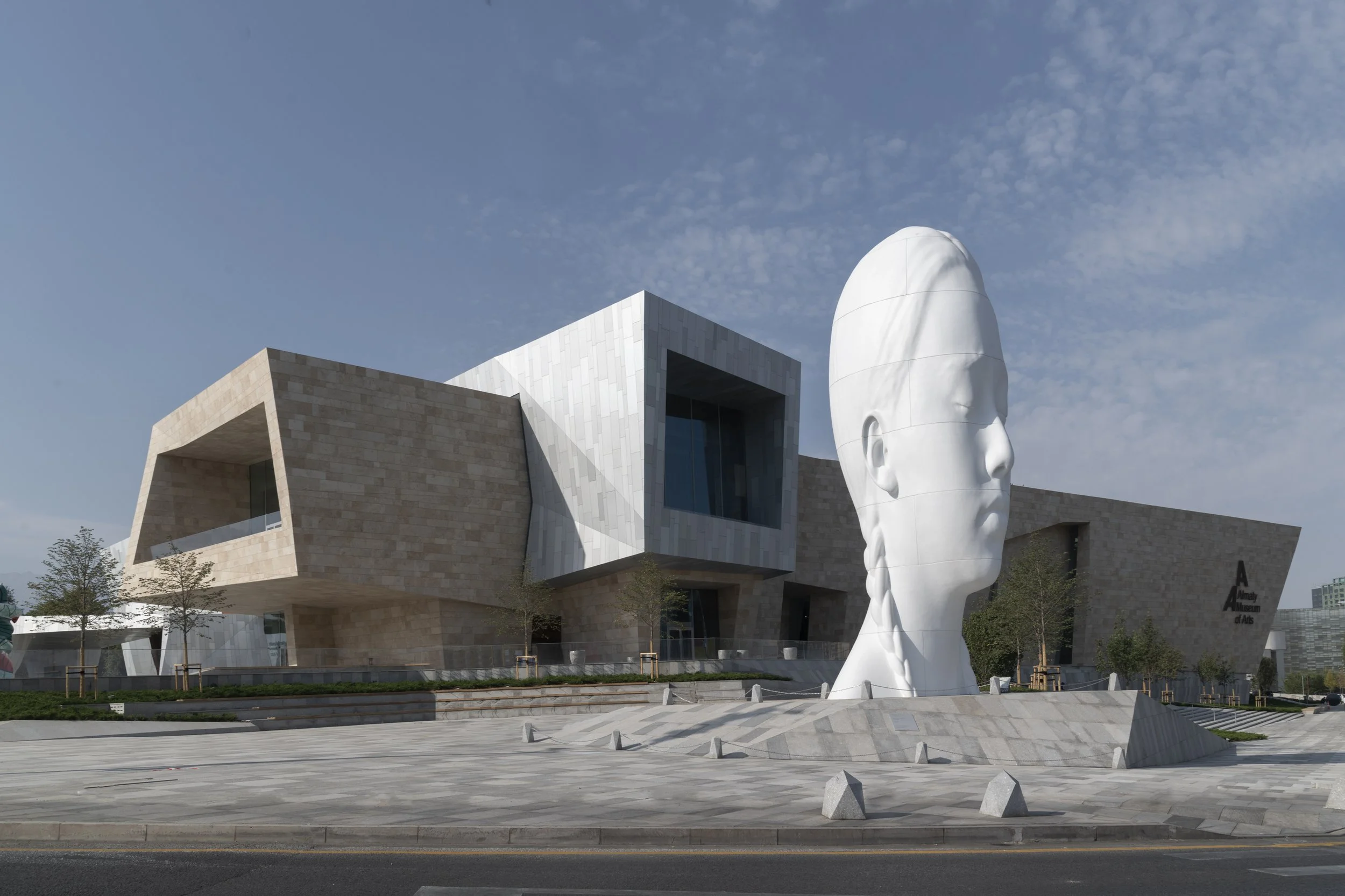
The Almaty Museum of Arts, Kazakhstan. Jaume Plensa (1955, Barcelona), NADES, 2023. Polyester resin, fiberglass, stainless steel.Commissioned by the Almaty Museum of Arts. Image courtesy of the Museum. Photography by Alexey Naroditsky.
NC: Your work often engages with post-Soviet art histories and diaspora networks. How do you see the role of memory and migration shaping contemporary artistic practices in Eastern Europe today?
IL: I think there is an interesting shift. For example, on the one hand, there was a moment of strong post-Soviet examination of socialist histories. But at a certain point, artists began to turn toward pre-imperial, pre-colonial narratives. This feels like a global shift: instead of only analyzing, there is an attempt to reach those earlier mythologies and processes, via craft, via embodied practices. Of course, they are not accessible purely or immediately, but they can be felt from a contemporary distance and reinterpreted through present-day language. I see this especially among younger artists across the Baltics, Central Asia, and Georgia. At the same time, there is still a focus—particularly in some contexts, like among certain Georgian artists such as Tekla Aslanishvili—on infrastructures of colonialism and Soviet imperialism. These histories have not disappeared. The “ghost” is still present, and it returns in waves. Another aspect—also reflected in my work on the Latvian Pavilion—is an emerging interest in the 1980s and 1990s. Perhaps we’ve reached enough distance to look at that period more reflectively, whether through lived experience or not.
NC: It’s interesting for our generation—those around 40. Which year are you?
IL: I’m 1986.
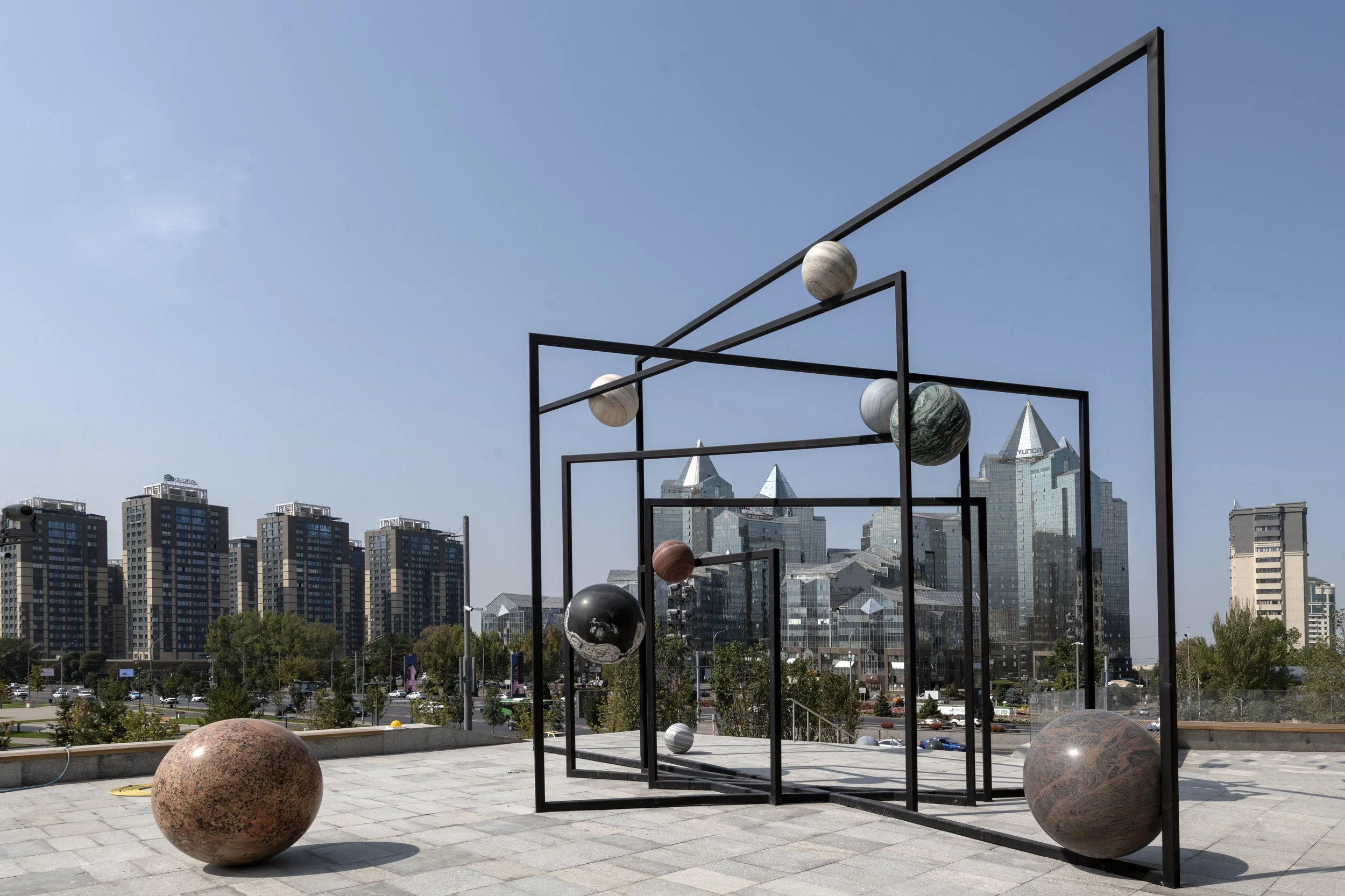
Alicja Kwade (1979, Katowice, Poland).Pre-Position, 2023.Carrara, Rinde, Verde Guatemala, Alaska White, Schlesisches Marmor,Macaubas, Aurelio. Antico/Praha Gold, Rosso Norwegia, Masi, Alaska Red, Wondergrey, powder-coated stainless steel. Commissioned by the Almaty Museum of Arts. Credit: Almaty Museum of Arts. Photography by Alexey Naroditsky.
NC: So, you’re younger, but you still remember the 90s as a child. Now, when I look at archives, it feels like something very powerful and fascinating. As Curator at the Almaty Museum of Arts, how do you balance local artistic narratives with the demands of international visibility? How does that influence your curatorial choices? And what has been the most significant challenge for you as a curator for a brand-new institution?
IL: When I began working on the collection exhibition Qonaqtar (“Guests” in Kazakh), which revolves around hospitality as a deeply inherited nomadic tradition, and migration in Kazakhstan across the 20th century, I began thinking about how art from Kazakhstan is already international—but in a different way. It’s not “international” in the sense of global market visibility, like New York or Paris, but because of migration histories. For instance, Koreans were deported to Kazakhstan in 1937. Through labor camps, people from Latvia, Ukraine, Russia, and elsewhere arrived. This created a complex cultural fabric. People might identify as German, yet have grown up in Kazakhstan. So curatorially, I think of this as a different form of internationalism.
Our task as a museum is to build bridges—ensuring that Kazakh and Central Asian art remains visible and center but in dialogue with what is conventionally called “international.” There are two approaches. One is theoretical—rethinking frameworks entirely. Instead of asking how to include Kazakh art in global narratives, we ask: what if Central Asia was never outside them?
The second is practical: when working with international institutions, we don’t want to display masterpieces simply. That also has a place to be, but I want meaningful exchanges—dialogues between works, commissions, and shared themes. For example, how does Western Land Art relate to nomadic practices in Kazakhstan? Or how does Korean art from Korea relate to Koryo-saram artists in Kazakhstan? It’s about creating a generative, non-prescriptive dialogue.
In terms of challenges, there are many. One is language and access. At the museum, we use three languages: Kazakh, English, and Russian. But those language communities are not always overlapping – a Russian-speaking event may not be accessible to a Kazakh-speaking audience, and an event held in Kazakh may not be understood by a Russian-speaking audience. We try to translate English-language events to introduce different voices and perspectives, but also make them accessible and legible. I am myself connected to the idea of “guests” in the exhibition, having arrived in Kazakhstan two years ago. Idea of guests in my show goes from traditions of warm welcome, food, and gatherings to histories where ‘guests’, in quotation marks, came voluntarily and involuntarily, settlers and colonizers and deportees alike.

Exhibition view, Qonaqtar, Almaty Museum of Arts, 2025.Image courtesy of the Museum, photo by Alexey Narodizkiy.
NC: That’s fascinating, Inga — it comes through very organically in your work. Now, about the pavilion. Having co-curated the Latvian Pavilion in 2019 and preparing for this year, what is the biggest challenge of presenting Baltic or Eastern European art on a global stage? Do you use different strategies when presenting Kazakh versus Latvian art?
IL: Our pavilion, which I’m co-curating with Adomas Narkevičius, centers the artist duo MAREUNROL’S interpreting and bringing forward the legacy of Untamed Fashion Assemblies – avant-garde fashion, art, and performance events, organized in the 1990s by Bruno Birmanis, an alternative fashion designer himself. We realized that many aspects of the 1990s are obvious to us—but not necessarily to an international audience: instability, scarcity, but also the sudden glimpse of freedom and the courage required to act publicly. There were also misunderstandings—Western visitors often exoticized what they saw. So in Venice, we ask: how do we communicate this without overwhelming the viewer with context? And how do we avoid nostalgia? We don’t want to recreate the 1990s—many objects of the shows no longer exist. Imagine garments made of paper, blankets or metal. Instead, we focus on the spirit—freedom, courage, experimentation. It’s interesting how the zeitgeist works. The collapse of the Soviet Union created a space of instability but also immense creative freedom. Now, we see new forms of political tension—right-wing populism, war in Ukraine, and even the return of the Russian Pavilion in Venice. It feels like another moment of erasure, where countries like Ukraine, the Baltics, and Georgia must actively assert their presence. This is why I don’t support boycotts—we need to be present. Our stories must be heard. Similarly, Central Asian pavilions must work through translation and visibility. And their stories need to be heard in nuance.
At the Almaty Museum of Arts, we aim to be a platform—a place where dialogue and exchange can happen. We are also working towards building art historical discourse, including oral histories, publications, and long-term research. I think that just by being here, the museum is already this kind of platform, an anchor. During the opening of the museum, as well as afterwards and even before, we invited and hosted curators, artists – some of them for the first time in Almaty. And we always try to bring new people here, because that helps to build meaningful exchange, a kind of translation process across countries. I think of our guests as future ambassadors not only for our museum, but for the art scene of Kazakhstan in general, and that’s a mission. Of course, if you see something in Venice, you may not exactly understand if from the first glance, but you may think, oh, it's interesting. The more stories you hear, the more they connect, building a network of knowledge around a region, be it the Baltics or Central Asia.
At the museum, we are also working with a Getty grant on Central Asian art histories conceived in collaboration with the Institute of Fine Arts of New York University. The task through this project is to gather regional art historians and artists to think about how the knowledge that exists should be kept, narrated, heard, or rethought, and individually and together they are producing new art historical research. I see it as an important mission of the museum to create a community of artists and professionals, and to build an ecosystem of knowledge production that is there also before, after, and in between the bigger, more visible presentations such as Venice.
If we look at the artists who have made the Baltic stories heard, it’s definitely the Lithuanian artist Emilija Skarnulyte. In Central Asia, it is Kazakh artist Almagul Menlibayeva, whose retrospective solo show “I Understand Everything” we opened our museum last September. Of course, also Uzbek artist Saodat Ismailova, whose work we have in our collection. These artists contribute to making the stories of the regions very visible, and I think that afterwards, it creates an interest to do more research, to understand more, and that’s where the museum and other institutions should be there for.
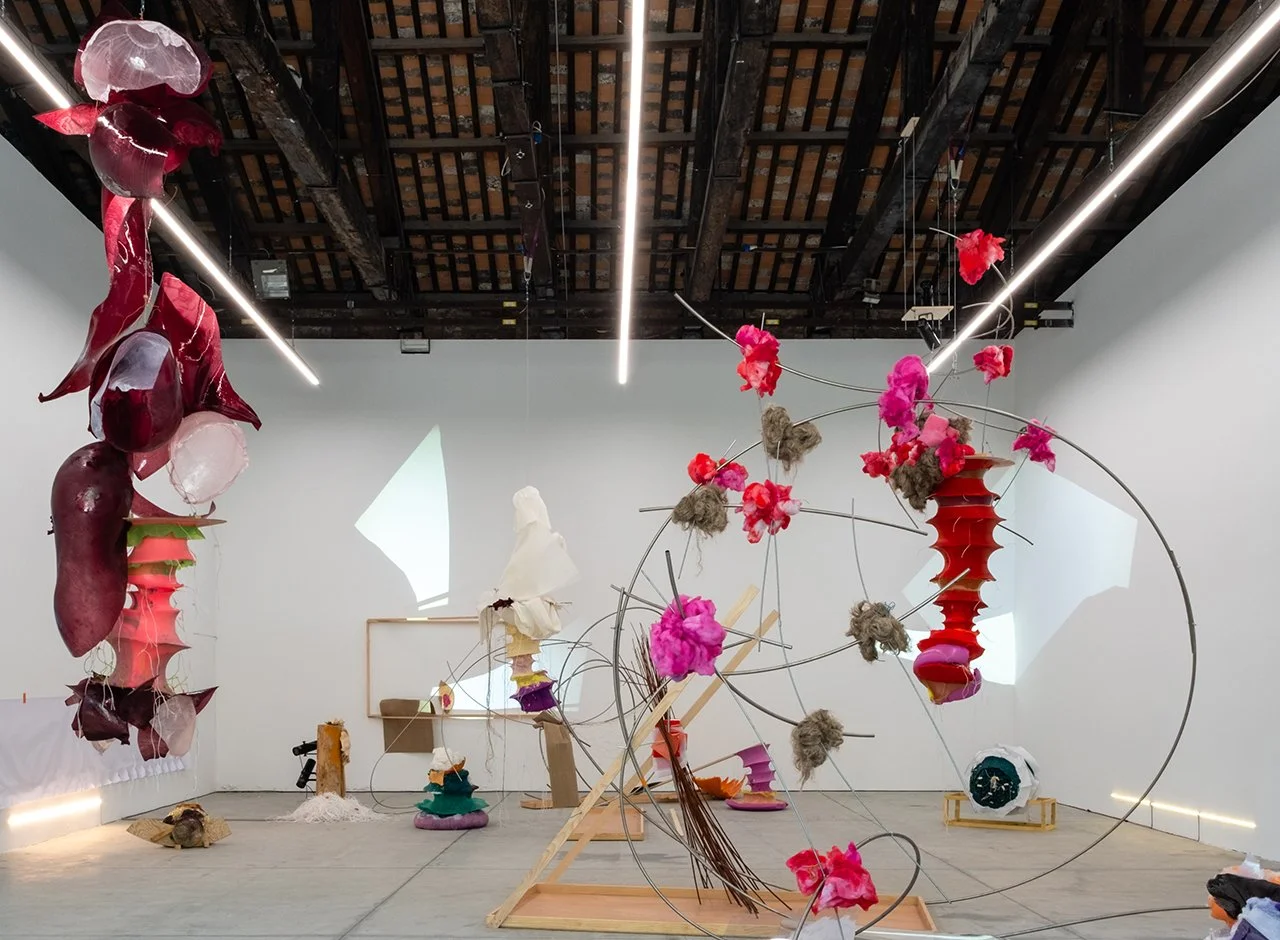
Daiga Grantina at Latvian Pavilion at Venice Biennale,2019, co-curated by Inga Lāce and Valentinas Klimašauskas.
NC: In Georgia, for example, there is a lot of oral art history, but very little that's written, right? I mean, in content, from a contemporary standpoint, it's all these different kinds of narratives and not one specific kind of larger understanding. So, it's great that you're doing this for Kazakhstan.
IL: Different histories are written by art historians at different times. But the Getty project is an opportunity to come together, and to look at what hasn’t been written yet, and what can and needs to be done right now by each participant individually and everyone together in a timeline of three years. It can also serve as a larger rethinking of what should be the next steps beyond the three-year research grant – is there a need, a time, and a possibility for a contemporary art history of Kazakhstan or Central Asia to be written, and who should be writing it? We are also publishing a catalogue of Almagul Menlibayeva for her exhibition. When you start this process, even with one artist, you only realize how much more needs to be done. But I think the museum has this chance to be systematic, to be long-term, and to be sustainable. One of the ideas within the Getty project is to interview art historians and have them as oral histories, filmed and transcribed. It’s not only about new writing but about understanding the shifts and ruptures that have happened in the discourse of art history itself.
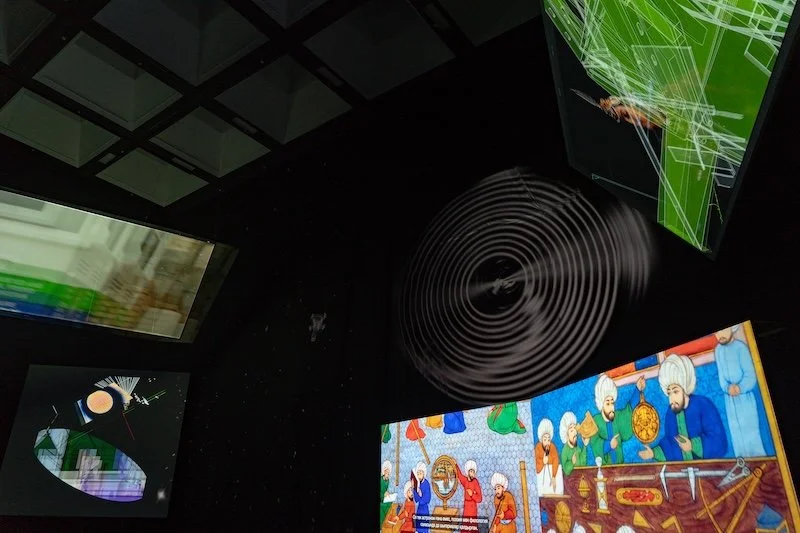
Exhibition view, Almagul Menlibayeva_ I Understand Everything, Almaty Museum of Arts, 2025. Image courtesy by photo by Alexey Poptsov.
NC: That’s incredibly valuable work. Looking ahead, what trends or emerging voices in Eastern European art are you most excited about, and how do you see curators supporting them beyond traditional exhibition formats?
IL: I think something interesting is happening between art, fashion, and performance. That’s where, for example, the artists I’m working with in Venice, MAREUNROL’S, stand. And I feel that now, as the 1990s are being reexamined across the board—there will be an exhibition at Tate about the 90s, and recently there was an exhibition on Leigh Bowery—you can see how all of that connects: club culture, queer culture, art, and fashion. I also feel that the younger generation of artists, for example, in Kazakhstan, is doing something very interesting. I work with a Uyghur artist, Guzel Zakir, and she is telling a story within a story - she did an exhibition around how the Uyghur print culture developed in Kazakhstan, and how the Soviet Union attempted to construct the “perfect” Uyghur Soviet citizen through text and visual representation. The lesser-known stories, diasporic and often invisible stories are being opened up with the younger generation of artists.
There are also other cases within the museum’s collection that require attention. For instance, the Buryat artist Serenjab Baldano, who has passed away, was self-taught, and the wooden sculptures he created during his time in Almaty are deeply compelling—embodying his Buddhist roots and knowledge of Buryat craft traditions.
Another example is Abdukerim Issa, a Uyghur artist who recently passed away. He dedicated his entire life to painting tigers, working in a style known as “tiger calligraphy,” where the tiger becomes a symbol of freedom and courage.
Alongside more widely recognized artists, there are others whose practices are equally significant, yet have emerged through different trajectories and remain less visible. As a museum, our aim is to provide a platform for this plurality and to bring these practices into closer consideration.
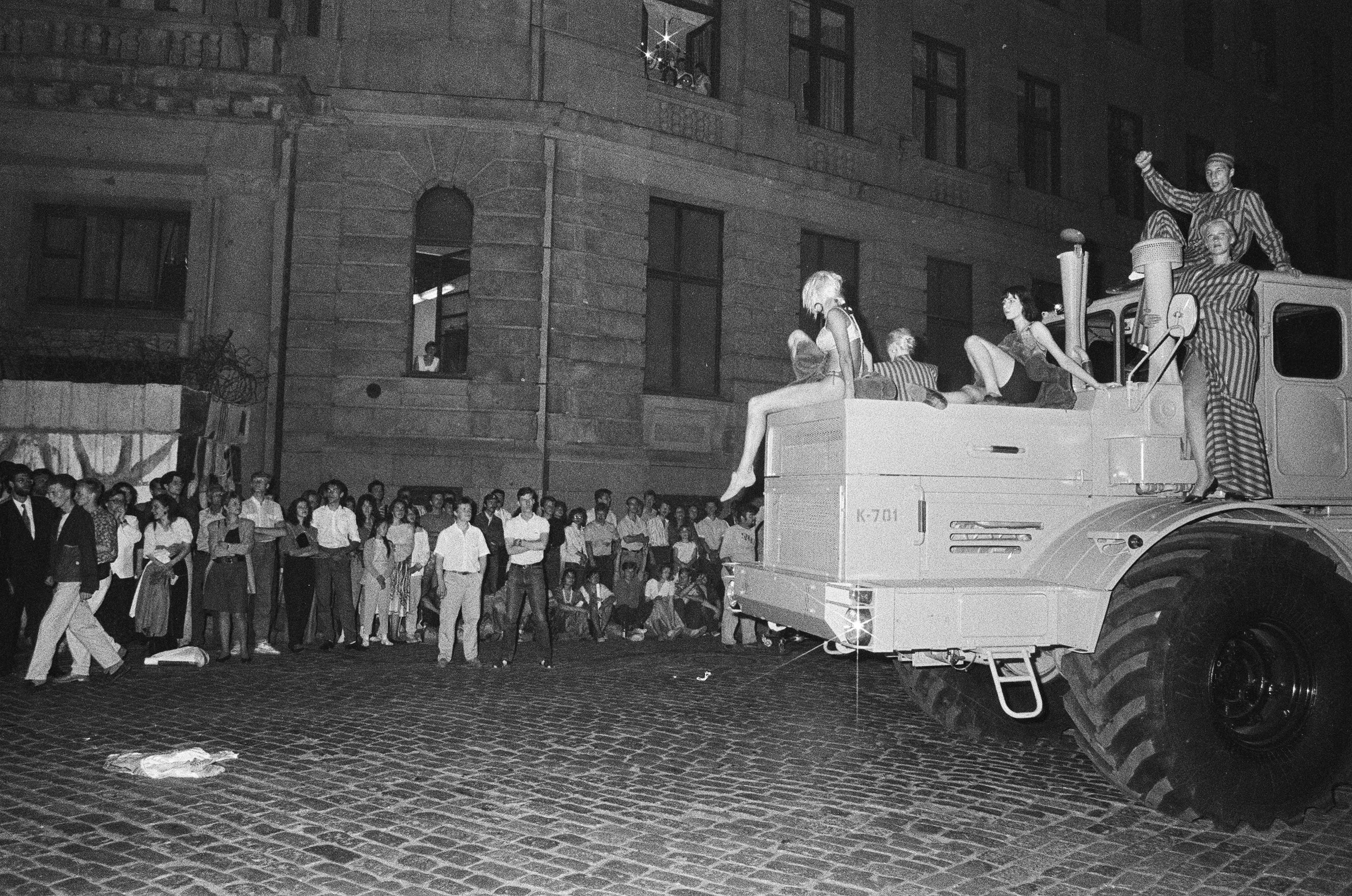
Untamed Fashion Assembly. 1991. Photo: Aivars Liepiņš. Courtesy of the artist. Bruno Birmanis archive, Latvian Centre for Contemporary Art.
NC: What is the single cultural experience that set you on your curatorial path when you were younger—what made you decide to become a curator? It could be an artistic experience or a cultural one.
IL: You know, it was the possibility to try making art myself, because I was going to an art school as an after-school activity, from around seventh to twelfth grade. So, I was trying art-making—I was drawing and painting. And at one point, I think I realized that I wanted to be close to that creativity, to always stay close to it. But I didn’t want to make art myself all the time. So in that sense, being a curator became the way I could stay close to that process continuously, throughout my life—I still never get enough of it and never get bored.
NC: I can absolutely relate in the same way, because it gives you that access, but at the same time, you understand what it means to be an artist. It depends on personality, but to really become an artist, you have to give all of yourself to it. Otherwise, you can remain a hobby artist. So rather than trying to be that, it’s better to be a curator, a writer, by calling.
IL: I agree—this is the best way, also, to work with so much talent and to try to leave your own mark in some way.
NC: What is a single piece of political or cultural news that has caught your attention, either in Kazakhstan or internationally? The reason I’m asking is that I want these interviews to feel current and rooted in specific moments.
IL: There is so much news right now, much of it deeply worrying. Still, I want to respond with a note of cautious hope: in Hungary, recent political developments suggest that change can happen through democratic processes—through elections and voting. In these extremely unsettling times, even such moments offer a sense of hope.
Portrait of Inga Lāce by Kristaps Kalns.
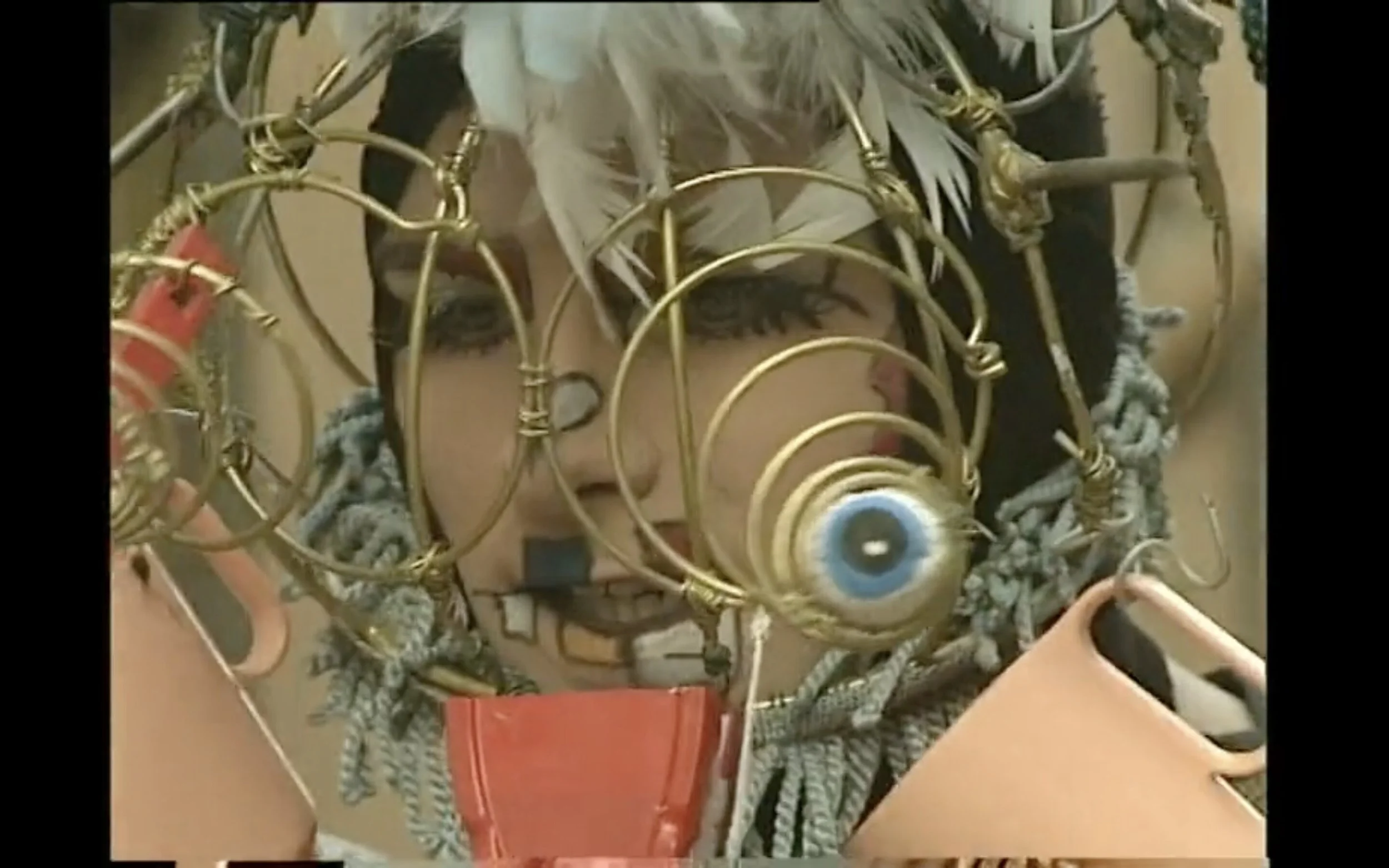
Untamed Fashion Assembly. 1991. Photo: Aivars Liepiņš. Courtesy of the artist. Bruno Birmanis archive, Latvian Centre for Contemporary Art.