GUEST Hot Coffee: Gabriele Medaglini with artist Bat-Ami Rivlin
Published Tuesday, July 7, 2026
The creative polyvalence of Bat-Ami Rivlin — artist, educator, and writer — finds its sharpest articulation in a sculptural practice that places the notion of the “object” at the core of its inquiry. Yet to speak in terms of the ready-made today risks sounding almost retroactive: another historical moment, another regime of images. That voracious attempt to violently rupture inherited modes of seeing and interpretation has long since exhausted much of its revolutionary force. The flattening effects of hyper-consumer culture, the black hole of social media, and the compulsive rhythms of contemporary overproduction are among the many conditions responsible for the erosion of what now stands as one of the scarcest and most valuable resources of all: attention itself. Stripped to the bone, attention demands continuous impact — a relentless hammering, second after second, in a war of attrition that inevitably extends to artistic production. It now feels almost unavoidable to imagine how an artwork might circulate through Instagram before considering its physical encounter in space; not as a moral question, but as a symptom of the conditions under which cultural production is compelled to operate.
If, then, this is hardly a case for surrendering to the nostalgia of the readymade, neither does Rivlin’s work align itself with the polished, “gigione” aesthetic of the many minimal-industrial assemblages currently in circulation—gigione here understood in the Italian sense of a figure of limited substance yet marked by vanity and self-importance, one who seeks admiration through theatrical displays and outward effects engineered for easy appeal. What emerges instead is a sustained tension: the capacity of artistic production to generate an acute awareness of the pervasive agency objects exert over both the subject and its ability to live the space. Her sculptures function as anti-monumental propositions that radicalize the original functionality of their constituent elements to the point of collapse, paradoxically rendering them unusable. In doing so, they expose the logic of a production system in which every object is generated according to a predetermined function and utilitarian imperative, foregrounding the latent failure embedded within such regimes of categorization.
Recent exhibitions include: Untitled (radiators, zip ties), Management, New York (2025-2026); Boat, Plastic, Tire, L21, Palma De Mallorca (2023-24); Simple Sabotage, Kunsthal NORD, Aalborg (2023-24); The Socrates Annual, Socrates Sculpture Park, New York (2023- 24); COLAPSO, Tenerife Espacio de las Artes, Tenerife (2022); EN-SITIO, Museo de la Ciudad de Querétaro, Santiago de Querétaro (2022); whereabouts, Hessel Museum of Art, CCS Bard, New York (2022); No Can Do, M23, New York (2021)
Gabriele Medaglini: Imagine that you are in your favorite coffee or tea spot. Where is it? What are you drinking? And what are the three things you see right now in that place?
Bat-Ami Rivlin: I’m having a coffee-banana-coco smoothie at Oasis Jimma on Broadway and Tiemann Place in Harlem. I’m looking at the busy intersection between Broadway and West 125th Street, where the subway bridges over the intersection and shades the block. I’m noticing a mark one of my former students left on a beam during their site-specific sculpture exercise at Columbia U.
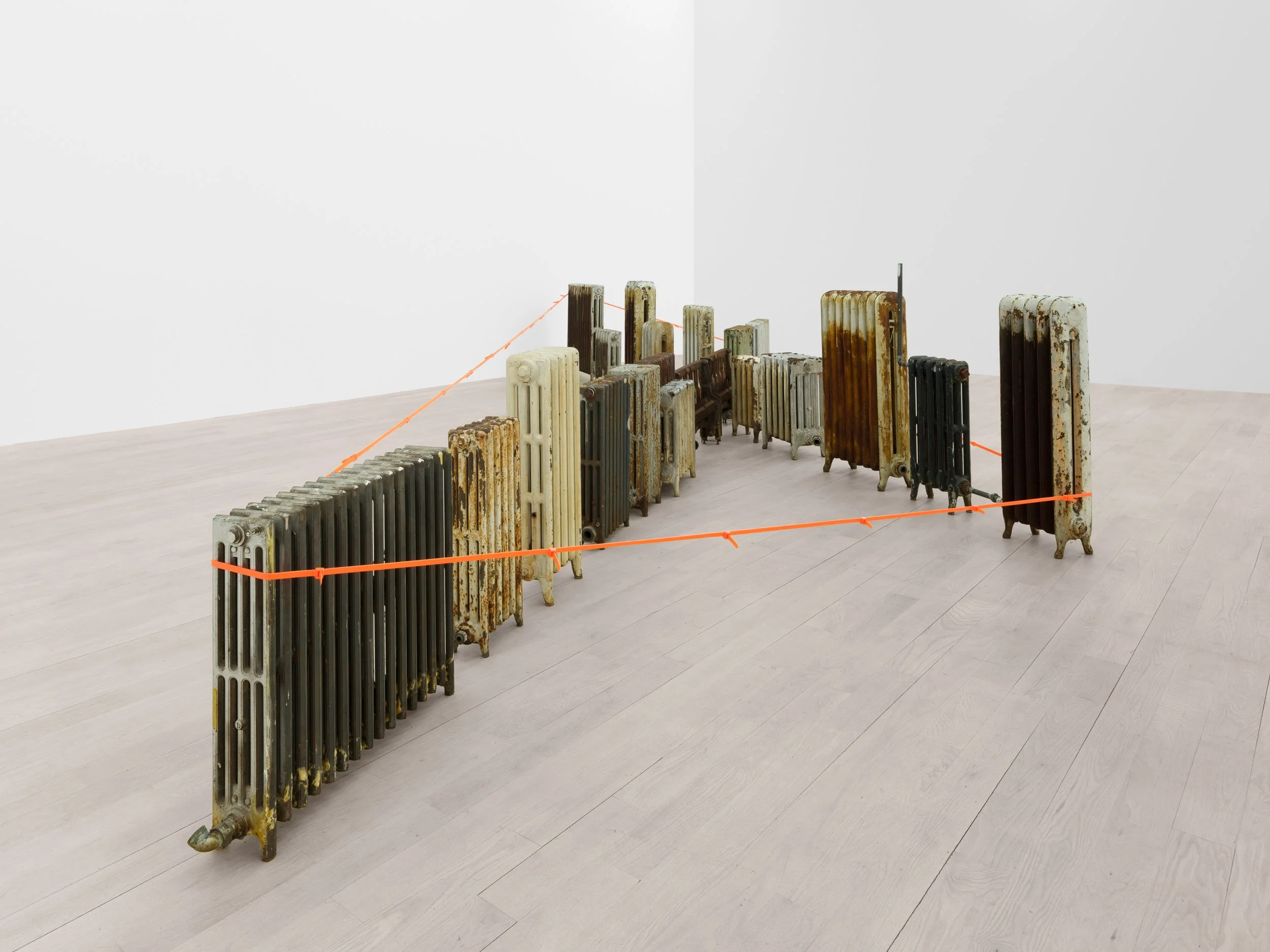
Bat-Ami Rivlin, Untitled (radiators, zip ties), Installation view, Management, New York, 2026. Credits: Inna Svyatsky.
GM: When I think of a coffee cup, I think of a convivial sphere — of all the hands that have held it, the laughter, grief, and secrets it may have silently witnessed. It is an object that comes to embody multiple temporalities and accumulated memories. In some ways, the radiators presented at Management in New York (March 11 – April 19, 2026) seem to operate similarly. Could you tell me more?
BR: That’s both true and a bit off. I started working with radiators because they’re one of the fewer objects that have a slow turnover in the city. On one hand, that allows for all those memories you’re describing; on the other hand, it also points to a certain generic standardization. Childhood memories of sitting next to the radiator’s emanating heat seem anecdotal to personal experience, but this object is also a product of the city’s real estate economics. It’s slow to “leave” a typical pre-WWI building because it’s connected to New York’s exuberantly expensive systems of habitation. It gradually trickles down to junkyards and dumps, lingering around decades after its production.
When I was planning for the show at Management, I started looking at what could be considered a “local object” in New York. My practice considers the locality of where an object is sourced as part of its content, situating the work between the object itself and its surrounding environment. Installation protocols prescribe local sourcing alongside formal rules, often using the object’s function (whether operational or not) as cues for installation. If we take the show at Management as an example, the protocol states that a collector would have to procure at least 3 radiators from their local area, place them in an X shape, and tighten zip ties around them (there are additional, more granular, rules in the protocol regarding how the radiators are spaced apart, the placement of the zip ties, etc.). The result is a pedagogical prompt of sorts– a collection of things that echo their environment while formally repeating their projected use.
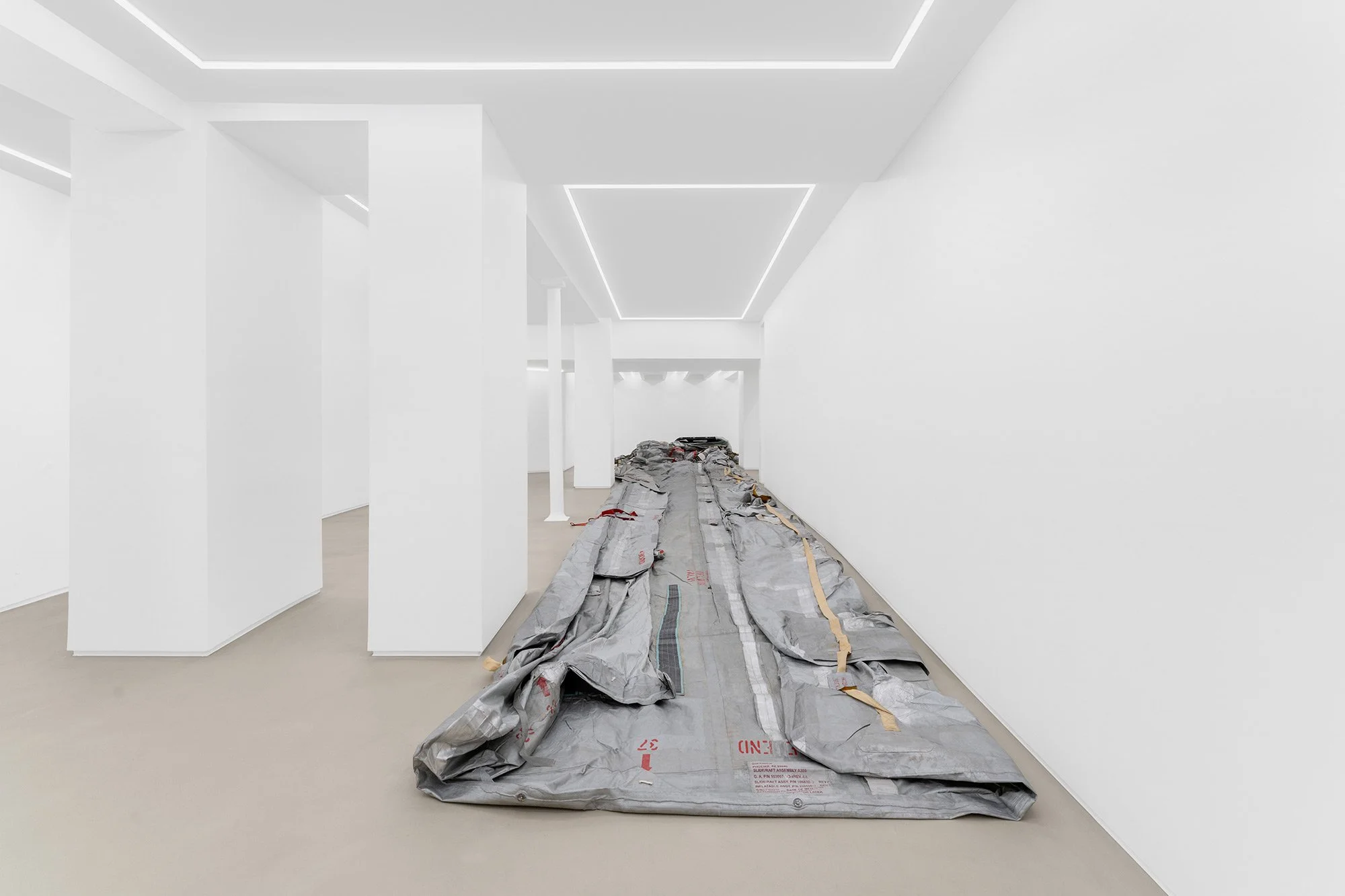
Bat-Ami Rivlin, Untitled (inflatable slider), Installation view, Lo Brutto Stahl, Paris, 2024. Credits: Courtesy of Lo Brutto Stahl, Paris
GM: Personally, radiators evoke a distinctly domestic dimension for me. Compared to our last conversation, it’s an aspect I hadn’t considered at all — perhaps due to the visual qualities of the works we previously discussed. In the accompanying text, Saskia Hubert uses phrases such as “memory of habitation” and “how bodies gather around the room.” Beyond that sense of the invasiveness and pervasiveness objects exert over individual life, I also perceived something far more intimate at play. In another interview, you stated that “in so much that sentimentality itself is just another industrial function baked into the product.” Does this leave any space for individuality in the most literal sense of the term?
BR: There’s always individuality because we make sense of the world through narrative. But we also have to consider that what we might perceive as intimate building blocks of individuality– domestic childhood memories, for example, as you described– is often structured through standardized objects and spaces. My work relies on that. To an extent, the fact that a practice like mine can even exist is in it of itself a criticism of how we produce and populate our built environment with objects.
This is also what structures the relationship between the work and its protocol. Previous projects I installed in Mexico, Spain, Denmark, etc. all relied on objects that already populated the areas where the exhibition spaces were. Purchasing a protocol from one of these projects means an institution or collector has to locally source the object prescribed. But there’s often (though not always) no shortage of used tires (like in the exhibition at Museo de la Ciudad de Querétaro), or dumped lawnmowers (like in the exhibition at Kunsthal NORD), or discarded bathtubs (like in the exhibition at Tenerife Espacio de las Artes). There’s a certain collapse in locality that happens when we look at the object as a phenomenon, particularly if the object is part of structuring our sense of individual experience.
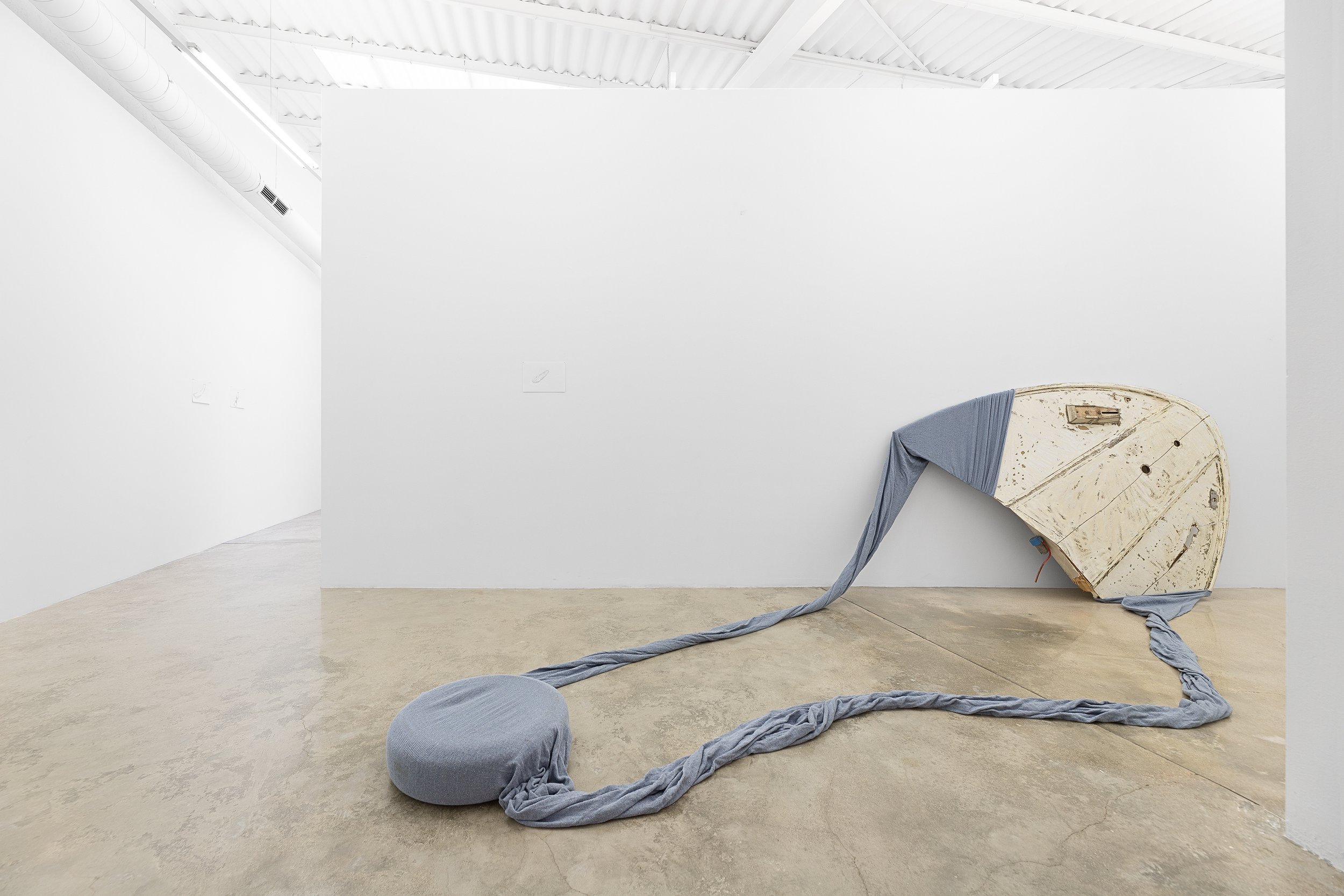
Bat-Ami Rivlin, Untitled (boat, 3kg rag, tire), Installation view, L21 PALMA, Palma de Mallorca, 2023. Credits: Juan David Cortés.
GM: The tension I perceive surrounding your practice seems to stem not only from a resistance to interpretive immediacy, but also from the literal difficulty of collecting works of this nature and, more broadly, from a refusal of compromise. The scale and material quality of the works feel inherently museum-oriented. To some extent, this appears to slow down the inevitable incorporation of the work into a commercial system — a short circuit that, in my view, art can never fully overcome. And yet, as long as those enormous tarpaulins, tangled cables, expanses of tires, or radiators remain too “difficult” or insufficiently visually appealing, the work seems able to reaffirm its position with the liberating force of something that does not entirely require compromise. This tension becomes even more pronounced through your use of protocols and instruction-based works — specific directives sold as the work itself and necessary for the sourcing and installation of the materials. One example is Untitled (inflatable slider), presented in the context of your solo exhibition at Lo Brutto Stahl and its satellite space at Basel Airport (December 7, 2024 – January 18, 2025).
BR: There’s an exchange of authorship and ownership that the protocols are forcing between the artist and collector that I think is interesting. I have to give away control of certain formal qualities that aren’t common or functional, and the collector or institution has to participate in the authorship of the work by following the protocol’s prompts. At the same time, the nature of the work undermines having complete ownership, because the sourcing process structures a level of randomness that negates complete authorship altogether. The particular object isn’t itself important; its category, what it indicates about its environment, is.
Untitled (inflatable slider), my solo show at Lo Brutto Stahl, is a good example. The gallery sourced two decommissioned A380 inflatable sliders from a local airport (the kind used for emergency landings as sliders or rafts). We installed Untitled (inflatable slider) at two locations– one at the gallery’s main space in Paris and another at their satellite in Basel.
The protocol for Untitled (inflatable slider) includes sourcing limitations, dictated minimal space from walls, folding dimensions, etc. The gallery in Paris was big enough for the slider to roll out entirely (the A380 is a two-storied airplane, so the sliders are about 46 ft long). The space in Basel was smaller, and included a folded version of the piece.
The result was two very different-looking installations that followed the same protocol. These were considered the same exact work; there are no originals or copies.
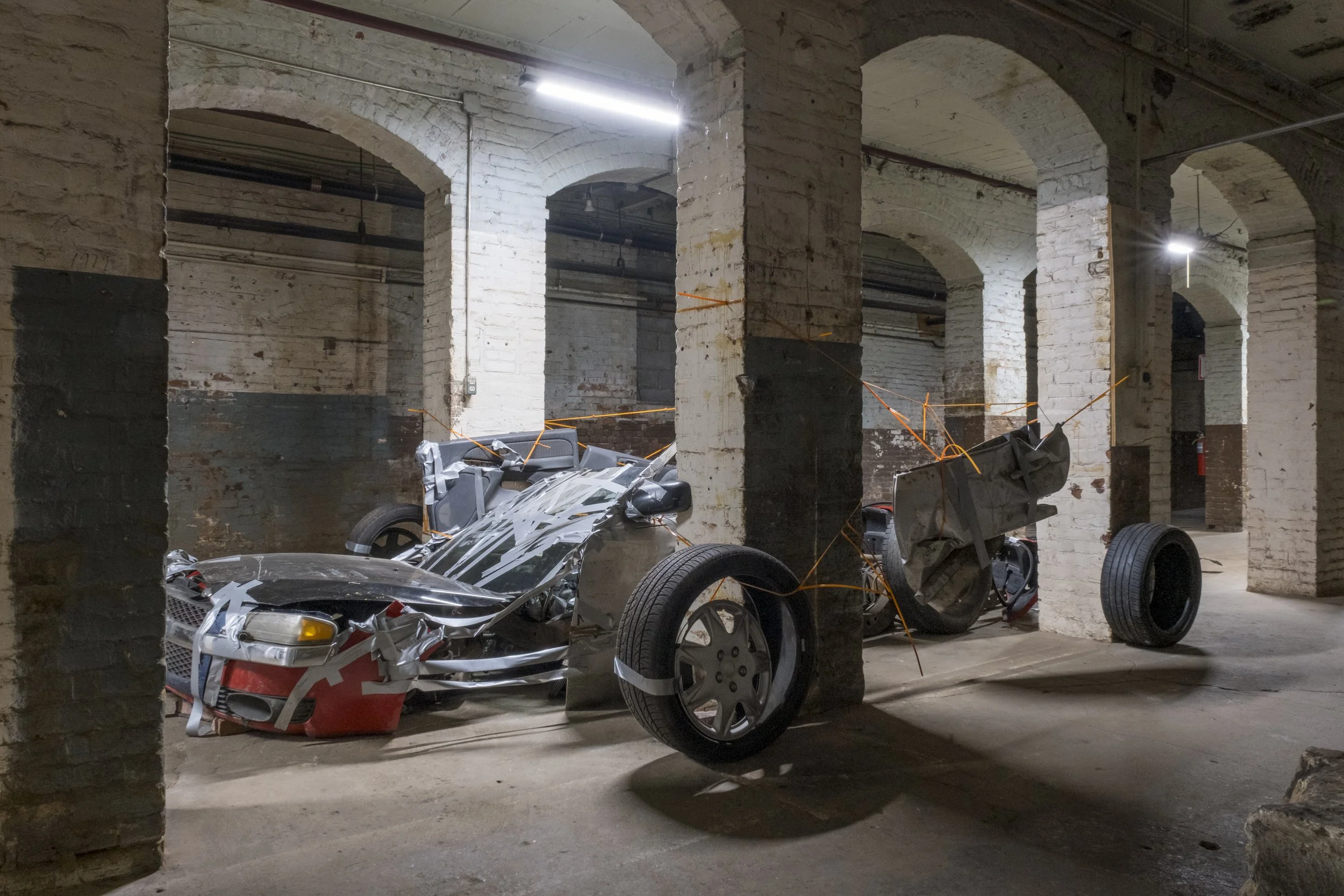
Bat-Ami Rivlin,Untitled (car, eyeballed), Installation view, lower_cavity, Holyoke, 2024. Credits: Courtesy of lower_cavity, Holyoke
GM: Your use of protocols brought to mind Do It, the project conceived by Hans Ulrich Obrist in 1993 following conversations with Christian Boltanski and Bertrand Lavier, to expand the very boundaries of the exhibition form. The participating artists were invited to provide sets of instructions that could serve as frameworks for the reactivation of their works, while still allowing for forms of interpretation and variation, thus producing an exhibition in a constant state of transformation. Unlike the expansive and inclusive ambitions of that project, your approach seems to operate more as an aut-aut: the variations permitted in the reproduction of the work emerge less from the interpretive freedom of the exhibitor than from the material, social, or cultural specificities of the contexts in which the work is staged. One thinks, for instance, of Untitled (400 bedpans), which, following an exhibition request in Copenhagen, had to be reconstructed using bedpans of a different shape and colour.
BR: Right. That’s another aspect of giving up a portion of authorship. The work itself is responding to what’s available to source. And while many objects (such as used tires) are almost everywhere at all times, other objects are less common. That availability is indicative of which objects are populating a certain area. When sourcing kidney basins (erroneously tagged “bedpans” by the surplus source, a name I kept since it seemed to relate to a projected function), what mattered was the object’s relation to its environment. It didn’t make sense to bubble wrap surplus basins from the US and send them to Denmark. If anything, it felt like it would be making them into a special object in this way. I asked the gallerist to source the same object from the Copenhagen area, which resulted in a variation in color and shape; the basins in the US were pink and slimmer, the Danish ones were off-white and wider. The variation actually kept the work closer, truer to itself.
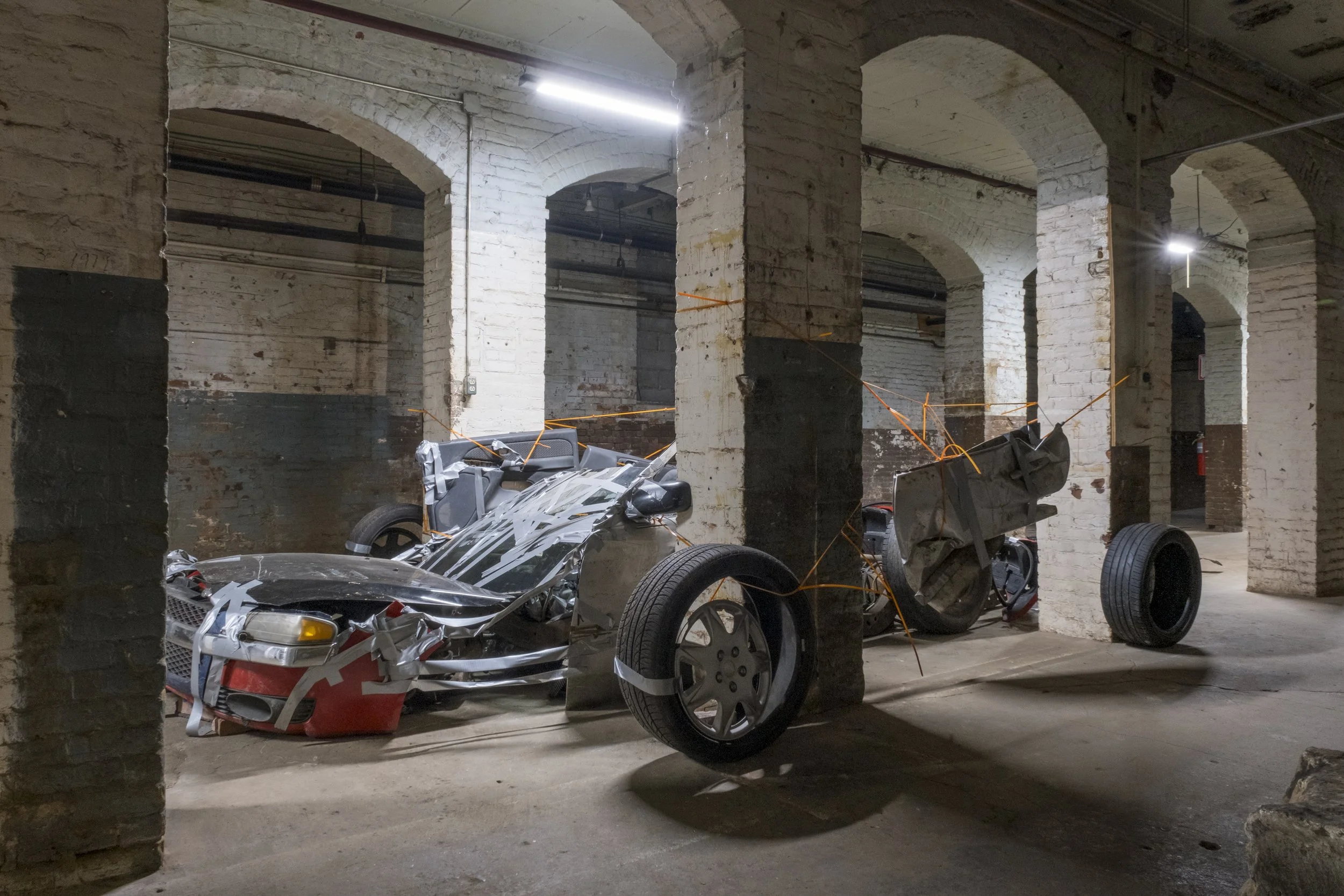
Untitled (car, eyeballed), Installation view, lower_cavity, Holyoke, 2024. Credits: Courtesy of lower_cavity, Holyoke
GM: If, on the one hand, your works seem to push to a paroxysmal degree the sense of failure and decay embedded within the contemporary drive toward absolute systems of categorisation, on the other they also suggest a perhaps more affirmative relation to the specific realities that host them. The materials, after all, must be sourced locally and according to highly precise instructions. It seems to me that such an approach foregrounds a recognition of the “specific case” against the backdrop of a global condition in which hyper-connectivity increasingly results in a kind of flattening or erosion of identity. In this regard, works such as Untitled (boat, 3kg rag, tire) and Untitled (plastic, duct tape), presented in the solo exhibition at L21 PALMA (17 November 2023 – 5 January 2024), as well as Untitled (car, eyeballed), shown at lower_cavity in Holyoke (21 September – 9 November 2024), seem particularly telling.
BR: What’s interesting about these works in Palma (L21) and Holyoke (lower_cavity) is that these are so-called specialized spaces. Their economies are more concentrated on one field. Palma is an island that suffers from over-tourism, which births certain jobs, structures the economy, and populates the area with particular types of waste. Naming materials in the works you’ve listed above– a hood off of an abandoned yacht, maintenance surplus rag sold by weight, a used tire, used sheets of heat-resistant plastic for boat spraying, and duct tape– these all serve as functional indications. That is not to say that an individual experience isn’t possible; the argument made by using these materials is that objects structure and affect our reality more than we often assume. They prompt the body and curate it in space, projecting what is or isn’t “naturally” occurring within a certain area. In relation to “hyper-connective global condition”, Mallorca would fall under a “type” of place in which one is “supposed” to experience being a tourist.
Holyoke is another excellent example. Holyoke used to produce %70 of the paper in the US, but as the industry died down, the city filled up with auto-savage yards. This transition from production to “scavenging-like” economy included a “reshuffling” of objects, but because the transition was relatively blunt, you’re able to see one material reality living in another. The residency that hosted my show, lower_cavity, is situated in an old paper mill, though the industry the mill stemmed from has almost entirely vanished. My show there, Untitled (car, eyeballed), was essentially a prompt to duct-tape a car together from parts I found in local auto-salvage spots. Like other projects, the installation inherited formal qualities from the projected function that the object was supposed to have. But because I don’t have any specialized education in cars, I ended up with a messy approximation of what looked like an eyeballed attempt at a car. This is probably where my own individual capacity is expressed the most. It’s not that my work negates individuality altogether; it reads individuality, including mine, as another product of many interlocking occurrences.