Hot Coffee interview with curator Sara Reisman
Published Wednesday, May 13, 2026
Sara Reisman is a New York–based curator and writer working at the intersection of contemporary art, public practice, and social engagement. She has held leadership roles at institutions including the Shelley & Donald Rubin Foundation and the National Academy of Design, and previously directed New York City’s Percent for Art program, overseeing major public art commissions across the five boroughs. Her curatorial practice focuses on politically engaged and socially responsive art, often exploring themes of labor, civic space, collective memory, and institutional critique. She has worked closely with artists such as Mierle Laderman Ukeles, Edgar Heap of Birds, Mary Mattingly, and Dor Guez, among others, and has developed exhibitions and programs that foreground art’s role in public life and social structures.
Reisman also teaches art history in the MA Curatorial Practice program at the School of Visual Arts. Currently on view at 601Artspace in New York is an exhibition Sara curated, When Thoughts Are Free that examines the limits of free speech and freedom of thought under contemporary political and technological pressures. The show brings together interdisciplinary artists working with installation, video, and participatory formats to explore how language, dissent, and collective knowledge are shaped—and constrained—by systems of power. It was a pleasure to catch up with Sara, who has been one of my curatorial role models over time, as her complex and deep engagement with artists, their works, and contexts is very close to my heart. Learning more about the start of her curatorial path and method in relation to the current exhibition at 601Artspace, on view through May 17. felt very enriching.
Nina Chkareuli: Imagine you are in your favorite coffee or tea spot. Where is it? What are you drinking? What are the three things you see right now?
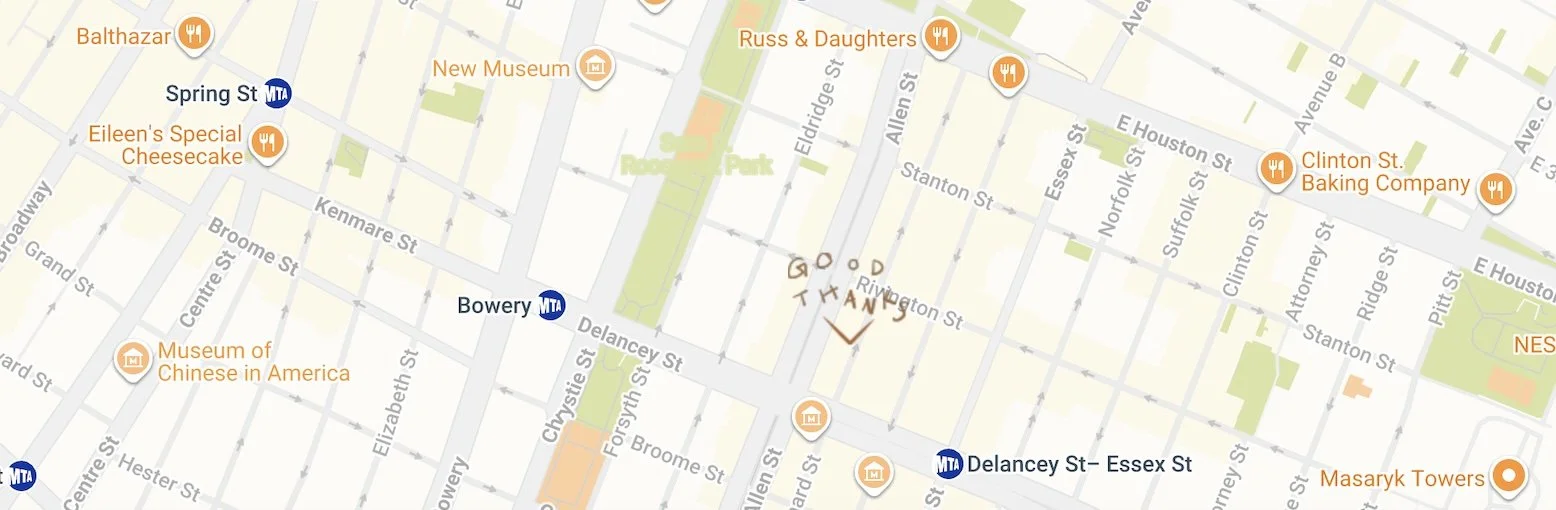
Sara Reisman:Oh, that's a funny question, because I kind of, as a rule, don't go out for coffee unless it’s for a meeting. Well, it's an efficiency thing. Some people get coffee every morning, maybe multiple times a day. It takes so much time to wait in line for your coffee, plus it produces waste, so I prefer to have it at home. In any case, my favorite place is called Good Thanks, on Orchard Street, New York. It was a little cafe that was really small, and then they expanded, I think they've expanded twice in the last, like, five years. They have a black sesame latte. I’m obsessed with sesame everything, and tahini of all kinds. So that, to me, looks the best. It's one of those spaces that has been retrofitted in such a way that you see the exposed vertical beams, so the design aesthetic reveals the architecture’s infrastructure. And their food is amazing.
I was there once, having an afternoon drink and looking around, and most of the people there weren't drinking alcohol. It was one of those moments of realizing, oh, right, the next generation isn't really drinking. Maybe they’re doing designer drugs or something, or they're totally sober. So, it's the kind of place where you might see people enjoying the luxury of a fancy coffee drink. It’s a clean, bright space, and the food is that kind of Australian healthy food— avocado open-face sandwich or kimchi eggs, good flavor combinations. Acai bowls—I love that.
NC: Please tell us more about your current show at 601 Artspace, When Thoughts Are Free. How did it come about? Why these specific artists?
SR: It started with conversations with Aliza Shvarts, who’s in the show, about this idea of: how could an exhibition coalesce around the idea of speech acts, and how does speech get used in the media? This was in early fall 2024, and I started putting together a proposal. Her work in When Thoughts Are Free uses language around the idea of the speech act. And the speech act in question for her is “I do” — and we’ll come back to that — but thinking about speech acts in terms of politics, and when speech is considered a hate crime, or the ways speech gets interpreted from a legal standpoint, is something she’s interested in. And of course, it interested me too.
As we were talking, I thought it would be really great to connect a throughline between Aliza, Liz Magic Laser, and Kameelah Janan Rasheed, thinking about their work with language and gesture. With Liz, it is more about gesture, although language is encoded. With Kameelah, it is about gesture and language, and the composition of text that appears more directly in her work. I mentioned it to 601 Artspace’s director, Sara Shaoul. So, I sent a proposal at the end of October 2024. The tenor of the proposal was this question of what constitutes free speech in this moment, and how is that changing?
Of course, we knew that the current president was running for office again, but I don’t think it was clear to many of us – or to me anyway – that he would win. So, it was a strange moment when the proposal was submitted. I was wondering how, if free speech is being curtailed and rolled back, how do we respond? And what are the ways artists are going to respond to this in their work? Because their work is often censored. Curatorial work is often censored, right? Writers are often censored depending on the institutional framework, the publication, the venue, or the educational setting. So, there are all these layers where speech gets pulled back.
When I wrote the proposal, and then Trump won the election, we were all a little bit shocked — though not as shocked as the first time, I guess. I started to think about how technology plays a role in speech in this indirect way, which, in the end, started to become very clear to me. With autocomplete functions, if you have your AI options turned on — and usually they are on unless you intentionally shut them off, right, in Gmail or whatever email program you’re using — you realize that it’s filling in the blanks before you finish your thought. And that, to me, is an interesting question: what does that mean in an aggregate sense, in a cumulative sense, if the blanks are being filled in for us before we have finished writing what we are thinking? How does that change what we think? I was interested in this question: there is free speech, but how free are our thoughts in relation to these societal and technological restrictions on speech?
There’s a notion that we have the right to think freely, no matter what. And that is true. But some structures start to become enclosures. The show’s title is borrowed from a German protest song that Pete Seeger recorded a version of in 1966 called “Die Gedanken sind frei” — “Thoughts Are Free.” It’s a concept I had dealt with before in a group exhibition (Revolution from Without, in 2019) at the Rubin Foundation, but not as the central focus of the show. So, it was an interesting experiment to put the language forward to the artists and see how they responded to the lyrics and ideas of the song.
And then we added a fourth artist, Jaro Varga, who’s based in Prague, but of Slovak background. He had this protest piece called Our Silence Will Not Protect Us, 2024. It’s a play on Audre Lorde’s famous quote, “Your silence will not protect you.” Jaro’s piece is this collective process of making protest signs based on book titles and manifestos. In its original iteration in 2024, Jaro led a workshop at an art space outside of Bratislava that used to be a synagogue and the signs were installed there afterwards. We did similarly structured workshops with students from Parsons in preparation for the opening of the show. The idea is that these signs demonstrate or visualize the relationship between the written word — not just literature, but what we read — and how that gets enacted in the world. How a literary title, or even just the suggestion of a book, can lead to action or inspire resistance.
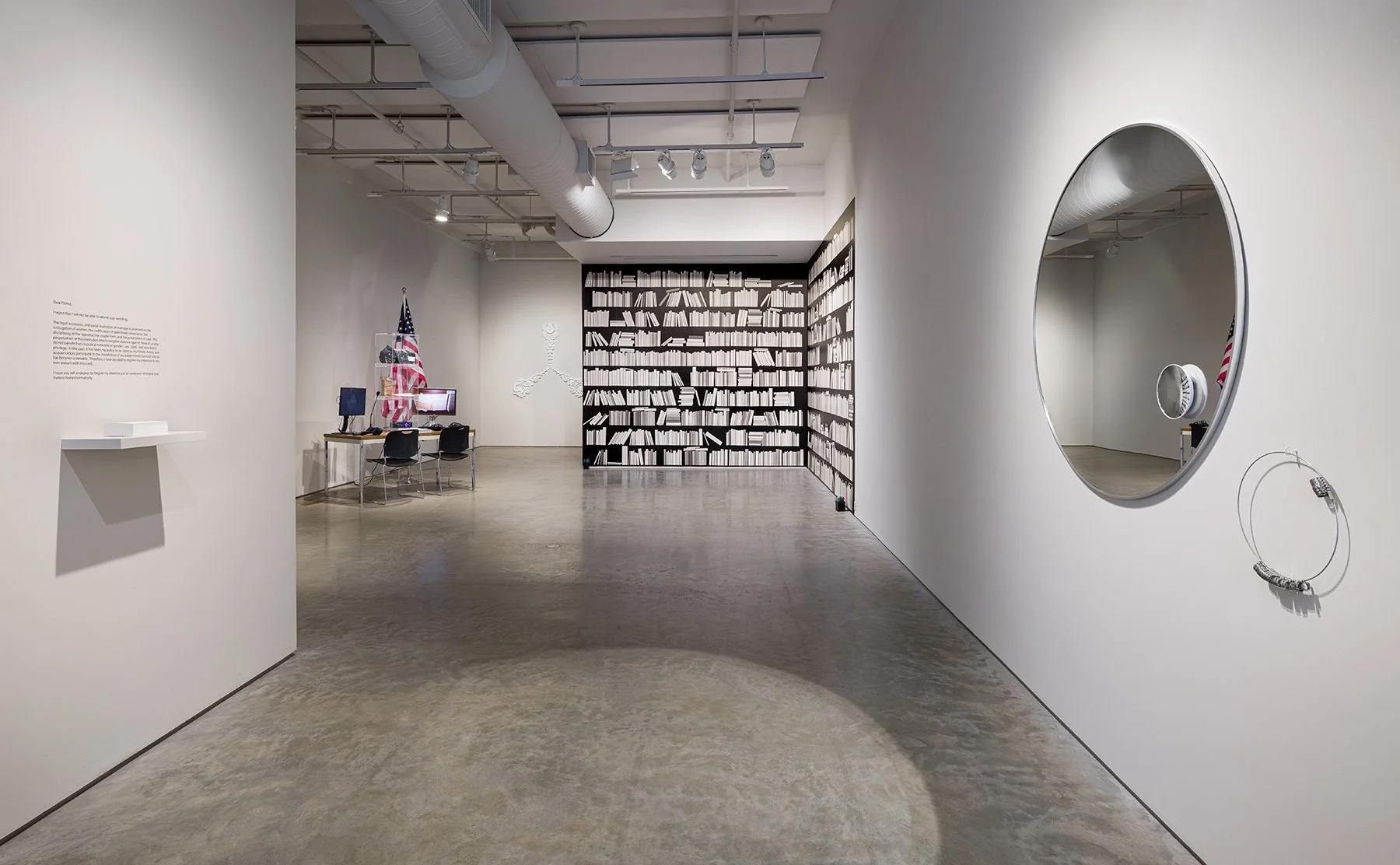
From left to right: Aliza Shvarts, Homage: Congratulations, 2017. Debossed text on cardstock and cut vinyl text, card: 4 x 6 inches; Liz Magic Laser and Nazareth Hassan, The Committee: Virtual Hearing Room Set (2026); Jaro Varga, Library (2011-ongoing),vinyl print, sharpie markers, dimensions variable; Aliza Shvarts,37 Illocutions: with this ring,2026; Engraved Wide-Shank Comfort Band Finger Gauge Set in stainless steel, 10" jailer's keyring, mirror, and magnifying mirror.Image courtesy of Sara Reisman and 601 Artspace.
NC: The exhibition frames thought as “free,” but so many of the works—especially Kameelah Janan Rasheed’s and Liz Magic Laser’s—suggest that language and perception are already conditioned, misheard, or structured by systems. Do you see the premise of “free thought” here as something real, or as something fundamentally compromised?
SR: I think with Liz, there were two kinds of questions in play when we started talking about the show last fall. I had approached her about The Digital Face, which is a performance of the gestures enacted by Barack Obama and George H. W. Bush in their State of the Union addresses. So, it is this idea of a more emotive, gestural way of speaking — the oratorial performance of a politician, right? That piece was done in 2012, and Power Moves builds on several layers of development of that project. I won’t go into all the details of those versions, but in this instance, there are these “power moves” that a wellness instructor, an aerobics instructor played by Cori Kresge — who’s collaborating with Liz — performs. Cori is doing these gestures and guiding the viewer-participant in a movement class that establishes different gestures that signal receptivity or dominance.
I think the more critical piece for Liz is something that I wanted to include in the show, and that’s The Committee, which is a project she released last fall. It is a piece of autofiction that functions as a committee hearing about her pedagogical practices — how she taught performance art at Columbia University in the visual art program. It is about a performed narrative of scrutiny, around her teaching methods. It includes fictional representations of Trump, Roy Cohn, and others, and some of the students are part of the hearing. So, this is really about academic freedom — the freedom to teach how you want.
As somebody who teaches, I think there should be some parameters around how teaching happens, for the well-being of the students and also for pedagogical standards. I don’t mean that a faculty member cannot say what they think, but in some cases, when politics come into the classroom too heavily, it can be hard for students if they are not engaged with those politics. Do they need to be? Is that the role of an educator? I am not sure.
But I think Liz’s project is brilliant because it becomes a kind of parody of a hearing. It is quite funny, but it points to these nerves in the system that get struck by experimental teaching methods, or by the suggestion that art is connected to activism, or that intellectual thought is connected to activism. So that piece builds that out as a discussion, and there is a whole evidence display that you can look through while listening to the recording. I mentioned Jaro’s work earlier. I think his approach to this question of free thought and free speech operates on two layers. In the show, there’s Our Silence Will Not Protect Us, which I described earlier. As I mentioned, that piece was originally staged in a former synagogue, now an art space, outside of Bratislava, in Slovakia.
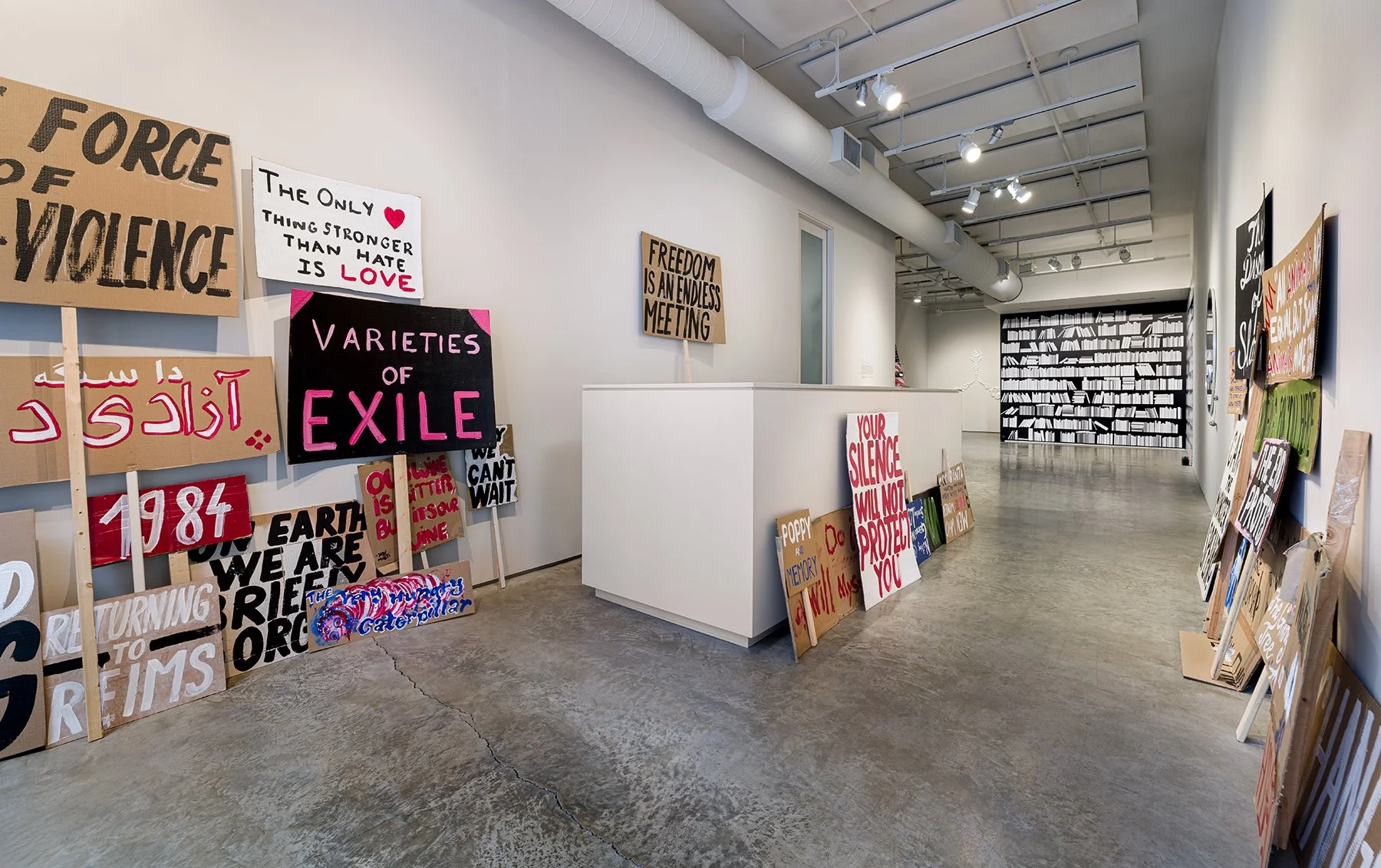
Jaro Varga,Our Silence Will Not Protect Us (2024/2026). Cardboard, paint, wood, dimensions variable. Image courtesy of Sara Reisman and 601 Artspace.
NC: Several works rely on audience participation—writing book titles, trying on vows, and engaging with surveys. Where do you locate responsibility in these works: with the artist, the participant, or the structure that frames their choices?
SR: Of course, the gallery is not a public space. It’s privately owned, so the question of responsibility takes on a different dimension here. I believe artists look at responsibility from slightly different angles. With Kameelah Janan Rasheed, her videos, which are modeled after karaoke videos, are captioned with a loose interpretation of the original lyrics, as if a lot of the lyrics are slightly off. There is a comedic aspect to how a song by Luther Vandross and a song by Sade get transcribed and kind of mixed up. And it’s basically a demonstration of how the AI is beginning to impact the way we understand language. Usually, when I am watching videos online – movies, for example – I prefer to use captions so I can read along, because I absorb information better through reading than listening. So that’s what I do. But you see things that have been miscaptioned or misaligned by the captioning technology, for better or worse, and it becomes a demonstration of this autocomplete function and the way that it can misrepresent information.
Kameelah’s works are actually pretty playful, and with Aliza Shvarts, what I love most is the way her two works operate together. The first one is called Homage Congratulations, 2017. It’s an homage to Adrian Piper’s calling cards from the late 1980s. So, it’s an RSVP card that Aliza designed with debossed, raised text that is very hard to read, but you can touch it. It is a negative RSVP to a wedding that calls out how the “perpetuation of the institution” of marriage “enacts tangible violence against those” who do not benefit from it. The work is intellectual and playful. After she got married last fall, I asked if she would like to do something about getting married as a new work. I thought it could be a really interesting way of capturing this arc of believing one thing and then changing your mind, shifting toward another perspective.
It goes back to a talk by Arundhati Roy that I attended in the fall for her book launch at the Brooklyn Academy of Music. During the Q&A, she was asked, “What does liberation look like to you?” And her response was immediate. She said: “The right to change my mind.” And I thought, that’s it. If thoughts are free, then you can change your mind, and you’re not instantly penalized or punished for doing so. You can change your mind — but then can you express that change in the current political climate? That, for me, feels very critical. In order for progress to be possible, if we can get to a better place of mutual understanding, people need to be able to change their minds. They shouldn’t be canceled for having an opinion that is somehow at odds with what they once thought. So, it becomes this question of: how do we acquire new knowledge and integrate that into the work and ideas we are pursuing, whether it be art or anything else?
NC: Very timely questions for our uneasy times. What is the single cultural or artistic event that started you on the curatorial path?
SR: In the late ’90s, I worked at Artists Space, and at that time, they had a program series called the Artists Select series. Artists would invite other artists as a very simple gesture. Seeing that, I realized — and at that moment in the late ’90s, there weren’t very many curatorial training programs — that while I had started as an artist, it became clear to me there was a real need for curators to facilitate artistic presentation.
I don’t know if there was a specific cultural event that changed my thinking or inspired me, but I was thinking a lot about public space in the ’90s and how that was changing in New York. So, some of my first curatorial projects involved activating public space. I organized a film and video series on the waterfront, site-specific to different waterfront locations around New York, between 1999 and 2003. Those screenings were a way of highlighting New York’s maritime history through experimental film and video. For me, that was really inspiring. I initially thought of it as an artist project, but then realized, no, it needs to be broader than that. So that’s one of the ways I shifted toward curating.
Also, reading the biography of Joseph Cornell made me take a step back from the kind of artwork I was making, because I was working a lot with collage using found film footage, found photography, and slides. I was reading Joseph Cornell’s biography (Utopia Parkway) by Deborah Solomon, and there’s a point in the book where Cornell describes himself as a curator of culture in relation to the screenings he organized at the Julien Levy Gallery. And I thought: I think that’s actually a more accurate way to describe what I want to be doing. Even in the artwork I was making, I was using other people’s artistic output, like photographic materials or film scraps. So I thought, maybe I should be a curator, and that would be a more honest way of interacting with these mediums. So that was the motivation, you know, 26 or 27 years ago, to curate. I don’t know if that fully answers your question.
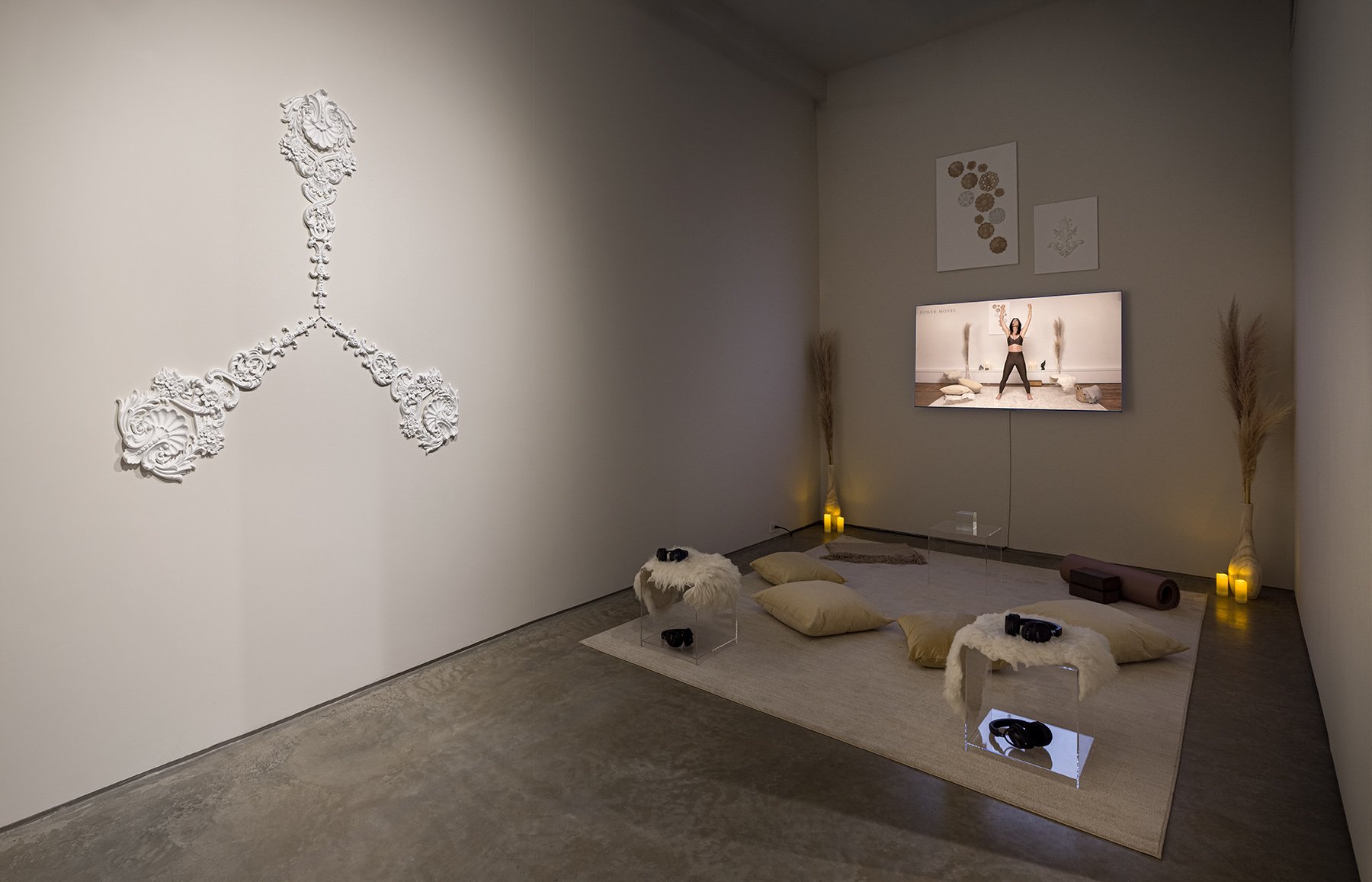
Liz Magic Laser in collaboration with Zoe Chait, Power Moves: Altar Studio (2026). Installation: carpet, pillows, Plexiglas, faux sheepskins, velvet pillows, blankets, wood vases, pampas grass, wood and polyurethane appliqué mouldings on canvas.Image courtesy of Sara Reisman and 601 Artspace.
NC: This is such an honest and yet non-linear way of starting on this curatorial path. And a very inspiring one, as you always stayed true to this public dimension of the work. What would you say was the most important turning point in your exhibition, writing, or work with an organization that influenced the trajectory you are pursuing today?
SR: There are two shows I did a few years apart. One was called The Book as Object and Performance at Gigantic Art Space, which has since closed. Then, a few years later, I did a show at the Center for Book Arts called The Only Book. I think The Only Book, in particular, is interesting because it looks at the impact of technology on how we interface with reading. “The Only Book” was actually a campaign by Apple around that time. The idea was that your laptop would be the only book you would ever need. There was an ad in the Apple Store. And I think it has actually done what I feared, which is that it has flattened out our capacity to absorb information in a hierarchical way, which I think one needs to do.
So those two shows were connected even though the settings were quite different, a commercial gallery (albeit experimental) and a nonprofit dedicated to book arts. I always liked the idea that books travel in a way that enables broader potential for circulation than some of the more rarefied art objects we associate with the higher ideas of culture. The idea of a book as something we can give to one another, or something portable, was always very exciting to me. Though I’m talking specifically about artists’ books as opposed to publications generally. But publications, too.
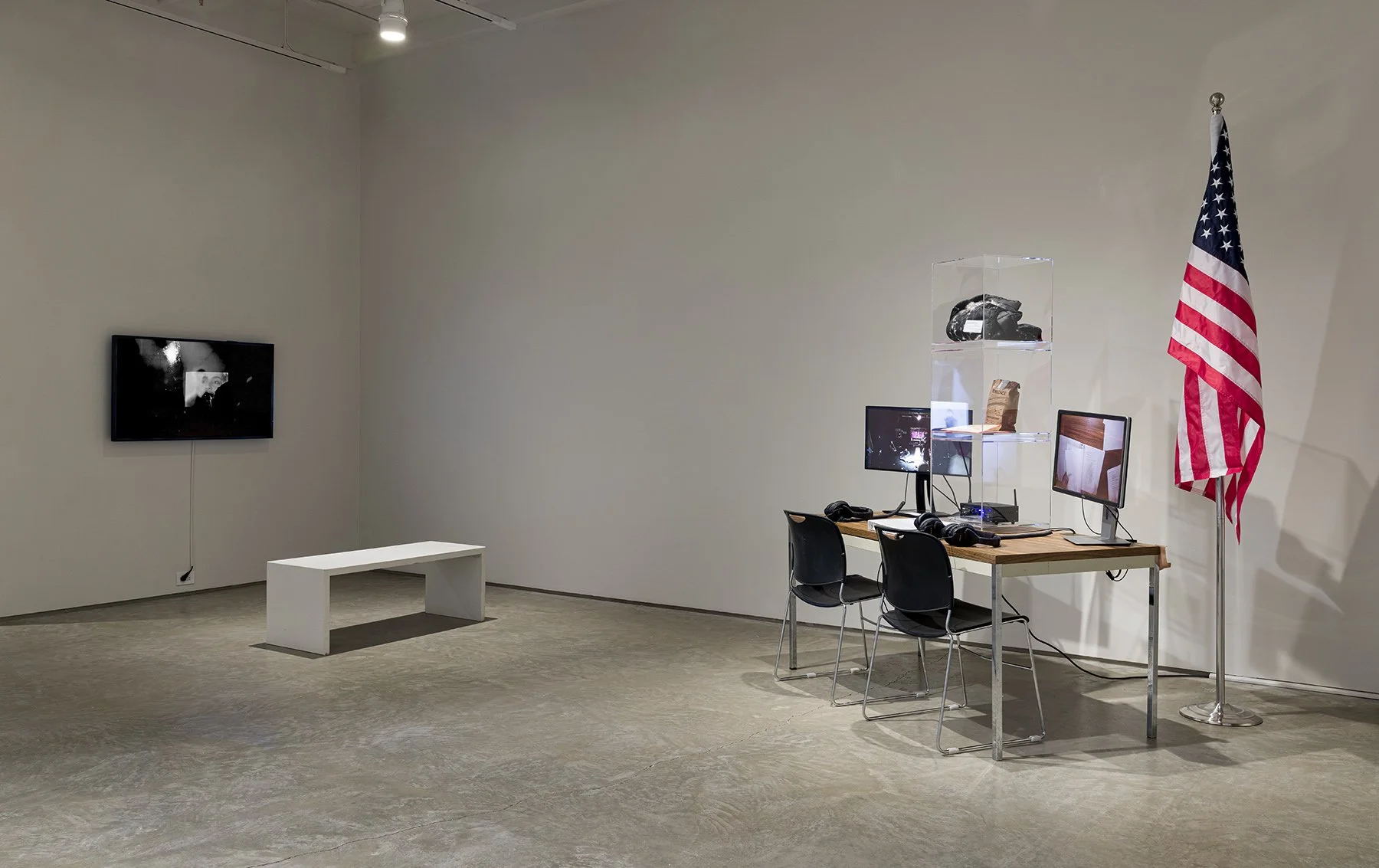
Liz Magic Laser and Nazareth Hassan,The Committee: Virtual Hearing Room Set (2026) [EVIDENCE EXHIBITS A-O]. Includes artworks, performance documentation, and ephemera created in collaboration with Giorgia Alliata di Montereale, Mason Harper, Hana Kim, Yshao Lin, Nico Vale, Maya Love Shkolnik, Nat, and art lawyer Barbara Hoffman.Image courtesy of 601 Artspace and Sara Reisman.
NC: What is the curator's role today, and what questions are you consistently returning to?
SR: The curator's role today is not singular; an independent curator can have a radically different role to play than that of an institutional curator. And independent curators work in so many different ways, some adjacent to institutions, some working completely outside that framework. But in either role, and in between these two positions, the curator's function is to have a point of view about art, its role in society, and, if working with living artists, how to support artists in bringing art to the public. All of this is, of course, contextually specific, but I consider my own role as one of culling from the breadth of cultural information I absorb on a daily basis. The question is, how do I make sense of this and translate that into meaningful exhibitions, projects, and educational situations? Over the course of my own career as a curator, I have increasingly felt that activating exhibitions is equally as important as curating, through talks, events, performances, and readings. Without these moments of activation, the site of the exhibition tends to become static, which is the opposite of what contemporary culture should be: ever-changing and evolving.
NC: What recent piece of news have you been following lately?
SR: Like many of us, I have been following the war in the Middle East. What strikes me is how these countries in the Middle East represent so much cultural heritage and how the intent to demolish a culture is devastating and inhumane. Just coming back from the opening of the Venice Biennale, I’m thinking about how, with the jury stepping down, the biennale has prompted discourse around dismantling national representation as a way of categorizing art and culture.
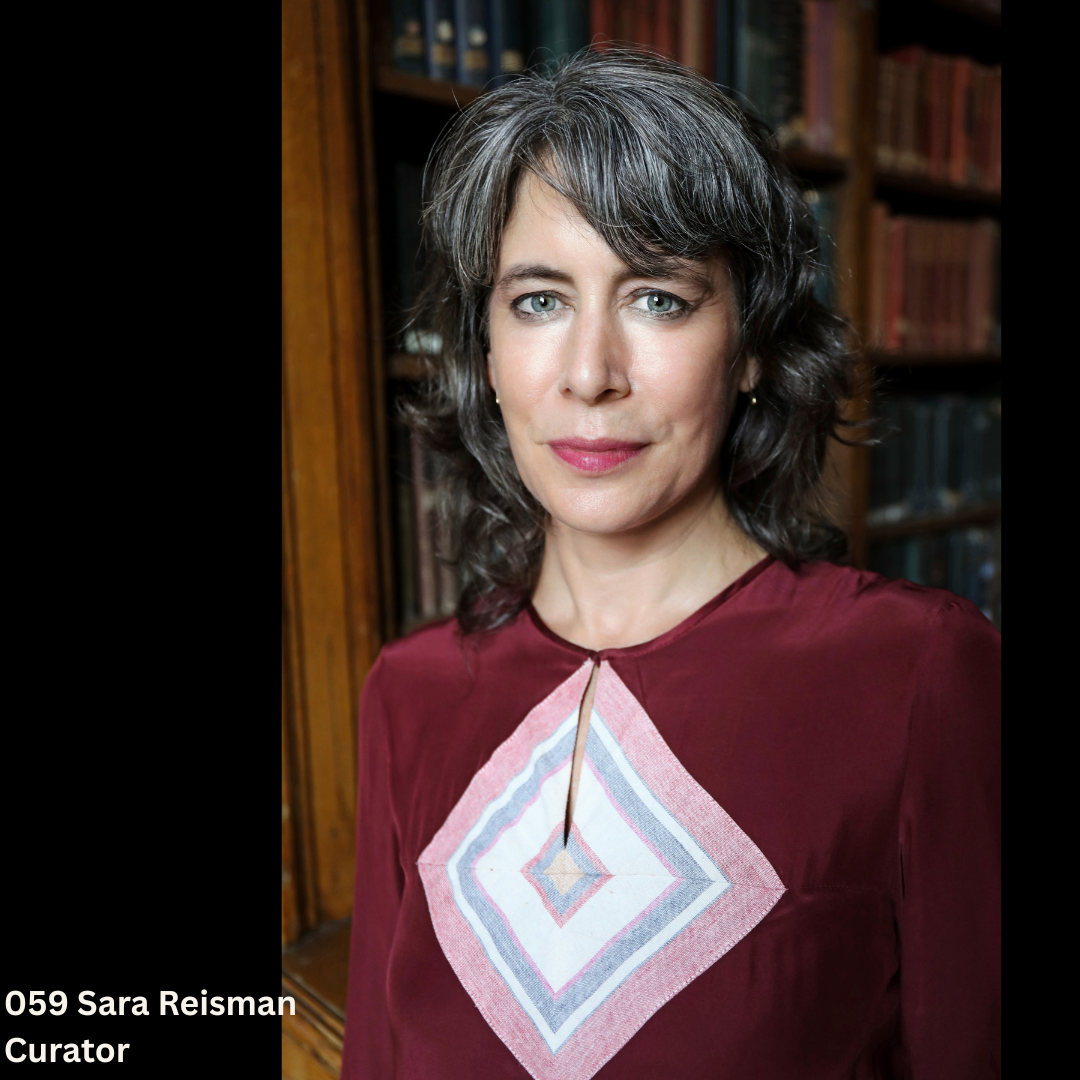
Portrait of Sara Reisman by Elia Alba.
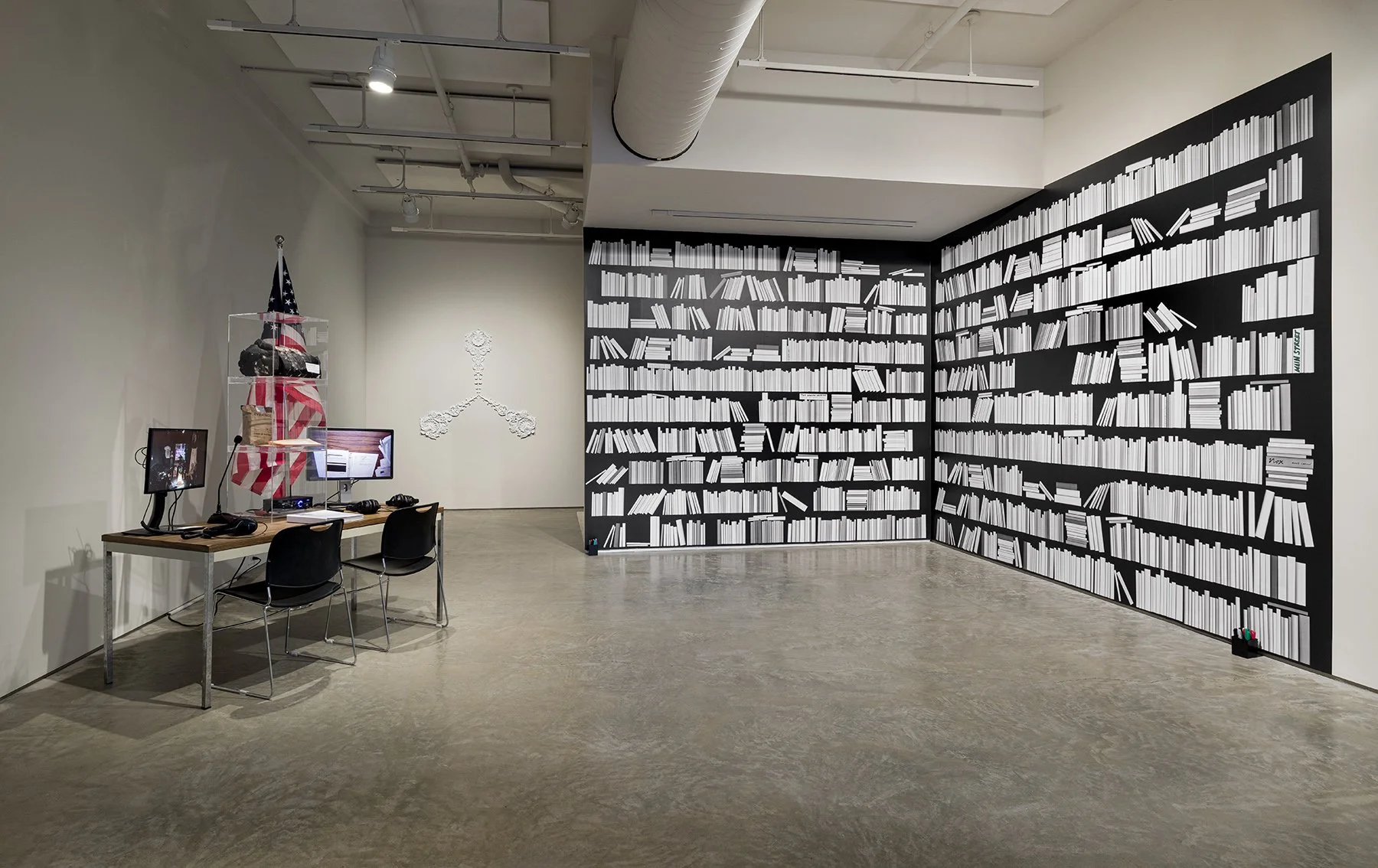
Left: Liz Magic Laser and Nazareth Hassan, The Committee: Virtual Hearing Room Set (2026) [EVIDENCE EXHIBITS A-O]Includes artworks, performance documentation, and ephemera created in collaboration with Giorgia Alliata di Montereale, Mason Harper, Hana Kim, Yshao Lin, Nico Vale, Maya Love Shkolnik, Nat, and art lawyer Barbara Hoffman.
Installation: desk, computer monitors, evidence exhibits A–N; listening-station scenario and Act 3 data collection survey. Dimensions variable.
Right: Jaro Varga, Library (2011-ongoing), Vinyl print, Sharpie markers.Dimensions variable