“Clair-obscur” at Bourse de Commerce, Paris
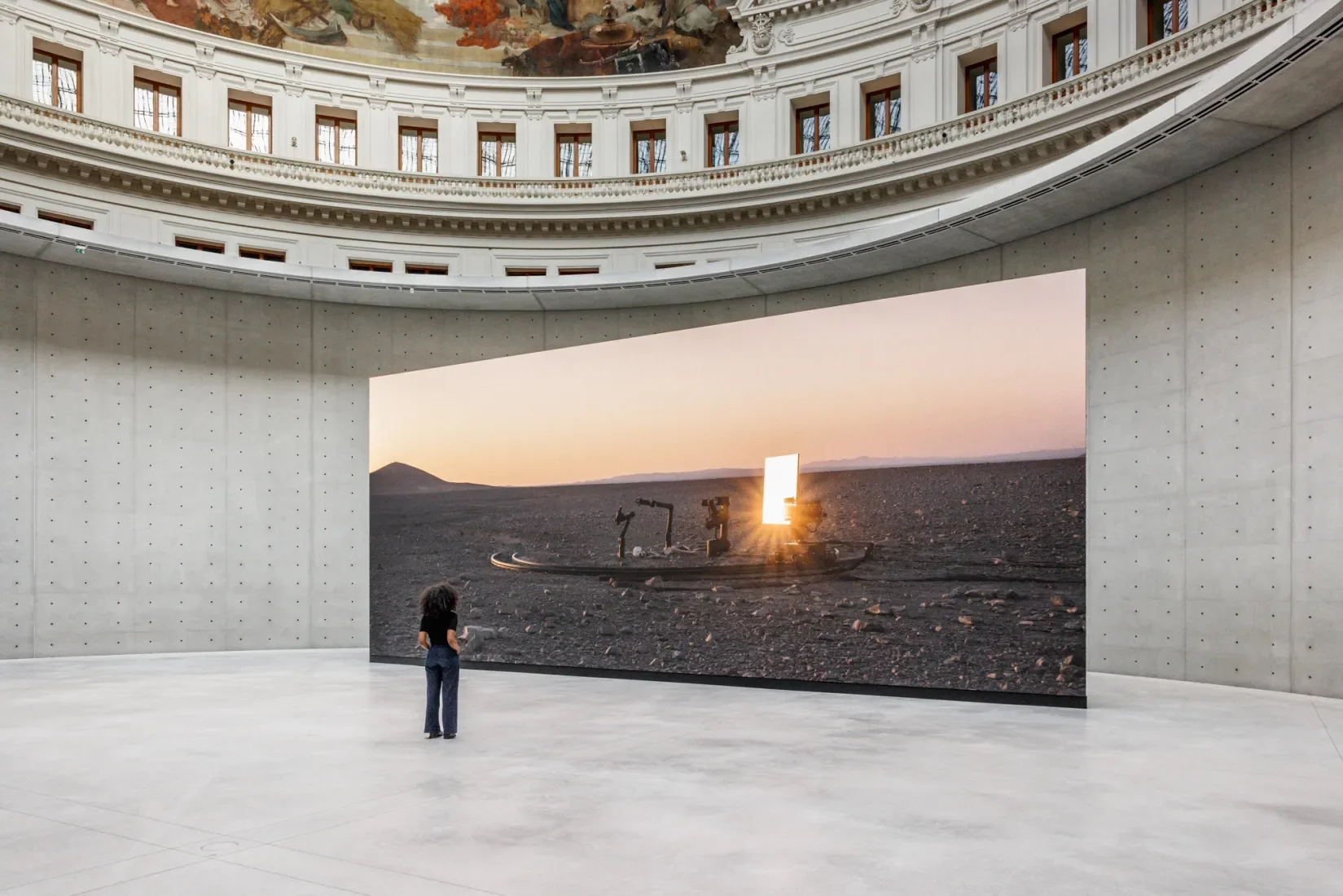
Installation view, “Clair-obscur” at Bourse de Commerce, Paris, Pinault Collection. ©
Author: Michela Ceruti
Published Friday, April 24, 2026
A history of chiaroscuro begins with the drama of a revelation: light as an incision, rather than an illumination. In Caravaggio’s The Calling of Saint Matthew (1599–1600), a beam of light cuts diagonally across the canvas, isolating the moment of conversation with almost forensic precision. Shadow does not recede but presses inward, thickening the space around the figure, forcing its way into visibility as though it is under interrogation. As Michael Fried notes in The Moments of Caravaggio, Caravaggio’s light operates less as a naturalistic device but more as a structuring force, producing a heightened sense of presence while simultaneously accentuating its instability. What is revealed is never fully secured; it flickers on the threshold of disappearance. This legacy, extended through centuries of painting and into photography and cinema, lingers as both technique and as a metaphor: a way of structuring perception itself.
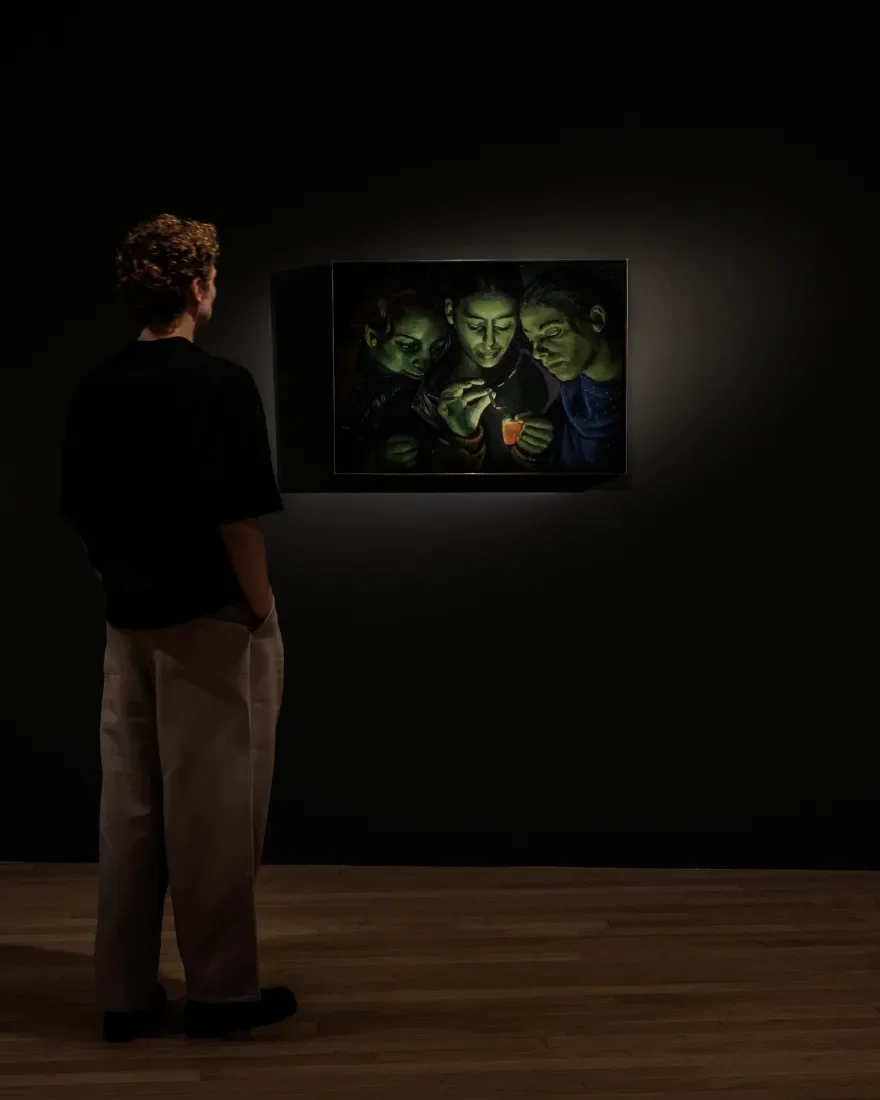
Installation view, “Clair-obscur” at Bourse de Commerce, Paris, Pinault Collection. ©
“Clair-obscure” at Bourse de Commerce, Paris, frames this lineage less as a stylistic homage than as a device. The major exhibition gathers over a hundred works from the Pinault Collection, bringing into dialogue artists across multiple generations–from postwar figures such as Sigmar Polke, James Lee Byars, and Rudolf Stingel to key contemporary voices including Pierre Huyghe, Philippe Parent, Cindy Sherman, Trisha Donnelly, Victor Man, and Urs Fischer –loosely orbiting the tension between visibility and concealment. Before entering the galleries, however, one internalizes the architecture itself – a structure with its own history quietly complicating the promise. Contrary to the persistent shorthand that places it in Le Marais, the Bourse de Commerce is located closer to Les Halles, its circular layout and rotunda bearing traces of its 18th-century origins as a commodities exchange. Renovated by Tadao Ando, the building now stages a dialogue between past and present, its concrete cylinder inserted into the historic shell as a shadow cast inward.
The exhibition unfolds through a sequence of chambers, each loosely dedicated to a cluster of artists, though the logic is more atmospheric than didactic. Light here is not curated so much as modulated; dimmed, refracted, occasionally withheld altogether. The effect is cumulative: one becomes aware not only of the works, but of the conditions under which they can be seen.
In one of the more arresting rooms, paintings by Victor Man hover at the edge of legibility. His surfaces, often steeped in near-monochrome darkness, resist the viewer’s attempt to fully grasp them. Figures emerge slowly, if at all, as if the act of looking were itself suspect. His engagement with art history –– echoes of religious iconography, fragments of myth –– feels like a residue, something half-remembered and half-erased. The chiaroscuro here is not theatrical but psychological, a condition of uncertainty rather than revelation.
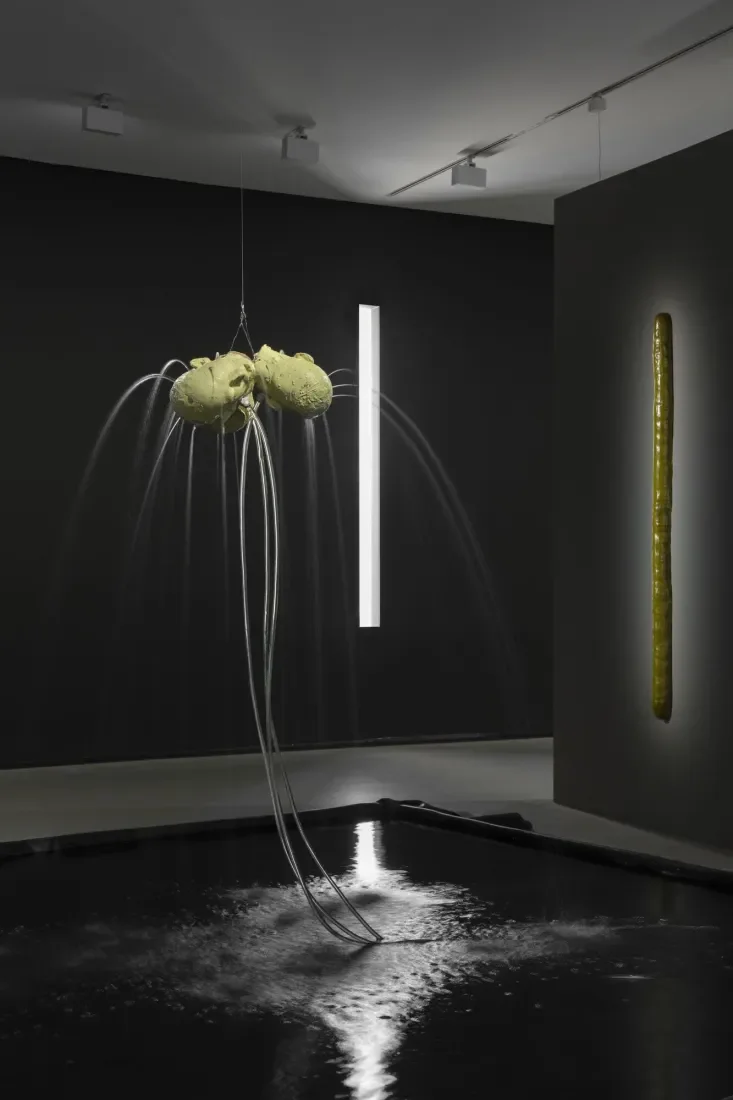
Installation view, “Clair-obscur” at Bourse de Commerce, Paris, Pinault Collection. ©
Elsewhere, works by Sigmar Polke introduce a different register. Polke’s alchemical approach to materials –– his layering of pigments, resins, and photographic processes –– complicates the simple binary of light and dark. In his hands, opacity becomes unstable; surfaces shimmer, absorb, and reflect in unpredictable ways. If Caravaggio’s shadows are dense and decisive, Polke’s are porous and riddled with interference. They do not conceal so much as distort, suggesting that visibility is always mediated.
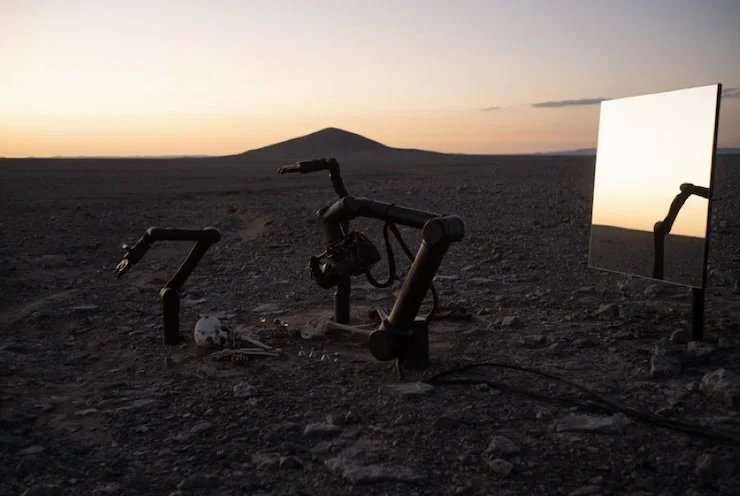
The exhibition’s spatial and conceptual center, however, is the rotunda, where Pierre Huyghe presents Camata (2024). In stark contrast to the dimly modulated galleries, the rotunda is flooded with an almost excessive brightness. The space is monumental, circular, and fully exposed; it functions less as an environment than as a screen for visibility pushed to its limits. At its center, a large-scale projection of Camata dominates the field, moving images unfolding with a clarity that feels at once total and destabilizing.
Huyghe’s work has long probed the thresholds between reality and simulation, the seen and the constructed. Here, however, the logic of chiaroscuro is inverted. Rather than emerging from darkness, the image is overexposed, suspended in a condition of relentless illumination. And yet, this surplus of light does not produce transparency. Instead, it generates a different kind of opacity: one rooted in saturation. The viewer is confronted with an image that is entirely visible and yet, resistant to fixation, its meaning dispersing as it appears.
Within the context of “Clair-obscur,” the rotunda thus operates as a conceptual pivot. If elsewhere the exhibition explores darkness as a site of ambiguity and withdrawal, here it is light itself that becomes unstable, excessive, and ultimately unreadable. The effect is more immersive than disorienting: one is not absorbed into the work, but is held at a distance, exploded alongside it in a space where nothing can fully recede from view.
Elsewhere, the exhibition turns toward artists whose work engages with absence and transcendence. James Lee Byars, with his austere, often monochromatic objects, approaches light as a form of ideality; something absolute and unreachable. His works seem to aspire to pure presence, yet they are haunted by their own fragility, their susceptibility to disappearance. In contrast, Trisha Donnelly operates through withdrawal and opacity. Her contributions to the exhibition resist easy description, as they often do: sparse, elusive gestures that seem to evade documentation as much as interpretation. Her work inhabits a space where meaning is deliberately withheld, and where darkness becomes not simply visual, but epistemological: a refusal to fully disclose.
What emerges across these varied practices is not a unified thesis, but a set of tensions. Light does more than reveal: it exposes, distorts, sometimes even blinds. Darkness does not merely conceal; it shelters, preserves, and occasionally relieves the demand to be seen. The exhibition’s strength lies in its refusal to resolve these contradictions, allowing them to accumulate and echo across rooms and works.
If there is a critique to be made, it is that the thematic framework occasionally risks becoming too diffuse. With so many artists and approaches, “Clair-obscur” can feel less like a tightly argued exhibition and more like a constellation of loosely related gestures. Yet, this diffuseness may also be its main point. Chiaroscuro, after all, is not a fixed method, but a shifting relation between light and dark, presence and absence, knowledge and uncertainty.
Leaving the building and re-entering the Parisian daylight, one carries with them a heightened awareness of these relations. The city itself might appear differently: shadows are sharper, surfaces seem more ambiguous. In this sense, “Clair-obscur” succeeds not by illustrating a concept, but by altering perception, reminding us that to see is never a neutral act, but always a negotiation with what remains in the dark.
Installation view, “Clair-obscur” at Bourse de Commerce, Paris, Pinault Collection. ©
“Clair-obscur” at Bourse de Commerce, Paris, is on view through August 24, 2026.
About the author: Michela Ceruti is a writer based in Milan. She is the managing editor of Flash Art Magazine.