Ellen Pau: She Moves - Images of Shifting Zeitgeists at SculptureCenter, New York
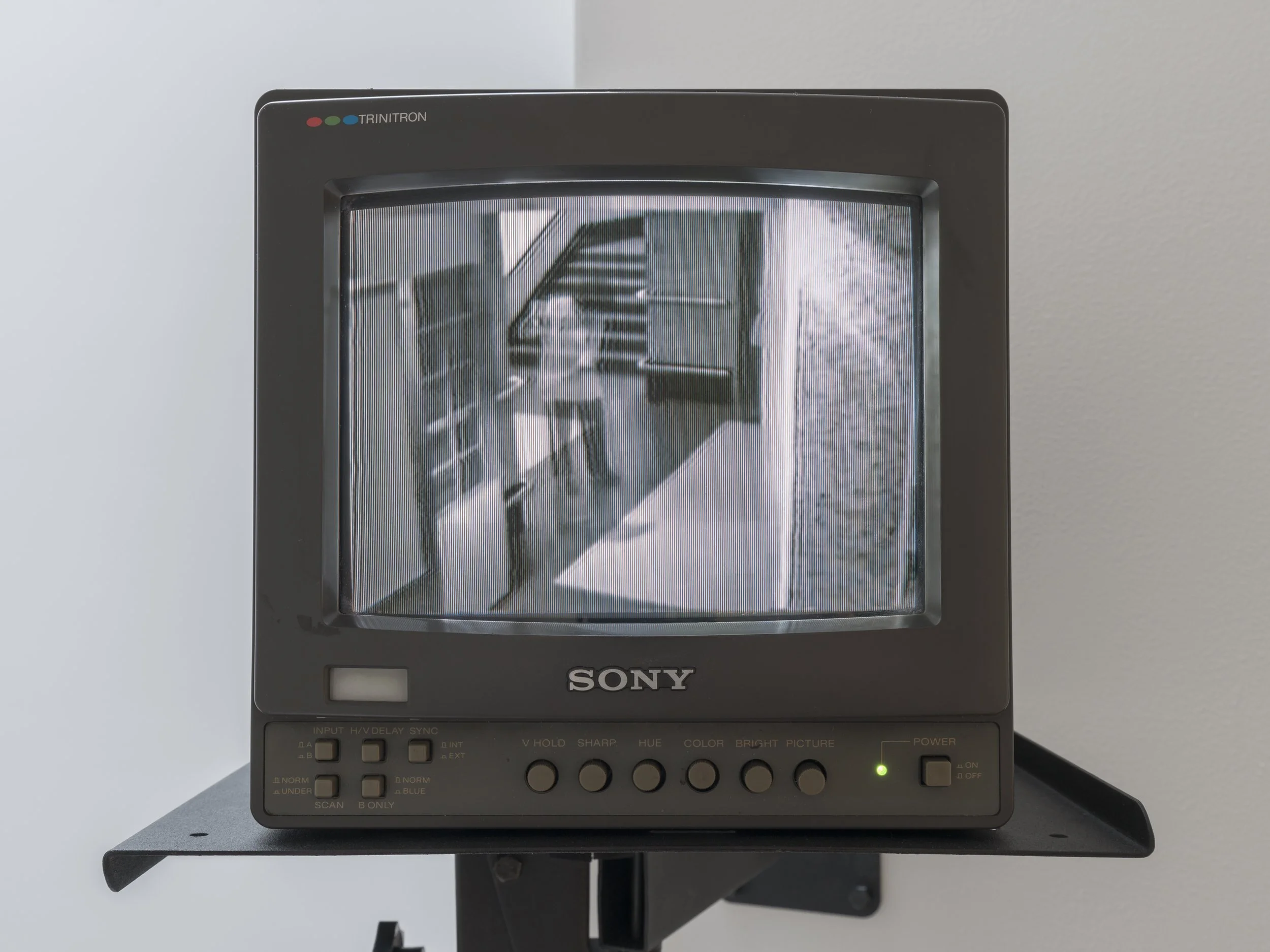
Ellen Pau: Operation Theatre 行動劇場, 1995, installation view, Ellen Pau: She Moves, SculptureCenter, New York, 2026. Video (B&W, sound). Original format: VHS, 4:3. 7:24 minutes. Courtesy the artist and Kiang Malingue, Hong Kong and New York. Image courtesy SculptureCenter, New York. Photo: Charles Benton.
Author: Irini Goudas
Published Thursday, July 23, 2026
Curated by Freya Chou, Ellen Pau: She Moves marks the first U.S. retrospective of Hong Kong-based artist Ellen Pau. Chou, who previously worked with Pau's practice while at Hong Kong's Para Site, returns to the artist's work for this first major U.S. survey. Spanning nearly four decades of work, the retrospective presents movement not only as a physical motion, but also as a condition of history, identity, memory, political change. and suppression. All these factors and elements have shaped both the artist's practice and Hong Kong itself through its historical transitions of the past century.
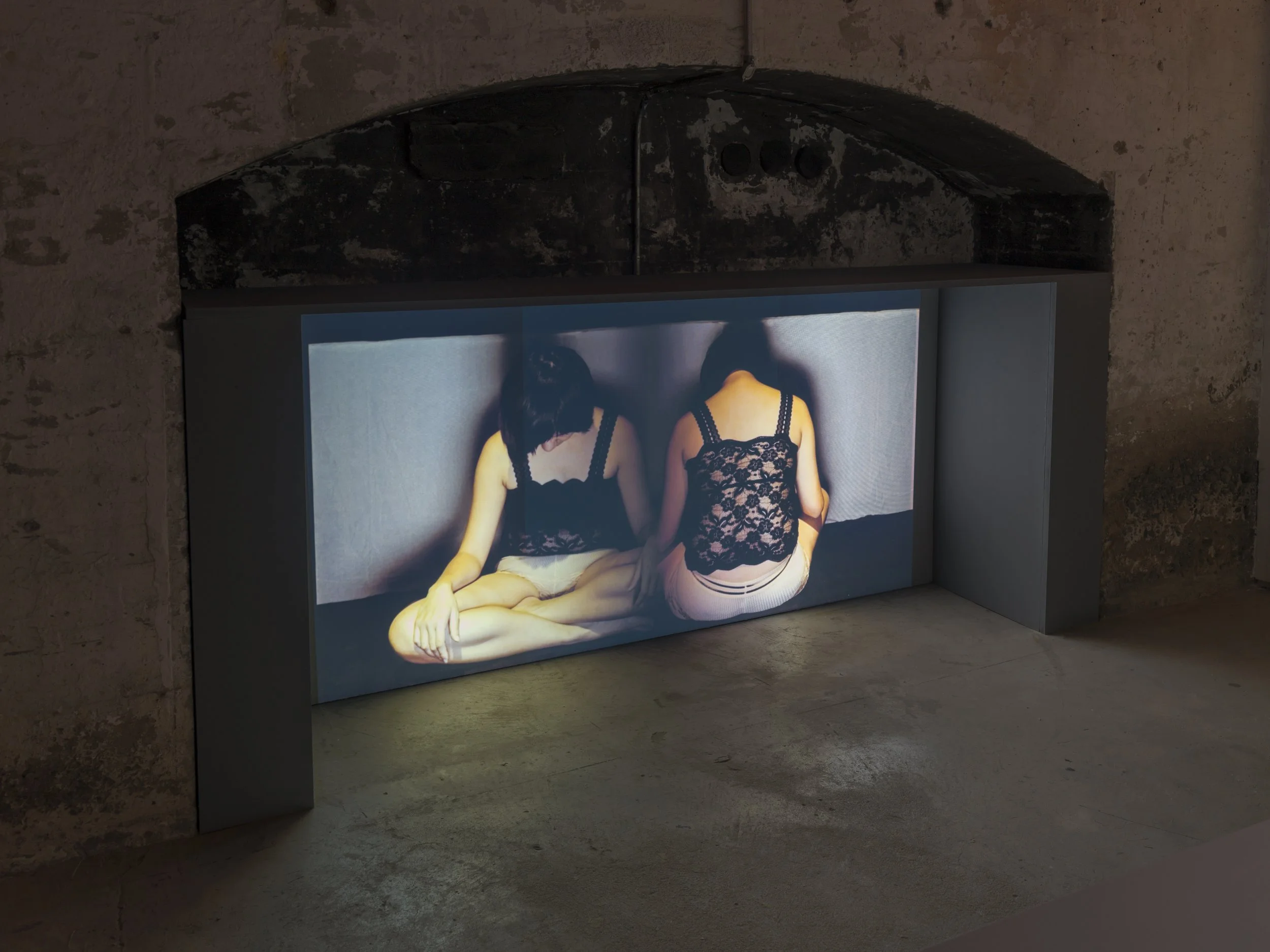
Ellen Pau, Pledge: Bik Lai Chu 碧麗珠, 1993/2018, installation view, Ellen Pau: She Moves, SculptureCenter, New York, 2026. Two-channel video installation (color, sound); panel. Original format: Video 8, 4:3. 1:00 minute (loop); installation dimensions variable. Courtesy the artist and Kiang Malingue, Hong Kong and New York. Image courtesy SculptureCenter, New York. Photo: Charles Benton.
Ellen Pau’s first retrospective took place in Hong Kong in 2018, organized by Para Site. Drawing knowledge about video art from the Phoenix Cine Club, a pivotal institution for the development of Hong Kong’s film culture, and Zuni Icosahedron, the artist developed her own unique abstract visual language. Equally formative was Pau’s nearly four-decade career as a radiographer, which informed her aesthetic preferences in various works, as well as her understanding of imaging technologies as a highly technical mediator for image production.
The title of the exhibition, widely open to interpretation, sparked my curiosity about this presentation right away. Having studied Chinese art history, I assumed that the title alludes to the Chinese art historical legacy of dance theatrics. In fact, this contextualization is present in the exhibition in works such as Operation Theatre, where medical staff and hospital patients are monitored through surveillance cameras, and movement resembles that of a Cantonese opera play. These movements in Operation Theatre are recorded, modernizing the traditional art form, as it evokes the formal language of Cantonese opera through choreography.
Movement is an overarching theme in the artist’s oeuvre. Ellen Pau’s artistic practice developed during a turbulent time for Hong Kong, when uncertainty about the future after the 1984 agreement for it to go under Chinese rule in the 1990s, protests, as well as vast economic shifts, contributed to a changing landscape. The region’s complex history and consequent cultural, social, and political hybridity inform the artist’s work also on view at the SculptureCenter. Pau’s works here capture different rhythms of her experienced zeitgeist, with visual and acoustic motions that fluctuate between harmonious and, at moments, frenetic, such as in the case of Pledge: Bik Lai Chu, 1995, a two-channel video installation where one witnesses a woman slowly hitting her head against the wall constantly in a one-minute loop. In an interesting curatorial symbiosis, The Shape of Light 2022, Pau projects a figure signing the Heart Sutra, one of the most important texts in Mahayana Buddhism. Their juxtaposition suggests that movement in her practice can oscillate between states of entrapment and liberation, mirroring the broader tensions between political uncertainty, personal experience, and the search for transcendence.
The artist does not shy away from more direct political commentary, such as in Rhythm TV Game of the Year, 1989, showing Chinese politician Li Peng’s televised speech in response to the 1989 Tiananmen Square protests, pairing it with a subversive reenactment of his gestures through the jejune hand motions typically associated with children's songs. Li Peng viewed the protests as a threat to state stability and became one of the principal political figures behind the declaration of martial law and the violent suppression of the demonstrations. TV Game of the Year, 1989, reflects the mechanisms of propaganda, suggesting how political authority relies on performance and the internalization of ideology to protect itself. Through the visual language of children's songs, Pau further critiques the paternalistic logic of authoritarian governance, in which citizens are expected to learn obedience through imitation rather than critical thought.
The dominant impression I took away from this exhibition—one that genuinely demands careful introspection and a nuanced understanding of the political and cultural realities of Pau's local context—is that her abstract visual language may have emerged as a strategy of necessity rather than purely aesthetic choice. Working within such an environment, abstraction appears to function as a means of negotiating the limits of representation and expression. At the same time, her extensive use of video technology, a medium inherently oriented toward mass audiences, reinforces Marshall McLuhan's well-known aphorism that "the medium is the message," suggesting that the communicative force of her work resides not only in its content but also in the medium through which it is transmitted.
Pau uses moving image, electronic acoustic sequences, as her personal image, as well as a variety of other media. Her presence in Pledge: I Can Only Tell It to Strangers 1996/2018 highlights how art can simultaneously capture the personal and the collective. Through abstraction, repetition, and technological experimentation, Pau transforms personal experience into a reflection on collective identity, revealing how images can transmit the complexities of a society in perpetual negotiation with its past and future.
Ellen Pau: She Moves at SculptureCenter, New York is on view through August 16, 2026.
About the author: Irini Goudas is graduating from a Master’s program in Art Business at Sotheby’s Institute of Art, where she wrote her thesis on the cultural phenomenon of Japonisme in Paris, with a particular focus on the work of Kitagawa Utamaro and his influence on late nineteenth-century art. Her professional experience spans gallery administration, curatorial practice, and art advisory.
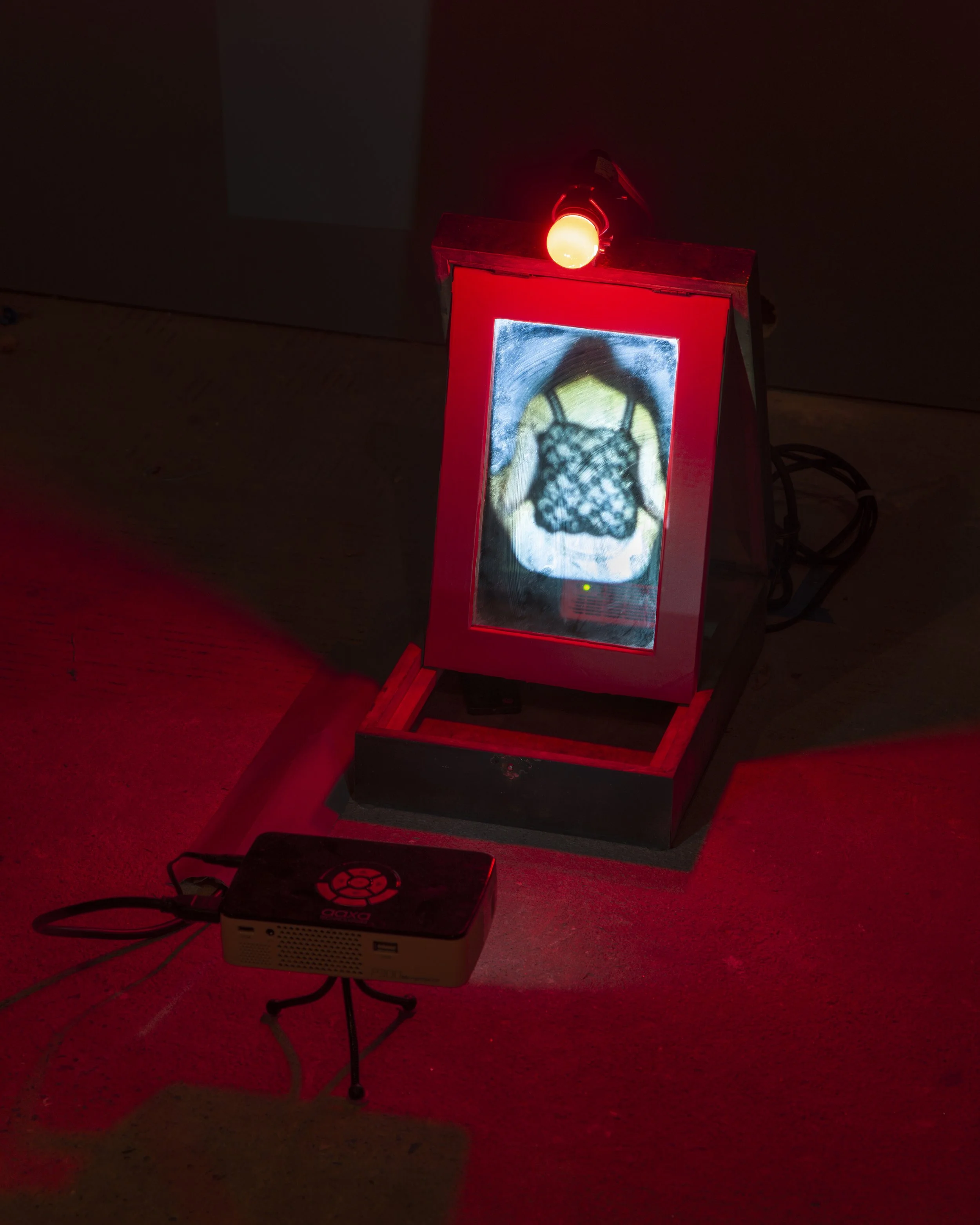
Ellen Pau, Pledge: I Can Only Tell It to Strangers 碧麗珠系列:我只跟不相識的說, 1996/2018, detail, Ellen Pau: She Moves, SculptureCenter, New York, 2026. Single-channel video installation (color, sound); found object, mirror, latex, string. Original format: Video 8. 1:00 minute (loop); installation dimensions variable. Courtesy the artist. Image courtesy SculptureCenter, New York. Photo: Charles Benton.