GHOSTLY, GODLY / 人間 during Hong Kong Art Week
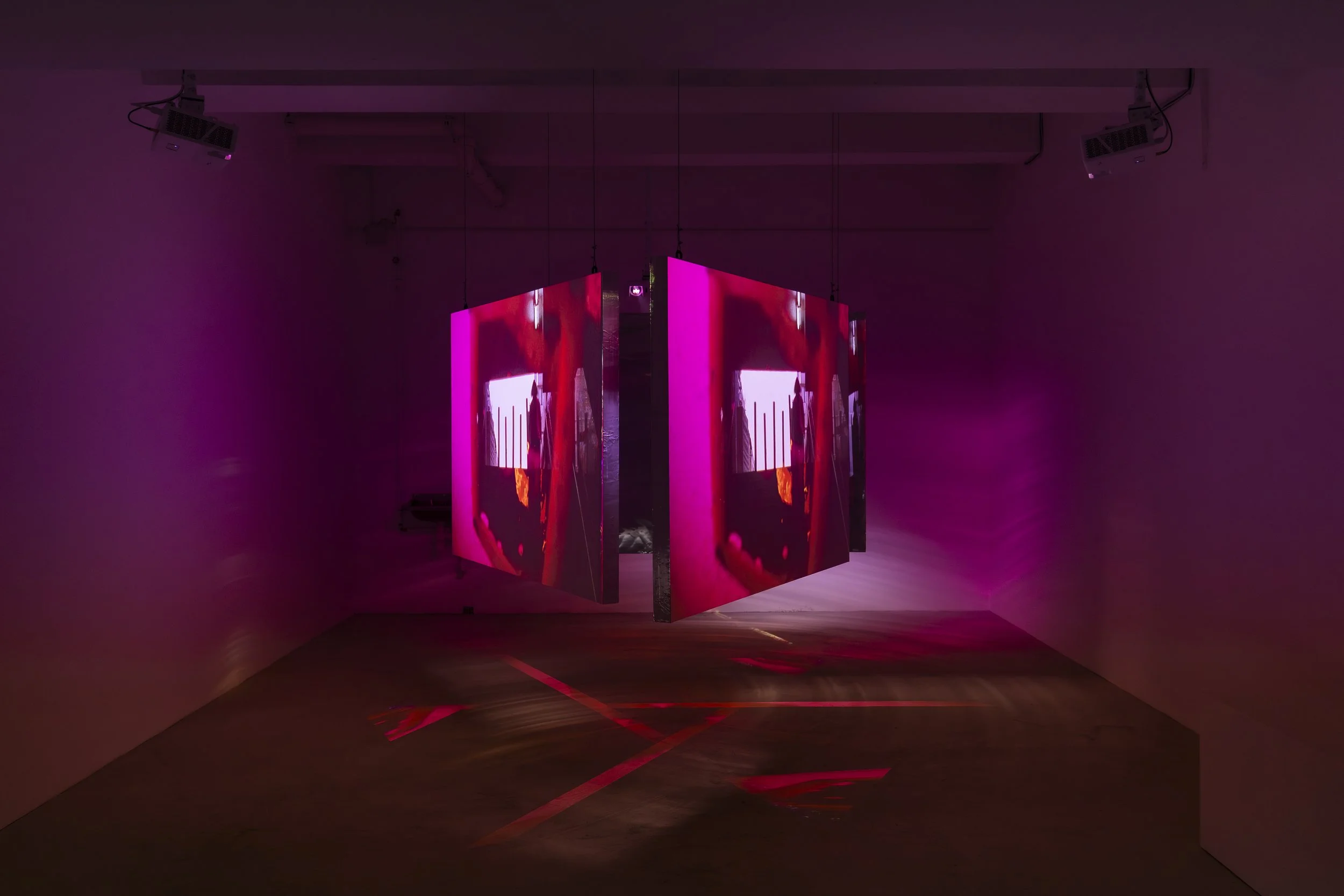
Installation view GHOSTLY, GODLY / 人間, curated by Chris Wan Feng. With Simon Liu, Cici Wu, Tang Kwok Hin, Ha Bik Chuen, and On Kino. 33/F, M Place, Wong Chuk Hang, Hong Kong was on view March 21 – April 8, 2026. Images courtesy of the author.
Author: Jaeyong Park
Published Friday, April 27, 2026
Art Basel Hong Kong generates its own weather system. For one week each March, the city reorganizes itself around transactions, around the particular energy of collectors, advisors, and gallerists moving between Convention Centre booths and Kowloon dinners with visible purpose. Two days before the VIP preview, Hong Kong gazetted an amendment to its national security implementation rules, making it a criminal offense to refuse police access to personal device passwords. The amendment passed with little public debate. That same week, on an evening after the fair floors had emptied, an elevator carried me to the 33rd floor of a narrow high-rise in Wong Chuk Hang, the former industrial district on Hong Kong Island’s south side that has quietly become one of the city’s denser gallery clusters, to see what happens when hauntology becomes a curatorial method.
Installation view GHOSTLY, GODLY / 人間, curated by Chris Wan Feng. With Simon Liu, Cici Wu, Tang Kwok Hin, Ha Bik Chuen, and On Kino. 33/F, M Place, Wong Chuk Hang, Hong Kong was on view March 21 – April 8, 2026. Images courtesy of the author.
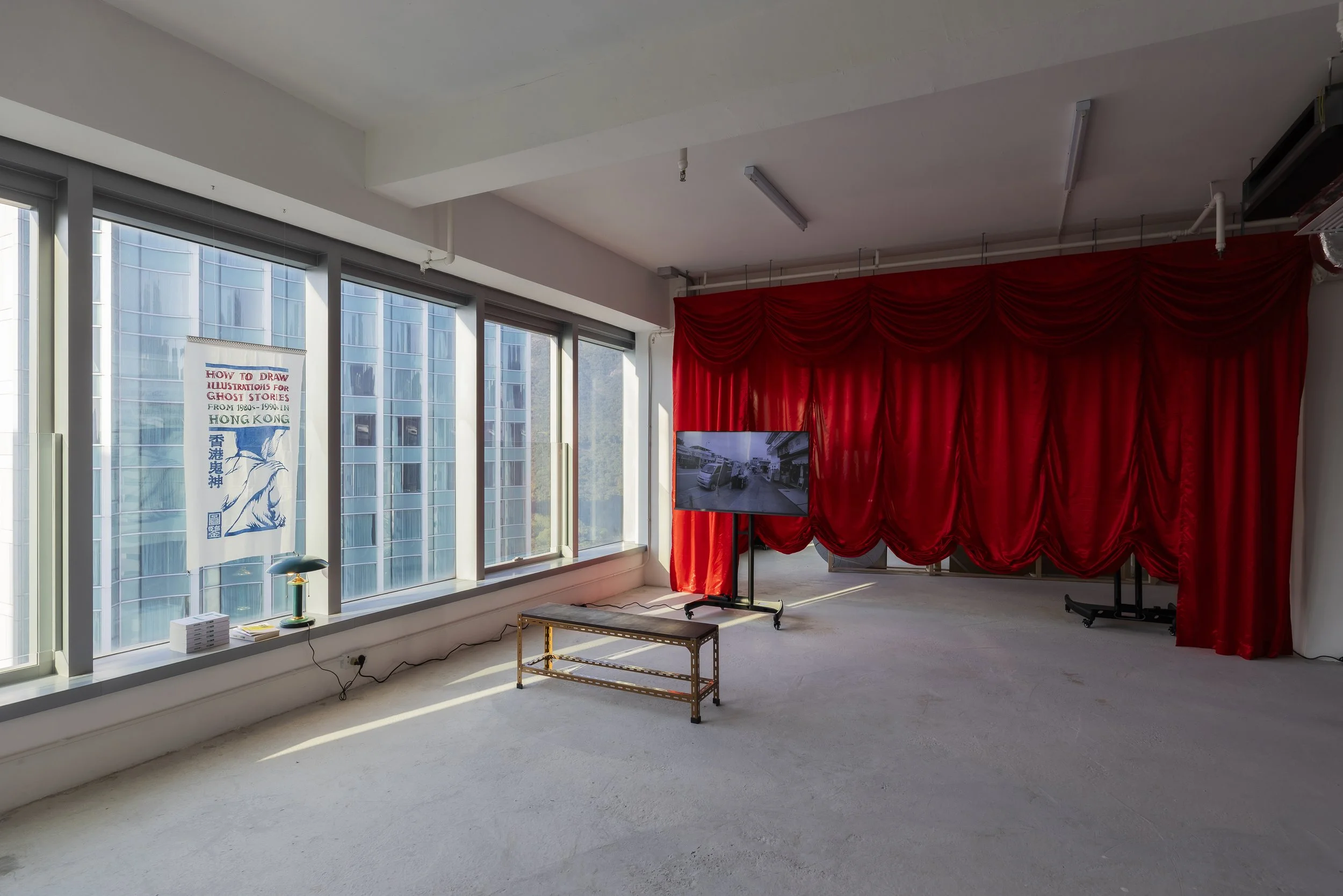
Against the floor-to-ceiling windows, with the night city visible behind it, a woodcut banner hung on cloth: “HOW TO DRAW ILLUSTRATIONS FOR GHOST STORIES FROM 1980s–1990s IN HONG KONG / 香港鬼神,” printed in red and indigo ink. Below and beside it, On Kino had assembled dozens of Hong Kong newsstand ghost story magazines from the 1980s and 90s on a table, their covers lurid and unsubtle. One title: Even Ghosts Emigrate. The magazines had a small, deliberate feature. Their publishers omitted publication dates so that each issue would always feel current, always of the present moment. Here was hauntology beginning not in philosophy but at a newsstand, in the commercial grammar of pulp superstition. Through the windows behind the banner: a building clad in bamboo scaffolding, residential towers stacking upward, the mountains of Hong Kong Island in dim silhouette. The ghost stories on the table and the city beyond the glass were doing the same work.
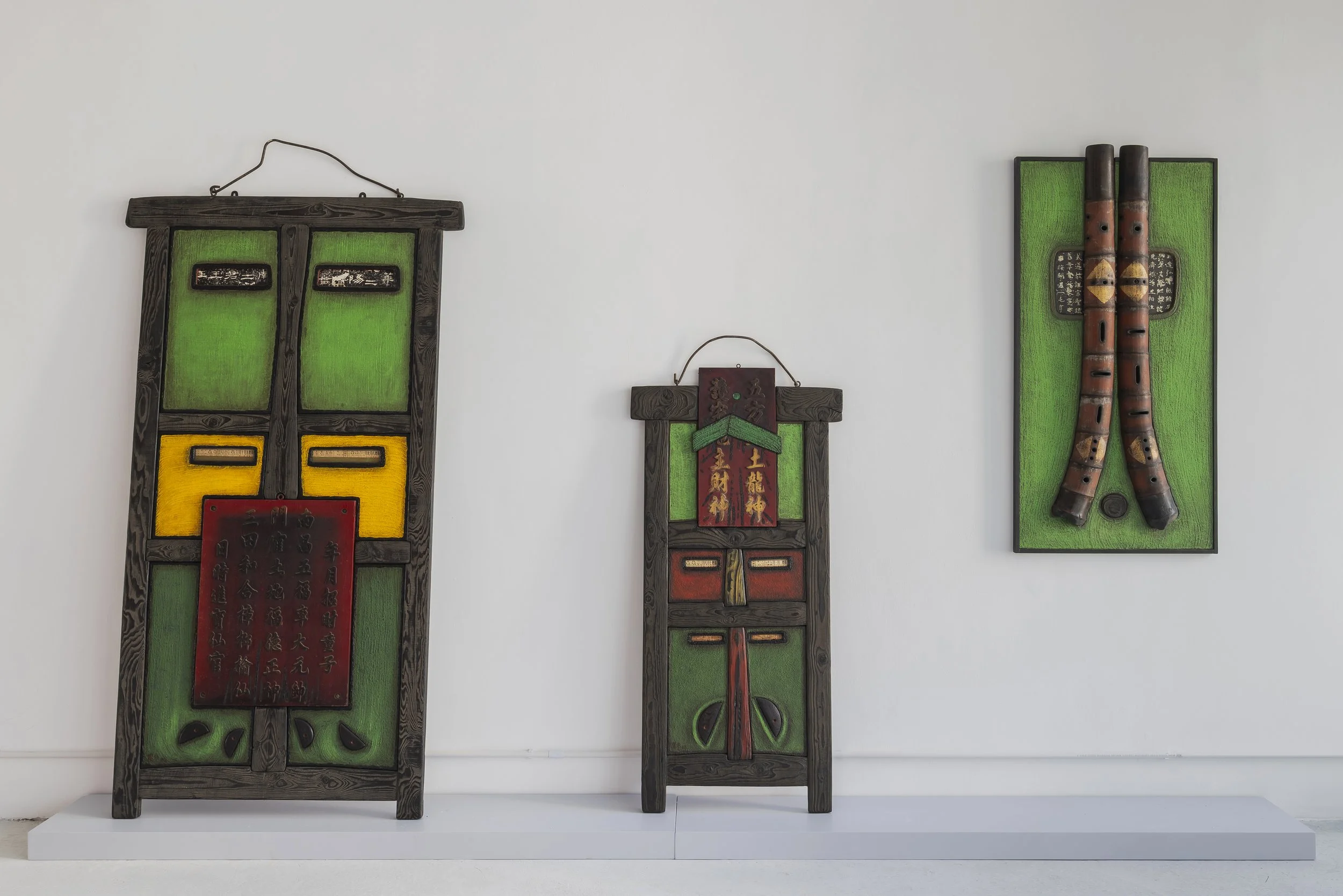
Ha Bik Chuen’s mixed-media collages stopped me with color before meaning arrived. Household deity plaques, 神牌, saturated in red and yellow-green, were assembled into compositions that vibrated with a palette immediately recognizable to anyone who has stood inside a Buddhist temple. Only later did the specifics clarify: these plaques venerate both earth gods and wandering yin spirits, ancient ghosts given domestic shelter. Gods and ghosts coexisting on a single surface. The exhibition title materialized. Ha had created this body of work for the 1998 Hong Kong Art Biennial. It was passed over and never publicly shown until now. Ha Bik Chuen, who lived from 1925 to 2009, was largely self-taught. He photographed over 2,500 exhibitions across decades, but kept most of this material private; the scale of his archive became apparent only after his death. His archive constitutes a shadow history of Hong Kong art. Now he himself exists only as an archive. Present only as a trace.
Installation view GHOSTLY, GODLY / 人間, curated by Chris Wan Feng. With Simon Liu, Cici Wu, Tang Kwok Hin, Ha Bik Chuen, and On Kino. 33/F, M Place, Wong Chuk Hang, Hong Kong was on view March 21 – April 8, 2026. Images courtesy of the author.
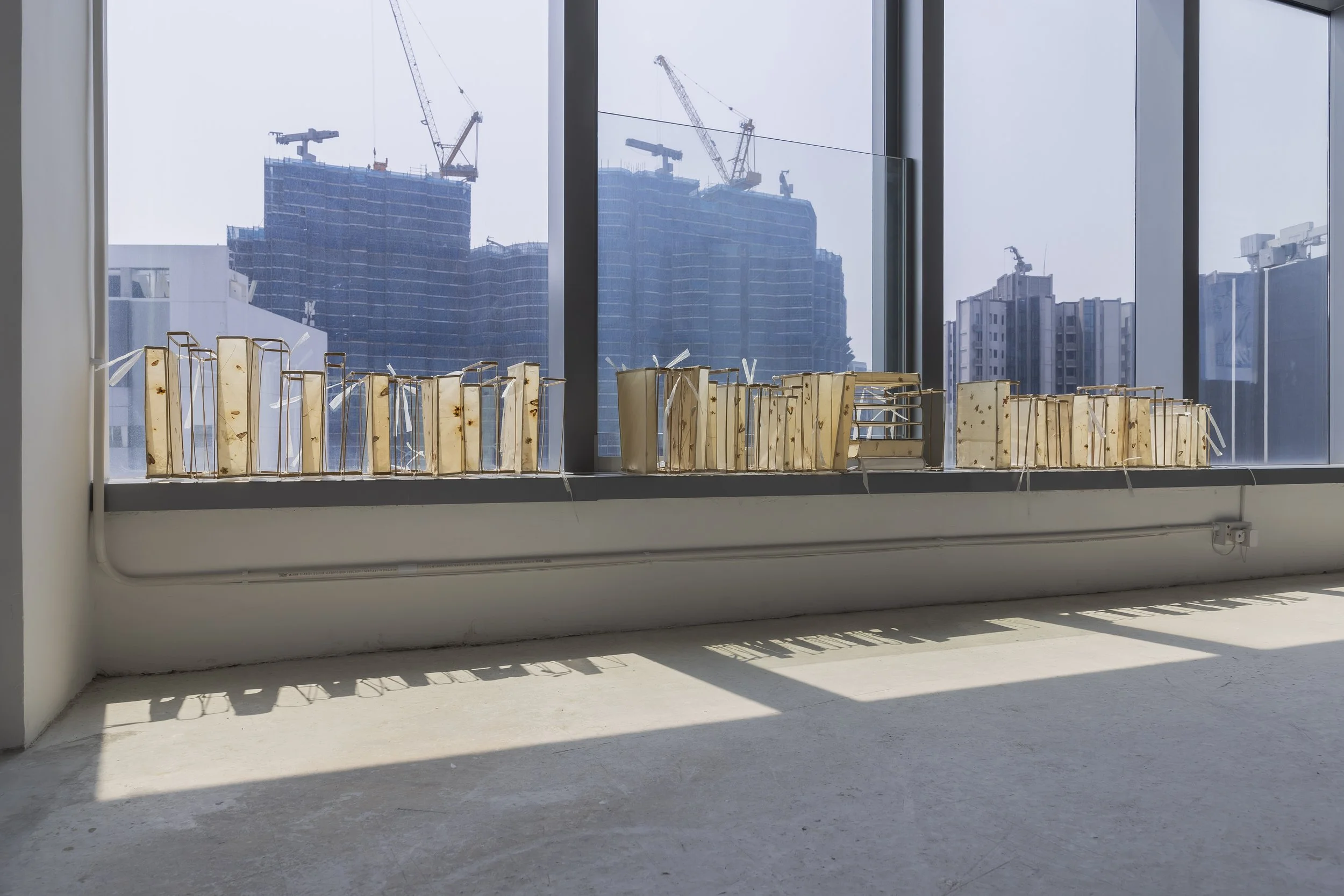
Cici Wu’s installation filled a darkened section of the floor with handcrafted paper lanterns, each shaped as a book. Bamboo frames, handmade paper, soft LED light from within. Placed along the windowsill, their glow filtered through the lattice, each lantern no larger than a hardcover held upright. The lanterns were memorials for books confiscated and destroyed during the Cultural Revolution, originally commissioned by the Rockbund Art Museum in Shanghai. The confiscated made luminous.
“Good Fortune,” Tang Kwok Hin’s two-channel video, documented the 34th Kam Tin Da Jiu Festival, a decennial Taoist ritual whose origins trace to the Qing dynasty forced displacement and return. The footage held together without hierarchy: Shek Kong military helicopters overhead, an empty opera shed, a red curtain bearing the characters for “good fortune.” The sacred was not separated from the ordinary but dissolved into it. Across East Asian folk traditions, the patterns rhyme. Tang also staged “Bad Habits,” a live performance during the exhibition’s run that addressed what it means to produce art under conditions that have fundamentally changed. On the opening night, he led a procession from the 33rd floor through the surrounding streets to a nearby art space, briefly carrying the exhibition into public view.
The curatorial statement circulated under the title “An Unsent Press Release.” Chris Wan Feng wrote a text that declared it could not tell you what the exhibition would be, while telling you. He noted that academic terms like hauntology and modernity “quickly felt inadequate.” The vivid images of ghosts and gods, he observed, had quietly faded into adjectives. Ghostly. Godly. Not nouns but atmospheric conditions. Where the English title names what haunts, the Chinese title names what is haunted: 人間, the human realm. “The word ‘Hong Kong’ disappeared,” he wrote, “and ‘the human realm’ suddenly came into view. Disappearance and return, both speak to this unresolved present.”
What deserves attention is the structural fact. This exhibition performed its own subject matter. It opened during the busiest art week of the year. Its press release was declared unsent. It ran for under three weeks on a high floor, free admission, with no gallery or museum affiliation, supported by a private foundation. It appeared, and it disappeared, leaving a minimal trace.
This is what ghosts do.
I come from a country that democratized in 1987. None of what this exhibition was doing was unfamiliar. Ghost stories, in any tradition, tend to be about what repression fails to bury. The installation photographs, taken in daylight, show a different exhibition from the one I entered at night. This review is partly an act of documentation. Holding the exhibition in circulation a little longer, keeping it findable, extending by a few weeks the period in which the work remains legible to someone who was not on that floor.
The 33rd floor is empty now. The elevator goes to other uses.
Installation view GHOSTLY, GODLY / 人間, curated by Chris Wan Feng. With Simon Liu, Cici Wu, Tang Kwok Hin, Ha Bik Chuen, and On Kino. 33/F, M Place, Wong Chuk Hang, Hong Kong was on view March 21 – April 8, 2026. Images courtesy of the author.
About the author: Jaeyong Park is a writer, translator, and curator based in Seoul. He is a co-founder of Seoul Reading Room and Curating School Seoul.