Culture as a Literal Construct: Hush Lobby at theNextWave Gallery, New York
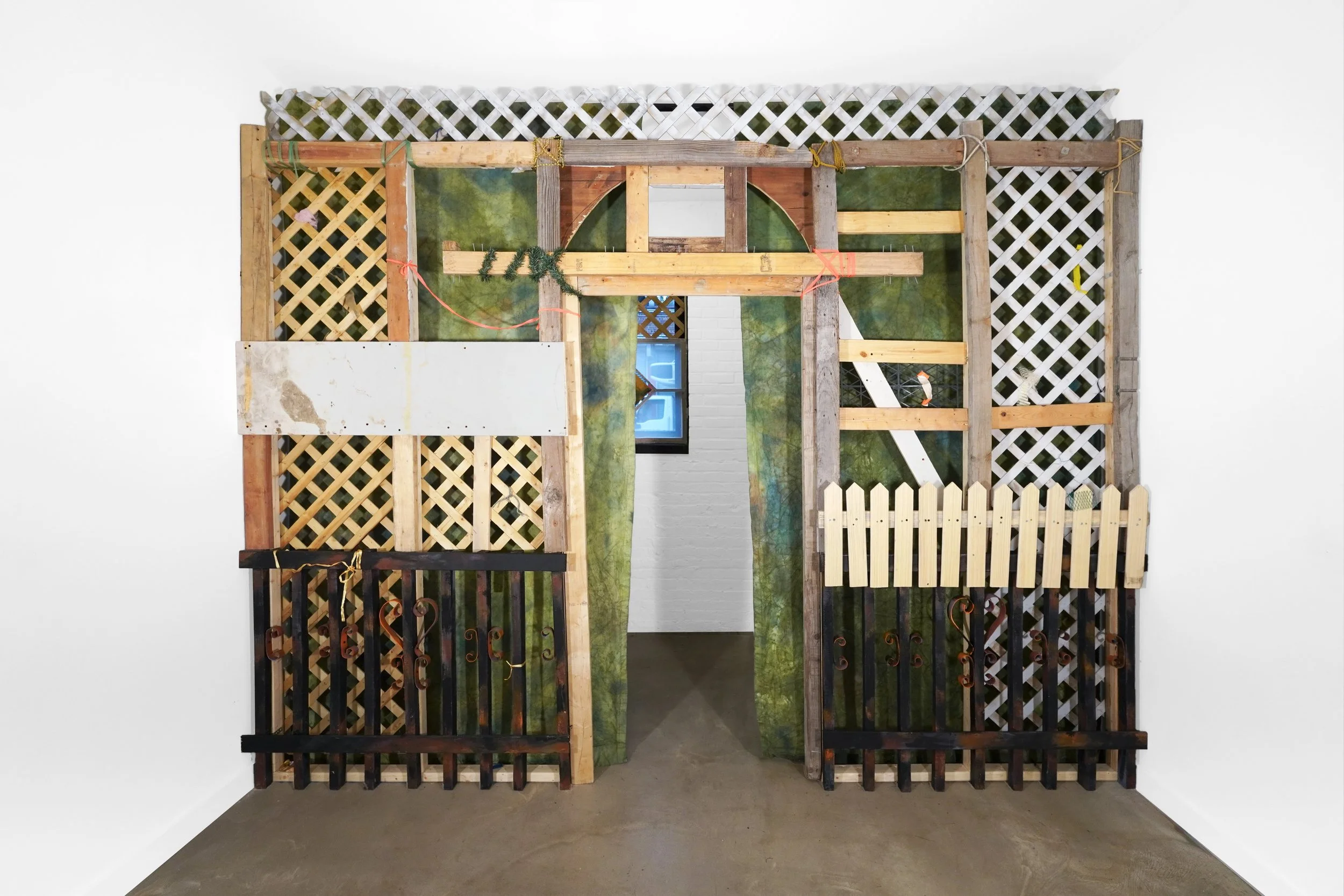
Meinzer and Victoria Reshetnikov, Hush Lobby, 2026. Wood cutoffs from 37th Avenue, Grand Street, and 48th Street, lattice from Facebook Marketplace, slats from 3 bedframes, deconstructed washing machine foundation from Middle Village, shipping palettes from Connecticut and a new Sunnyside grocery store, 3D printed custom parts, cords, produce netting, shoelaces, surveyor’s tape, plastic bags, braided strings, pine, canvas, tulle, fabric dye, colored pencil. 4 ⅛ x 11 ½ ft (wall form). Image courtesy of the artists.
Author: Colleen Dalusong
Published Thursday, January 29, 2026
Hush Lobby is difficult to define. Is it an entrance or an exit? It resembles a balcony, but also a backyard fence. I’m not sure if I’m meant to pass through briskly, or if it’s a place where I’m allowed to linger in. The site-specific installation is nestled inside the NextWave Gallery, a small room located within a wedge-shaped pre-war commercial building on a quiet street in Greenpoint, adjacent to a plastic fabrication company and a smoked fish factory. While working in collaboration with fellow artist Meinzer for Hush Lobby, Victoria Reshetnikov has rearranged the detritus of the streets within the interior of the gallery, creating a liminal space that is simultaneously public and private.
The pursuit of privacy in a densely populated city is a recurrent motif throughout the exhibit. Reshetnikov is informed by Bernard Rudofsky’s Architecture Without Architects, a book exploring the vernacular architecture created by “non-pedigreed” people, rather than professional architects. In the context of New York City, vernacular architecture can be seen in immigrant and working-class neighborhoods that use leftover, unwanted materials to personalize, improve, and transform standardized living spaces. The wall that forms Hush Lobby consists of disparate elements that strangely merge well together: bedframe slats, a deconstructed washing machine, lattice bought off Facebook Marketplace, shipping palettes from the new grocery store in Sunnyside, shoelaces, plastic bags, and produce netting. The dyed green canvas is evocative of both backyard greenery (a luxury in New York, more easily found in the outer boroughs) and the infamous scaffolding that transforms daily commutes into a labyrinthine odyssey. Moreover, the wall is approximately the average size of a balcony in New York, lending the green canvas a new reading as a pair of curtains shielding the private interior of the apartment from the public exterior of the balcony.
Reshetnikov recognizes that windows act as the gateway through which we decide what aspects of our inner lives enter the public view. After all, it is hard to find privacy in New York City, but it is even harder to resist the urge to slip into the habit of casual voyeurism (Let he who has not glimpsed longingly through the windows of Brooklyn Heights brownstones and Greenwich Village townhouses cast the first stone). Living in New York for long enough will turn anyone into the characters from Hitchcock’s Rear Window, as many cross-borough commuters choose to alleviate their boredom by peeking into the windows, balconies, and rooftops of the unfortunate souls who happen to live within sight of the elevated train tracks. In Hush Lobby, the windows are slightly obscured by hazy mesh, wooden blinds, lattice, and dyed canvas. People cannot look in from the outside, yet it is equally challenging for the people inside to see what lies beyond their four walls. Sketch for a Window is arguably the Platonic ideal of itself, with a Chagall-esque landscape on canvas mounted on scrap wood that forms the head, jambs, and sill. The fabric dye and colored pencils create a lush green scenery accented by strokes of pink, blue, and red that may suggest the sun, water, and trees. Here, the view of the outside world is colored by each visitor’s personal interpretation, with Sketch for a Window essentially functioning as a sort of architectural Rorschach test.
At its core, Hush Lobby is a love letter written (or perhaps constructed) for the American, immigrant, and urban experience. It is a reminder that cities such as New York are built collectively, animated by all who reside in them. A city’s accents, aesthetics, and architecture develop into a living record of its inhabitants, creating a culture that seamlessly traverses both public and private space. This shared code is materialized in Hush Lobby, eliciting knowing smiles and soft laughter from those who can decipher it.
HushLobby at theNextWave Gallery, New York is on view through February 1, 2026.
About the author: Colleen Dalusong is a curator and writer based in New York City. She has curated exhibits at Accent Sisters, Uncool Gallery, CP Projects Space, Think!Chinatown, and A Space Gallery. Her reviews have been published in Whitehot Magazine, Cultbytes, sabukaru.online, Mercer Street Reader, and Impulse Magazine.
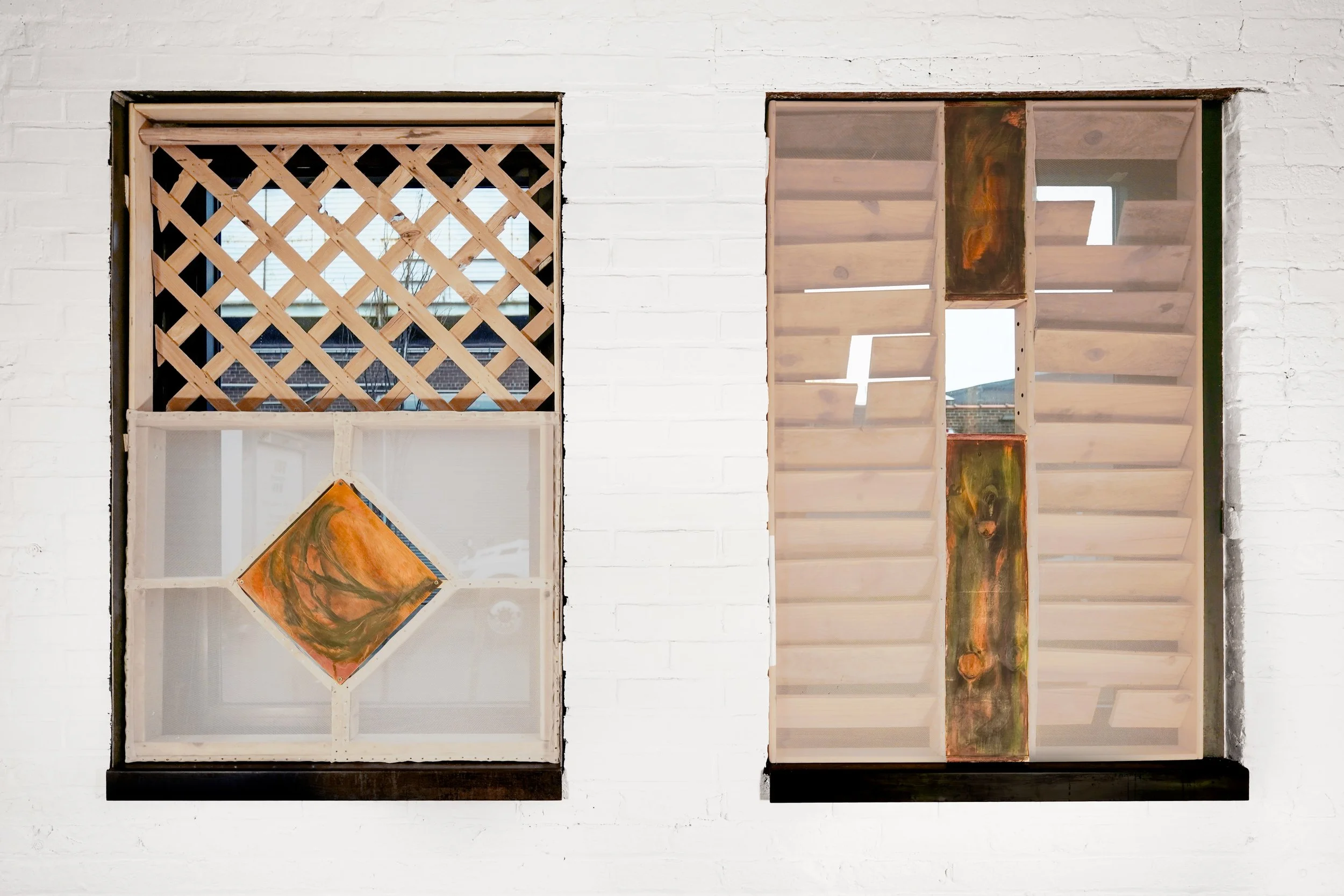
Meinzer and Victoria Reshetnikov, Hush Lobby, 2026. Wood cutoffs from 37th Avenue, Grand Street, and 48th Street, lattice from Facebook Marketplace, slats from 3 bedframes, deconstructed washing machine foundation from Middle Village, shipping palettes from Connecticut and a new Sunnyside grocery store, 3D printed custom parts, cords, produce netting, shoelaces, surveyor’s tape, plastic bags, braided strings, pine, canvas, tulle, fabric dye, colored pencil. 2 ⅞ x 4 ⅜ ft (window forms). Image courtesy of the artists.
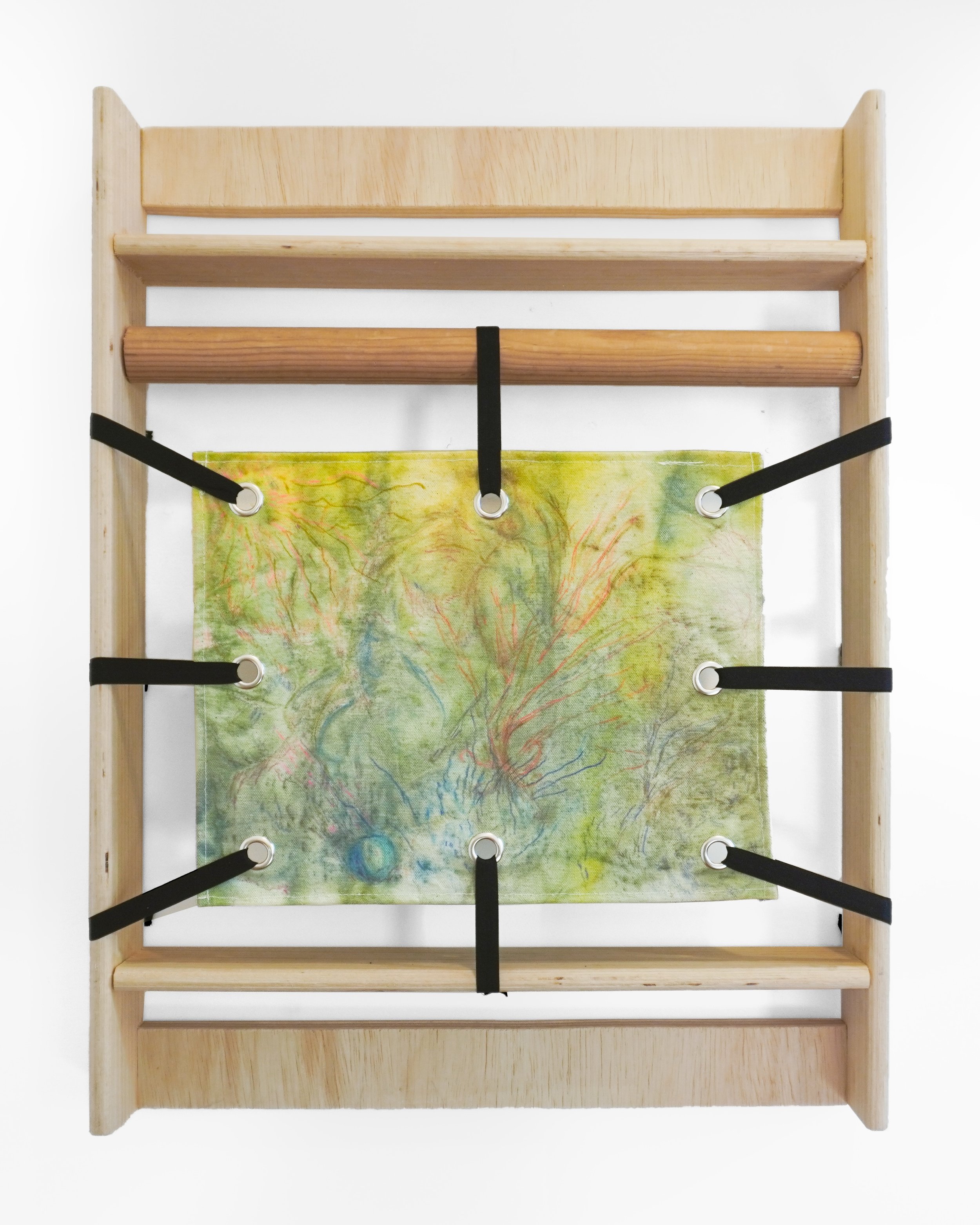
Meinzer and Victoria Reshetnikov, Sketch for a Window, 2026. Fabric dye and colored pencil on canvas, mounted with grommets and ribbon on scrap wood. 16 x 23 inches. Image courtesy of the artists.