Hito Steyerl “The Island” at Osservatorio Fondazione Prada, Milan
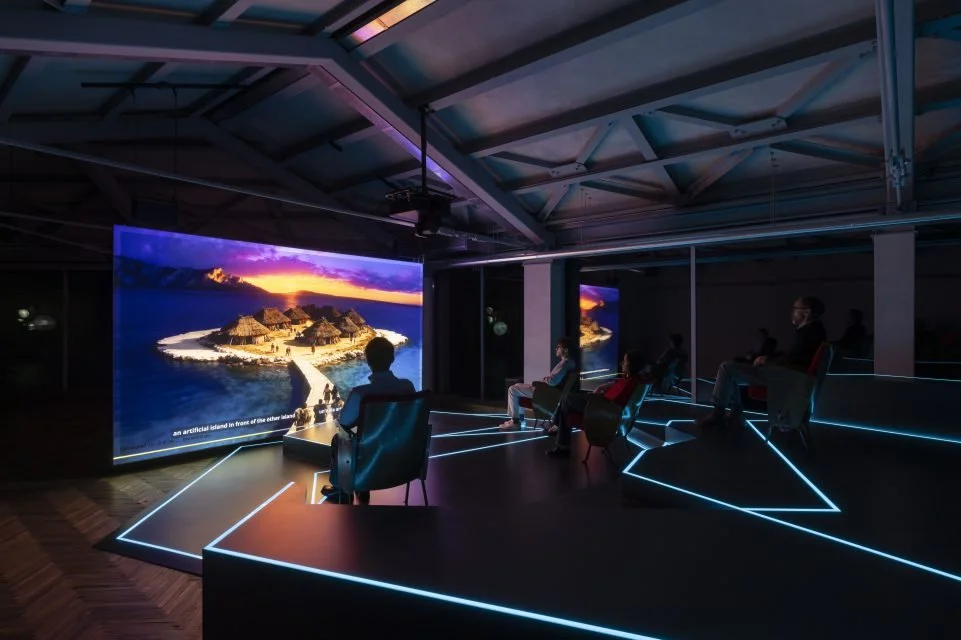
“The Island” by Hito Steyerl, Osservatorio Fondazione Prada, Milan. Photo: Andrea Rossetti, Courtesy Fondazione Prada.
Author: Michela Ceruti
Published Thursday, January 22, 2026
“The Island” unfolds as a rumor one follows upward. Hito Steyerl’s exhibition occupies two floors of Osservatorio Fondazione Prada, perched inside the classy Gallerie Vittorio Emanuele II in Milan, a site defined by transparency and spectacle. For this exhibition, though, this promise is reversed. The windows are completely blacked out, the daylight is erased, and the space is reduced to a nocturnal corridor where blue LED lines skim the floor, guiding visitors’ steps with the calm authority of sci-fi runways.
On the first level, a constellation of works prepares the ground for The Island (2025), Steyerl’s new movie, installed on the next floor of the building. This film is the gravitational center of the exhibition rather than its culmination.
The first level is articulated through four separate, but interlinked narratives – “Lucciole,” “The Artificial Island,” “The Birth of Science Fiction,” and “Flash!”. They unfold across:
(a) sculptural installations that project 3D scans of submerged Neolithic archaeological sites,
(b) LED screens displaying conversations with scientists and scholars (including a quantum physicist, an archaeologist, a linguist, and Suvin himself)
(c) straightforward video interviews.
(d) At the center of the room stands a large heptagonal structure resembling a fictional excavation site, containing scattered objects –– a lamp, a sword, a copy of Darko Suvin’s book.
This collection of objects and structures especially explanatory tone, contrasts sharply with the exhibition’s overall sense of instability.
Knowing Steyerl’s long entanglement with science fiction, surveillance, and simulated realities, the gesture feels legible, even inevitable: immersion as disorientation, darkness as method. Still, the experience is not frictionless. Moving through a dark space demands attention, a careful choreography to avoid collision, fatigue, or mild panic. Yet, this difficulty sometimes feels intentional. To be forced into alertness, to navigate slowly and slightly off-balance, becomes a way of “alienating oneself from alienation” –a small, blue-lit rehearsal for existing inside systems that are clearly already too dark.
What follows refuses the comfort of clarity, too. Even after multiple visits, “The Island” remains slippery, withholding, oddly resistant to synthesis. The generated confusion does not dissipate with familiarity; if anything, it is exacerbated. Returning here for a second or third time does not unlock the exhibition but sharpens that sense that something is perpetually out of reach. Reading the exhibition booklet –– usually a stabilizing devise, a handrail of sorts –– only deepens the vertigo. Concepts proliferate, references multiply, and instead of anchoring the experience, the text seems to open further loopholes of meaning. This is not a failure of intelligence on the viewer’s part, nor an absence of rigor in Steyerl’s. It is something closer to a productive misalignment: the feeling that the exhibition is operating at a frequency this presentation format could barely contain.
At a certain point, however, this productive misalignment begins to resemble a test. “The Island” appears to demand a viewer willing to subject themselves to a prolonged uncertainty, to accept confusion as both method and outcome. The question is not whether this demand is illegitimate, but whether the exhibition meaningfully differentiates between opacity as a critical strategy and opacity as a controlled experimental condition. In refusing resolution so consistently, the show risks reproducing the very saturation of images it seeks to diagnose. Transforming complexity from a tool into an atmosphere that is difficult to push against is a lofty ambition here.
This tension is a familiar territory for Steyerl. Across works from the last decade such as How Not to Be Seen, Factory of the Sun, or Duty-Free Art, she has repeatedly staged collisions between dense theoretical research and the unruly affects of moving images, humor, glitches, and narrative breakdowns. Her practice has long been animated by a distrust of seamlessness –– of images that behave too well, arguments that close too neatly. The Island extends this critique, but does it with a severity that feels exhausting. The skepticism the show provokes does not stem from disbelief in its ambition –– on the contrary, the research underpinning it is vast, almost intimidating –– but from the sense that ambition itself has become part of the problem.
At the heart of this project is Steyerl’s encounter with Darko R. Suvin, a towering figure in science fiction studies, best known for theorizing the genre as a space of “cognitive estrangement.” Born in 1930 in Zagreb, Suvin is a literary scholar and critic whose work reframed science fiction not as escapism but as a critical tool: a way to imagine other worlds to see this one more clearly. It is Suvin who recount the childhood memory that structures The Island. On April 10, 1941, Zagreb was occupied by Italian and German forces, power was handed over to local fascist groups. A few months later, while riding a tram through the city, Suvin –– then a child –– experienced an explosion on the tracks ahead, halting the vehicle mid-journey. He did not fully understand what was happening, only that something was wrong, that danger had ruptured his everyday. Fear displaced comprehension. And into that fear slipped another image, another world, Flash Gordon Conquers Mars (1938), a film he had recently seen. His memory fractured, reality blended with science fiction, and his trauma was processed through planetary conquest and cosmic adventure.
This logic of derailment–– of history interrupted and reimagined through speculative imagery–– reappears at the upper level of the exhibition, where The Island is presented as a cinematic environment rather than a linear film. Installed in a theater-like space with red seats arranged on an island-shaped platform, the work collates archival footage, CGI landscape, and choral Dalmatian clap songs into a dense audiovisual montage that refuses any resolution.
In this sense, the exhibition succeeds and stalls at once. It honors the radical potential of science fiction as a tool for imagining otherwise, while simultaneously demonstrating how easily such generative devices can become alienating. Steyerl’s island is not a refuge; it is an unstable ground. And maybe this is the whole point: an exhibition that does not reassure, does not resolve, but mirrors the cognitive and emotional convictions of a world where clarity itself has become suspect or even obsolete.
About the author: Michela Ceruti is a writer based in Milan. She is the managing editor of Flash Art Magazine.
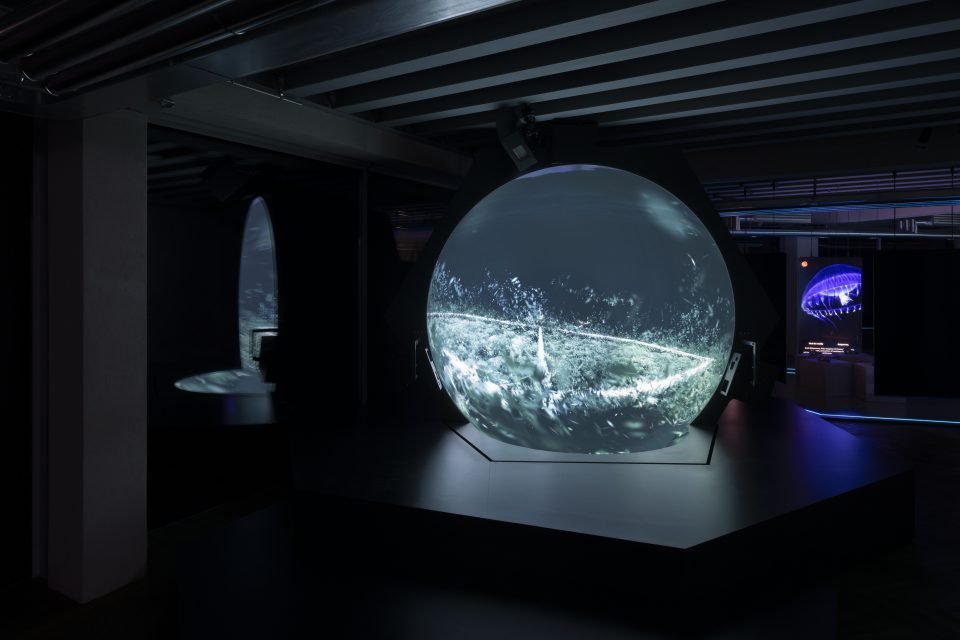
“The Island” by Hito Steyerl, Osservatorio Fondazione Prada, Milan. Photo: Andrea Rossetti, Courtesy Fondazione Prada.
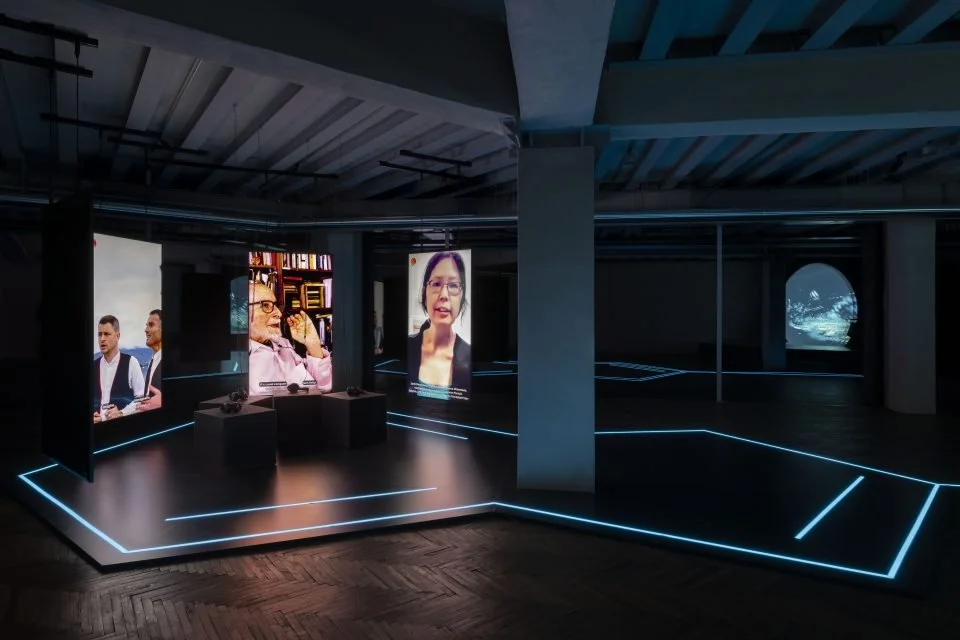
“The Island” by Hito Steyerl, Osservatorio Fondazione Prada, Milan. Photo: Andrea Rossetti, Courtesy Fondazione Prada.
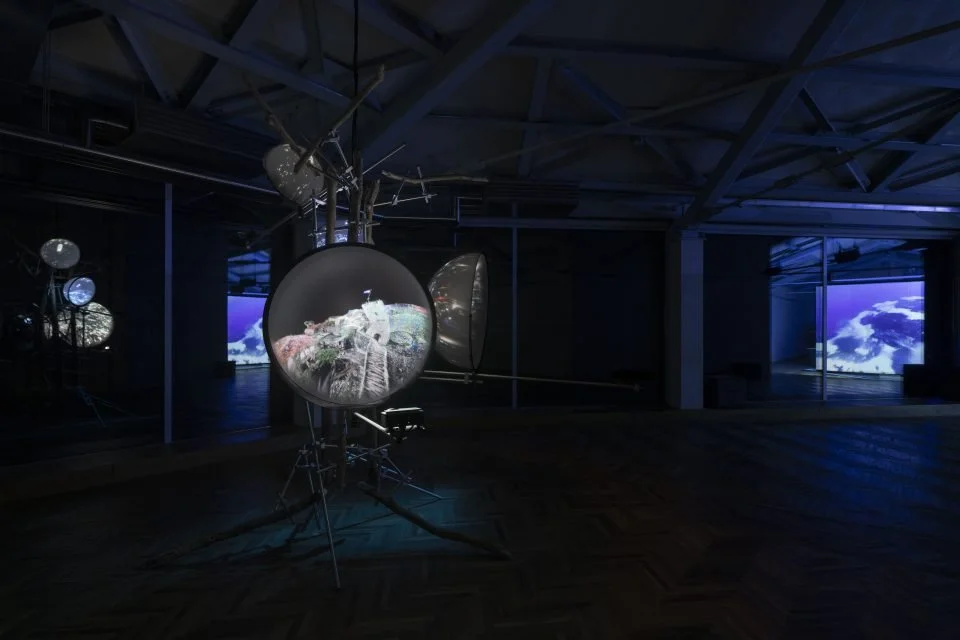
“The Island” by Hito Steyerl, Osservatorio Fondazione Prada, Milan. Photo: Andrea Rossetti, Courtesy Fondazione Prada.