Multiple Frames of the Ukrainian War: Lesia Khomenko’s “Lens of Witnesses” at Shevchenko Scientific Society, NY
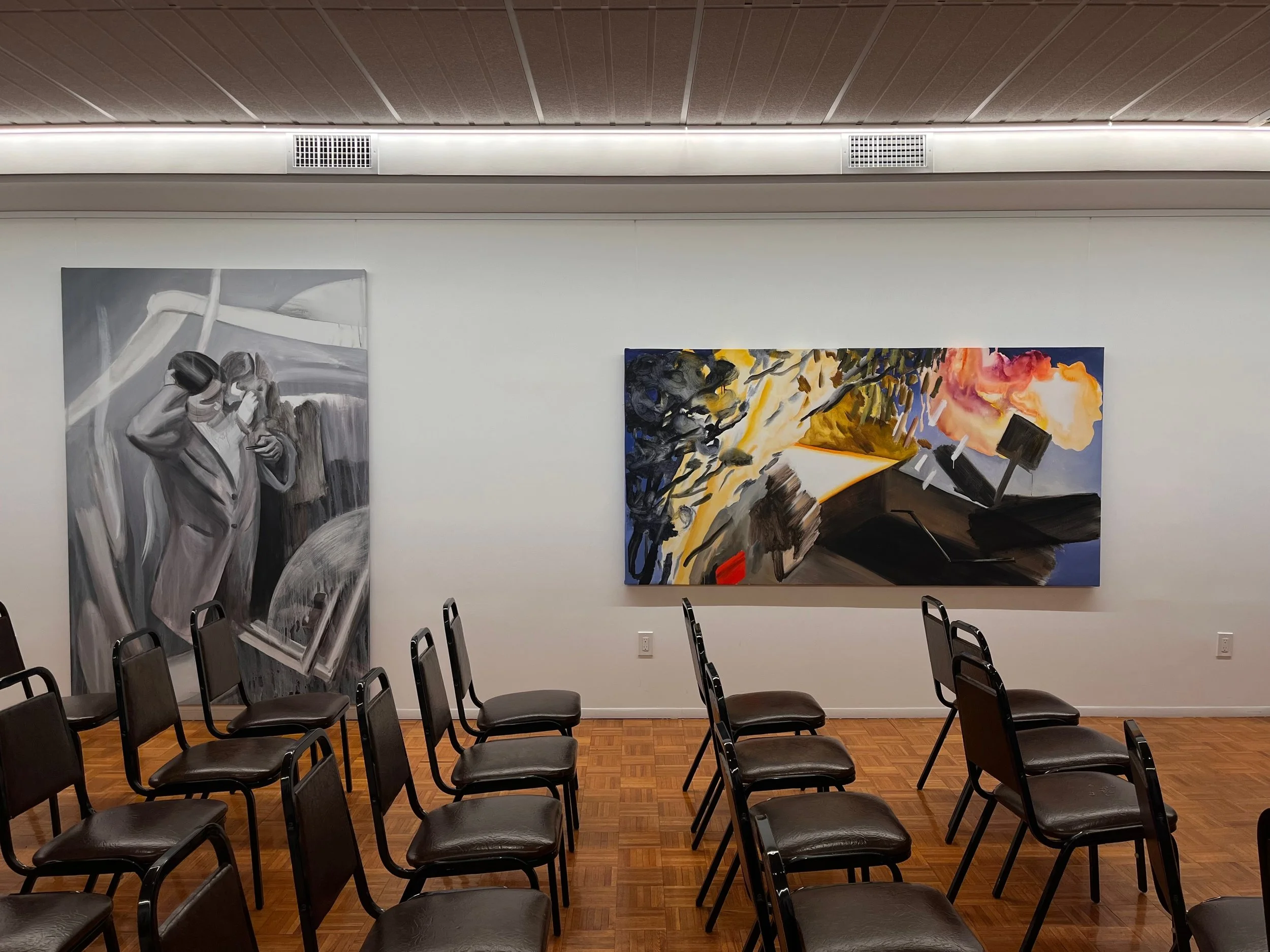
Installation view, Lesia Khomenko “Lens of Witnesses” at Shevchenko Scientific Society, NY, February 6-August 31,2026. Image courtesy of the artist.
Author: Nina Chkareuli
Published Thursday, August 6, 2026
Entering the exhibition of Ukrainian artist Lesia Khomenko at The Shevchenko Scientific Society on the corner of Fourth Avenue and East 9th Street, I could hear bomb explosions. All seven paintings on view are directly related to the war in Ukraine and are created by stitching together videos from eyewitnesses and participants. Transformation of reality into images gives the presentation an immediacy rarely experienced in our blase reality when entering the show on a serene New York morning. The Shevchenko Scientific Society is one of the leading centers for Ukrainian scholarship outside Ukraine, continuing the legacy of the original society founded in Lviv in 1873. Reestablished in New York in 1947–48 by émigré scholars, it promotes research on Ukrainian history, culture, literature, and the arts through publications, conferences, public lectures, and research grants. The Society also maintains one of the most significant collections of Ukrainian archives, a specialized research library, and an art collection in the United States, making it an important resource for scholars and the broader public interested in Ukrainian studies.
What Khomenko brings here is literal in a sensory way, reorienting a viewer towards sound they cannot hear and movement of people they cannot see, but can imagine. The Missile Strike in Kharkiv. Montague series, 2026 is one of the largest works in the exhibition showinf the exact moment of several missiles deteriorating existing structures. Expressionistic yellow and orange flames envelop a building now only conceivable as dilapidated geometric shapes. We do not see people or the panic; we just see an abstracted notion of dismantling. This is one example of Khomenko’s practical approach to subverting realities.
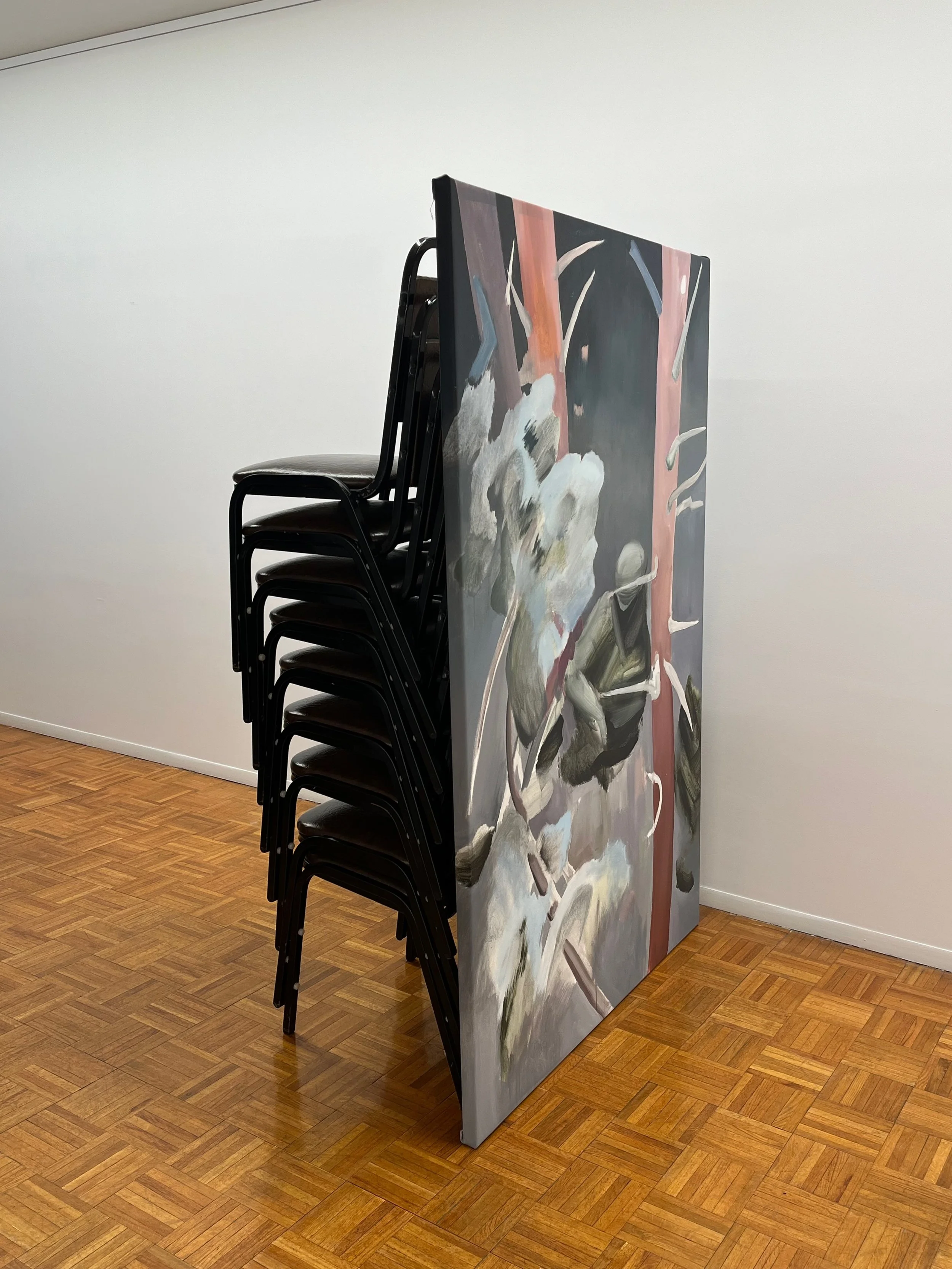
Installation view, Lesia Khomenko “Lens of Witnesses” at Shevchenko Scientific Society, NY, February 6-August 31,2026. Image courtesy of the artist.
Lesia Khomenko (b. 1980, Kyiv) is a leading contemporary Ukrainian artist whose practice critically examines the politics of representation, collective memory, and the construction of historical narratives. Working primarily through painting while extending into installation, performance, and video, she challenges the authority of images by exposing the mechanisms through which history and identity are visually produced. A member of the influential R.E.P. (Revolutionary Experimental Space) collective since 2004 and co-founder of the curatorial platform HUDRADA, Khomenko has played a significant role in shaping Ukraine's contemporary art discourse. Since Russia's full-scale invasion of Ukraine, her work has increasingly engaged with the visual culture of war, transforming blurred digital photographs, soldiers' selfies, and documentary fragments into powerful reflections on visibility and resistance.[1] What we see on view in New York is part of this story.
A Woman in the Middle of the Explosion. Kyiv Apartment. Six Frames from the Video of Surveillance Camera, 2026 is another example of Khomenko’s methodology. What we see is a black-and-white image cut and distorted. It is based on a video taken by a woman who just entered her apartment and was taken aback by the exploding missile. The abstracted figures do not specifically point to violence, but this conscious removal from emotional and material decomposition heightens the reality bringing in discussion of modernism and postmodernism.
Modernism removed us from the life processes; postmodernism looked both at us and the process as a meta-narrative; post-postmodernism, as demonstrated by Khomenko, is set on a course to get back to the immediacy of the experience while taking into account the process we observe, us as we observe it, and the how we observe it. A bird’s view if you will in addition to a bird being observed from a cloud. In Khomenko’s case, if the painted explosion was a removal, a modernist version of painting an explosion would have been a T.S. Eliot poem about the quality of fire as it moves from the center outward and abstract allusions to Dante. A post-modernist version of an explosion would have looked at Khomenko and the explosion being wrestled with within a frame. But she shows us stretched and stitched-together frames that themselves represent removed process, thus paintings here become post-postmodern objects.
Another important point worth touching upon here is what Frederic Jameson terms écriture, or the textuality of time that changes from one strand of modernist engagement to the next.[2] He points out how schizophrenia has become a symptom of the fragmentized world we live in, as it points to the quality of being outside of time. What Khomenko shows us is remarkably connected to “hallucinogenic intensification of our normally humdrum and familiar surroundings.”[3] In this artist’s case, we can completely see how it is based on her lived experiences without a struggle to shock, but rather to bring in an human tragedy to a New York space without showing blood to the viewer, only engaging with frames. An effect this more clinical methodology produces is full of affective emotions: Sitting in a room with empty chairs, watching geometric destruction and hearing the resulting silence.
[1] Khomenko, Lesia. “Lesia Khomenko.” post, The Museum of Modern Art, https://post.moma.org/author/lesia-khomenko/. Accessed 26 July 2026.
[2] Jameson, Fredric. "Postmodernism and Consumer Society." The Anti-Aesthetic: Essays on Postmodern Culture, edited by Hal Foster, Bay Press, 1983, pp. 111–125.
[3] Ibid.,p.121.
About the author: Nina Chkareuli is a Tbilisi-born, New York-based writer and curator.
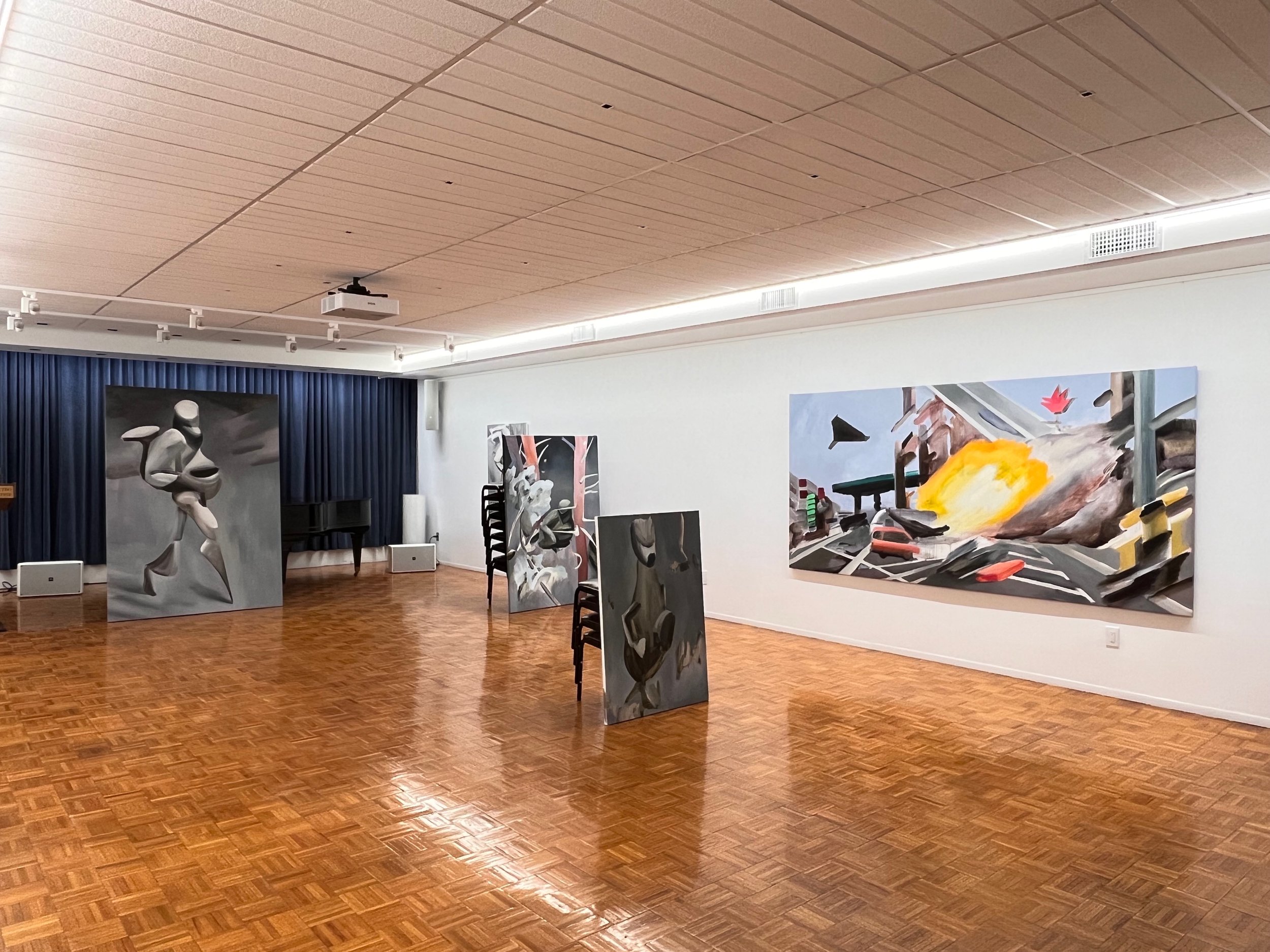
Installation view, Lesia Khomenko “Lens of Witnesses” at Shevchenko Scientific Society, NY, February 6-August 31,2026. Image courtesy of the artist.