White Is the New Coral: Hapticality and the Color of the End in Mulyana: Vital Ecosystems at Sidney and Lois Eskenazi Museum of Art, Indiana
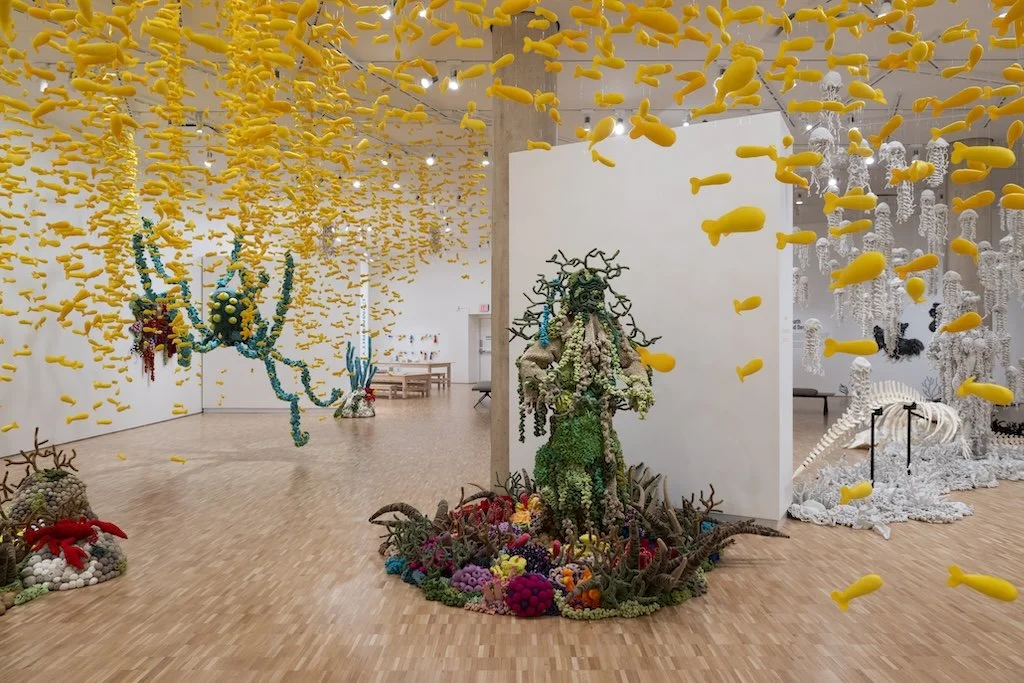
Installation view, Mulyana: Vital Ecosystems at Sidney and Lois Eskenazi Museum of Art, Indiana, image courtesy of the Museum.
Author: Sujin Jung
Published Friday, May 22, 2026
White is the new coral. In Mulyana’s undersea world, white functions as a somber signifier, reminiscent of graying hair on a dying organism or the pale ash that remains after wildfire. In other words, it is the color of the end. At the heart of Mulyana: Vital Ecosystems (Sidney and Lois Eskenazi Museum of Art, February 7, 2026–June 28, 2026), this bleached finality stands in stark contrast to the vibrant colonies nearby, forcing us to confront an ecological collapse that is difficult to conceive within the relentless logic of neoliberal capitalist growth.
In the “Vital yet Vulnerable” section at the center of the gallery, a swarm of white jellyfish hovers above a blanched coral bed, encircling a polyurethane resin cast replica of a Pygmy Sperm Whale skeleton. Their undulating bodies resemble hats with wavy edges, while their spiraling, twisted tentacles are tied with plastic vinyl. Together, these forms produce a profound hapticality. Though we are forbidden to touch in the white cube, the familiar textures of plastic yarn, nets, and cable wires evoke the tactile memory of crochet. This haptic encounter becomes a bridge, allowing us to imagine the undersea, a world often unreachable and abstract, and to feel the weight of its end. It suggests that our assumption of nature as an infinite resource is burning out. This same sense of precarity extends to the Betty series of coral islands (2022-2024). Crafted from plastic rope, net, and dacron, these malleable white coral forms spread across the gallery floor and walls.
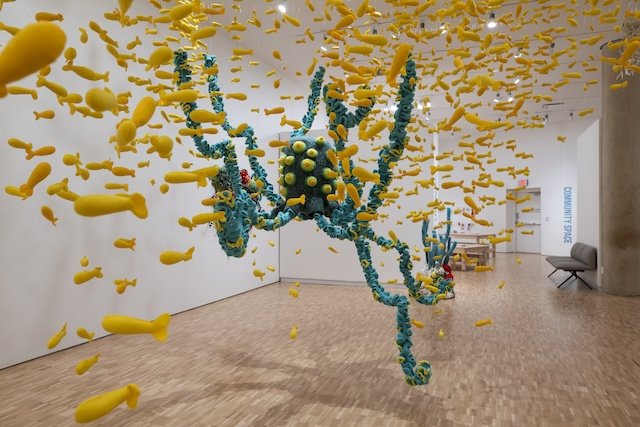
Installation view, Mulyana: Vital Ecosystems at Sidney and Lois Eskenazi Museum of Art, Indiana, image courtesy of the Museum.
In the “Death and Decay” section, the Candramawa (2021-2023) and KH/KA series of coral islands (2018) dominate the space with black and gray hues. Above them hover the artist’s alter egos, the Mogus Kosong (2018), their solitary eyes suggesting that toxicity is now a condition of shared existence. Yet, through the towering Big Mogus [Octopus] (2020) and the vibrant Harmony series of coral islands (2020-2024) on the other side of the gallery, Mulyana offers another way to imagine coexistence. The visceral hapticality of these bulbous forms and tubular extensions narrows the distance between the unreachable undersea and our own bodies.
This tactile imagination reaches a complex peak in the Harmony series of coral islands (2020-2024). Here, the presence of the lobster, traditionally a symbol of prosperity and abundance in art history, together with a mass of vibrant yellow fish, creates a seductive lushness. Biologically, coral expansion is driven by fierce territorial competition. Mulyana, however, reworks this territorial logic. In these installations, the aggressive expansion of the reef is transformed into the expansion of the community. These massive installations are the result of collective labor, hand-knitted and crocheted by various artisan communities. In this shift, occupying space is no longer about the exclusion of others or the survival of the fittest. It becomes an act of “becoming-with.”
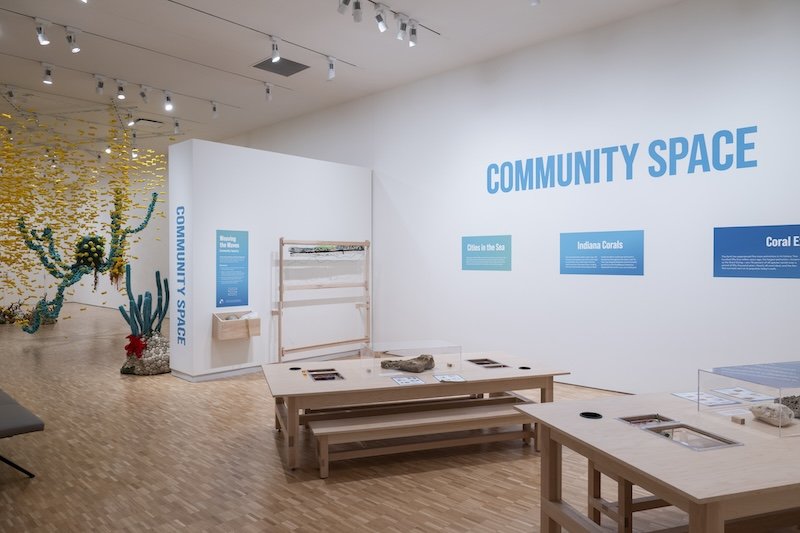
Installation view, Mulyana: Vital Ecosystems at Sidney and Lois Eskenazi Museum of Art, Indiana, image courtesy of the Museum.
This bodily hapticality also reshapes the exhibition as an immersive field of relations. The bulging clusters and tendril-like extensions, at times resembling internal organs, bring the distant undersea world into the domain of the body. The coral islands dispersed across the gallery floor and walls may appear isolated, yet they remain tethered by the invisible underwater flowing through the spaces between them. As viewers submerge themselves in these invisible currents, they move beyond the perception of singular objects and begin to inhabit the dense network of becoming-with that structures the deep sea. By making the end and the unseen tactually present, Mulyana echoes Donna Haraway’s call to stay with the trouble. The exhibition invites us toward a response-ability grounded in our intertwined world.
One of the most enduring impressions of the exhibition is a powerful spatial contrast that greets the viewer upon entering the gallery. Adikara(2021), a lush green figure of growth, is set against Form of Silence(2024), a costume shrouded in bleached textures. When these ‘costume-creatures’ are activated by performers, the competitive boundaries of nature are reimagined through a community-based hapticality. Through this encounter, Mulyana reminds us that even at the end, survival depends not on territorial dominance but on the strength of multispecies kinship.
About the author: Sujin Jung is a writer based in Bloomington, Indiana. She is a Ph.D. student in art history at Indiana University Bloomington, and her research focuses on the intersections of contemporary art, race, class, gender, and ecology.