Body and Thread: Olga de Amaral’s Cuerpo Textil at MALBA, Argentina
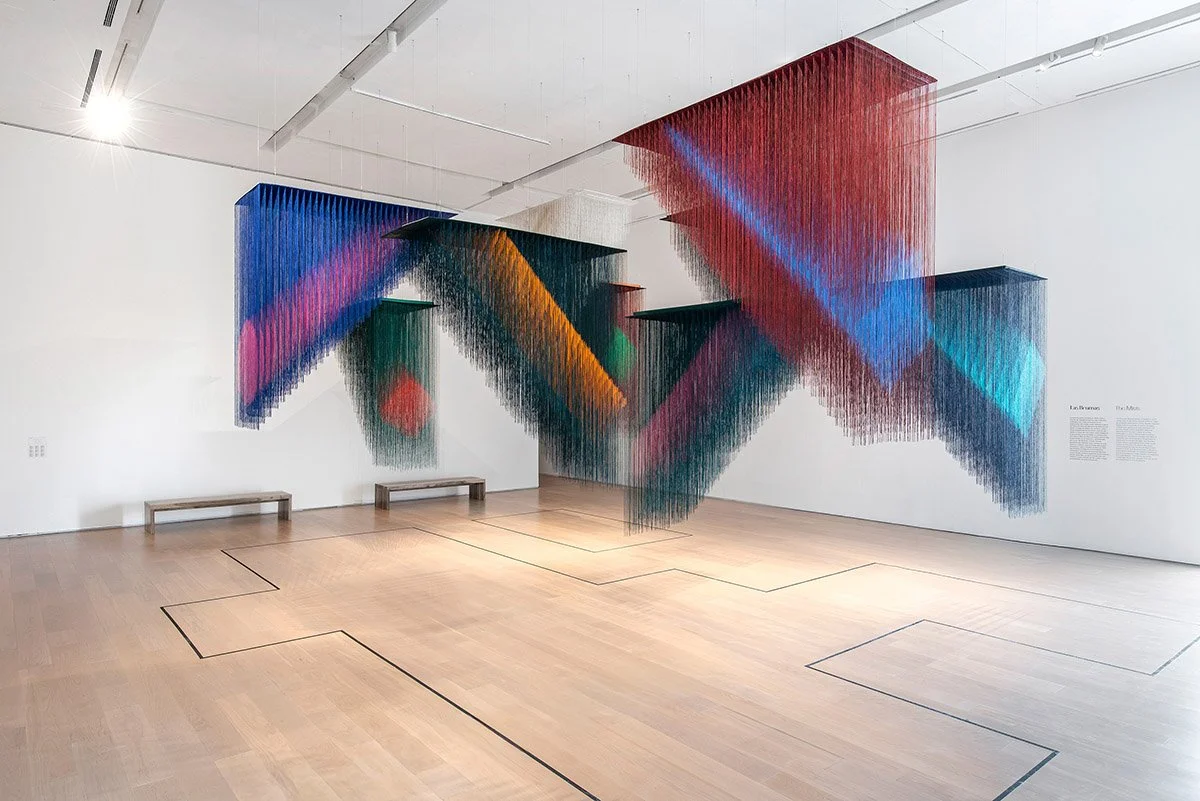
Installation view, Olga de Amaral’s Cuerpo Textil at MALBA, Buenos Aires, Argentina, February 27-May 11, 2026. Image courtesy of The Latin American Art Museum of Buenos Aires.
Author: Mariam Kvavadze
Published Saturday, May 2, 2026
In his 1946 essay The Ontology of the Photographic Image, André Bazin, the French film critic and theorist widely regarded as one of the most influential voices in 20th-century cinema, writes about the Mummy Complex: the need of humans to use the plastic arts to embalm the dead to defeat time and death. According to him, the first Egyptian sculpture was a mummy. He argued that we no longer preserve bodies because of art: “the image helps us to remember the subject and to preserve him from a second spiritual death.” In a way, museums support Bazin’s argument by bringing the plastic arts into conversation with their viewers and, in doing so, extending their life. In Buenos Aires, that second death feels further away than most places. The city’s museums are integral to its cultural life, visited often and talked about both in the press and in everyday conversation. The early months of 2026 proved especially interesting for museums and galleries in Buenos Aires, Argentina. A notable exhibition among them is Olga de Amaral’s Cuerpo textil at MALBA (The Latin American Art Museum of Buenos Aires), a title that translates as "Textile Body" and announces the exhibition’s central tension: thread as a stand-in for the human form and for history itself.
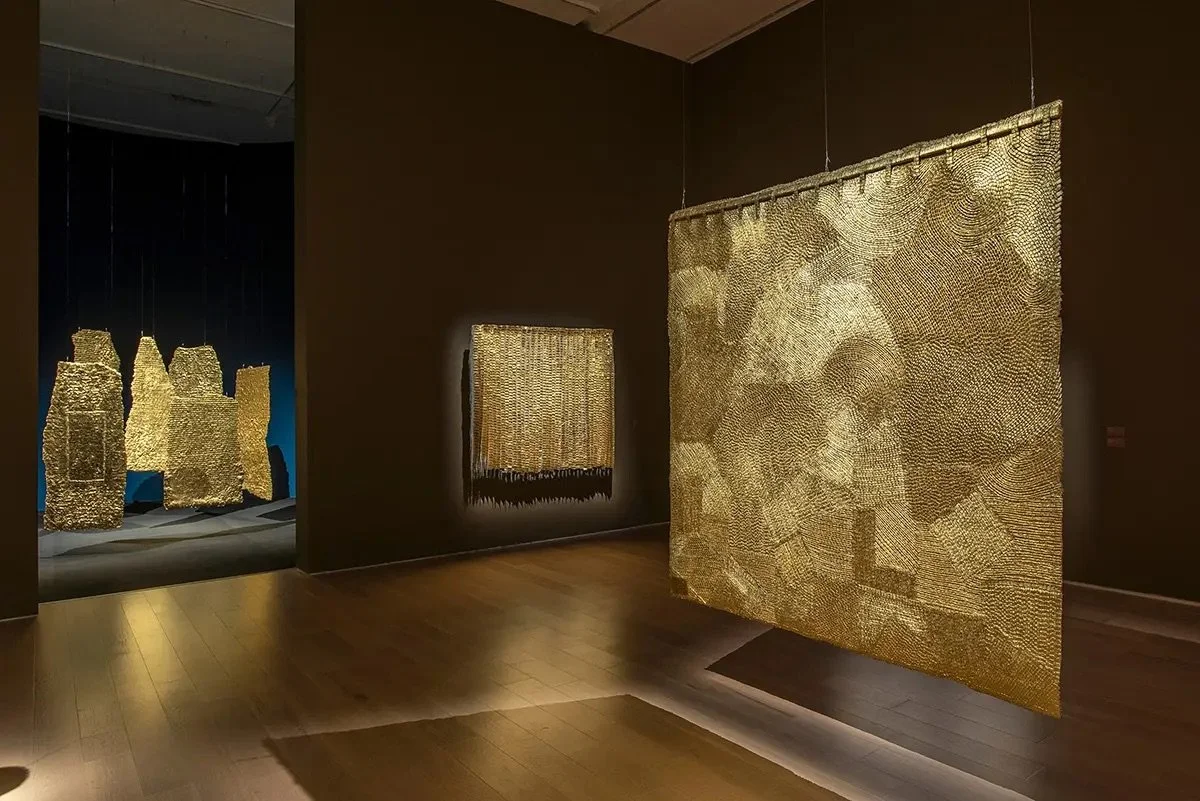
Installation view, Olga de Amaral’s Cuerpo Textil at MALBA, Buenos Aires, Argentina, February 27-May 11, 2026. Image courtesy of The Latin American Art Museum of Buenos Aires.
A pioneer, alongside Magdalena Abakanowicz and Sheila Hicks, Olga de Amaral became known for her textile art in the 1960s. The exhibition brings together more than fifty works dating from the 1960s to the early 2000s. Inspired by constructivist art, Latin American craft traditions, among them the backstrap loom weaving of indigenous Andean communities and the intricate knotting techniques of Colombian artisans, de Amaral experimented with color, materials, and scale. Mirroring the contrast between light and dark, the exhibition is divided similarly, between two halls. The first room displays nine hanging pieces from de Amaral’s series Brumas [mists], created between 2013 and 2018. The series consists of 34 pieces, each featuring thousands of individual cotton threads suspended from wooden supports, coated with gesso and painted with acrylic pigment to create, as the artist describes, a “misty rain” of pure color. Simple geometric forms – circles, triangles – are painted directly onto the hanging fibers, so that as one moves through the room, these shapes shift and dissolve. De Amaral has said that thread, for her, is like a pencil: elemental and infinitely possible. These pieces introduce the viewer to the first of many optical illusions in the show, inviting them to observe each work from multiple vantage points, and to keep coming back to them.
At the entrance of the second hall, one encounters de Amaral’s most ambitious work from 1976, El Gran Muro [The Great Wall]. Originally commissioned by the American architect John C. Portman for the atrium of his newly opened Peachtree Plaza hotel in Atlanta, it took a whole neighborhood to complete it on the streets of Bogotá. It is woven from wool, coarse horsehair, and cotton. One can feel the collective presence of the piece while standing in front of it. El Gran Muro feels less like a wall and more like a dense, textured landscape. All of de Amaral’s pieces, but especially this one, make the viewer aware of their body and its place within the surrounding space. El Gran Muro is also a defining example of la nouvelle tapisserie (new tapestry), a movement that emerged most visibly through the Lausanne International Tapestry Biennial, founded in 1962, which brought fiber art into dialogue with the broader contemporary art world. The movement rejected tapestry as purely decorative or functional, as artists began embracing three-dimensional and sculptural forms. It also changed the weaver's role from a craftsperson to an artist.
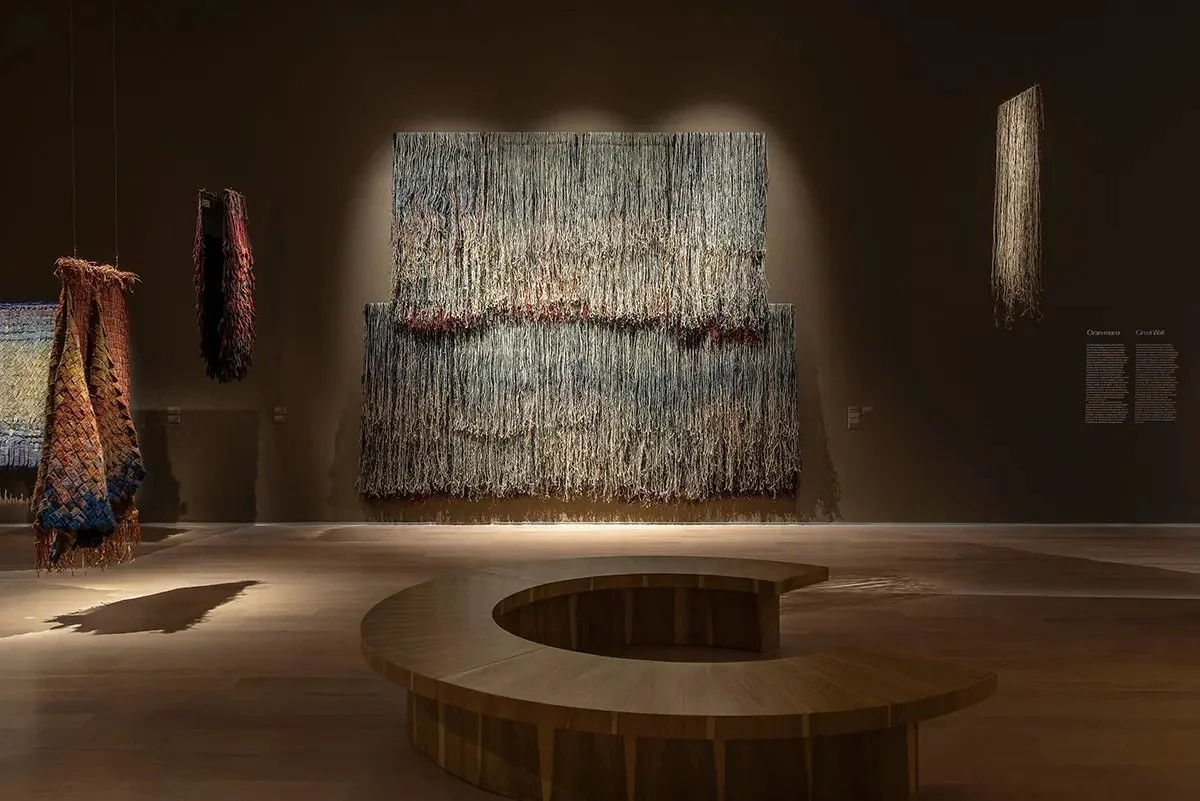
Installation view, Olga de Amaral’s Cuerpo Textil at MALBA, Buenos Aires, Argentina, February 27-May 11, 2026. Image courtesy of The Latin American Art Museum of Buenos Aires.
After two decades in the hotel atrium, the panels of El Gran Muro were dismantled during renovations, with several destroyed and others rolled into storage. What one encounters at MALBA is a fragment of something that was once inseparable from a specific building and a specific volume of air. De Amaral’s work illustrates what R.G. Collingwood, the British philosopher and historian, best known for The Principles of Art (1938), called the fundamentally collaborative nature of art – that it is never fully individual, always borrowing. This extends beyond the act of making, into the ongoing relationship between the work and the viewer.
Another striking piece is Luz blanca [White Light], made entirely from polyethylene, completely different from de Amaral’s usual selection of materials. Hundreds of layered, transparent plastic sheets are attached to a cotton grid, creating a translucent structure that radiates light and appears to move like falling water. Made in 1969 and later reconstructed in 1992 and 2010, the piece feels almost futuristic. While other pieces let light pass through fiber, Luz blanca makes light its primary subject, light which is never quite still. The fact that it required reconstruction twice is meaningful in that the work exists in time and is changed by it, very much like a human body. There is something radical and forward-looking in de Amaral's choice of plastic in 1969 – she turned the most industrial and disposable material into something close to ethereal.
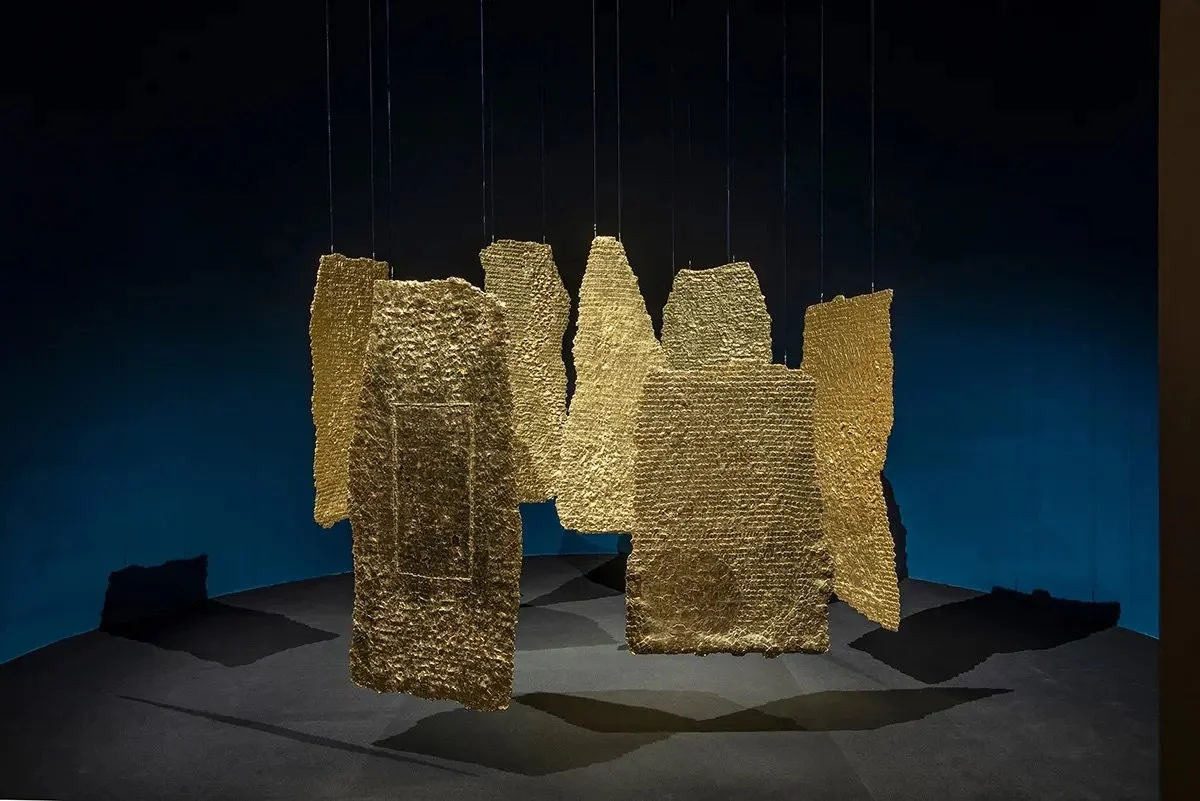
Installation view, Olga de Amaral’s Cuerpo Textil at MALBA, Buenos Aires, Argentina, February 27-May 11, 2026. Image courtesy of The Latin American Art Museum of Buenos Aires.
Right when one thinks they have seen everything in the exhibition, they notice a small, rounded space, intimate and almost hidden, filled with her gold-leaf pieces, Estelas [Trails], made in 1966. Standing there, it felt like coming close to something sacred, something pure, so simple and yet deeply emotional. The gold, drawn from the intertwined histories of pre-Columbian and colonial art, catches the light differently depending on where a viewer stands. After the textures and volumes of everything that came right before, the room feels like a culmination. It almost mimics the experience of meditation, and this is a conscious curatorial choice.
De Amaral’s works defy categorization. Some of her works look like paintings, some are visibly sculptures, and some help shape a place into what it was meant to be. They ask questions about time, place, and the body, but leave enough room for the viewer to find their individual experiences.
About the author: Mariam Kvavadze is an art and literature student at Minerva University with experience in museums and cultural institutions across five countries. She is currently interning at MALBA in Buenos Aires and will be joining Sotheby’s New York as their incoming Latin American Art intern.