Processes of Becoming | Legacies in Paper: Nancy Cohen, Sara Garden Armstrong, & Helen Hiebertat the Robert C. Williams Museum of Papermaking, Atlanta
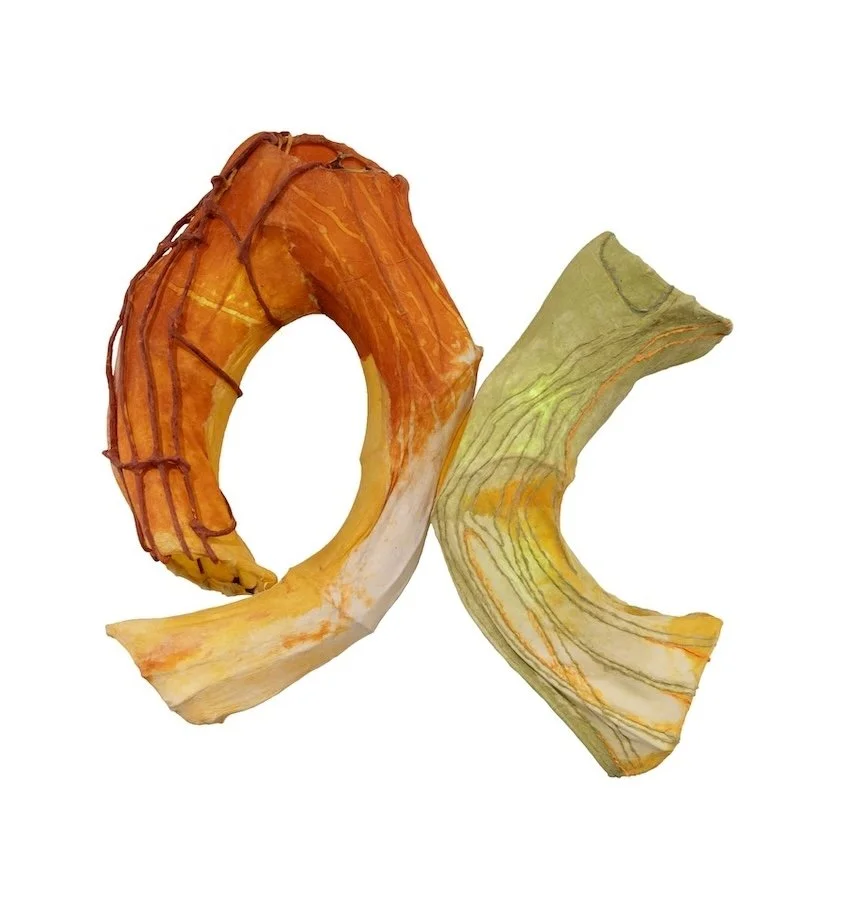
Nancy Cohen, A Bridge Between, 2025, Paper pulp, handmade paper, & wire 20 x 20 x 5 inches, photo courtesy of Joya Chapman and Robert C. Williams Museum of Papermaking
Author: A.E. Chapman
Most astronomers cite the universe as 13.8 billion years old or even older while evidence of homo sapien life dates back to at least 300,000 years ago. Within this vast conception of time, the 2,000-year history of paper seems relatively nascent. Yet in our increasingly digitized world where time appears to accelerate, our relationship to materiality and duration becomes increasingly elusive. Legacies in Paper: Nancy Cohen, Sara Garden Armstrong, & Helen Hiebert, an inaugural presentation in the triennial exhibition series, curated by Jerushia Graham at the Robert C. Williams Museum of Papermaking at Georgia Institute of Technology, presents an apt expansion on the museum’s rich collection by showcasing contemporary artists rethinking the potential of paper, appreciating its history but also insisting on its future, despite our exponentially digitized day to day.
Housing over 100,000 objects such as rare books, manuscripts, papermaking tools, and paper samples, the oldest artifact in the museum’s collection is a fragment of a Chaldean tablet, from approximately 4000 BCE while its oldest paper object dates back to roughly 25-220CE from China. The museum itself has an itinerant history. Founded by Dard Hunter in 1939, it relocated from its original location at the Massachusetts Institute of Technology in 1954 to the Institute of Paper Chemistry in Wisconsin before moving to its current home base, Atlanta, in 1989. The common denominator of institutional support across this trajectory poignantly suggests that the palpable tangibility of paper still holds significant value even within the most technologically driven environments. Furthermore, Legacies in Paper: Nancy Cohen, Sara Garden Armstrong, & Helen Hiebert posits paper’s unique resonance with the corporal, mimicking and channeling the organic tactility of the body and nature, while bolstering the material’s ability to connect us to the act of being present, slowing down time.
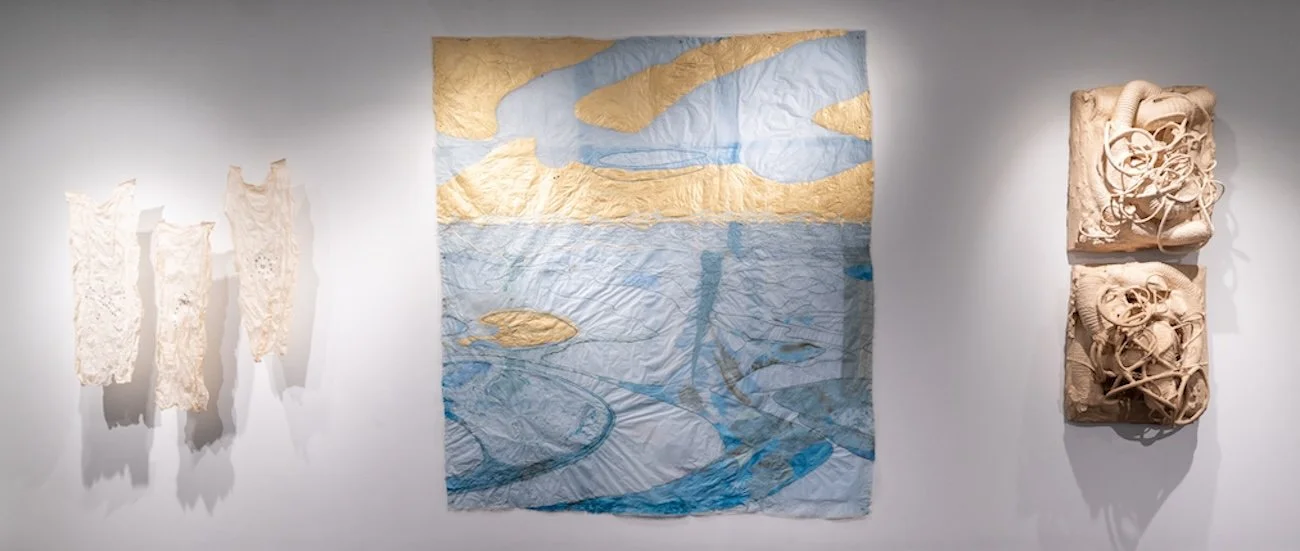
Installation view, Legacies in Paper: Nancy Cohen, Sara Garden Armstrong, & Helen Hiebert, Robert C. Williams Museum of Papermaking, photo courtesy of Joya Chapman and Robert C. Williams Museum of Papermaking
At the entryway of the exhibition, a steady, soft whir emanates from a dark room where Armstrong’s Airplayer XIX (2025) pulls viewers into the uncanny installation of large sprayed abaca sculptural forms, embedded plastic hosing, blower boxes, video projections, and digitized sound of an oceanscape. Some forms hang from the ceiling like cocoons or pods, while others stand stoically erect in the manner of stalagmites or coral, surrounded by bulbous neighbors emerging from the walls. Air blows through industrial hoses attached to several of the objects, spinning those hanging around slowly, in tune with the rushing air. The slightness of their movement reminds viewers of the sensitivity and agency of air in our physical world, shifting attention to the relationship between our own physical presence and the invisible currents flowing through the gallery. Armstrong juxtaposes the exterior body with that of its interior—the hose tubing alluding to systems inside the body, particularly those powering its most basic rhythms, heart and breath. The tension between interior and exterior, flow and containment, visible and invisible disorients the viewer. The ethereal projections throughout the room and glowing lights illuminating many of the membrane-like forms from within imbue the installation with a mystical, sci-fi, supernatural overtone, encouraging viewers to ponder the subjective and ever-shifting nature of reality—experienced differently by individuals but interdependently and collectively negotiated.
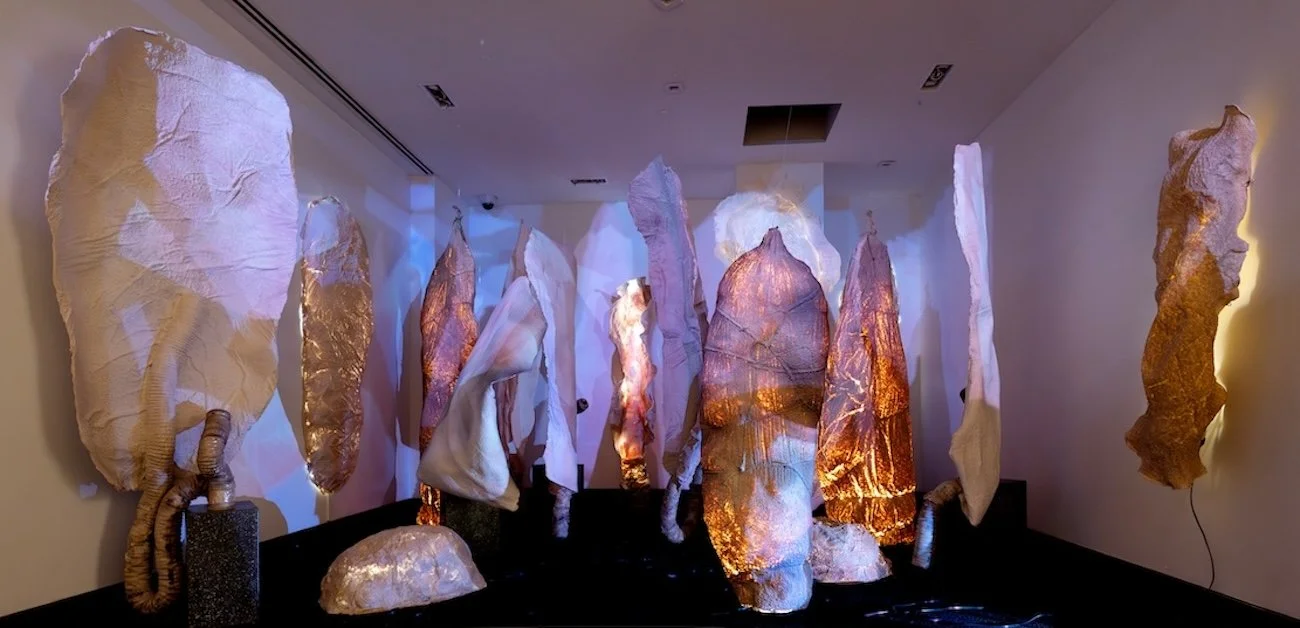
Sara Garden Armstrong, Air Player XIX, 2025, Sprayed abaca forms, embedded plastic hosing, blower boxes, microcontroller, video projections, digitized sound, LED and incandescent lighting, acrylic, 14 x 12 x 8 feet, photo courtesy of Joya Chapman and Robert C. Williams Museum of Papermaking.
A wall of small frames with abaca paper and thread by Hiebert demonstrates interventions in the surface of the handmade paper works such as slices in the paper and holes mended with thread. Formally, this series shares affinities with Anna Maria Maiolino’s exploration of holes, thread, and paper prevalent in her oeuvre, most strikingly in Maiolino’s work from the late 1960s through mid 1970s. Though both artists explore thread and line as a metaphor for connection (motherhood in particular), Hiebert finds her forms during the process of handmaking paper, making cuts to the material while it is still wet and allowing time and paper’s own molecular process to transform it. Also on view, Hiebert’s mesmerizing film Water, Paper, Time documents her collaboration with paper—Hiebert’s interventions become prompts for the actively drying paper to react to. Her series Specimens (2015-2025), a collection of tiny sculptures, articulates the abundant results of this ongoing partnership.
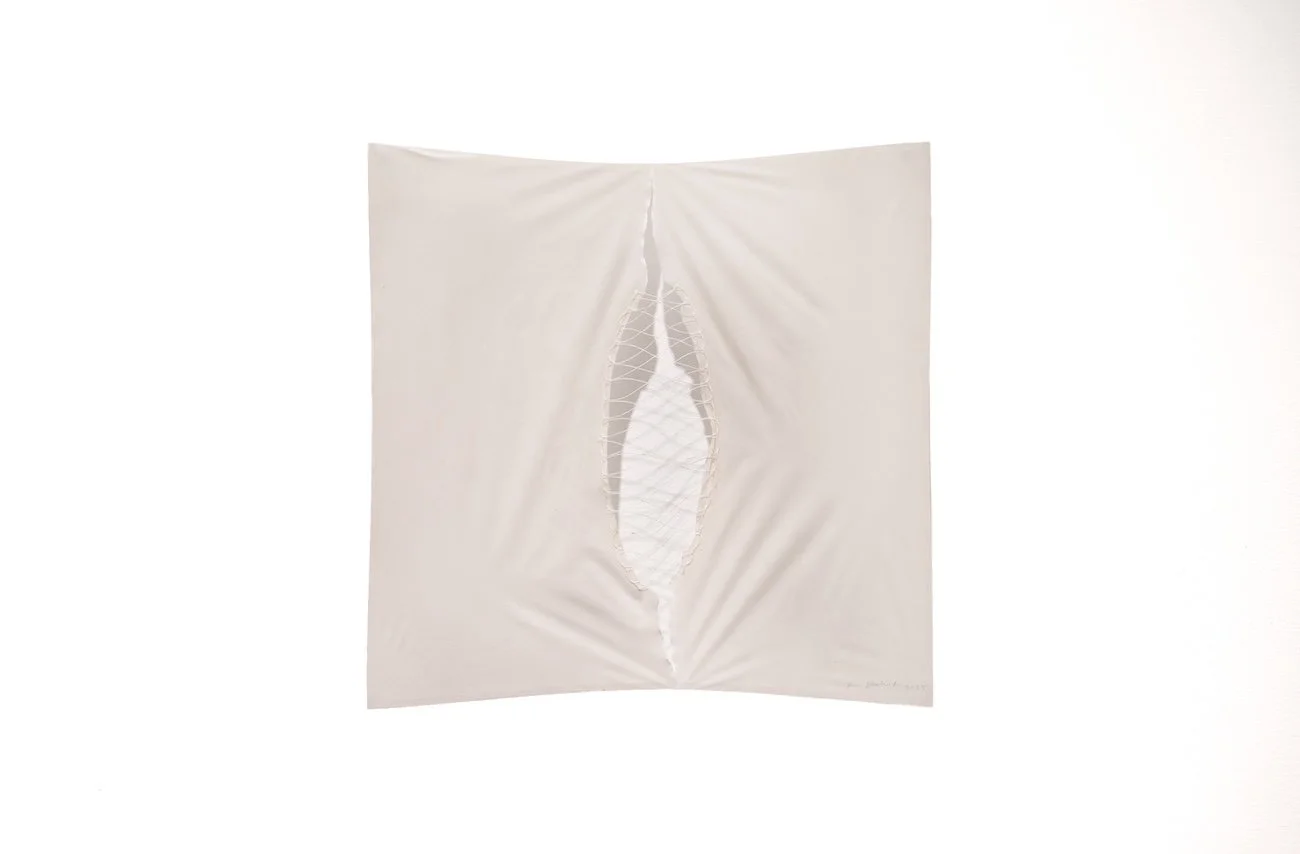
Helen Hiebert, Across (2025), fragile plexiglas frame pieces with abaca paper and thread, 14” x 14” x 1-¾ inches, photo courtesy of Joya Chapman and Robert C. Williams Museum of Papermaking.
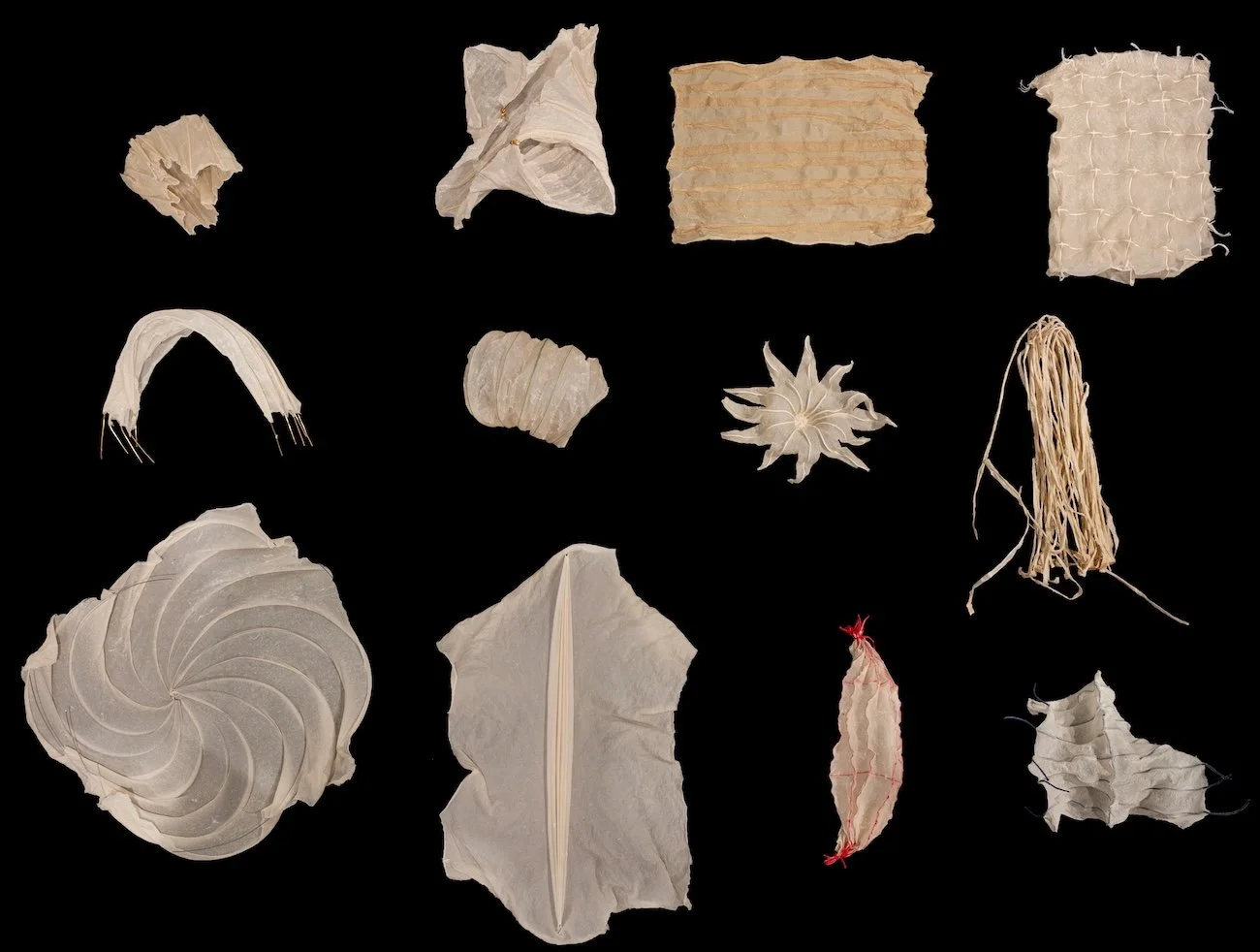
Helen Hiebert, Specimens, 2015-2025, abaca, wire, and string, dimensions variable, photo courtesy of Joya Chapman and Robert C. Williams Museum of Papermaking
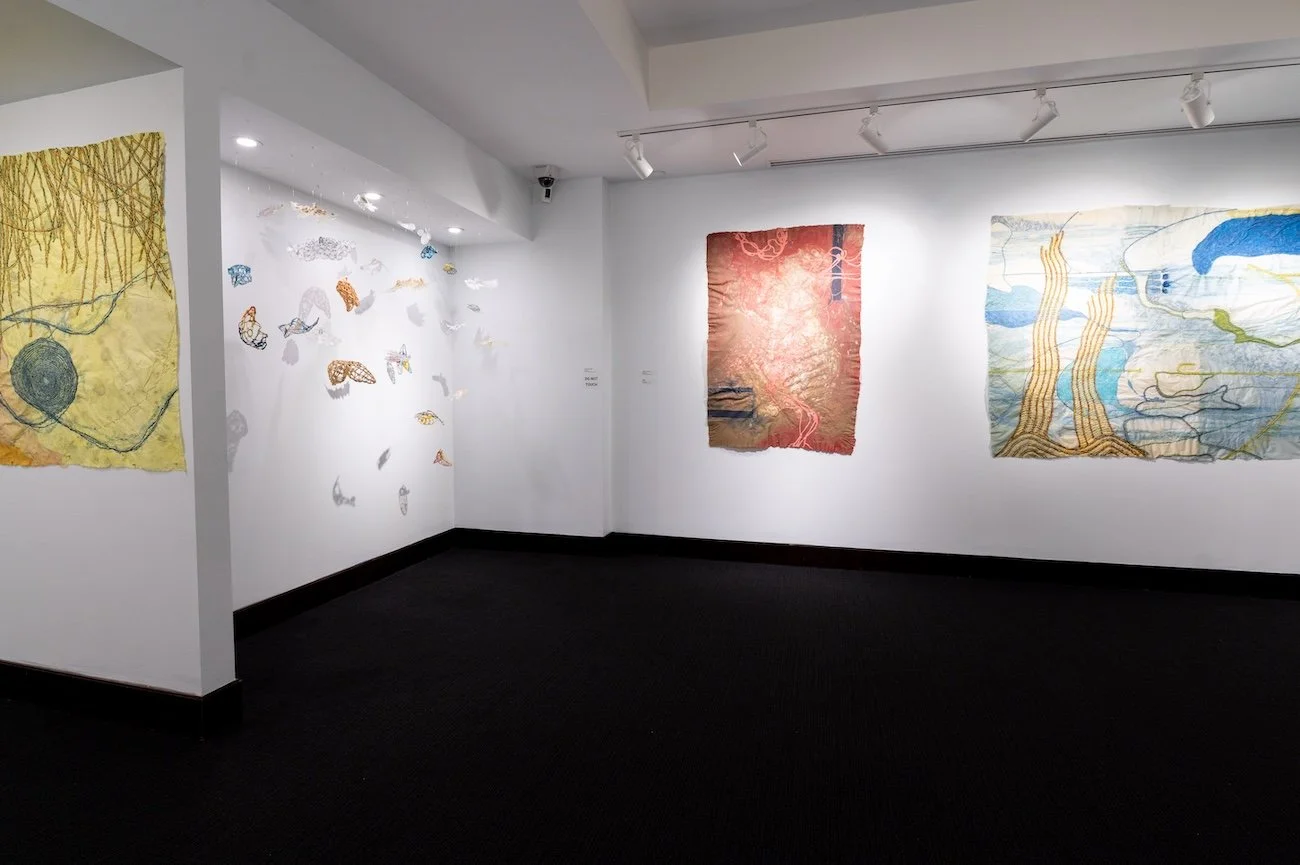
Installation view, Legacies in Paper: Nancy Cohen, Sara Garden Armstrong, & Helen Hiebert, Robert C. Williams Museum of Papermaking, photo courtesy of Joya Chapman and Robert C. Williams Museum of Papermaking
Subverting popular associations of paper as simply a backdrop for applied marks, Cohen’s vibrant pigments are embedded in the paper pulp that she employs to create organic forms that oscillate between abstraction and figuration. The ripples and textural depth of this pulp across the surface of her large paper works serve as witnesses to Cohen’s intimate, intuitive approach to the material and its responsive, tactile nature. Her proclivity for dimension and physicality is exceptionally evident in the sculptures on view. The Meaning of Wings (2021-2022), an installation of intricate, delicate sculptures made with glass, wire, and handmade paper, hangs in a quiet nook diagonally across several new sculptures by the artist, including A Bridge Between (2025). With this new sculpture, Cohen has placed lights inside its body, illuminating the transparent layers of the resilient yet fragile form reminiscent of large, fossilized bones.
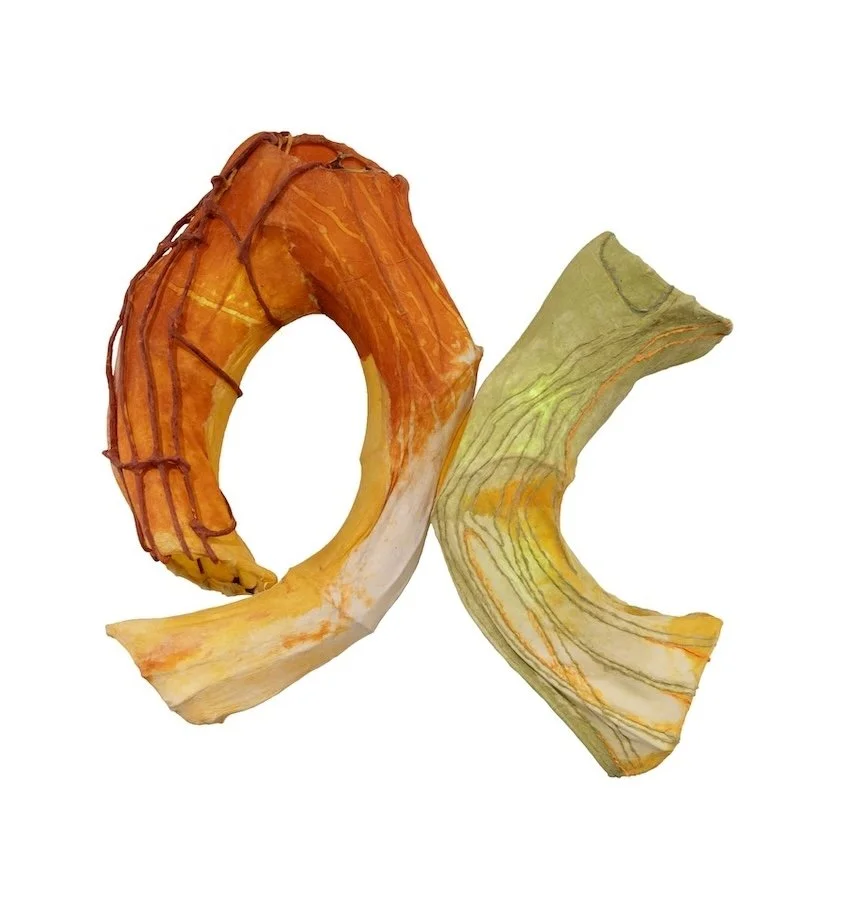
Nancy Cohen, A Bridge Between, 2025, Paper pulp, handmade paper, & wire 20 x 20 x 5 inches, photo courtesy of Joya Chapman and Robert C. Williams Museum of Papermaking.
Curator Graham stages a robust, sensual show championing touch, intimacy, and sensorial emotion. In Legacies in Paper: Nancy Cohen, Sara Garden Armstrong, & Helen Hiebert, an undulation of physicality and ephemerality accentuated by a continuous interplay of shadow brings viewers back in touch with not only the transformative processes and materiality of paper but also the material of their own, ever-evolving (fleeting), corporeal existence.
About the author: A.E. Chapman is an independent curator, writer, teaching artist, and facilitator based in New York City. She received her MA in Art History and an Advanced Certificate in Curatorial Studies from Hunter College, where she was awarded the Edna Wells Luetz/Frederick P. Riedel Scholarship to support her master’s studies based on her excellence in significant post-baccalaureate undergraduate coursework at Hunter in studio art and art history. She holds an undergraduate degree in Journalism with a Photojournalism Emphasis and a minor in Sociology from the University of Georgia.