Raphael: Sublime Poetry
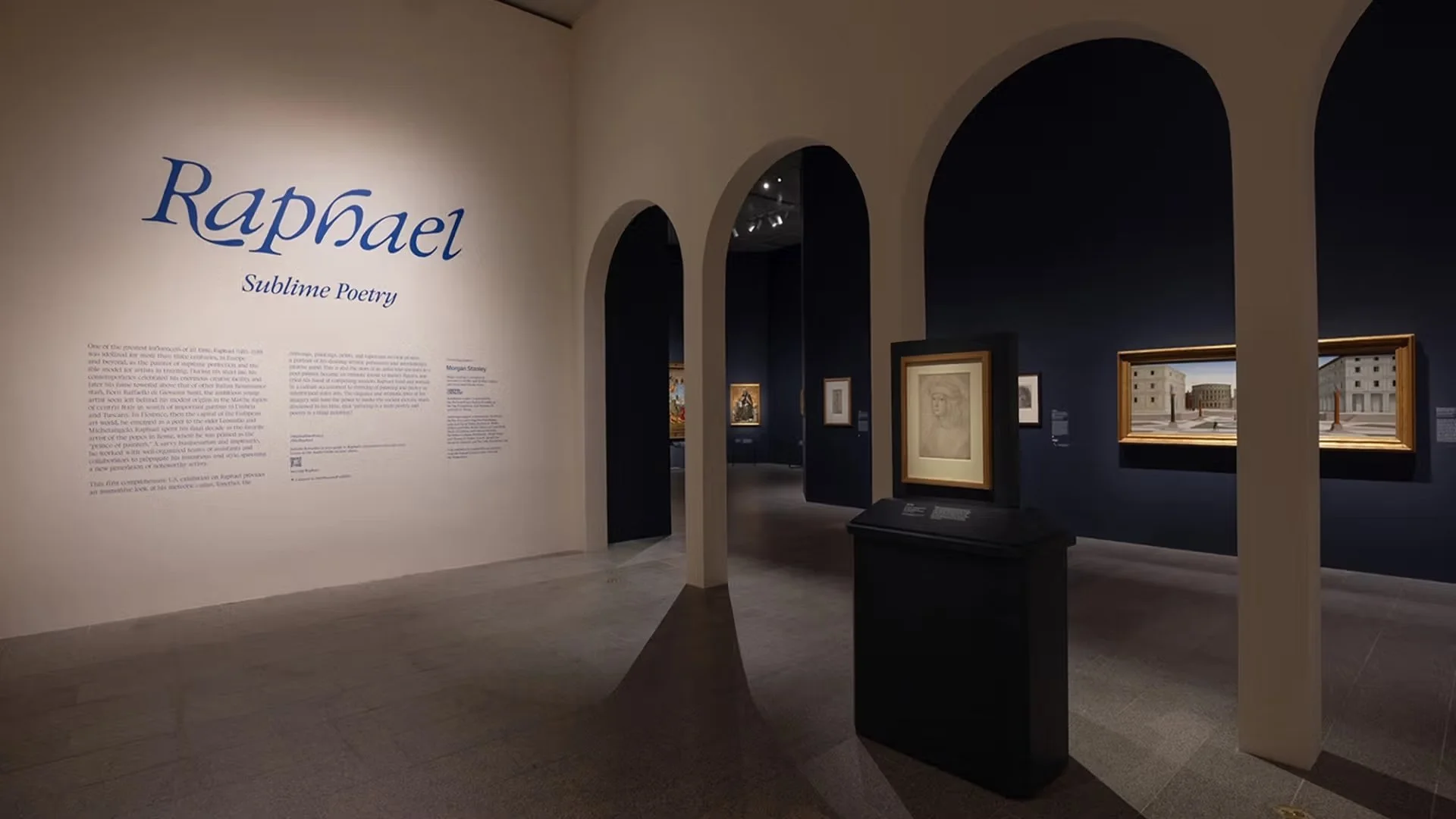
Installation view, Raphael Submlime Poetry, image courtesy of the Met.
Author: Yasmeen Abdallah
Published Saturday, June 20, 2026
Sublime Poetry, an expansive retrospective of the renowned Renaissance artist, Raffaello di Giovanni Santi (known colloquially as Raphael). This carefully crafted curatorial vision is presented as an extensive journey of the artist’s life. The exhibition features 237 works, with over 170 of them by Raphael. Additionally, prominently displayed pieces by mentors and peers significantly inform his unique style and the greater trajectory of his path. The youngest of the most renowned Renaissance artists, Raphael’s short, dynamic life is laid out thoughtfully, highlighting not only his masterworks but also his ideations and inspirations.
The show is composed of artworks already in existence at the Met, as well as many on loan from private collections, public institutions, museums, and collections across the globe. Collaborations and loans, as well as archival restoration, were also a part of this extensive undertaking, and this has been an exceptional milestone for the Met. Eight years in the making, intensive research was dedicated to understanding not just the artist, but the person in a holistic sense. There is a grand presentation of the selected works, and a fascinating narrative laid out for viewers to dive into. 144 drawings that are rarely exhibited are present, in an impressive manner that lays bare the breadth of Raphael’s knowledge.
This exhibition unfolds like a story - a visual narration of the brief but prolific life of Raphael. The galleries open to reveal various segments of his life: early renderings that depict delicate line work, after moving to Florence and experiencing Da Vinci’s work, develops a more scrawling style like the elder artist. His early life started in the town of Urbino, before he moved to Florence to study and train in the flourishing city where great masters Leonardo Da Vinci and Michelangelo were working. It illustrates a journey of a young man saddled with loss and responsibility at a young age, driven to create a prolific studio practice that would become one of the most significant cornerstones of Western art.
Raphael was born Raffaello di Giovanni Santi in the Marche region of central Italy in 1483, and would die at the age of 37 years old in 1520. During his brief but impactful life, his talents were celebrated and cemented his legacy as one of the greatest artists to emerge from the Renaissance. His journey as an artist began through training with his court artist and poet father, Giovanni Santi, before moving to Umbria, Tuscany, and later Florence, where he would ultimately be creating work alongside older contemporaries he admired, such as Leonardo da Vinci and Michelangelo. Raphael soon came into favor with powerful papal leaders in Rome, and was selected for numerous significant commissions in his brief but magnificent career.
Glimpses of Raphael’s life, from personality traits, to perspectives, to those he felt closest to, are thoughtfully included in the show, in a considered effort to round out the larger-than-life legacy of the artist and reveal the human, earthly qualities of Raphael. Harmony, ethereality and discipline spill through the works that leave one spellbound. His compositions are up close and personal, allowing viewers a peek into the brilliant mind at work. The low lit setting and dark walls contribute to this elemental experience, enhancing a dramatic mood in which the work shines brilliantly.
Carmen C. Baumbach, Marica F. and Jan T. Vilcek, curator of Drawings and Prints at the Metropolitan Museum of Art served as the organizing curator of the exhibition, and is one of the leading experts on Renaissance art. Dan Kershaw served as designer of the exhibition, creating a chapel-like environment to enhance the viewing experience of the work by extending the renaissance experience to the structural components as well. This entailed the dedication of a 200 ft walkway from one end of the gallery to the other, as a means of creating a clear path to move more easily around the works, and to avoid a sense of overwhelm by the amount of works. The geometry of Raphael’s work is reverberated through these fabricated walls, underscoring his profound talents and capabilities to metabolize hard angles and physics seamlessly with emotional intelligence and utter grace.
Drawings, prints and paintings are displayed from the beginnings of his career until the end. His proficiency as an artist extended into his work as a master draftsman of architecture and designer of sets, and tapestries. Raphael’s dedication to the discipline of portraiture is also prominently represented; a tenderness and familiarity between artist and subjects clearly visible to viewers even today. Raphael was able to weave these disciplines seamlessly into his breadth of work, supported in part by a well-organized studio practice, reflecting that, “painting is a mute poetry, and poetry is a blind painting.”
As is the case with most special exhibitions at the Met, the show is sweeping and majestic in both appearance and concept. The breadth in which one has the potential to witness the brief but prodigious life of Raphael is truly a gift to the public. The gallery’s cathedral-like ceilings reveal an acoustic charm that allows for an old world parallel. Transfiguration, Raphael’s final work, is highlighted in this presentation; an absolute masterpiece that feels miraculous and like a pilgrimage of sorts.
The curatorial vision also included a devoted section of the exhibition reflecting upon the high mortality rate of women of childbearing age, which was unfortunately incredibly common at that time, and also something that impacted. Curator Carmen Bambach refers to Raphael as one of the greatest influencers of all time, due to his ability to persuade and depict daily life and biblical idealization, composition and perfected storytelling through perspectives and emotional connection. stories in a manner that appears seemingly effortless childbirth, death, likely influenced by the early death of his own mother.
Much of Raphael’s drawings reveal his efforts to animate the subjects, with particular focus on the young Christ and his disciples as cherubic babies and children. Other objects, such as devotional processional crosses allowed for Raphael to explore various design studies and fabrication strategies. The architectural structure of the gallery was envisioned and constructed to mirror the architectural work by Raphael. High ceilings, dome-like ceilings, and a grandeur to mirror the glorious aura of the precious Renaissance works. The darkly painted walls lend a sense of piety and awe, similarly to entering a cathedral, temple, or sacred house of worship.
The various Madonnas that Raphael portrayed interestingly start blonde, and later shift to a brunette look. There are subtle gestures like this throughout Raphael’s oeuvre that reveal themselves to observers as little gems of discovery. A sense of serenity and peacefulness is consistently shown in these works, situated in beautiful, pastoral landscapes that present a heavenly element. His determination regarding continual refinement of his artistry is evident through the development of cherubic figures, particularly in Composition Study for the Holy Family with Saints and a Pomegranate (recto); Letter to Domenico Alfani (verso), circa 1507-08; The Virgin and Child with the Infant Saint John the Baptist (Studies for the Madonna of the Meadow) (recto and verso); and Madonna and Child with the Infant Saint John the Baptist.
Closing on June 28, 2026, at the Metropolitan Museum of Art in New York City, this is a must-see, sprawling examination of the endless ingenuity that Raphael possessed. Sublime Poetry is true to its title as anexhibition that unfolds little glimpses into the brilliant mind of the artist, and ways in which Raphael saw the world, offering slivers into the beautiful gifts he bestowed upon it.
Images courtesy of the Metropolitan Museum of Art.
Raphael: Sublime Poetry is on view through June 28,2026.
Yasmeen Abdallah is an interdisciplinary artist, curator, educator, and community organizer focused on history, contemporary culture, social engagement, and decolonial practice. Her work is in public, private, and traveling collections. She is a contributing writer for Artspiel and Urban Activist, among other publications, and is based in New York.