Working Conditions at Westbeth Gallery, New York
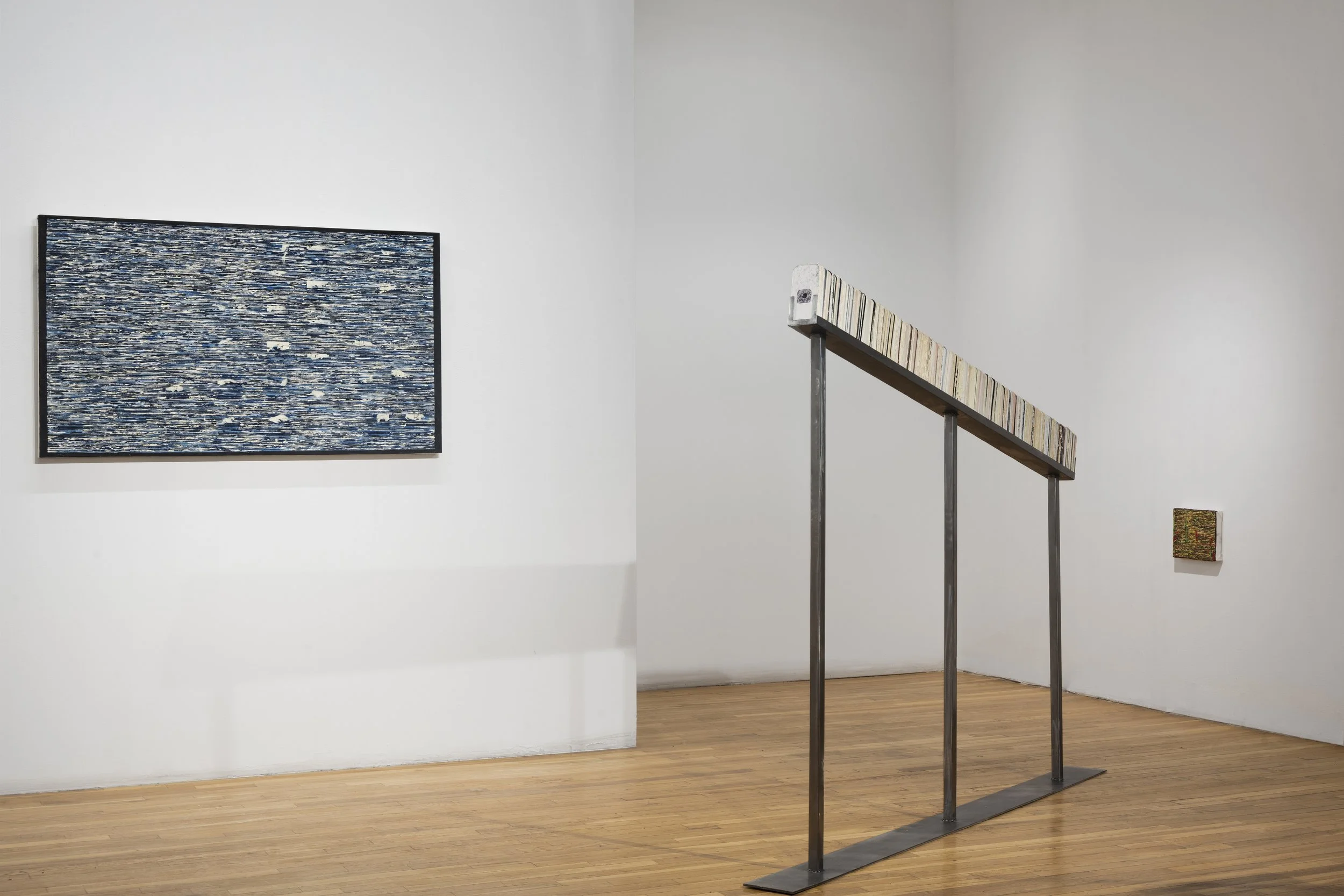
Installation view, Working Conditions, Westbeth Gallery, New York, April 28- May 17, 2026. Image courtesy of the artist and Residency Unlimited.
Author: Chloe Alto
Published Thursday, July 9,2026
An Artist Survived Today–the phrase hangs on a black flag in stark sans-serif font at Westbeth Gallery. Created by Ekene Ijeoma, the work once billowed above a street before relocating indoors, where it remains fully legible to passing New Yorkers through the gallery’s glass facade. The statement could read as observational, a Darwinian reminder that only the fittest, slickest, and most commercially savvy artists have won today’s fight for survival. Or perhaps it operates as a bereft and neutral fact that to be a working artist is to accept the title’s instability and lack of support systems as a permanent condition. In either case, the phrase implicates the viewer: an artist survived today–what will you do about it?
Perhaps nothing. An artist survived today, and somehow the gallery stands unperturbed, indifferent, never not full with art. While the labor required to produce an exhibition- time, energy, resources, wage work- is implicitly understood, the systems sustaining this labor often obfuscate. Curated by Phil Cai, Working Conditions presents several artists whose survival is predicated on one set of conditions: to work as an artist, one must also work elsewhere. The exhibition brings together five artists whose multi-hyphenate careers include roles as a JPMorgan product manager, a conservation technician, and an internal Operational Director at Residency Unlimited. This very organization brings the show’s artists together.
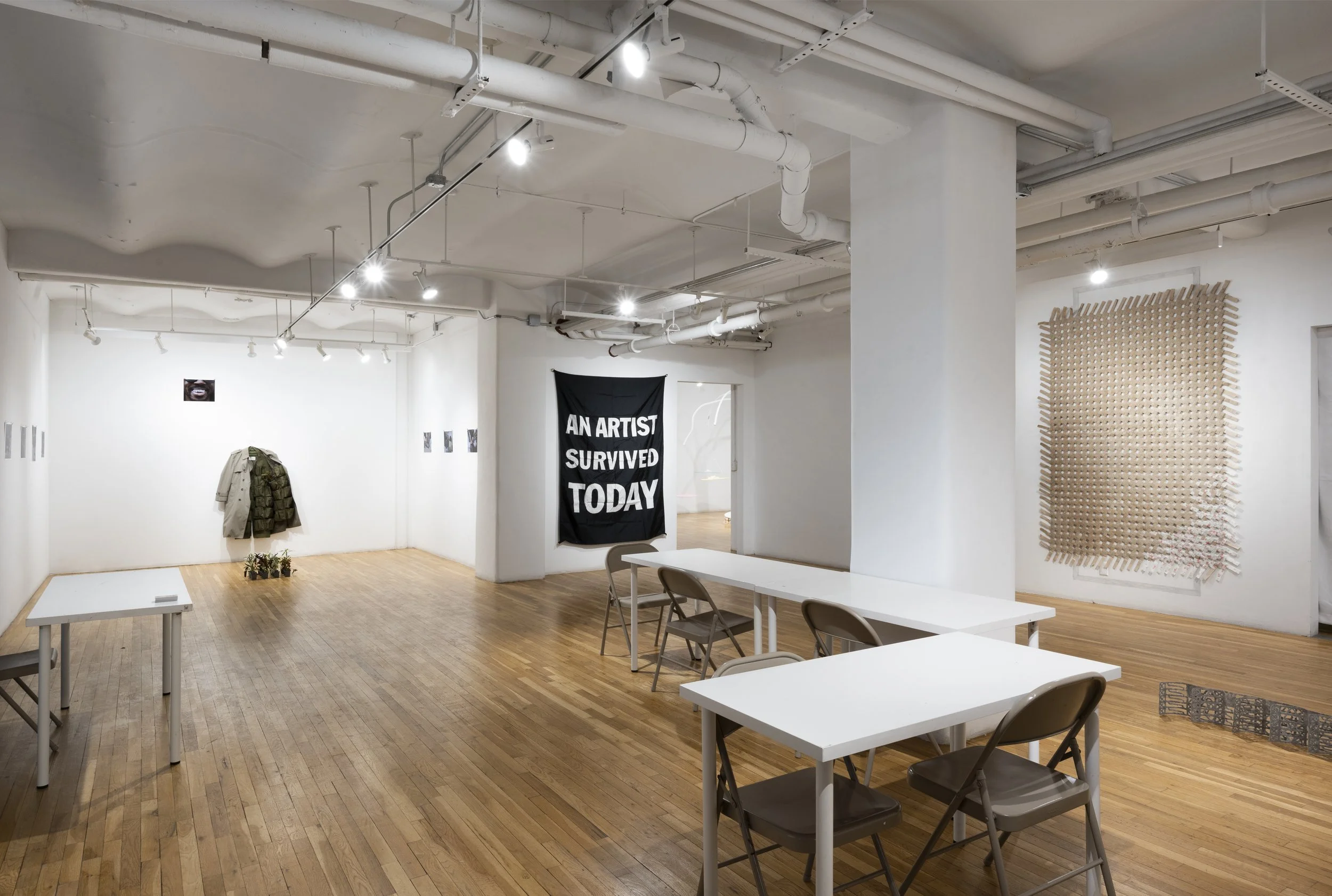
Installation view, Working Conditions, Westbeth Gallery, New York. April 28- May 17, 2026. Image courtesy of the artist and Residency Unlimited.
Automated doors make way for several tables fitted with metal chairs, and a station for free corporate gut-healthy sodas sits against a wall. The show resembles a functioning coworking space; I recall a patron asking if the gallery was open or an office. A heavy three-sided desk is the first spatial clue that something is misaligned. Embedded into Catherine Chen’s Brute Gamification (2025) sit three-by-three grids of notepads densely penned with what resemble office doodles, a step back revealing them as endless rounds of tic-tac-toe. The adjacent Office Pantry Sign (2026) reads “Please take only 1, or there will be none for your fellow employees,” a malleable aluminum cast from Chen’s office. Test you to test me (2026) is an oblique line within the pseudo-office landscape, created with precariously stacked palm-sized paper cards against slanting stainless steel, a single string pulling it upwards. The stack is sedimentary, created in layers of Manila folders cut in the shape of iPhones, and at the bottom, fossilized fragments of a Chase Freedom card.
Photography is a choice medium for three of the artists in Working Conditions. On one end of the main room, Ekene Ijeoma’s Tree Hustler (2026) is presented in photographs along with a work jacket and several saplings arranged on the floor. The elements presented in Working Conditions are the product of a two-day performance where the artist used a wearable coat with 40 pockets to sell 160 trees around New York. Following the cancellation of a $1.5 billion urban forestry grant, Ijeoma began the Black Forest initiative and raised funds to plant over 40,000 trees across the U.S., Africa, and the Diaspora over 12 years. The numbers 4/40 and 12 reference 40 Acres and a Mule and 12 Years a Slave, framing the work as a form of reparations.
Rehan Miskci is a Photography and Digital Imaging Manager at the Woodman Family Foundation, and directly reproduces her workplace’s technical conditions in her personal studio. A drawn curtain reveals a room of Miskci’s hidden technicolor gradients, streaks, and smears at large scale. These polychromatic experiments compress time, space, and light in filmic Digital C-prints. Jiangshengyu Nova Pan is a conservation technician at the Baltimore Museum of Art and a moving image artist. Pan’s short film Soft Push (2026) is set at the Baltimore Museum of Art, its locale collapsing the artist’s labor and artistic production in the depiction of a routine sculpture-brush off.
If the axiom holds that the “artist” must remain separate from one’s secondary, supportive day-job or career, the division dematerializes in Working Conditions. Office furniture, workplace systems, and tools of administration become material for artwork, and the workspace becomes an installation. Working Conditions takes its title from the eponymous writings of Hans Haacke, which dissects the notion of the “artist” into two intertwined identities: the one who makes art, and the one who performs “artist” as a profession. If there is a tension in the exhibition, it lies in the increasingly impossible fantasy of identifying solely as “artist.” Josh Kline’s recent contribution on New York Real Estate has prompted the broader question: How does New York sustain artistic practice in the present, if at all? Working Conditions does not choose to answer this conundrum, but does instead reflect the current systems under which working artists live, survive, create, and work. Perhaps the show is a reminder that art indeed necessitates its own conditions of labor; there is a reason we refer to it as artwork.
Lulu Meng’s Toric Allying (2026) takes up an entire room, a hybrid of pastel playground equipment and a branching tree, completed with scales and weights. The interactive sculpture balances, or loses balance, through interactive weights. One may place all weights on one scale, in an even dispersion, or stand in observation. Ultimately, the chosen gesture does not matter; even the smallest changes by another patron will send the sculpture jolting the other way. Though a galley attendant waters them every day, interior light dulls the saplings from Tree Hustler. In Brute Gamification, there are in fact no winners; every notepad tic-tac-toe configuration ends in stalemate.
But these artists do more than lament such conditions. At the show’s opening, Toric Allying (2026) brought together a steady stream of viewers in a blithe spirit. Office Pantry (2026) offers up protein bars from Chen’s office to passersby (one of which I took on the way out). Dust from a museum’s discard pile spawns the shape of a bunny (The Fourth Night, 2026). If the collapse of the office into the art space produces anything, it may be a form of collectivity.
To my surprise, the tables I misconstrued earlier as office desks do actually function as working spaces. Conceived by Phil Cai, Vu Thien An Nguyen, and the operational Director of Residency Unlimited, Lulu Meng, the tables are both performance art and a free, designated workplace. If artists labor in art production, spectators labor in their active consumption–were this relationship not clear enough, one can book a table via QR code and sit alongside the gallery attendant. It is as much the artist who must follow the rules of labor acted upon by the art world, as the viewer; to view is to spend time, energy, financial and cultural resources, in some instances wage work. The press release addresses those who choose to sign up to work: Please feel free to sit down, pay some bills, do your taxes (if you are late), brainstorm an idea, or curate your next show. No credit-giving is required.
Working Conditions was on view at Westbeth Gallery, 55 Bethune St, New York April 28 – May 17, 2026.
About the author: Chloe Alto is a New York-based writer and founder of CRITCLUB, an organization holding formal studio critiques for young artists with the goal of fostering dialogue around developing practices. Her writing centers contemporary art discourse, with a focus on Asian and Asian American artists. She has worked with galleries including SAPAR Contemporary and Eli Klein and was the curator for Silk in collaboration with the Asian American Alliance at Columbia University. She continues to engage in critical writing and exhibition-making, and in advancing spaces for rigorous discourse in emerging New York artist communities.
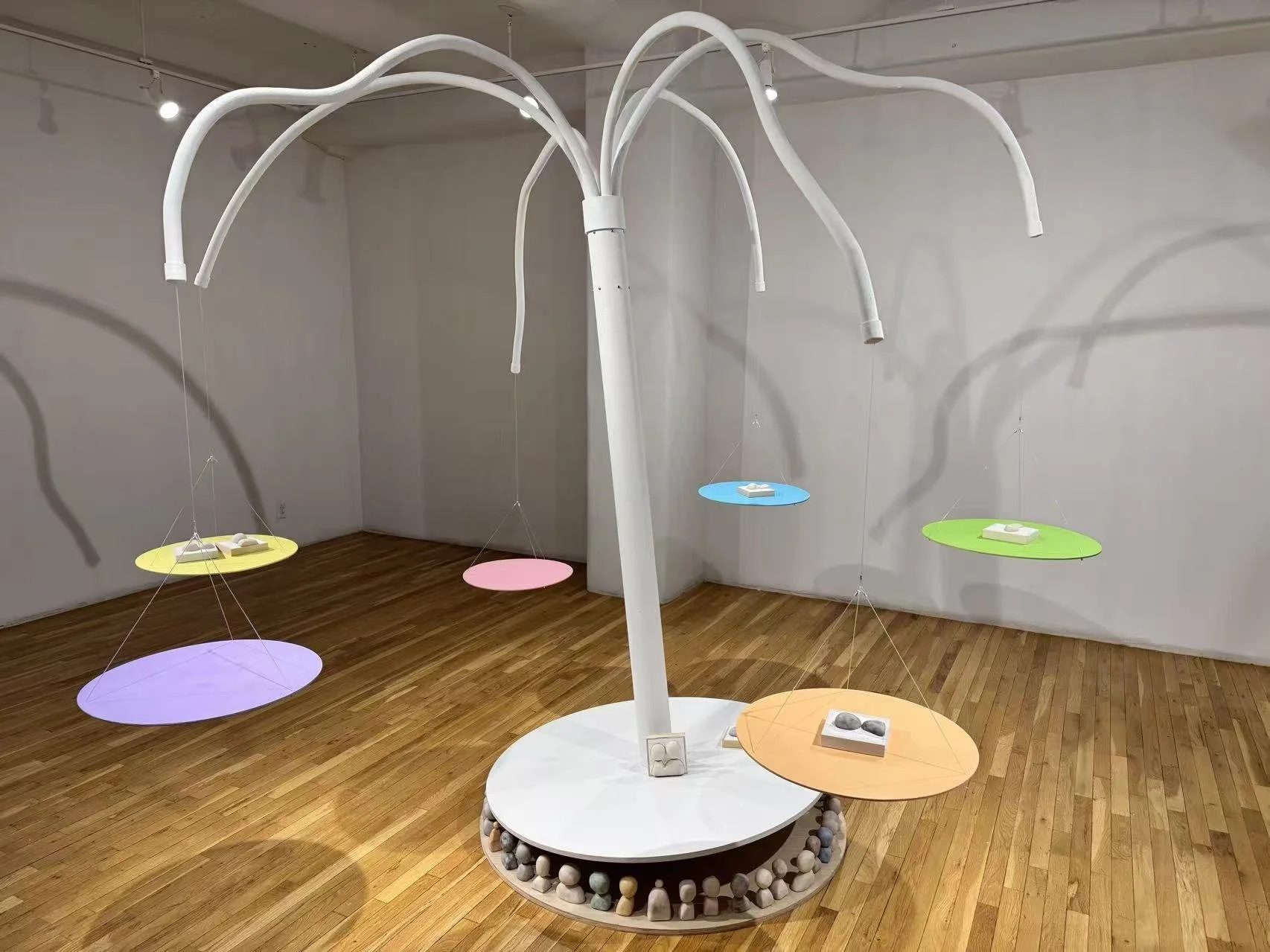
LuLu Meng, Toric Allying, 2026. Wood, plastic, PVS pipes, cold porcelain, plaster, acrylic, watercolor, fishing lines, 97×116×118 inches. Image courtesy of the artist and Residency Unlimited.