Jamie Martinez’s Visions of Material Cultures
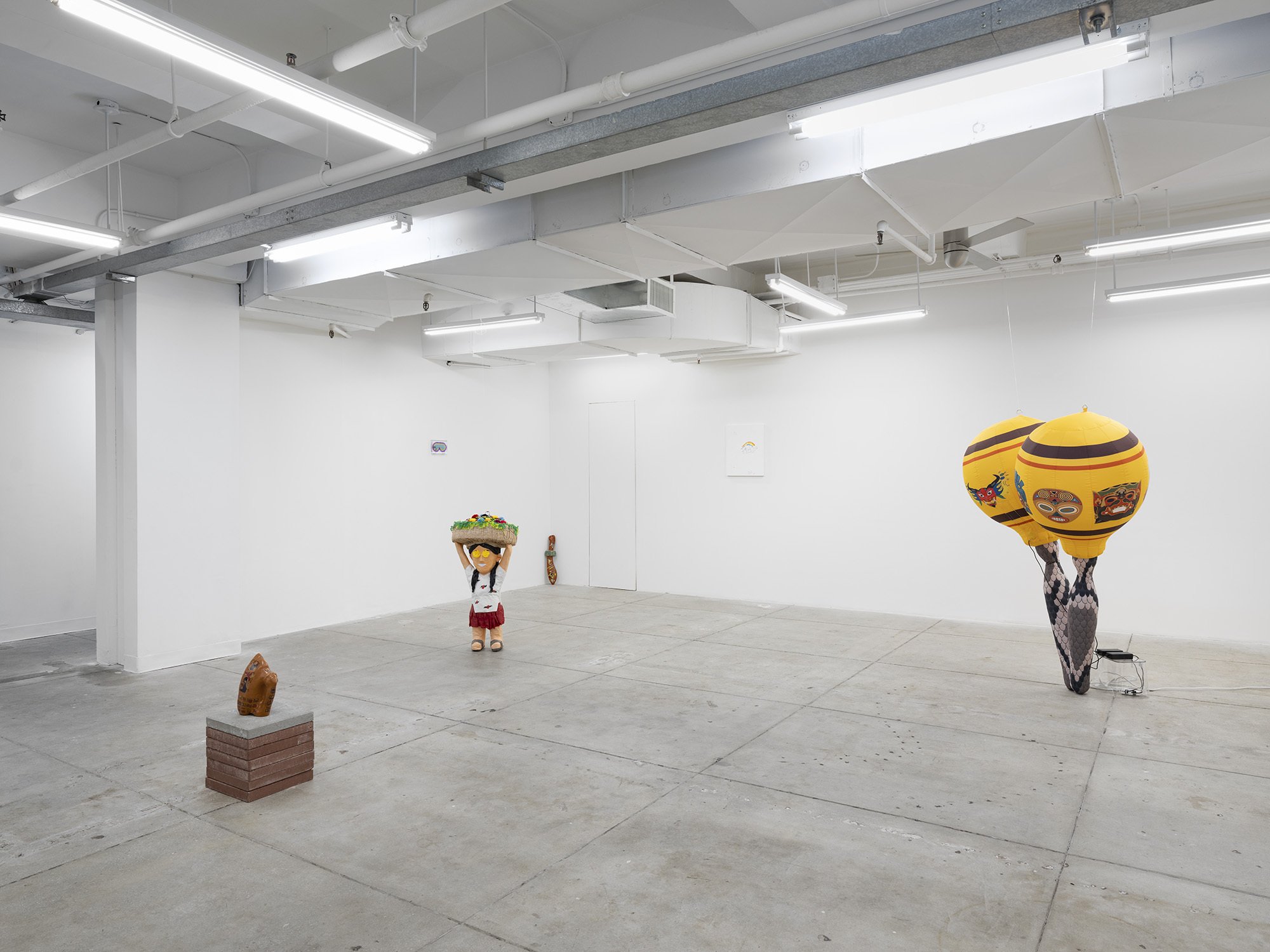
Installation view, Fabuloso Jamie Martinez at MAMA Projects Gallery. Image courtesy of the gallery and the artist.
by A.E. Chapman
Presented consecutively, Jamie Martinez’s solo exhibitions My Mother’s Labor: The Machines at GHOSTMACHINE Gallery, curated by Emireth Herrera Valdés, and Fabuloso at MAMA Projects cement the artist’s passionate and earnest mediation on labor and care through the excavation and reimagination of memory and tactility. The two shows foreground Martinez’s singular approach while unveiling a nuanced expansion of the artist’s oeuvre.
My Mother’s Labor: The Machines posits the entanglement of soul and machine, exploring the stitched nature of humanity and machines. Nestled along the walls of the gallery at varying heights, portraits of Juki sewing machines, machine needles, and an iron, each painted individually on canvas with exacting detail, elicit a sense of familial grouping, their matching blue contour lines reiterating kinship. The simple outlines of the paintings share an affinity with the formal silhouettes of sewing patterns; yet, the blurry, dispersed spray of paint emotes the inevitable illusiveness of memory. In My Mother’s Labor, The Needle 1, the presser foot of a machine and the tip of the sewing needle dominate the canvas, which is covered in textured off-white paint and scrawls of red and blue scattered throughout, recalling the domestic walls of childhood. The parallel red zig-zag lines in the painting resemble stitches, but also the up-and-down vital sign reading of a heartbeat, while the softer blue scribbles and hazy outlines of the machine elicit an affinity with air, whooshes of breath. Heavily employing an airbrush across the paintings, Martinez shapes the contours of each object with a bodily softness disparate from their everyday hard and clunky, laborious reality. By embodying the utilitarian objects with an anthropomorphic empathy through the airbrush, a machine itself, he suggests the fluidity of machine and hand in art and labor, object and life.
Viewers encounter consistent intervals of sound throughout the space. Every few minutes, a strong, whirring rush of air exhales out of a timed blower, inflating My Mother’s Labor, La Estrellita 2. The work, a giant flexible PVC replica of the Singer machine, oscillates between grand monumentality and exhausted peril. Fully expanded with each rush of air, the sculpture begins to sag under its own weight, as the air seeps out of its body in a long and ragged exhale. Though lasting only a few minutes, the process of deflation seems to slow time. As the last gasp of breath exits, another whir of air blows into the machine, reviving it to its erect form. The cycle evokes a strange, corporeal resonance—Martinez reimagines the undeniably recognizable machine as a pair of lungs in an enduring performance of resilience, honoring the labor of his own mother who owned a sewing company in Colombia before the family moved to the United States. This personal interpretation of the mass-produced machine posits its local and global presence as intimately threaded throughout domestic private life, yet circulated anonymously across international networks of consumption.
Layered over the stop and start spurts of My Mother’s Labor, La Estrellita 2, a distinct, steady thumping reverberates every other minute or so from an actual Singer machine resting atop a small table in the back of the gallery as the machine’s needle, illuminated by its tiny, flickering light, pierces the metal plate underneath (void of any fabric) in strong up and down motions. The table, encased in clay and polyurethane, feels like an altar. A line of small, bright figures painted on the clay’s surface—an owl, a well-known statue on view in the Museum of Gold at Bogotá, an African mask, and an Aztec eagle—parade along its bottom edge. Thimble-like clay molds of fingers accented by colorful Mayan glyphs, scissors covered in clay and green aventurine, a thimble, a tiny brass owl perched atop a crystal, vials of machine oil and synthetic sweat rest on the desk. Many of the objects hold personal meaning for Martinez: his mother used both the scissors and thimble while working on a fashion show this year, and the artist personally used the desk for one year. The fingers, thimble, and scissors reiterate the sense of tactility in both the act of sewing and bodily experience itself. Additionally, Martinez charged the green aventurine crystal during a full moon, reiterating the coalescence of art, labor, and spirituality in the work and his broader practice.
While an undercurrent of sound permeates My Mother’s Labor: The Machines, smell takes center stage in Fabuloso at MAMA Projects. Celebrating the popular multi-purpose cleaning solvent, the show does not feature actual material smells wafting in the air; the iconic name alone activates the sense, triggered by the power of memory. Mutually, smell evokes memory with distinct efficacy. In this sense, they can carry the concept of home during periods of transience, imbuing new spaces with continuity, familiarity, security, and belonging.
US company Colgate-Palmolive began manufacturing and distributing Fabuloso in Venezuela in 1980, its original version, the iconic purple colored detergent with exuberant lavender scent. After much success in South America, the Caribbean, and Mexico, the product arrived in the United States in 1996, retaining its Spanish name, Latin American origins, and ubiquitous exuberance. Now primarily manufactured in Mexico, it holds the number one market share position of all-purpose household cleaners in the United States. This trajectory overlaps with transitions in Martinez’s own family, who relocated from Colombia to Florida in September of 1984, where his mom found work cleaning houses after leaving the sewing floor that she owned back in Colombia. The act of cleaning saddles the boundary between the domestic, private acts of care and that of labor in the broader economy. Unpaid work performed in the family home intersects with the disparity of pay in the cleaning and housekeeping industry, disproportionately carried out by immigrants and in the US workforce.
Martinez’s paintings Fabuloso concentrate 2X Lavender Scent 1 (2026) and Fabuloso concentrate 2X Ocean Cool Scent 1 (2026) feel like youthful drawings of a superhero. The Fabuloso bottle fills the small wood board painted with a white background and similarly sized to a sheet of paper. Formally, this childlike quality connects the Fabuloso paintings to Martinez’s sewing portraits in My Mother’s Labor: The Machines; yet, the presence of childhood threads the two exhibitions together as honoring his mother, bridging her professions before leaving Colombia and arriving in Florida. It is apt, then, that the Fabuloso paintings evoke a superhero, symbolic of Martinez’s mom.
Cleaning can serve as a grounding, meditative, ritualistic act and offer a sense of control in uncertain times. Often associated with pride, cleaning offers a “long-lasting freshness” that can provide more clarity and confidence going about daily life. In Fabuloso Sweat, Martinez mixes the fragrant, fresh cleaner with synthetic sweat in three Fabuloso bottles sealed in clay. The artist used these bottles to clean a block in his neighborhood, Hell’s Kitchen. By combining the sterile solution with perspiration, he juxtaposes the gritty grunginess of urban life (particularly during this sweltering July heat cloaking the city at this time) with the effervescence that tidies it up, makes it a home.
Martinez’s dual solo presentations articulate the pervasiveness of our relationship with popular material culture.
About the author: A.E. Chapman is an independent curator, writer, teaching artist, and facilitator based in New York City. She received her MA in Art History and an Advanced Certificate in Curatorial Studies from Hunter College, where she was awarded the Edna Wells Luetz/Frederick P. Riedel Scholarship to support her master’s studies based on her excellence in significant post-baccalaureate undergraduate coursework at Hunter in studio art and art history. She holds an undergraduate degree in Journalism with a Photojournalism Emphasis and a minor in Sociology from the University of Georgia.