Negotiated Agency: Ke Zhang’s Hybrid Cinema and Performance on Flushing’s massage workers
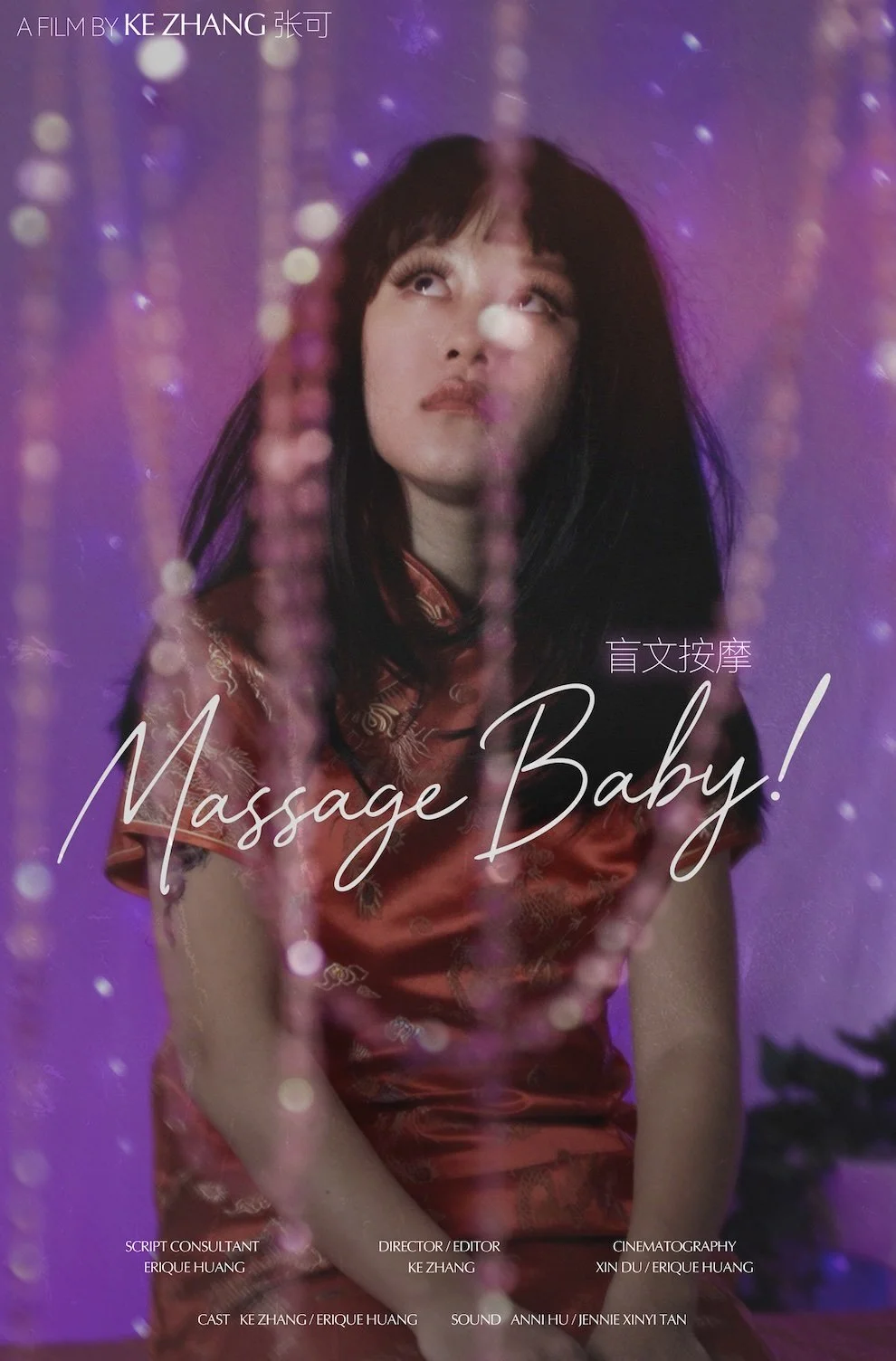
Massage Baby!2026, director Ke Zhang. Film poster. Courtesy of the artist.
by Jiani Wang
On stage, rainbow disco lights flickered as the room glowed in pink neon. A young woman, dressed in a red cheongsam and black high heels, slowly emerged from behind the curtain. It was Coco, a Chinese massage worker in Flushing, embodied by artist Ke Zhang(KEKEZ). She began reciting fragments of conversations with clients and her “sisters”, fellow massage workers in Flushing. Snippets about massage services, daily routines, and seemingly inconsequential moments were recast into a theatrical script, delivered in a deliberately exaggerated, declamatory cadence reminiscent of the highly stylized poetry recitations long familiar in Chinese classrooms.
This performance extends Ke Zhang’s ongoing, multimedia project on the lives and social conditions of Chinese female massage workers in Flushing, a body of work she has been developing over the past two years. Earlier that evening at Flohaus Gallery, she had screened Massage Baby!,an experimental film from the same series. In the film, Ke Zhang appears as the same protagonist Coco, a fictional migrant massage worker in Flushing. The audience first encounters her during an interview conducted by two college students, who remain off-screen throughout the film.
The unequal dynamics of looking, speaking, and translation are established from the outset, setting the tone of the rest of the film. Speaking limited English, Coco answers a series of questions posed by an off-screen interviewer, who alternates between Chinese when addressing her and English when speaking to the cinematographer, while Coco remains visibly guarded throughout the exchange. At several moments, the translator deliberately withholds questions from Coco, taking advantage of the language barrier and filtering the conversation through his own mediation.
Coco’s demeanor undergoes two distinct shifts over the course of the film. At the beginning, she performs for both the camera and the audience she imagines behind it. Seated on a massage bed behind a pink beaded curtain—a decorative element commonly associated with massage parlors—Coco wears a red cheongsam, heavy eye shadow, and dramatic false eyelashes that seem on the verge of falling off. She listens cautiously to every question posted by the interviewer and responds with a degree of timidity.
Later, as the interview concludes, the camera follows Coco through the busy streets of Flushing at night before arriving at a massage parlor. The handheld, shaky camerawork and subjective point of view suggest that the person behind the camera has assumed the position of Coco’s client, simultaneously experiencing and documenting the massage. It remains unclear whether Coco is simply providing a standard massage. As the client’s breathing gradually grows louder and heavier, eventually turning into panting, the film creates the impression that he may be experiencing something beyond the massage itself. Back in her familiar environment, Coco appears more natural and at ease, as though the imagined audience for whom she had previously performed has begun to recede.
The film then arrives at a second shift in its dynamics of looking, culminating in its dramatic climax. All the other figures have disappeared, leaving Coco alone in the massage room with the camera still rolling. Her body begins to relax: she lies down, slowly removes her false eyelashes, and places them onto the camera lens with absentminded playfulness. For the first time, she looks directly into the camera, no longer appearing preoccupied with how she might be perceived. Her attention seems to turn inward as she enters a state of self-possession, free from the hesitation, anxiety, and timidity that characterize her earlier interactions with the translator and the cinematographer. It is only in the absence of an identifiable gazer that Coco appears able to exist as a subject rather than an object of the gaze.
Massage Baby! emerged from nearly two years of sustained fieldwork, interviews, and research conducted by Ke Zhang. In the film, highly staged sequences are interspersed with lower-resolution handheld footage shot inside the massage parlor and on the streets of Flushing, where Coco standing at the curb soliciting potential clients—a reenactment of her actual working conditions. By making the transitions between staged and quasi-documentary footage almost imperceptible, the film renders the boundary between fiction and reality increasingly unstable.
Through the construction of the fictional character Coco, Ke Zhang creates a space in which her research participants can exist not merely as objects of ethnographic observation but as active participants in the construction of their own images. By positioning Coco within differently stylized cinematic spaces and traces her transformation across changing conditions of being looked at, Ke Zhang explores how performance can function as a form of agency within her hybrid film.
In the sequel film If Longing has a Color, It Must be Sino-Red, this creation of performative agency becomes even more noticeable. The film presents a similar staged scenario in which a Chinese female therapist, dressed in a velvet red cheongsam and black high-heels, gives a full-body massage to an anonymous client concealed beneath a white linen sheet. Throughout the performance, she moves around the massage bed with exaggerated sensuality, climbing onto it at times, while speaking to the client in an overtly seductive tone. The background audio, consisting of excerpts from the hosts’ script for the Chinese Spring Festival Gala, functions as a symbolic clue that sheds lights on the therapist’s background, suggesting her identity as a Chinese immigrant.
As the performance unfolds, however, these expectations are gradually destabilized. Blood slowly seeps through the white linen under the therapist's touch, until it is revealed that the anonymous "client" is in fact a human skeleton. The therapist's gestures become increasingly playful and violent as she straddles the skeleton, crushes its spine beneath her heels, and eventually dismantles its body. In the final moments, after briefly flirting with its skull, she abandons it altogether and slips into an ecstatic game with herself.
Rather than remaining an object of voyeuristic consumption, the therapist actively orchestrates the performance, manipulating both the anonymous body before her and the audience's expectations. By transforming the erotic encounter into an absurd and grotesque performance, Zhang displaces the therapist from the position of a fetishized object to that of an active performer who directs the scene. Here, performative agency lies not only in the character's control over her own body and gestures, but also in her ability to reshape the terms through which her body is seen and interpreted.
Ke Zhang's practices enters into dialogue with a growing body of journalistic, activist, literary, and cinematic representations of Chinese female massage workers in recent years, including The New York Times' investigation into the death of Song Yang, a Flushing massage worker who fell from a fourth-story building in 2017 under circumstances that remain contested; the advocacy and artistic practice of Red Canary Song; and the 2025 feature film Blue Sun Palace. Ke Zhang’s films contribute to this broader conversation while departing from its dominant representational frameworks. Through the deliberate intertwining of documentary and fiction, orchestration of shifting gazes, and the construction of speculative narratives, Ke Zhang creates cinematic and theatrical spaces in which her protagonists can perform, confront the gaze, and negotiate their identities. In this way, their agency emerges on screen and onstage, are hopefully extend beyond them, as they become active participants in constructing their own representations.
About the author: Jenny Jiani Wang is a Beijing-born visual artist, writer, and producer whose work spans writing, film, and multimedia installations. She is drawn to exploring the causes of things. Her writing has appeared in a range of art and design publications, including Art Journal, Office, Noisé, Life and Arts 集锦, and IDEAT, among others. She is an writer and editor-in-chief of :iidrr mag .She holds a BA in Politics and Sociology from University College London, an MSc in City Design and Social Science from the London School of Economics and Political Science, and an MFA in Photography, Video and Related Media from the School of Visual Arts in New York.
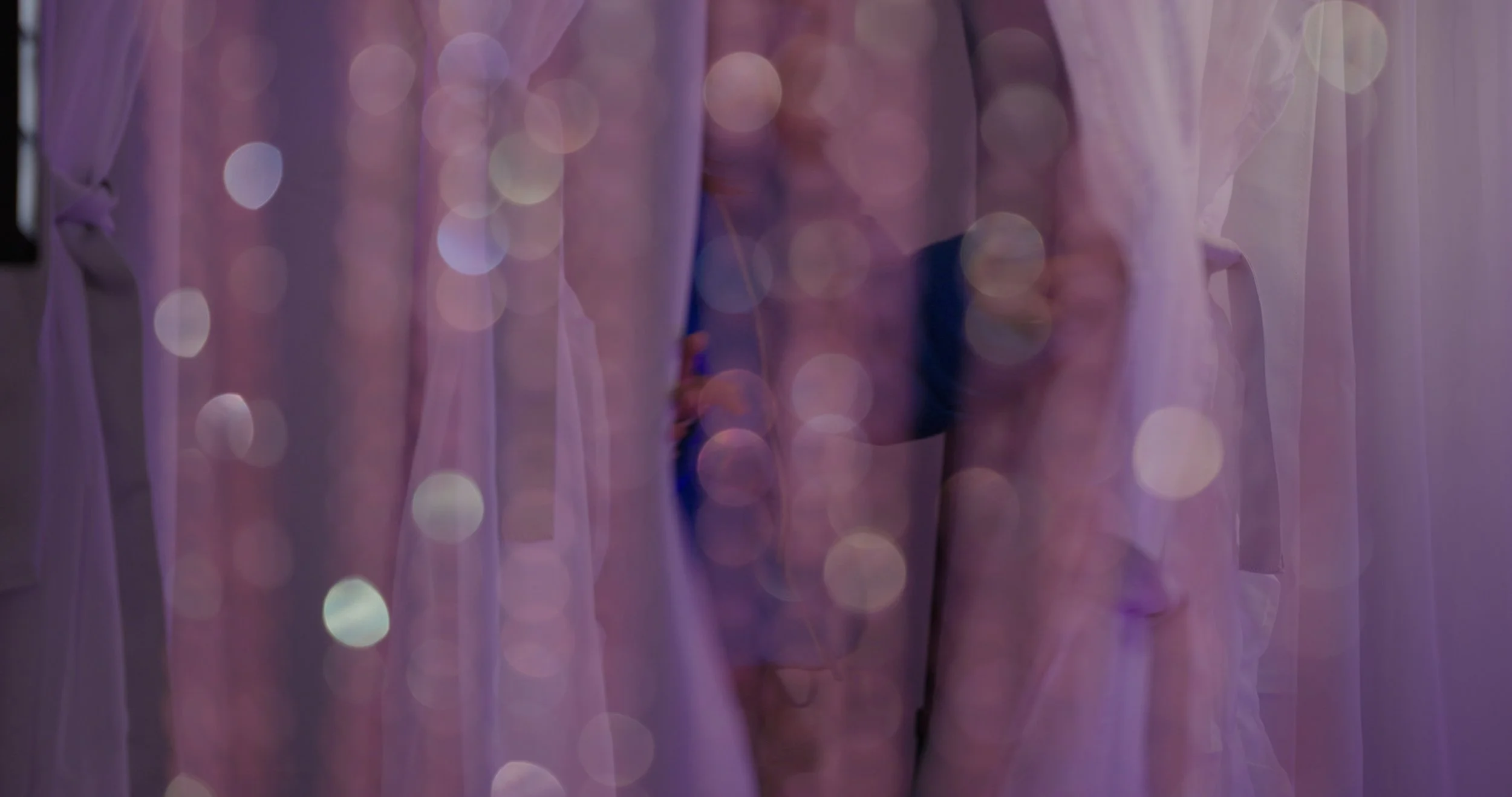
Massage Baby! 2026, director Ke Zhang. Film still. Image courtesy of the artist.