Hot Coffee interview with artist Himil H. Ramani
Published Wednesday, June 10, 2026
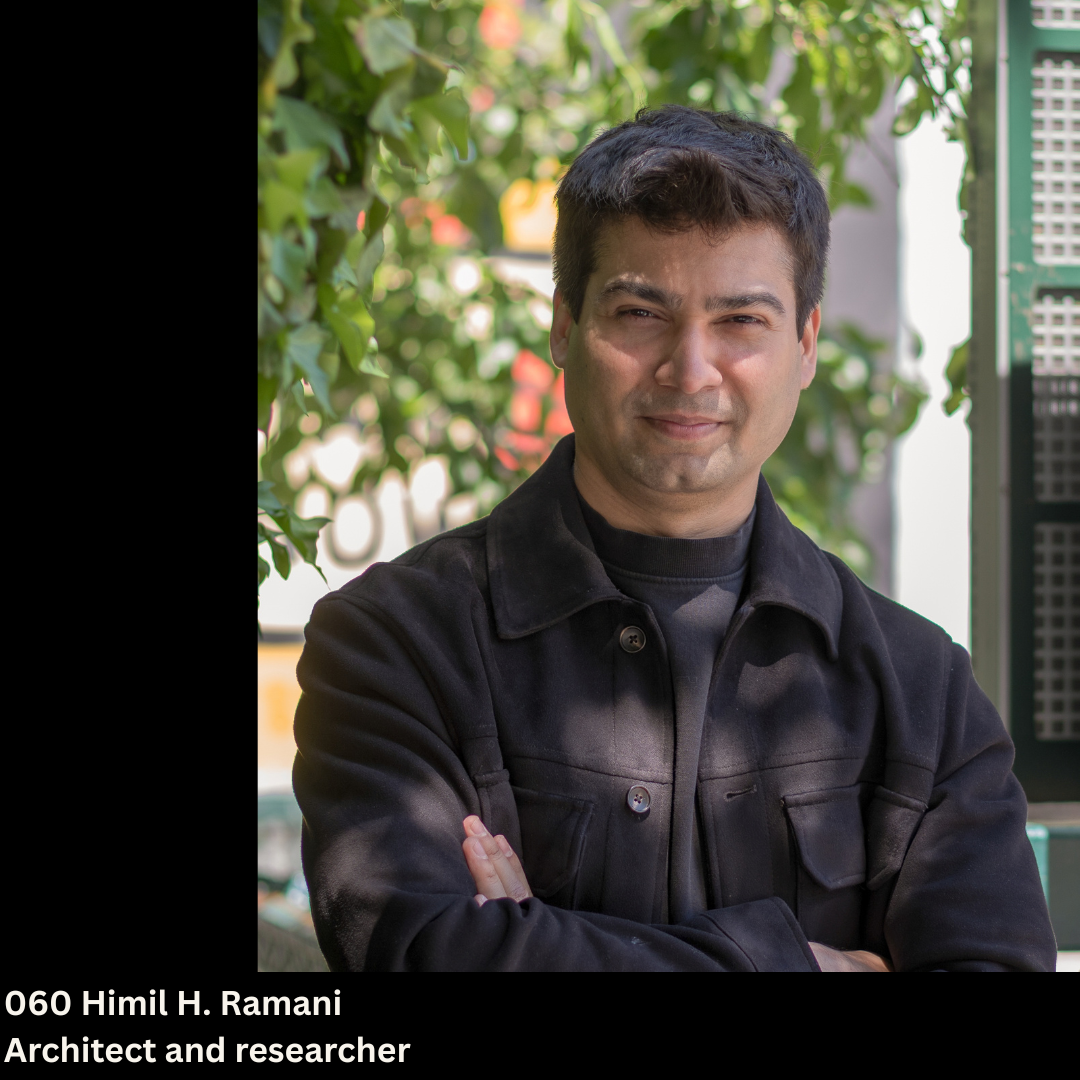
Himil Ramani is an architect, researcher, writer, and curator whose work explores the intersections of architecture, performance, media, ecology, and exhibition-making. He holds a Bachelor of Architecture from the University of Mumbai and an M.S. in Critical, Curatorial and Conceptual Practices in Architecture from Columbia University Graduate School of Architecture, Planning and Preservation. Ramani has worked on documentary films, furniture projects, exhibition design, and performance-based research, and has served as an adjunct faculty member at Columbia University while also working with Storefront for Art and Architecture. His research focuses on the relationship between media, architecture, and ecology, including a book project titled Interrogating Plants: Cleve Backster’s Experimental Media Practice.
Nina Chkareuli: Imagine you are in your favorite coffee or tea spot. Where is it? What are you drinking? What are the three things you see right now?
Himil Ramani: Butler Bakeshop & Espresso Bar in downtown Manhattan’s SoHo district, having an espresso. They share a thin transparent sheet of glass between the interior tables and the exterior sidewalk of Lafayette, overlooking the Rapkin-Gayle Plaza across the street. It’s a great spot to spectate the performative nature of this neighborhood, and it is really close to the Storefront for Art and Architecture. It’s fascinating how various empty storefronts on this street go through transformations every few days for pop-up sales by fashion brands, and there’s always someone in an interesting costume for photoshoots out in the streets. The incredible graffiti tattooed all over the building’s skin, and they’re always changing hand-painted billboards on the building facades every few weeks. It’s really amazing to witness the kaleidoscope of art, architecture, fashion, and performance of this neighborhood, while the bodies of its architecture encapsulate the memories of its past.
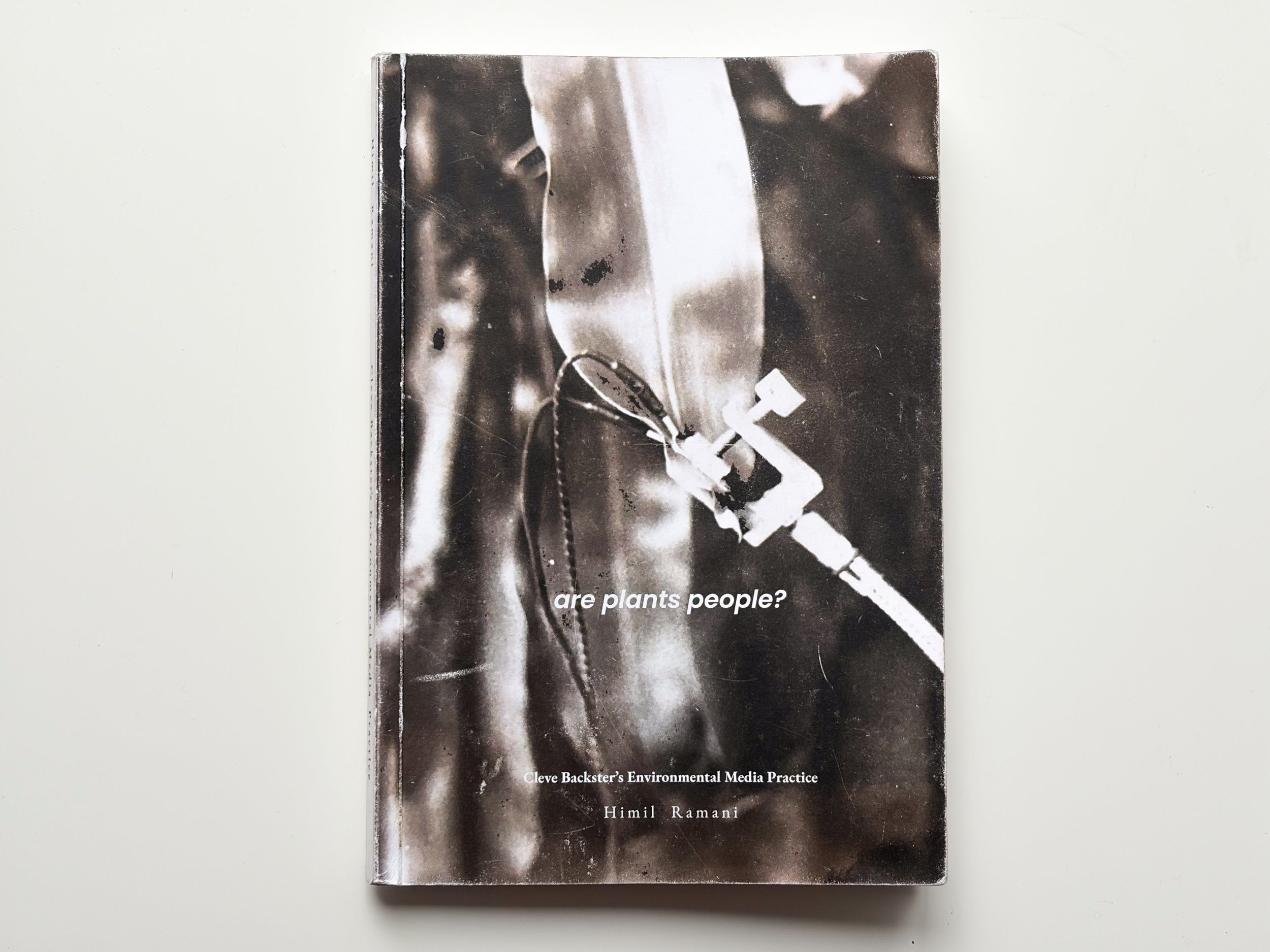
Photo credits: Book Interrogating Plants: Cleve Backster’s Environmental Media Practice by Himil Ramani.
NC: Your project reframes Cleve Backster’s plant experiments through the lens of Cold War cybernetics. What initially drew you to this particular archival moment, and why revisit it now?
HR: House plants today are seen as one of the most meaningful companions to humans. And we need to go back in history and find out where this idea comes from, what makes plants our greatest companions? The idea roots back to bringing the outdoor nature inside our domestic spaces, for decorative purposes, especially during the Victorian Era and the Industrial Revolution, when human interaction with the world was highly overwhelmed by non-human machines. There was a growing sense of fear in the loss of a natural sense of experiences, and nature provided intimacy with the natural order of the world. However, this practice was done so by placing nature in a pot that is designed by humans, with just enough room for the amount of soil required for it to live, and by controlling the expansion of its roots from growing bigger than the desired aesthetics of domestic spaces. This practice blocks nature’s interaction with other plants’ roots through which they communicate with each other. The idea of isolating plants in a domestic pot and positioned in a controlled environment that is suitable for human bodies is an idea of a caged prisoner that is blocked from its natural form of existence. And if you live and talk enough to the prisoner, it might just talk back, like most domestic animals that have proven to. It positions humans in control of nature by creating a dependency as a central source for providing water, nutrients, and light for its existence.
Right now, we have a growing form of intelligence in environmental consciousness and ways of plant thinking. This work provides a history of one such early interspecies experiment that unfolds the epistemology of technologies that were driving the force in building companionship between plants and humans during the Cold War in the United States.
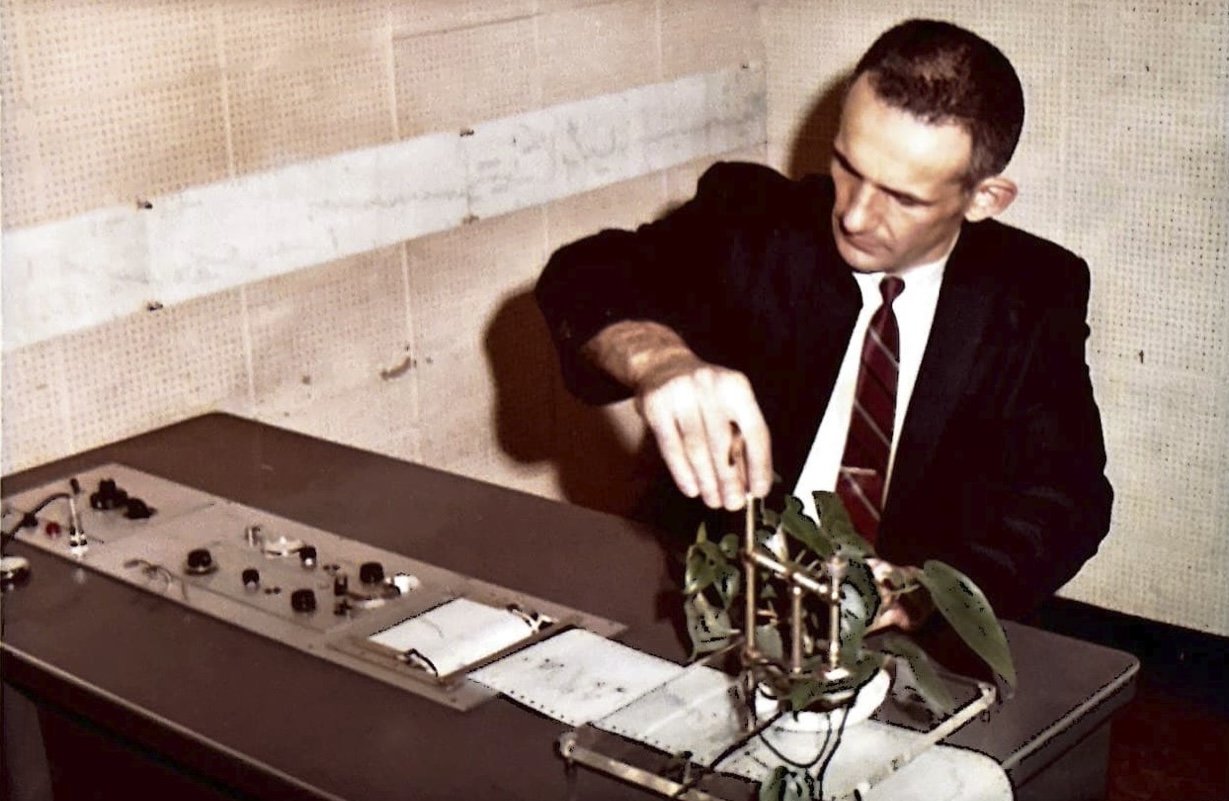
Photo Credit: Cleve Backster with his research plant in his research lab. Backster Research Foundation Archives, Courtesy University of West Georgia.
NC: You describe Backster’s work as producing a form of “interrogative environment” between species. Where do you locate the boundary between communication and control in these experiments?
HR: A shared fear of control and unpredictability was growing with the development of nuclear weapons during the Second World War, not limited to human beings but the influence of the environment humans live in as a whole. And there was an attempt to study patterns of reactions in different environments to neutralize them, one that resulted in the building of intelligent information systems that took off during the post second world war period by Macy Conferences in Cybernetics, from 1946 to 1953, officially titled Cybernetics: Circular Casual and Feedback Mechanisms in Biological and Social Systems. Charlotte Sleigh points out that the communication with insects and animals was well recognized in terms of the funding and attention it received in the United States, as animals provided examples of “effective orientation and meaningful communication” in a manner that was to be directly translated into military and social tools.
In Cleve Backster’s case and the polygraph machine, knowledge production is a physical act of extracting knowledge, which relies on a reverberation of feedback mechanisms. During Backster’s experimentation with plants, there was a growing frustration with plants not responding to his every attempt at provocation, in a language that humans (and more importantly, scientists for him) understand. And so, Backster exercises a symbolic feedback loop using architecture as a hypnotic device, by putting up the previously recorded polygraph responses from plants onto the wall of the interrogation room, hoping that plants could be reminded of their past. The definition learned in the course of life’s experience is put into the environment and then feeds back, provoking a kind of behaviorist symptomatology in psychology. And so the meaningful communication with other species turned into a projection of an anthropocentric ideology onto other species, which creates more serious damage to a more intelligent species.
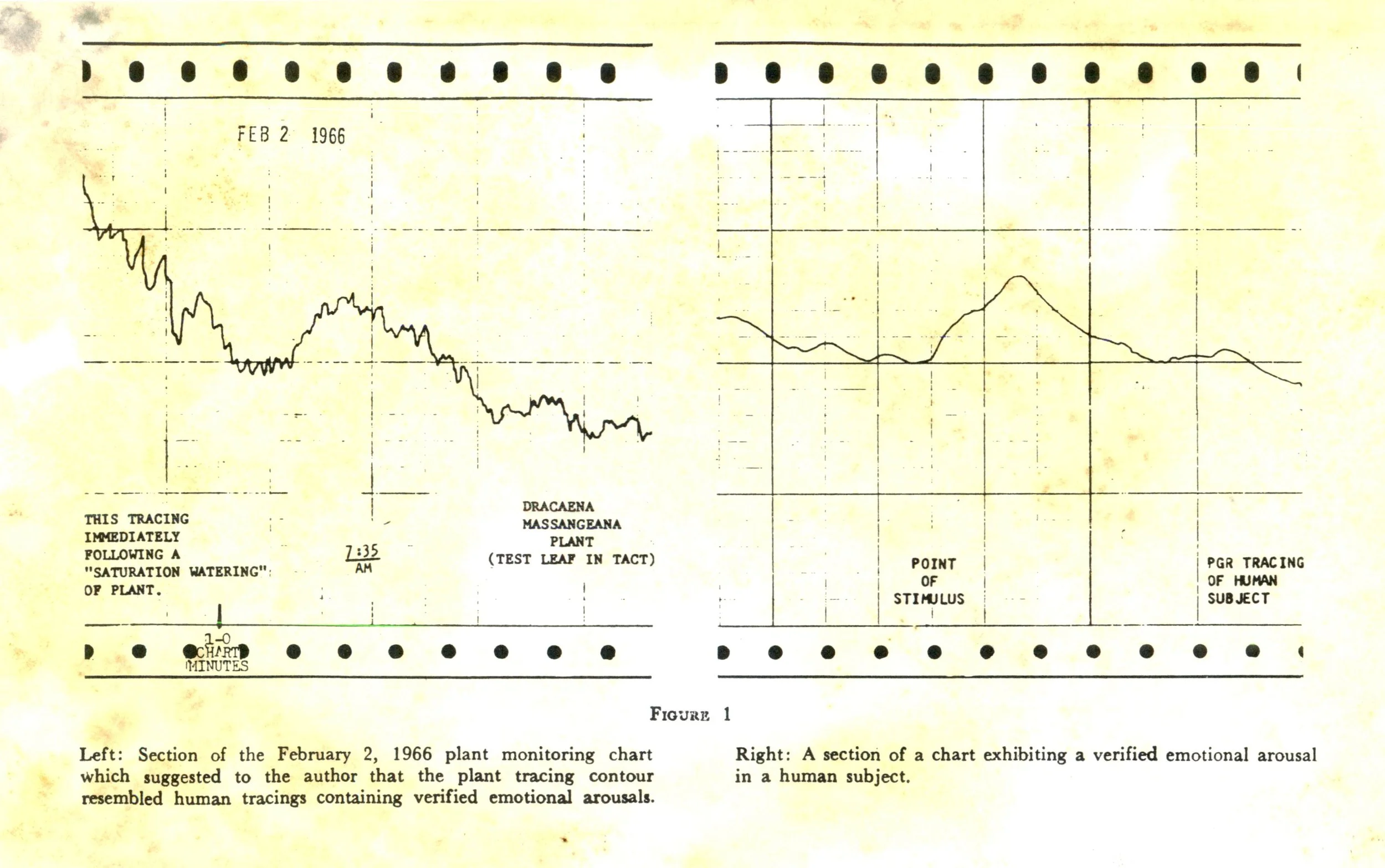
Section of the February 2nd, 1996, plant monitoring chart, Backster Research Foundation Archives, Courtesy University of West Georgia.
NC: The polygraph machine is central to your narrative as a technology of both deception and belief. How does its use on plants shift our understanding of what counts as evidence or response?
HR: On February 2nd, 1966, the retired CIA agent Cleve Backster in his research lab in Times Square, New York, decided to attach his dracaena plant to a polygraph machine, known as a lie detector, to check if the plant would respond to his act of watering it. Surprisingly, the polygraph tracing recorded a short-term change in contour similar to the reaction pattern of a human subject who might have been briefly experiencing the fear of detection. Backster responded, “If this plant wants to show me some people-like reactions, I’ve got to use some people-like rules on it and see if I can get this to happen again.”[1] He watered the plant, played music, and said nice things to it, and the plant responded with electrical signals that were extremely similar to the ones the human body gives out when secreting serotonin. If Backster brought scissors, knives, fire, or any other violent instrument near the plant, it would respond with negative electrical signals that were similar to those that human bodies emit when scared.
The way a polygraph machine works is that a small amount of electricity is passed through electrode plates, one attached to two fingers of the human body. Backster placed the leaf between the two sensor electrodes and encircled it with a sandwich leaf with a rubber band. By attaching electrodes to the surface of plant leaves, Backster clearly imagines plants as a human subject that rests above ground, communicating through a human scale of interaction. Undermining the plant's way of communication, which takes place through the network of fungi attached to the roots. It challenges the knowledge production with other species on a human scale, in order to find a common language, instead of exploring the possibility of using the language of the other.
NC: Your text suggests that plants became a “screen” for anthropocentric projection. Do you see this as a failure of imagination, a technological limitation, or something more structural in how knowledge systems operate?
HR: The plant’s responses were not limited to Backster’s actions. It started responding to changes in its environment, such as the long overdue cleansing of bacteria from the laboratory sink, the urine being washed down the urinal in the next room, the disposal of a frozen chicken Backster had left in his freezer for months, and Backster making breakfast as he boiled the eggs. When Backster realised that the plant was attuned to the environment on a microbial level, he started modifying the interiors of his lab into an interrogative room, by removing ornaments, decorative objects, or shapes that could inhabit any form of microbial life and influence the subject. Backster adds symbolic features that could provoke a desired reaction from the subject. Backster possibly desired to test if the plants could be used as an information extraction source as a witness for crimes. And for plants to be able to participate in such an exercise, they needed to be familiarised with human consciousness and remove any distractions that might not concern us. These techniques can be directly seen to be used by modernist architects to neutralise the interiors of our domestic spheres, with a clear space of communication between the use of technology such as television and the human subject, to impose messages of desired behavioural patterns. Communication on a societal scale becomes an act of imposing messages on the other, mobilizing a collective sense of consciousness.
[1] Cleve Backster, Primary Perception: Biocommunication with Plants, Living Foods, and Human Cells, published by White Rose Millennium Pr, 2003
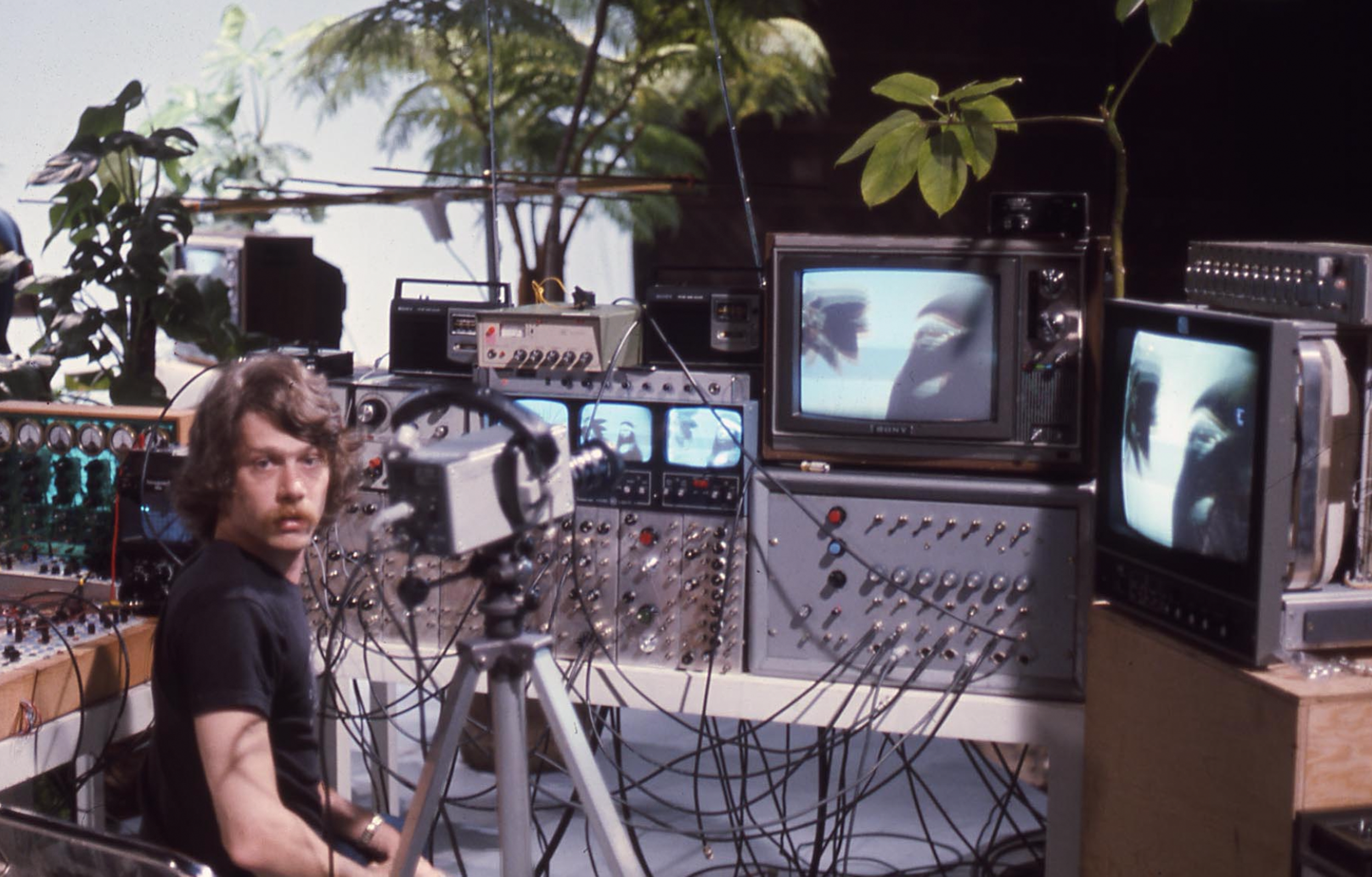
Photo Credit: Jim Wiseman at the controls of the Paik-Abe and Sandin video synthesis/processing systems, Richard Lowenberg Archives.
NC: The book introduces multiple layers of archival material—readings, diagrams, film references, and annotated texts. How does this layered visual structure shape the reader’s experience of “truth” or interpretation?
HR: The book’s design includes graphic miniatures of plant leaves overlapping text and letters on pages, bringing the question of this research to the forefront – are these experiments a source of meaningful communication with plant species, or are we merely imposing our thoughts and our ideas using media and technology onto the plants? This gets amplified in the way this research has taken different forms in its engagement with audiences, from a media installation, a short film, a performance, and a book. I’ve engaged my body through different forms of communication to open up the linear standard of narrative.
The book includes many such early experiments between artists, scientists, botanists, and other practitioners collaborating with plants during the Cold War, when the United States was developing Agent Orange, used to kill trees and plant life in Vietnam to trace Vietnamese soldiers. The transparency between multiple layers of text, graphics, language, and ideas in this book allows the reader to see through the different media through which messages were projected about plant companionship during the 1960s and early 1970s.
NC: Today, plant consciousness is often discussed in more sympathetic or even spiritual terms. How does your project challenge or complicate contemporary New Age or ecological narratives around interspecies communication?
HR: Interrogating Plants foregrounds the unseen connection between media and ecology during the Cold War period; a time when US military and intelligence agencies engaged in numerous forms of biofeedback experimentation intended to operate in the thresholds of consciousness, and to mobilize bodies and ecosystems as sites for surveillance and control. These techniques and technologies invented for surveilling human bodies on a microbial scale continue to be a source of meaningful engagement with other species with various practitioners, both creative and scientific.
This book suggests that to think about plant life is to maybe think about the ‘other’ in a way that we may not understand, given our limitations in understanding the world through the human body. And our bodies have very conditioned senses trained to use and understand the world. Perhaps the ‘other’ might interact with the world in a less verbal, non-visual, and entirely different set of sensorial experiences in the world. To use cybernetic technologies in order to create awareness towards environmental consciousness, one might ask if humans are connecting with plants, or using anthropocentric messages using plants as a media screen for meaningful communication.
Portrait credit: Susan Behrends Valenzuela