Hot Coffee Conversation with artist Jacqueline Qiu
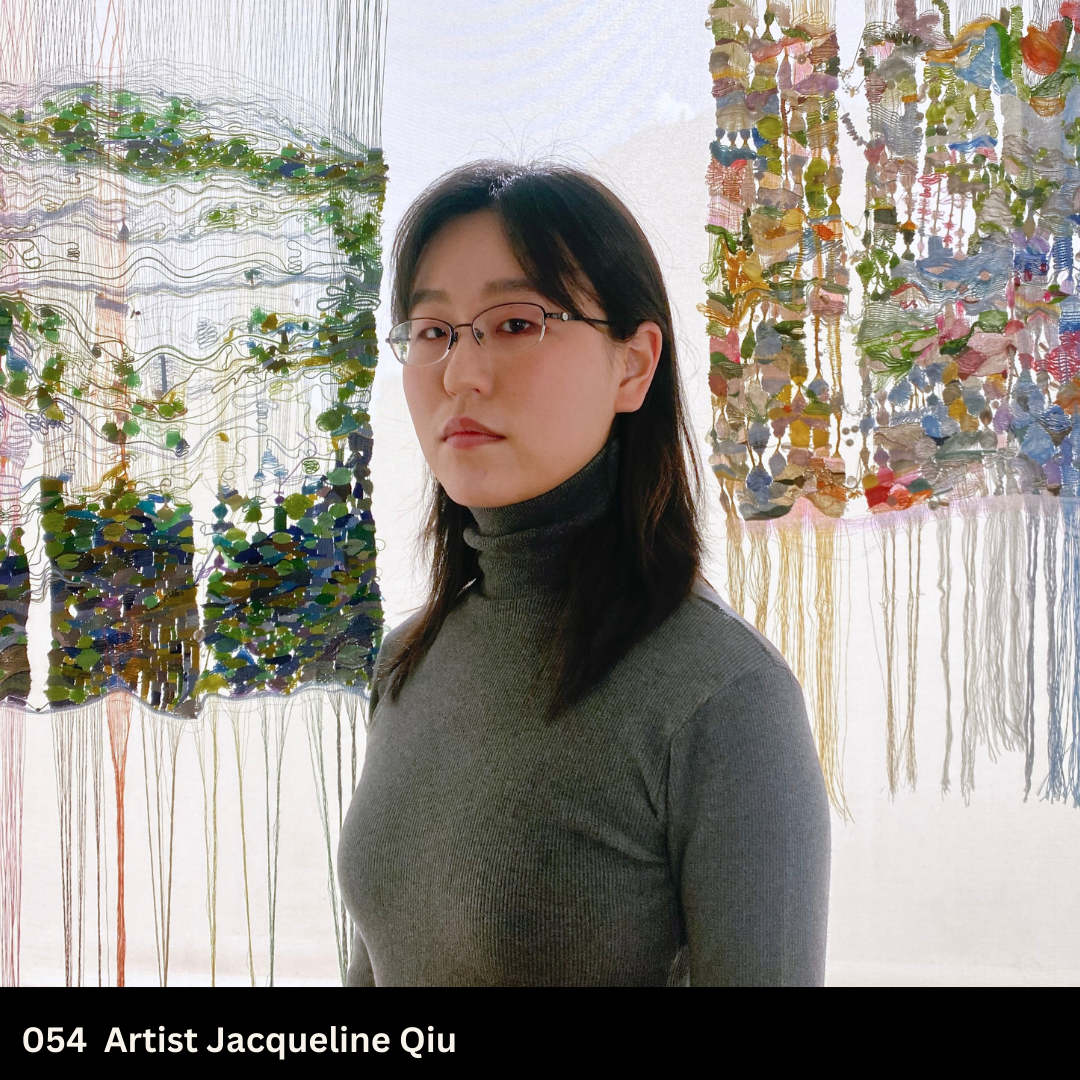
Published Wednesday, March 11, 2026
How can air be represented without depicting the cloud, or the sensation of a light touch conveyed without showing it directly? In Jacqueline Qiu’s practice, this paradox is approached through a delicate and labor-intensive engagement with thread. Working methodically day after day, she weaves while reflecting on lingering attachments, memory, and layered cultural inheritances.
Jacqueline Qiu (b. 1999, Montclair, New Jersey) earned her BFA from the Rhode Island School of Design. Her recent work engages textiles, installation, and painting, moving between traditional fiber techniques and painterly approaches. Through careful reconfigurations and reconstructions drawn from nature, Qiu preserves fleeting connections and ephemeral impressions. She has participated in the Studio Residency with The Here and There Collective in New York and the Ós Residency at the Icelandic Textile Center in Blönduós. Her work has been exhibited at Hesse Flatow, Abigail Ogilvy Gallery, BravinLee, Latitude Gallery, Harper’s Gallery, Underdonk Gallery, Woods-Gerry Gallery, and Gelman Gallery. She has also taken part in workshops at Tianzifang, the New York Academy of Art, Anderson Ranch, and Huang Lan-Ye’s Kesi Studio. Qiu lives and works in New York.
I met Jacqueline Qiu right after her show at Chart Gallery, New York, titled Burying Flowers, curious to learn more about what associations and experiences drive her.
Nina Chkareuli: Imagine you are in your favorite coffee or tea spot. Where is it? What are you drinking? What are the three things you see right now?
Jacqueline Qiu: I’m probably looking out a window, ideally with a book and a notebook in my hand, and something delicious. I’m more into tea than coffee, though I don’t have a specific favorite. It would usually be at my studio, sometimes at a random tea shop or a small restaurant. Occasionally, I’ll even take out my notebook while drinking tea there. I don’t really have a go-to spot.
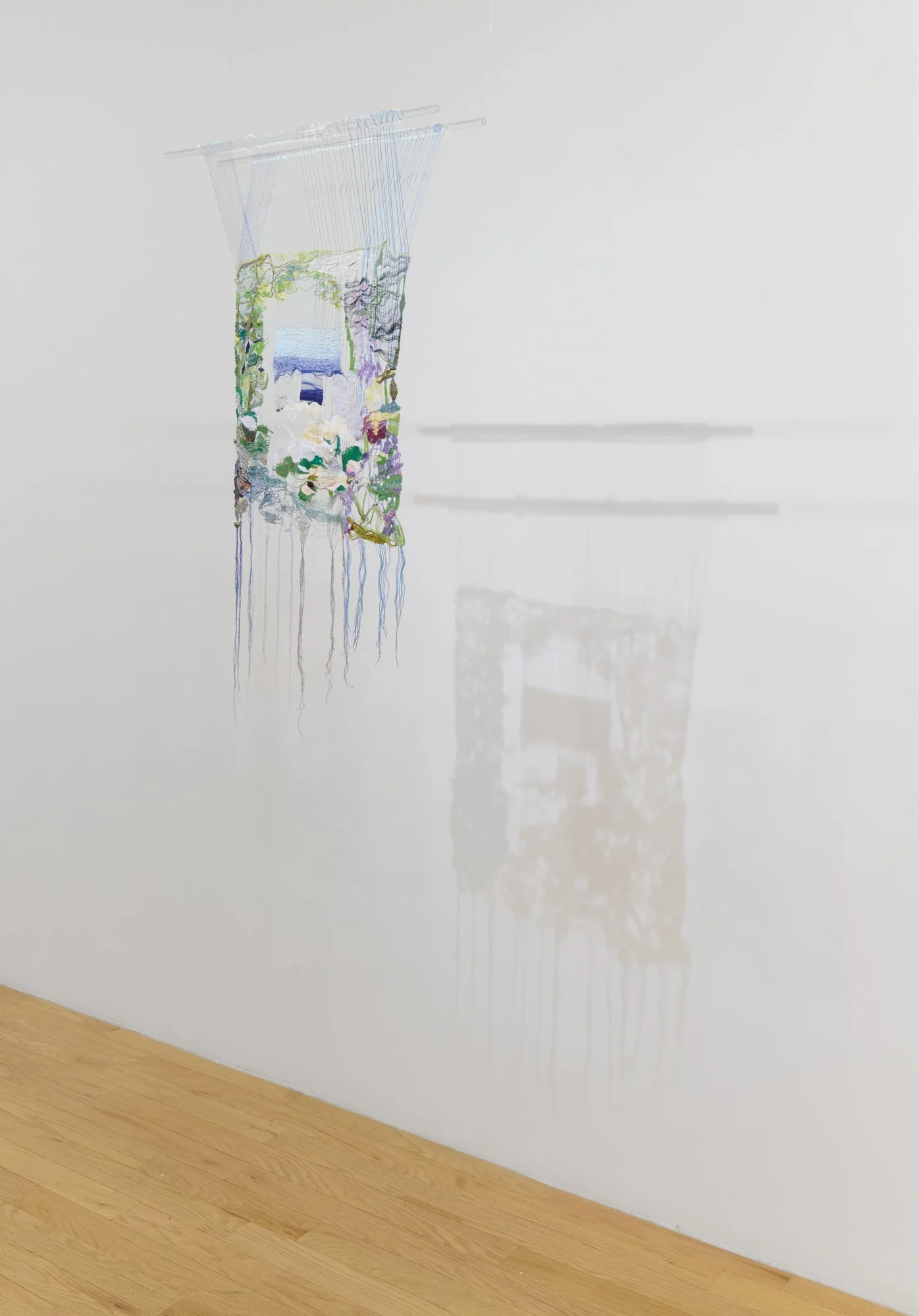
Installation view, Jacqueline Qiu: Burying Flowers, Chart Gallery, New York. Image courtesy of the artist and CHART. Photo: KC Crow Maddux.
NC: Can you tell me a little bit about your trajectory in the arts? I know that you went to an art school, so what made you decide to become an artist in the first place?
JQ: Growing up, I was kind of along a path where my parents nurtured many of my talents, and then I saw that visual art really stuck. I have to say, the decision to become an artist wasn’t something I set as a self-imposed goal—it became clear through a lot of trial and error. I was in art school, initially coming from mostly a painting background, and I was actually in the illustration department at the time. In that department, I realized that painting was something I could continue to nurture myself in, but I wanted to learn something new and branch out. RISD’s textiles department is amazing; it has so many different pieces of equipment and facilities, so I thought I would dip my toes into that world. It was really guided by the classes at RISD, because I didn’t have much of a relationship with textiles in my art-making practice that I was conscious of. Suddenly, I was thrust into learning knitting, weaving, fabric work, silk-screening, embroidery, sewing, and exploring all the processes from handwork to industrial scales. Over time, after exploring different avenues that were maybe more design- or teaching-related, I realized that for actual art-making, I was more interested in following my own vision and using art to make a statement where I had agency.
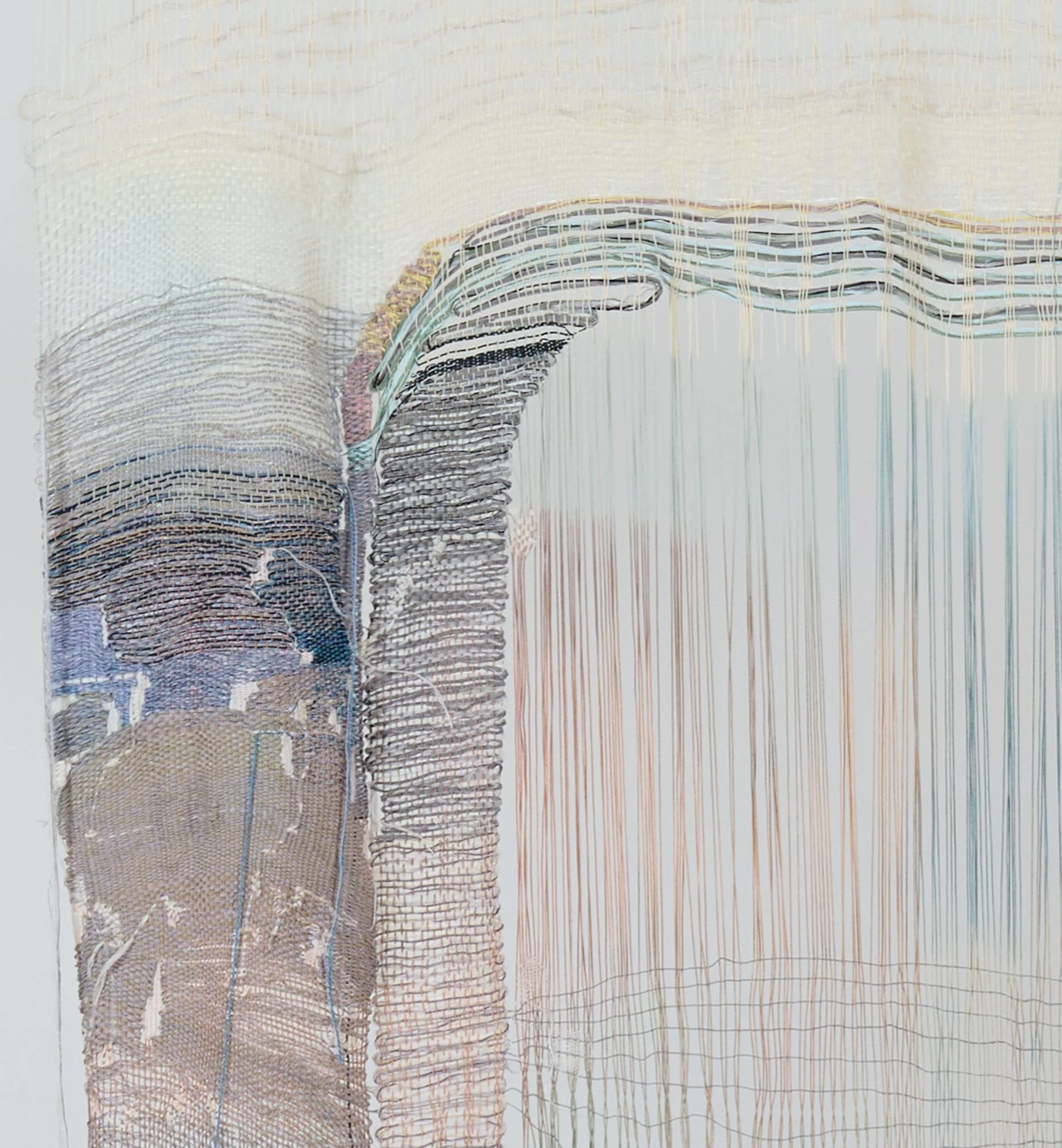
Detail, Jacqueline Qiu, Murmur, 2025. Handwoven tapestry on vertical loom using cotton, wool, silk mohair, mohair, silk, shigoki paper yarn, shosenshi paper yarn, pine paper, raw silk, linen, rayon, bouclé yarn, metallic yarn, lurex yarn, hand-cut stone beads, and other beads, hand-painted cotton warp using acryl gouache and gouache, 91 x 45 in, 231.1 x 114.3 cm. Image courtesy of the artist and CHART. Photo: KC Crow Maddux.
NC: Let’s talk about your show that ended in February at Chart Gallery. Starting with the title: Burying Flowers. Where does it come from, and can you tell me a bit more about this body of work?
JQ: I decided on the title Burying Flowers just three months before the show, which was important because the work spans the past four years. It isn’t really a body of work with one defined narrative or conceptual theme, since each piece reflects a period in my life. When I was thinking about the title, I tried to connect to certain literature and influences that spoke to this body of work. I landed on two stories. First, the Shanidar flower burial: a theory proposed when archaeologists found a Neanderthal skeleton with traces of pollen, suggesting that Neanderthals buried their dead on a bed of flowers. The theory implied humans might relate to Neanderthals with more empathy if their emotional complexity mirrored ours more similarly, which I found very interesting. I was also struck by the imagery of a large adult male Neanderthal skeleton buried on a bed of flowers—it was visually beautiful.
Second, I had been reading Dream of the Red Chamber, one of the most famous works of vernacular Chinese literature. It explores Chinese society, rituals, and interpersonal relationships, especially the roles of women, through the lens of the elite, working, and servant classes. The majority of the characters are women, and the novel’s attention to their lives, power, and agency fascinated me. Burying Flowers is inspired by a scene in the novel: a boy in the interior courtyard garden of his home is reading as petals fall around him. He initially wants to toss the petals into the river to avoid stepping on them, but the main female character tells him not to throw them into the water, because it would be muddied by the outside world. Instead, she says, let’s bury them in the earth so they can return to the soil. This scene grapples with transitory attachments. The story reflects how humans cling to beauty and impermanent things, which inevitably change or disappear.
For me, my art-making process is like creating relics to preserve some memory of these attachments. Even though everything will eventually be lost to time, the work exists as a record of what I found meaningful. The imagery I use often comes from physical, natural surroundings, and the composition mirrors my philosophical or contemplative thoughts at that moment in life, whether influenced by books, current events, films, or personal relationships.
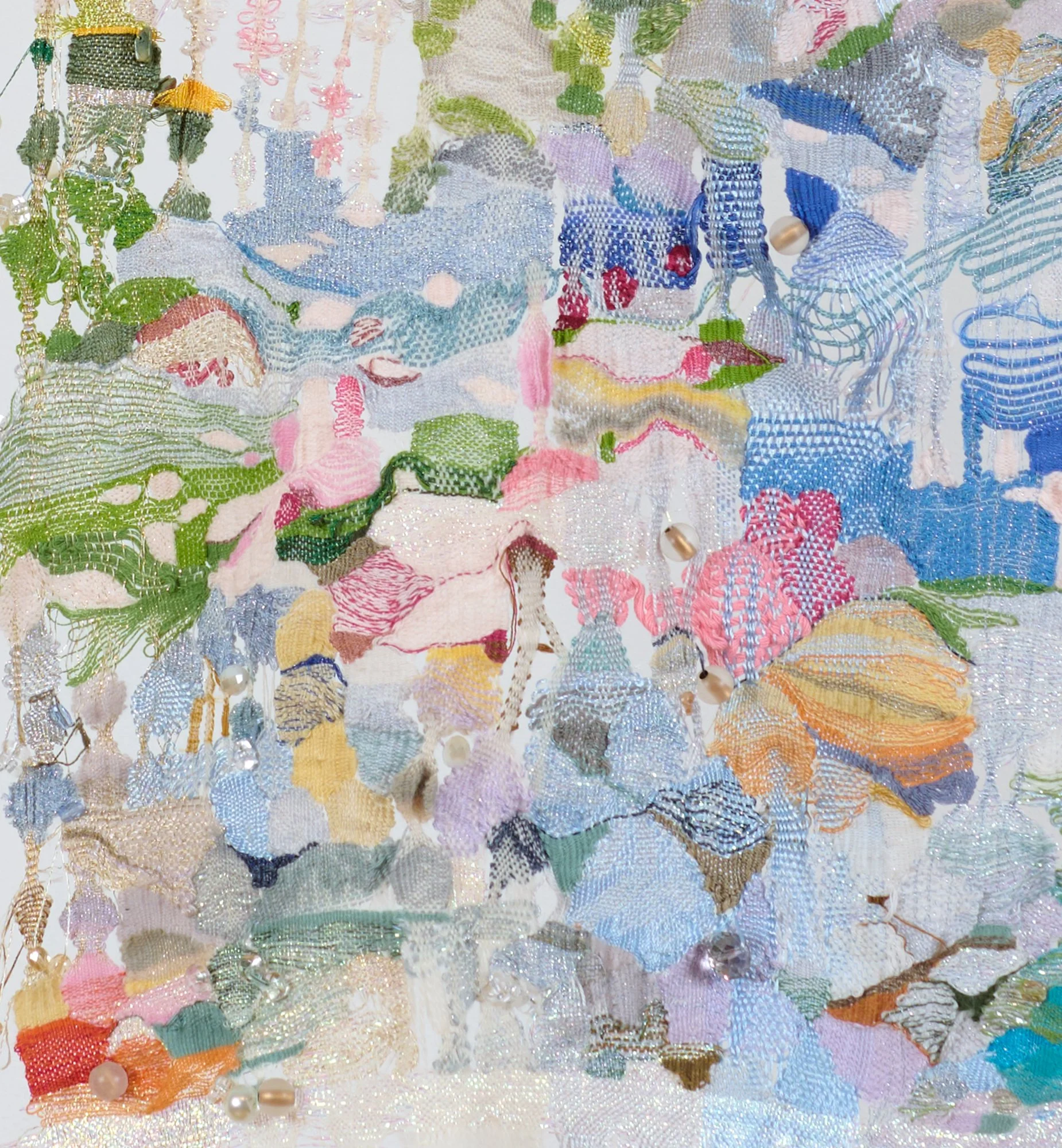
Detail, Jacqueline Qiu, Transient, 2022. Handwoven tapestry on floor loom, using cotton, merino wool, linen, rayon, polyester, acrylic, metallic yarn, lurex yarn, and beads, acrylic dowels, 40 x 18 x 7 in., 101.6 x 45.7 x 17.8 cm. Image courtesy of the artist and CHART. Photo: KC Crow Maddux.
NC: What was the single formative experience that started your career in the arts?
JQ: I think it was a series of experiences rather than a single one. I grew up in a family that didn’t see pursuing art as a viable option, so the idea of an art career wasn’t something I considered. Even when I went to art school, the attachment to art was personal, not professional. As I approached adulthood, I realized that a career would take up most of my time. I had to decide: how could I turn my artistic passion into something that could occupy a significant part of my life? I took a gap semester to transfer into the textiles department, and I interned at a small interior textiles studio. The artistry there was fantastic—very artisanal, beautiful, with mentors I loved—but I felt hollow. Returning to school, I realized that contributing to someone else’s vision for the majority of my time was not what I wanted. That experience pushed me to take a risk on myself and forge my own path.
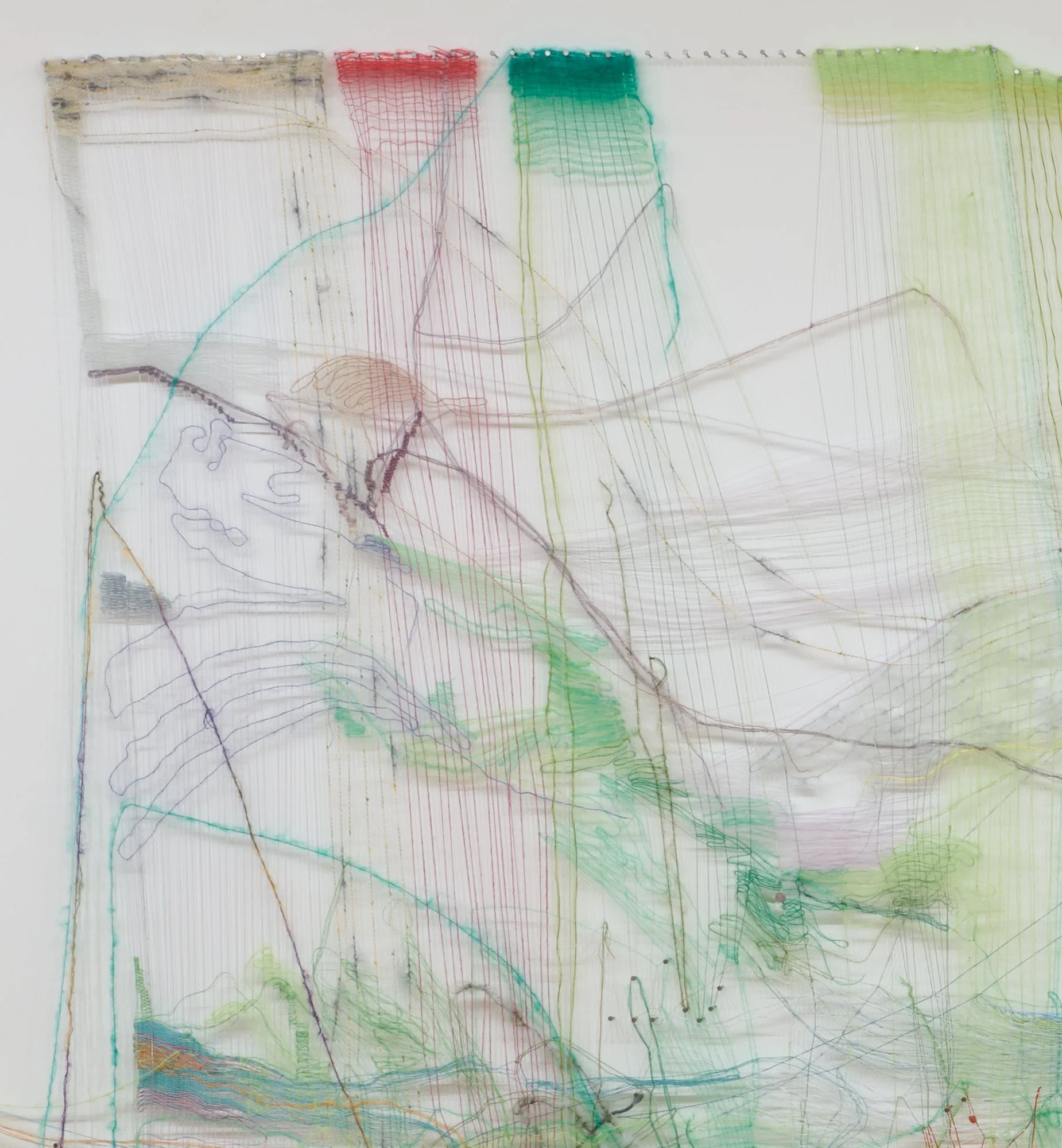
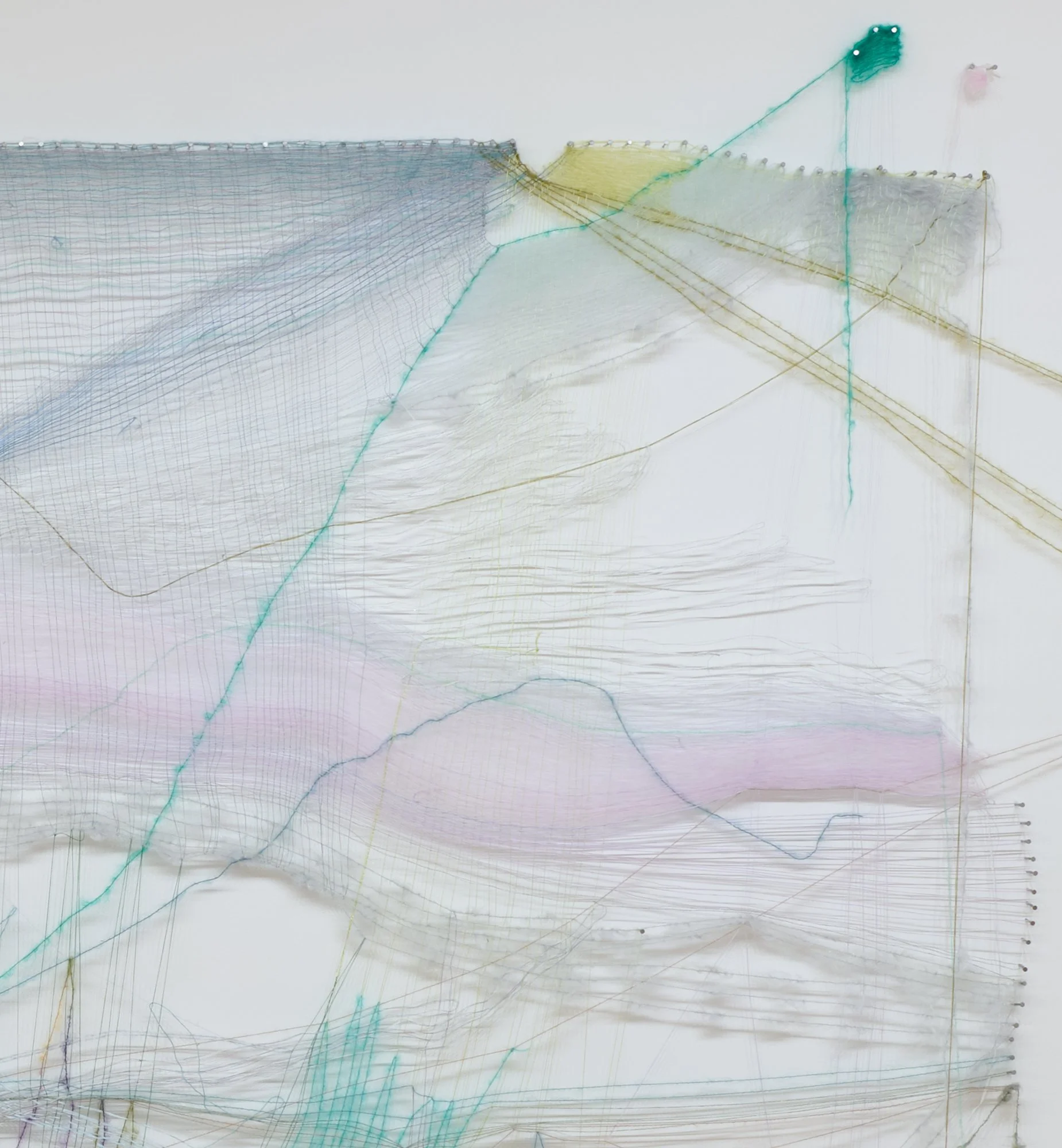
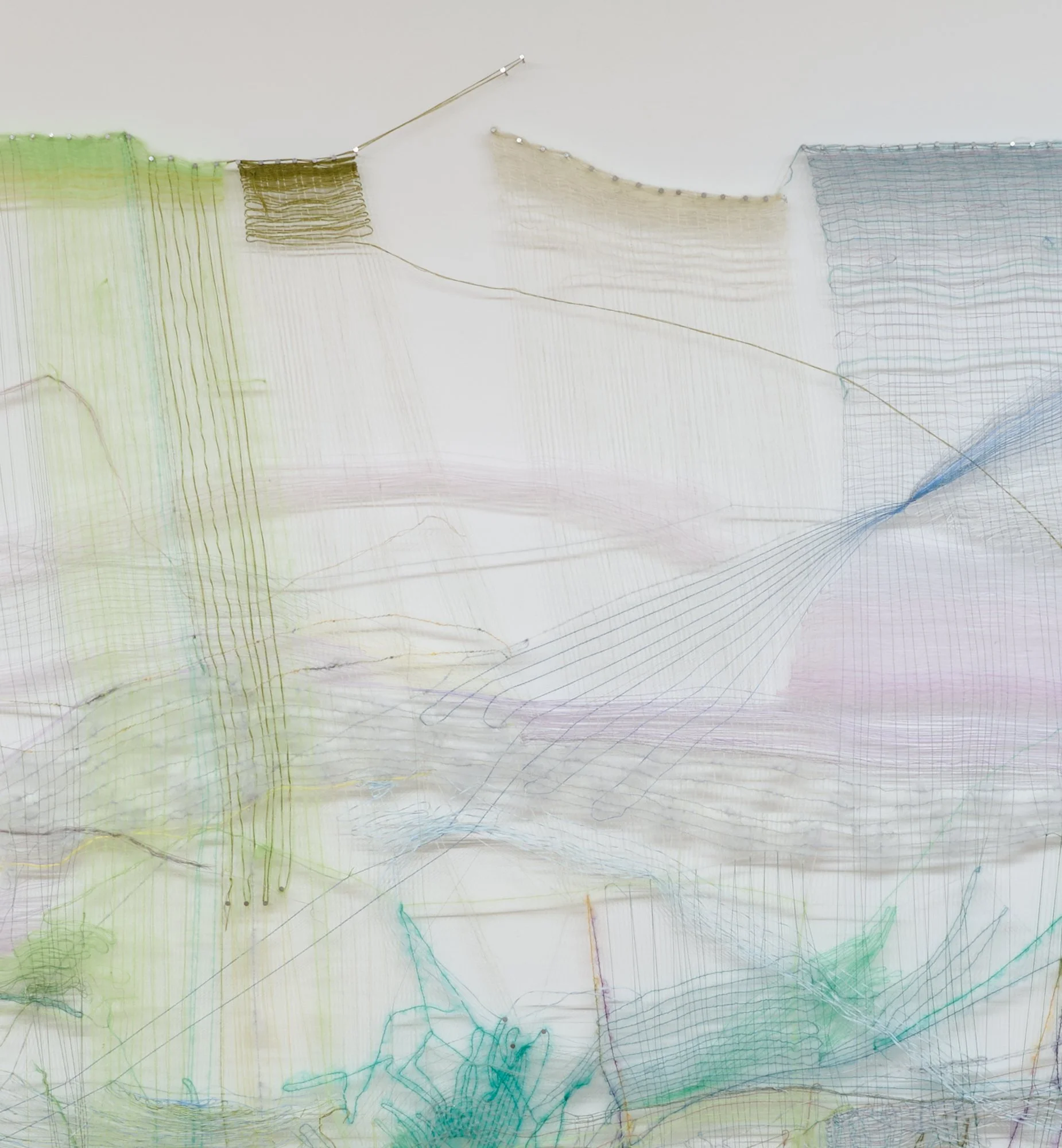
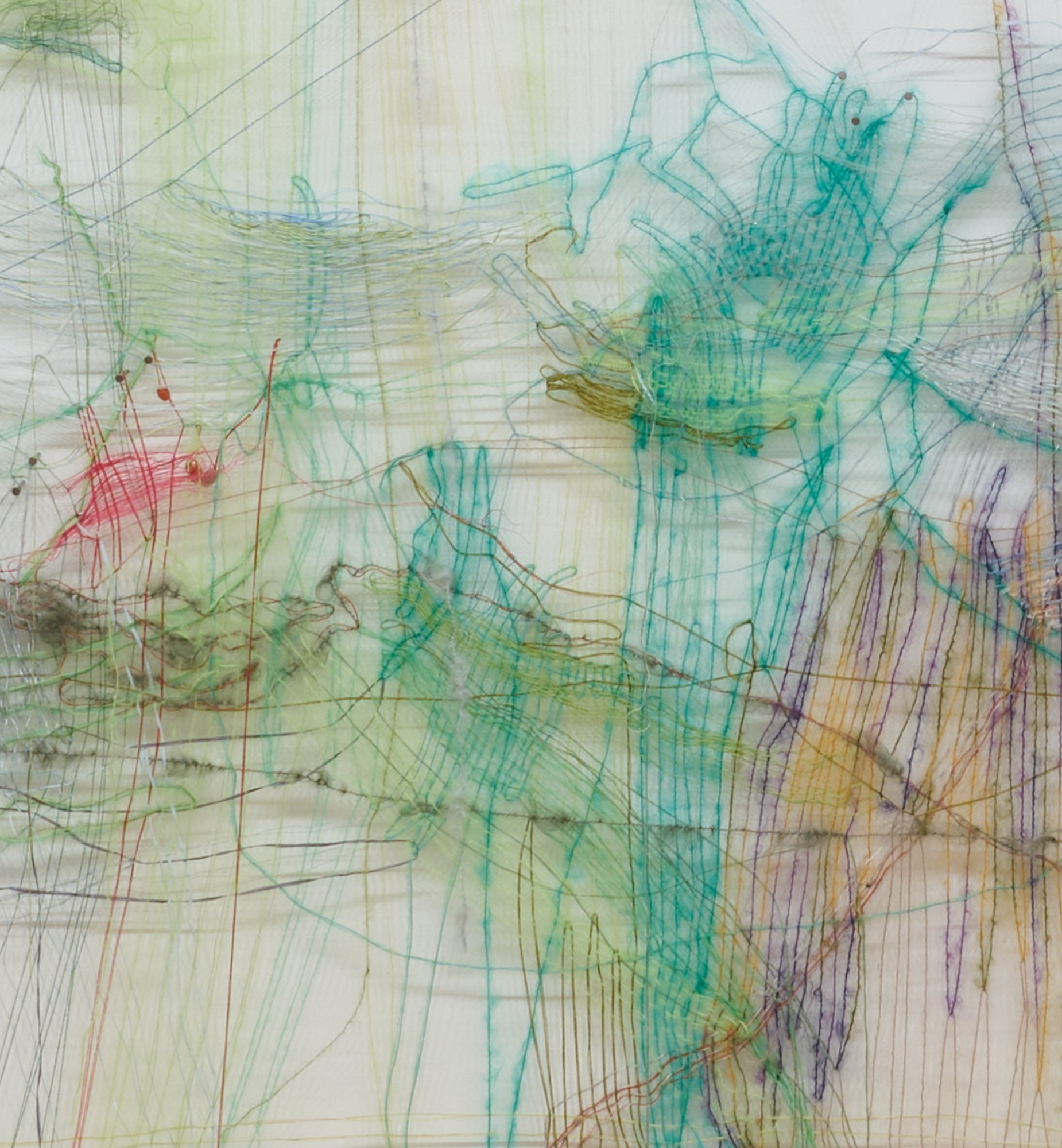
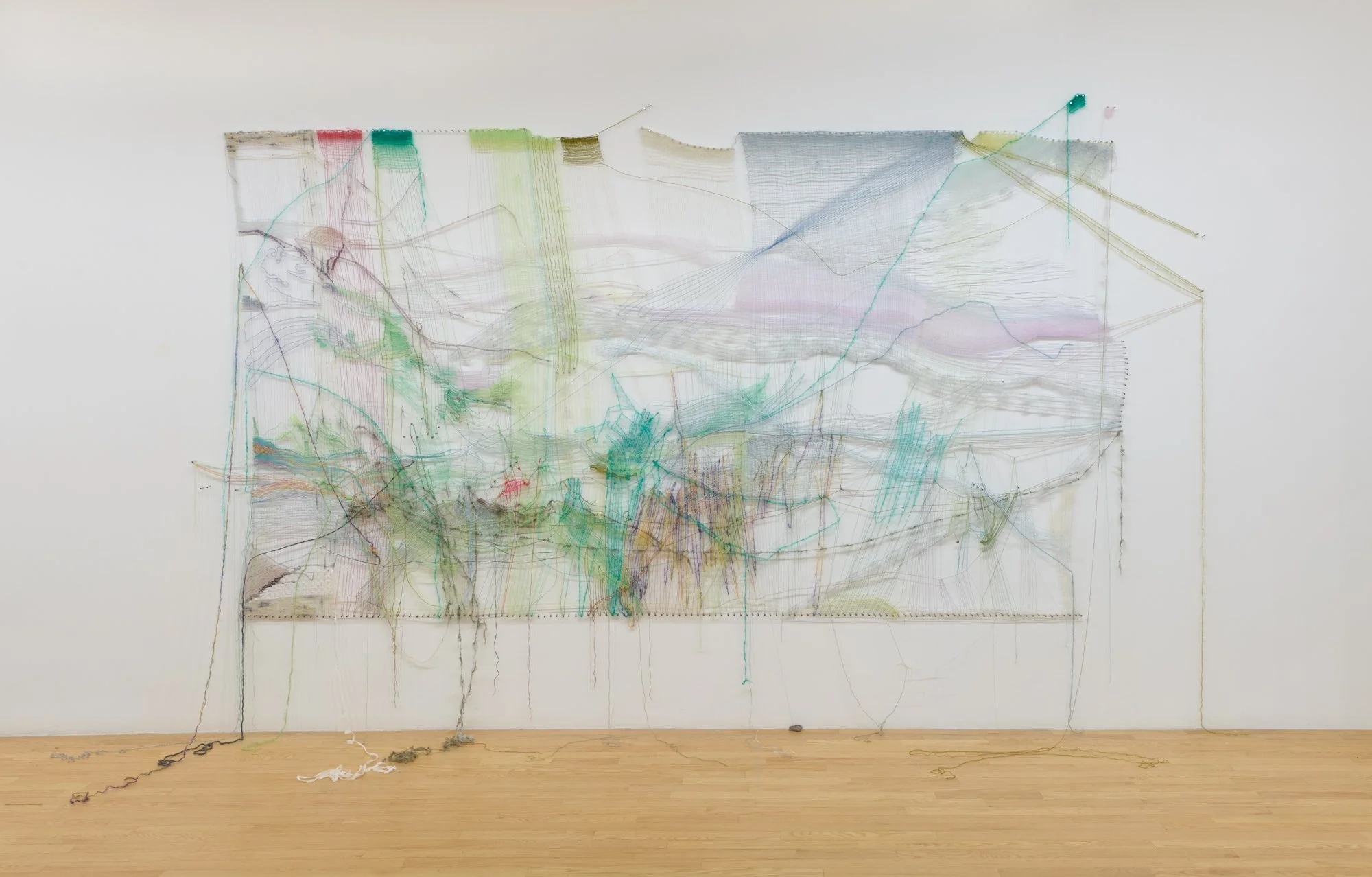
Details, Jacqueline Qiu, Rot, 2025. Steel nails, handwoven tapestry on the wall using vintage mohair, silk mohair, wool, plant-dyed Icelandic wool, shigoki paper yarn, shosenshi paper yarn, cotton, rayon, polyamide, metallic yarn, lurex yarn, hand-cut stone beads, and other beads. 84 x 155 in 213.4 x 393.7 cm Image courtesy of the artist and CHART. Photo: KC Crow Maddux
NC: What recent piece of news has caught your attention, either in the U.S. or China?
JQ: I’ve been following the Epstein files, ICE detainment, and the genocide in Palestine. These issues influence my work, particularly recent pieces. For example, Rot reflects on fighting over land, casualties to humans and landscapes, and rights to exist on land. In that piece, I was thinking about horizon, perspective, and the linear conception of time. Historically, I feel that time operates more cyclically, and recognizing these patterns can help us understand human actions. Rot plays with the tension between representational imagery and the structural, material reality of the piece. It’s a reflection on narrative, history-making, and the coercive power that images can carry. Another piece, Murmur, is about migration and movement in nature. I observed birds, insects, and natural cycles—like blooming foliage and falling petals—and translated their clustered movement into my free and playful woven markmaking. The overarching composition isinspired by the architecture seen in Chinese vernacular paintings. The archway in the piece represents an access to home or shelter that is changing, open, and welcoming, subverting the tradition in Chinese vernacular painting and literaturewhich constrained and eroticized women in interior spaces. Murmur imagines a freedom of movement and a sense of belonging for all, and honors the natural cycles that allow life to flourish and wane.
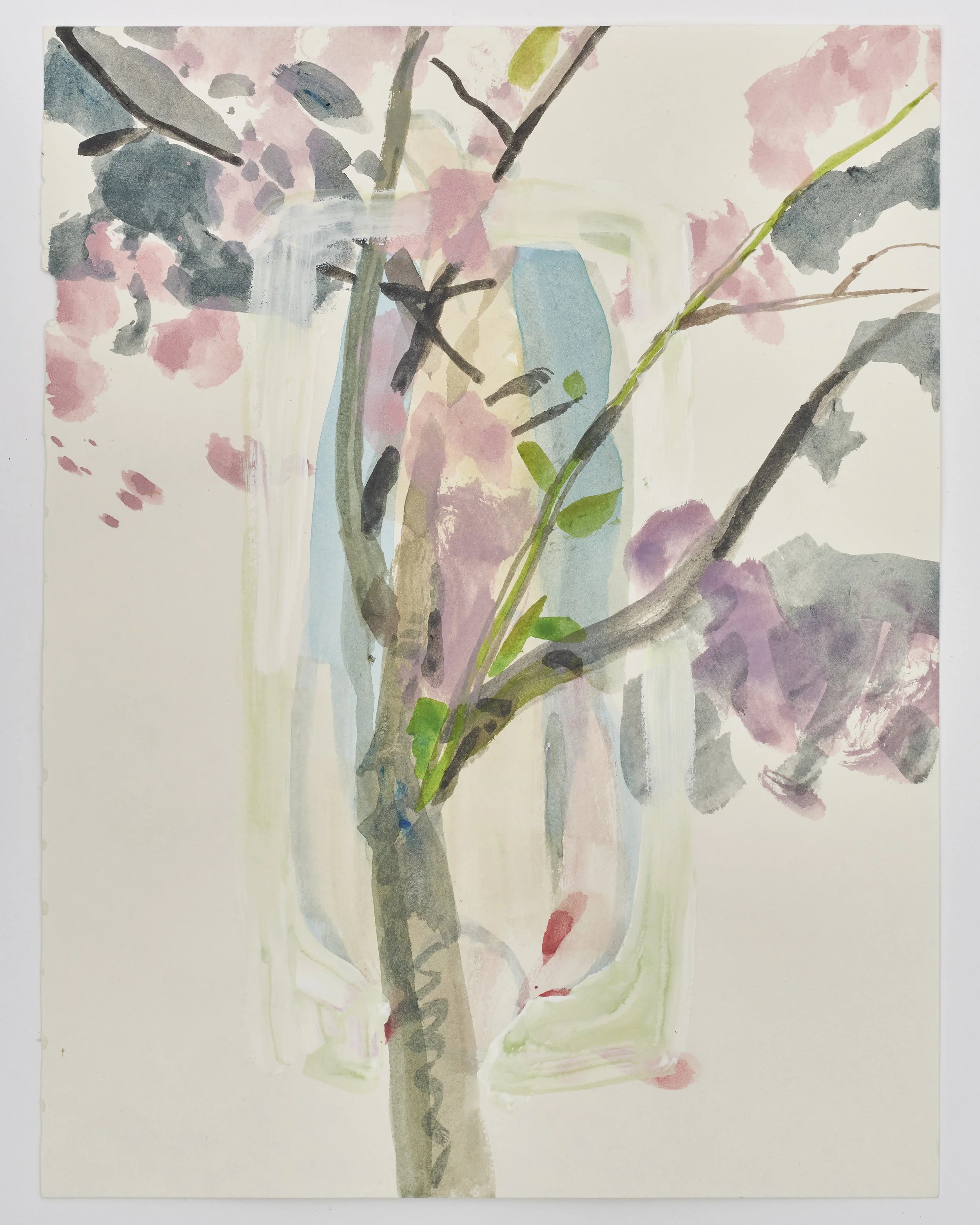
Jacqueline Qiu, 6, 2025. Watercolor on paper, 11 x 8 1/4 in., 27.9 x 21 cm. Image courtesy of the artist and CHART. Photo: Flaneurshan.studio
NC: As an artist, what are the main questions you find yourself returning to, either formally or conceptually?
JQ: There are several, of course. Two years ago, I was in a Zoom philosophy class with Darla Migan, and we read a text, “On Beauty and Being Just,” by Elaine Scarry. It explored how humans, affected profoundly by beauty, try to recreate it endlessly. That resonated with my own work and the attachment to impermanence I explore. Although my work is visually beautiful in a conventional sense, I think aesthetics can be deceptive. I question people’s definition of beauty. In America, beauty often means “fresh” or “new,” but that narrow definition can be harmful. My work encourages me to define and create beauty as I understand it, as a way of being in relation.