GUEST POST Hot Coffee Conversation Colleen Dalusong with artist Rei Xiao
Published Wednesday, March 25, 2026
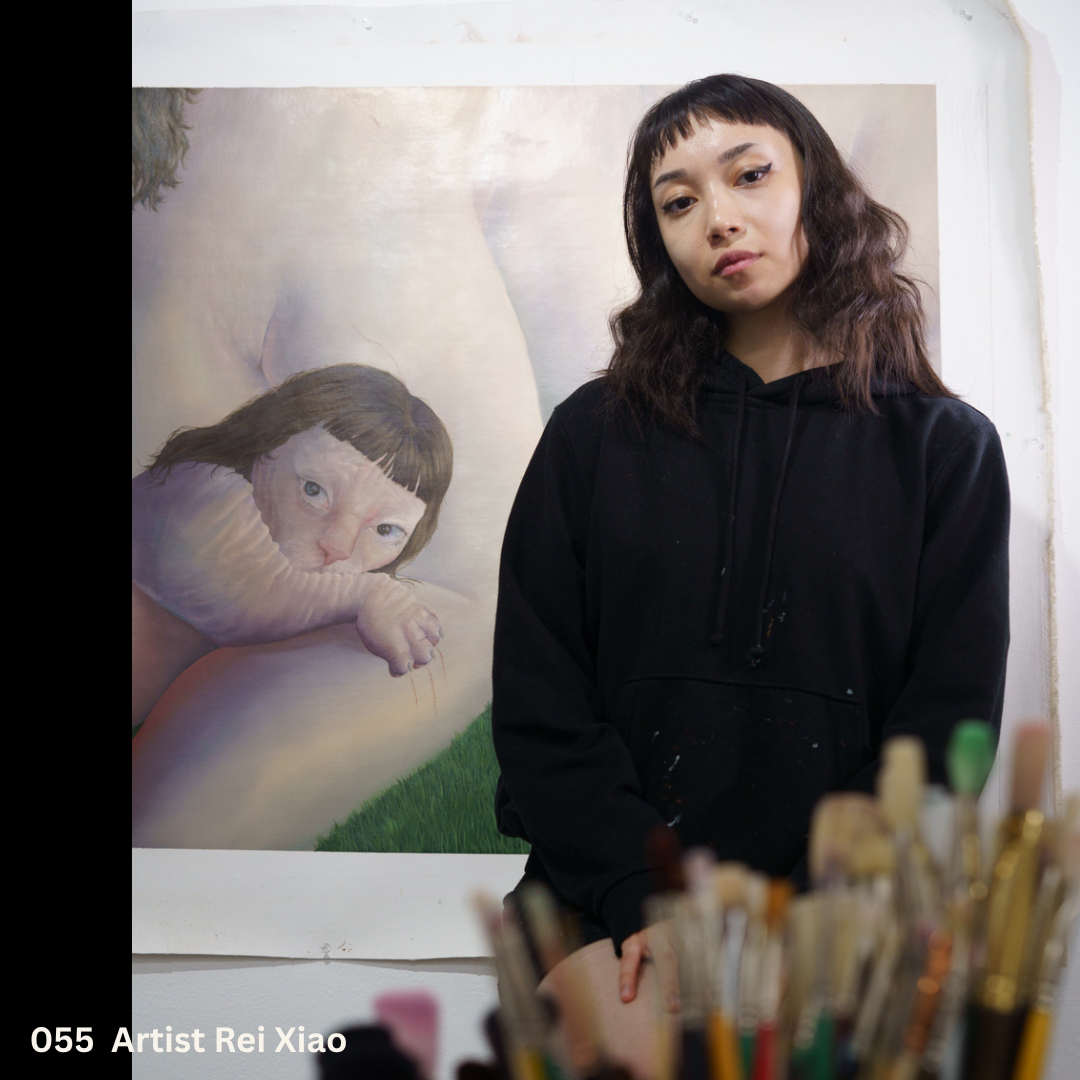
Rei Xiao (b. 2000, Istanbul, Turkey) is a Brooklyn-based artist who earned her BFA from the School of the Museum of Fine Arts at Tufts University. Her work explores trauma and multiplicity, functioning as a means to cope with loneliness and uncertainty. Xiao’s paintings are informed by her Chinese-Turkish lineage, childhood isolation, alienation, and displacement. Through sinister and painful imagery in which humans, animals, and objects intersect as hybrid beings, Xiao reimagines personal memories and liminal spaces to reclaim agency over trauma. She has participated in the Fountainhead Residency in Miami, the Macedonia Institute Artist Residency in Chatham, and the ChaNorth Artist Residency in Pine Plains. Her work has been exhibited at Fragment Gallery, September Gallery, The Macedonia Institute & Ten Barn Farm, Muskegon Museum of Art, CerModern, Evin Art Gallery, Martch Art Project, Subtitle Labs, Abigail Ogilvy, Boston Museum of Fine Arts, and Piano Craft Gallery. Rei and I met not long after realizing we had many mutual friends. She invited me to her studio in February, and I willingly trekked through the damp and snowy streets of Brooklyn, eager to learn more about Rei and her practice.
Colleen Dalusong: Imagine you are in your favorite coffee or tea spot. Where is it? What are you drinking? What do you see?
Rei Xiao: I’m somewhere familiar and cozy, maybe my own room, and I’m drinking hot tea with some cookies. The tea is from Trader Joe’s and has ginger and cinnamon, so it has a sweet, familiar scent that’s become very comforting to me. I’m looking at my computer screen, playing one of my comfort TV shows on repeat. It’s a show I’ve seen a couple of times, so it feels familiar, but not so frequent that the script is engraved in my memory.
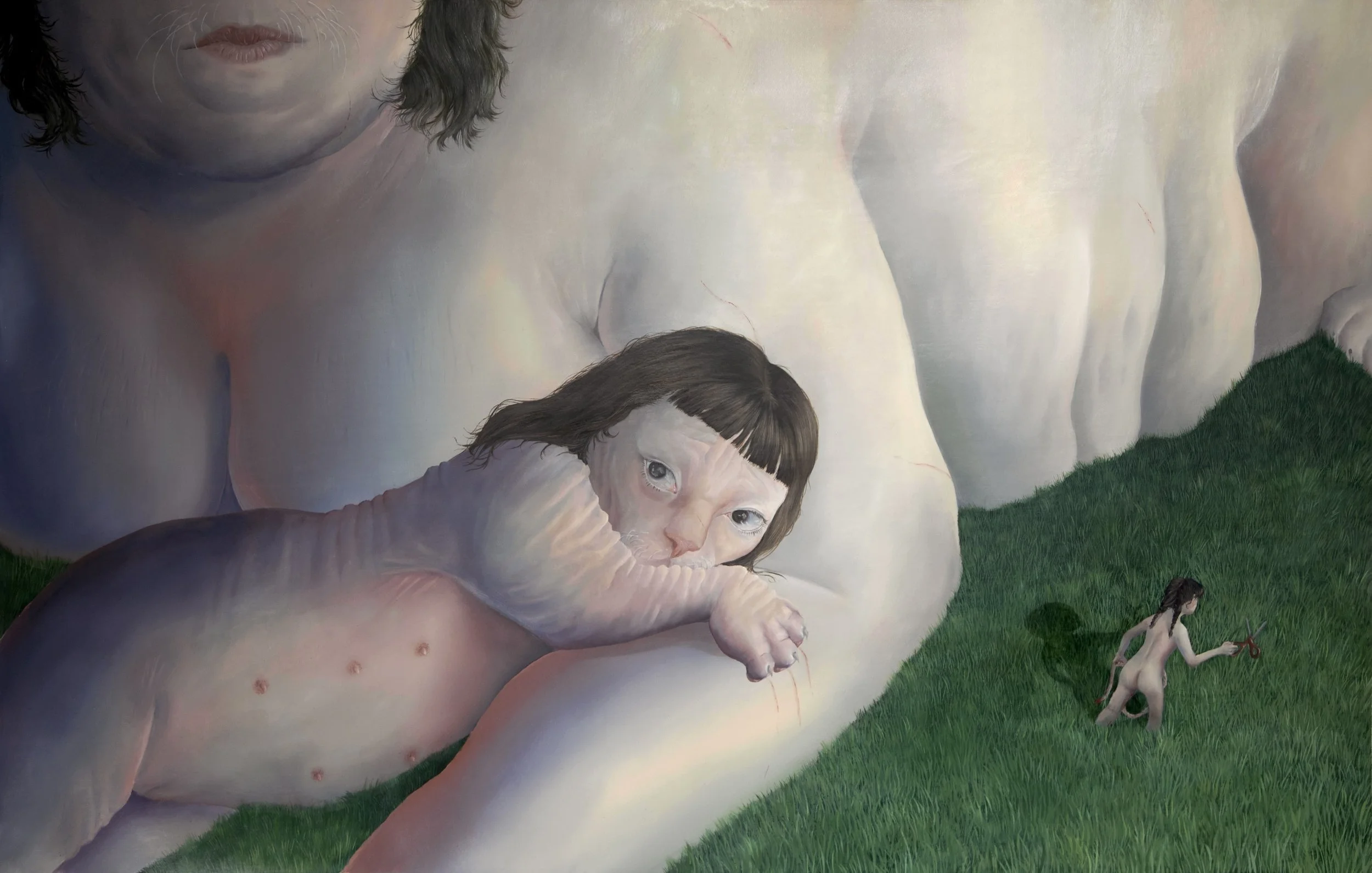
Rei Xiao, My soft and comfortable mama, 2026. Oil on canvas, 33 x 52 in / 83 x 132 cm. Image courtesy of the artist.
CD: You recently moved to New York after spending the past few years in Boston. Have you noticed a change in your art now that you’re in this new environment?
RX: I’m originally from Istanbul, so when I first came to Boston, I thought it was so calm and peaceful. I was living in a more suburban area, which could be very dull and isolating at times, but that solitude pushes you to become more introspective. During this period, I started integrating more self-portraiture into my work, and I began to make art about my mom. After coming to New York City, which is very similar to Istanbul in how chaotic yet richly multicultural it is, I began to embrace my Chinese-Turkish lineage because I realized that I don’t have to align myself with just one culture or nationality. In New York, there’s this melting pot situation where everybody and nobody belongs here, and this manifested in my art with an emphasis on the idea of multiplicity and the appearance of more chimeric figures.
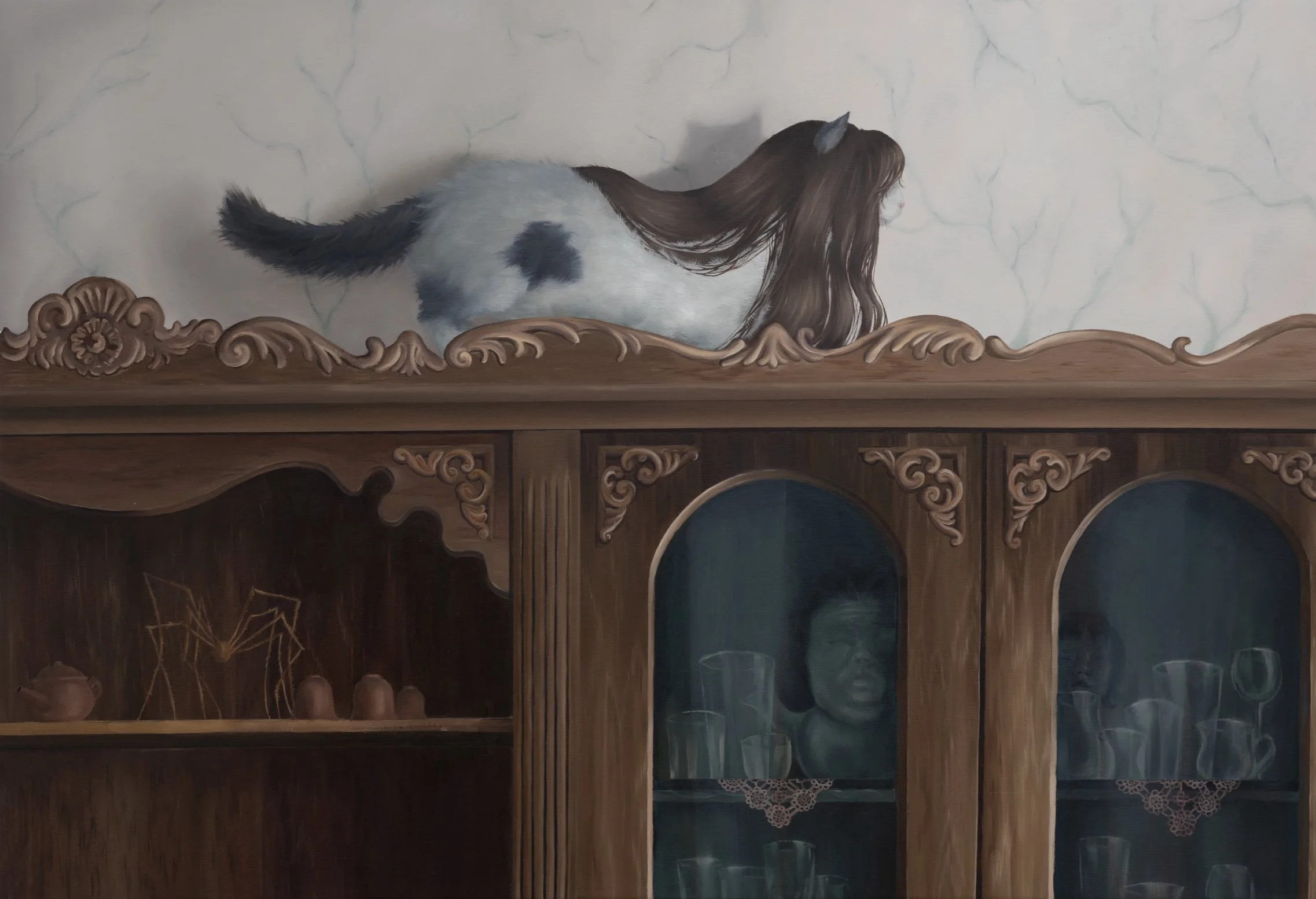
Rei Xiao, You've been Turked, 2025. Oil on canvas,30 x 44 in / 76 x 112 cm. Image courtesy of the artist.
CD: I noticed that many of your paintings feature feline-human hybrids. I’m not complaining because I also love cats, but I’m curious why you’ve chosen to paint cats in particular. Do cats hold a special meaning for you?
RX: My mom and I lived with 15 cats when I was growing up. When you live with this many cats, you realize they each have their own personality; it’s kind of like a reality TV show or a mockumentary. Some cats are bullies, other cats would constantly seek my mom’s attention, and there’d be a few cats who could not be allowed in the same room because they hold these crazy grudges against each other. There’s so much drama among them, and I naturally started anthropomorphizing all of these cats. I recently read a study that said the tendency to anthropomorphize objects or animals is connected to seeking certainty and connection. I would say the cats in my paintings symbolize this impulse, because uncertainty is just so hard to live with, and I’m still trying to find my own connection and purpose. As for why they are hybrids, I resonate with the human figure more when it’s fragmented, because I’d rather use symbolism and animal or object imagery to depict something reminiscent of the human figure. I like the idea of having layers of hidden meanings hiding underneath all the symbolism.
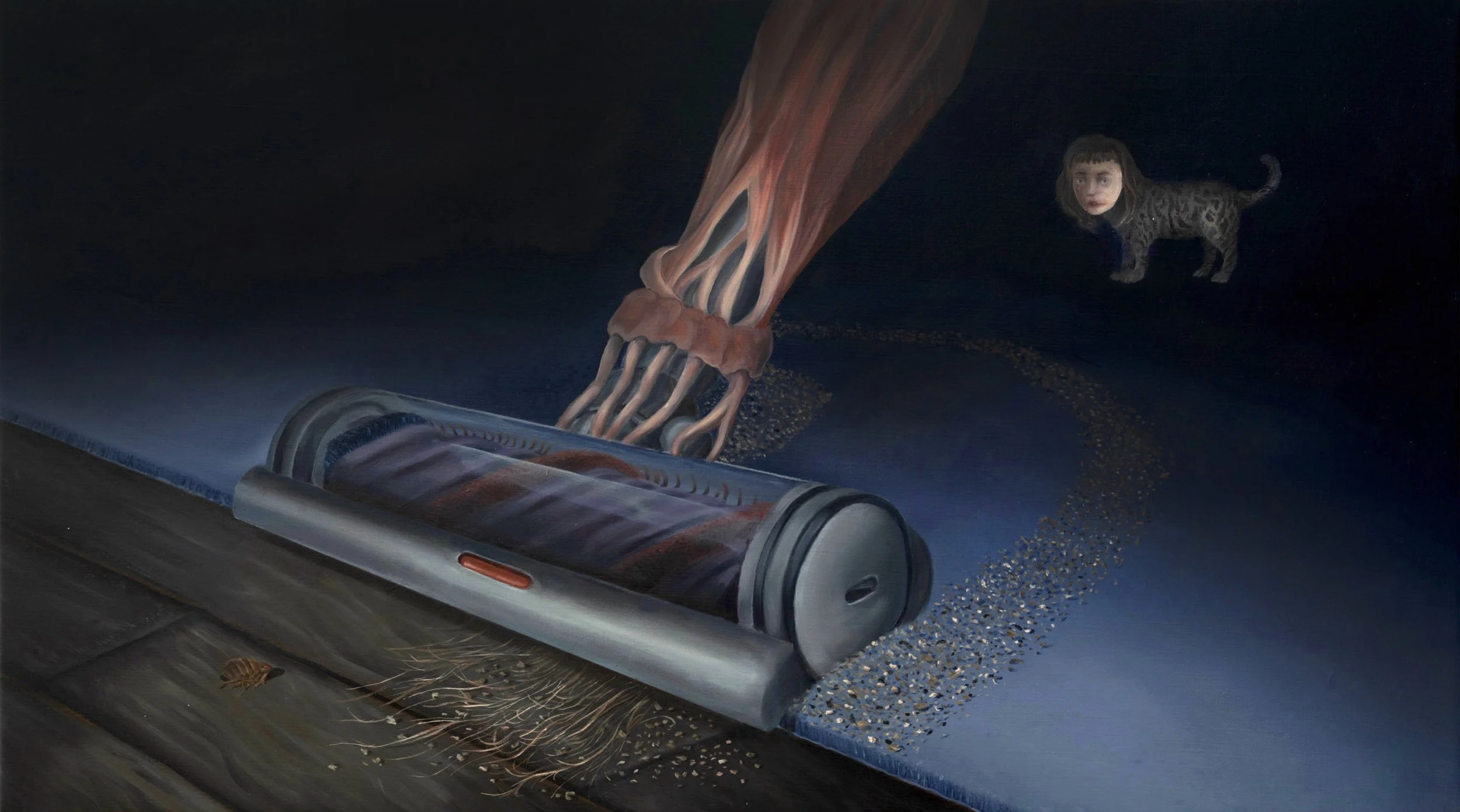
Rei Xiao, Cyclone v10 absolute,2024. Oil on linen.24 x 42 in / 60 x 106 cm. Image courtesy of the artist.
CD: One of your paintings, Cyclone v10 absolute, has a human-vacuum hybrid in it. Can you talk more about that piece and your decision to merge flesh and the machine?
RX: Whenever we had winter or summer breaks in college, I would go back to Turkey and stay at my mom’s house. Since she has 15 cats, you can imagine how messy the house is, so I bought this Dyson vacuum cleaner because I decided that someone needed to take charge and keep the house in good shape. I ended up having this ritual every day where I would clean the house, work on my paintings, then repeat, so I started thinking of the Dyson as an extension of myself. This painting is a self-portrait in a way, because the muscles surrounding the vacuum are meant to represent how the Dyson functioned as another limb for me to use during my daily routine, and I love this idea of being able to see past the flesh. There’s a quote from the Fallout series that goes, “The flesh is weak, but steel endures,” and that’s always stuck with me because I have OCD, so I view parts of my brain as this machinery that’s more akin to a laundry machine or a ceiling fan rather than something that belongs to the flesh. There’s a sort of persistence and mechanization that doesn’t quite belong, but it keeps coming back anyway, so I’ve started experimenting with incorporating the human flesh with the machine in my paintings.
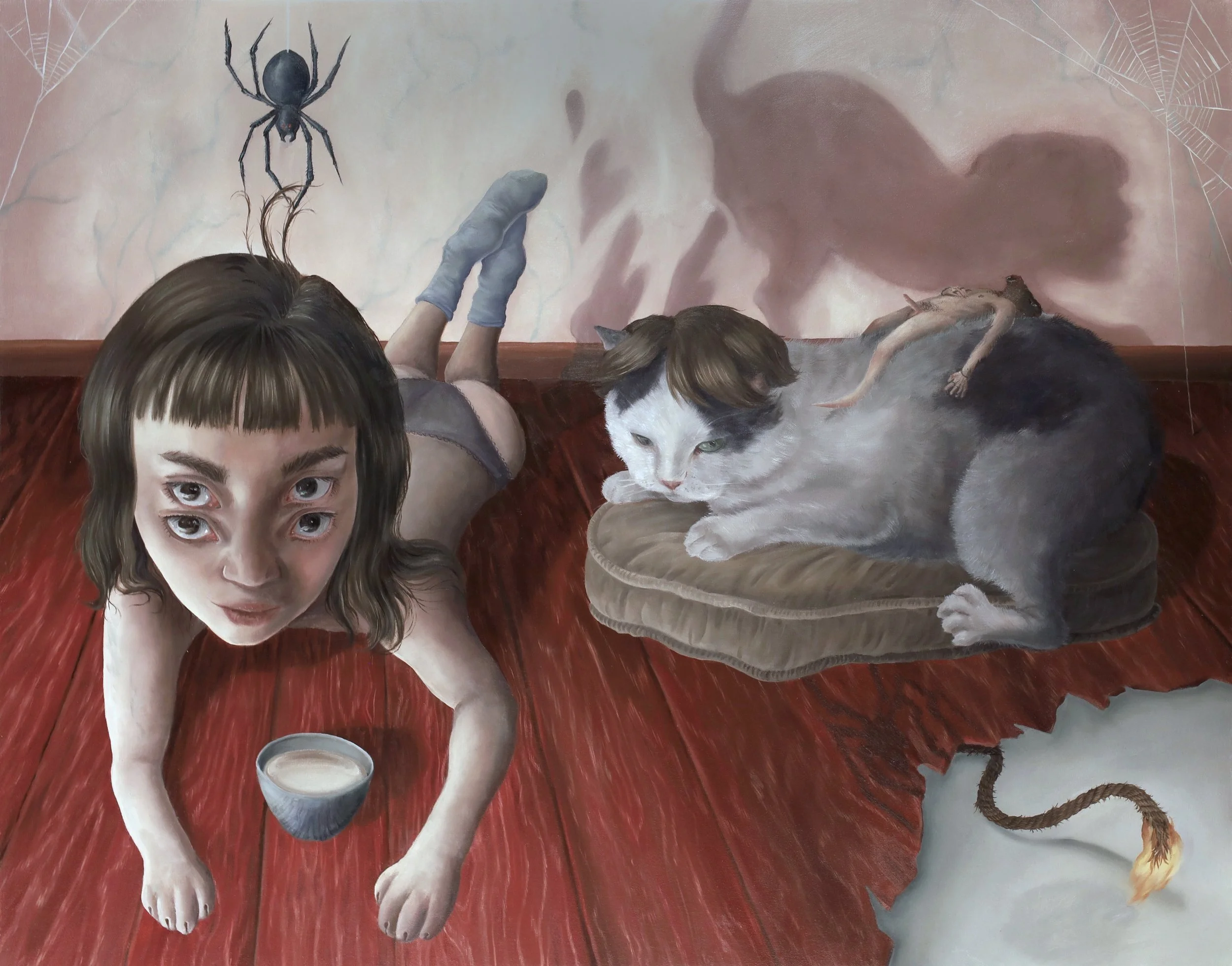
Rei Xiao, Aqui Gatito, 2025. Oil on canvas, 33x42 in / 83 x 106 cm. Image courtesy of the artist.
CD: Your paintings have such a distinct style, from the uncannily smooth texture of the figures’ flesh to the gloomy and ominous color palette. How do you see your art developing over time?
RX: I’m trying to experiment more and step outside of my comfort zone. I don’t want to become too familiar with something or have ideas repeating themselves too often, especially when it comes to painting. I think I’m going to start making more art about monkeys soon.
CD: Why monkeys?
RX: People would always ask me really invasive questions when I was growing up in Turkey. I definitely looked like a foreigner, so people wouldn’t shy away from pointing at me and interrogating me about my Chinese heritage, my family, and why I couldn’t speak Mandarin. It really made me feel like a circus monkey, and that people wanted me to do some kind of dance for their entertainment.
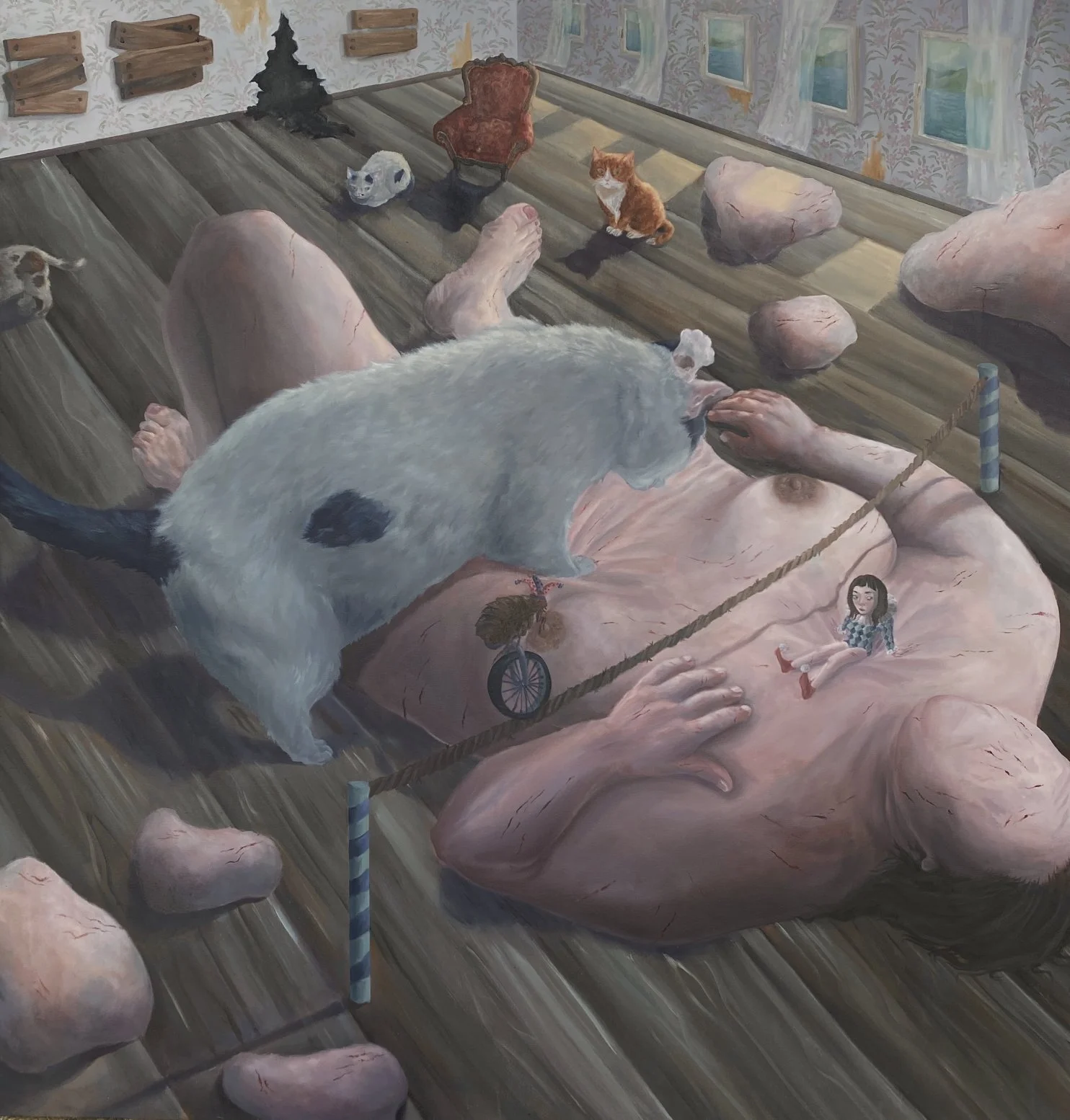
Rei Xiao, Baking mommy, 2022.Oil on canvas. 61 x 64 in / 156 x 164 cm. Image courtesy of the artist.
CD: Interestingly, you’ve brought up the image of the circus monkey, because now I’m realizing that a lot of your work is connected to this circus-like element of being the subject of entertainment and dehumanization at the same time.
RX: Oh wow, I never thought about it like that, but I definitely get what you mean because so many of the paintings are about the feeling of being dehumanized for the sake of someone else’s entertainment. Oddly enough, this plays into the title of my first solo exhibition, which was called “The Flea and the Acrobat,” because I was thinking about how the acrobat can only walk on the tightrope and go back and forth, while a flea could jump in any direction and hide wherever they want. That dichotomy between the two figures and how they’re allowed to move in space really resonated with me and my own experiences, since I grew up in a house infested with fleas thanks to all the cats living with us, so I constantly sought a means of mental escapism. It’s funny because now I’m talking to you about this, and I’m realizing that I also have a little archive of flea circus images on my computer.
CD: [Laughing] I guess this ties into what we were talking about earlier, with symbolism and the subconscious.
RX: Whenever I talk about my work with another person, I always learn something new about my own paintings, but that’s why I love using symbolism. The subconscious narratives that go into making a painting might only be revealed long after it’s already been completed, and that’s what makes it so fun.
Interview by Colleen Dalusong. Colleen Dalusong is a curator and writer based in New York City. She has curated exhibits at Accent Sisters, Uncool Gallery, CP Projects Space, Think!Chinatown, and A Space Gallery. Her reviews have been published in Whitehot Magazine, Cultbytes, sabukaru.online, Mercer Street Reader, and Impulse Magazine.
Portrait of artist Rei Xiao by Karli Evans.