“In Minor Keys” - 61st Venice Biennale
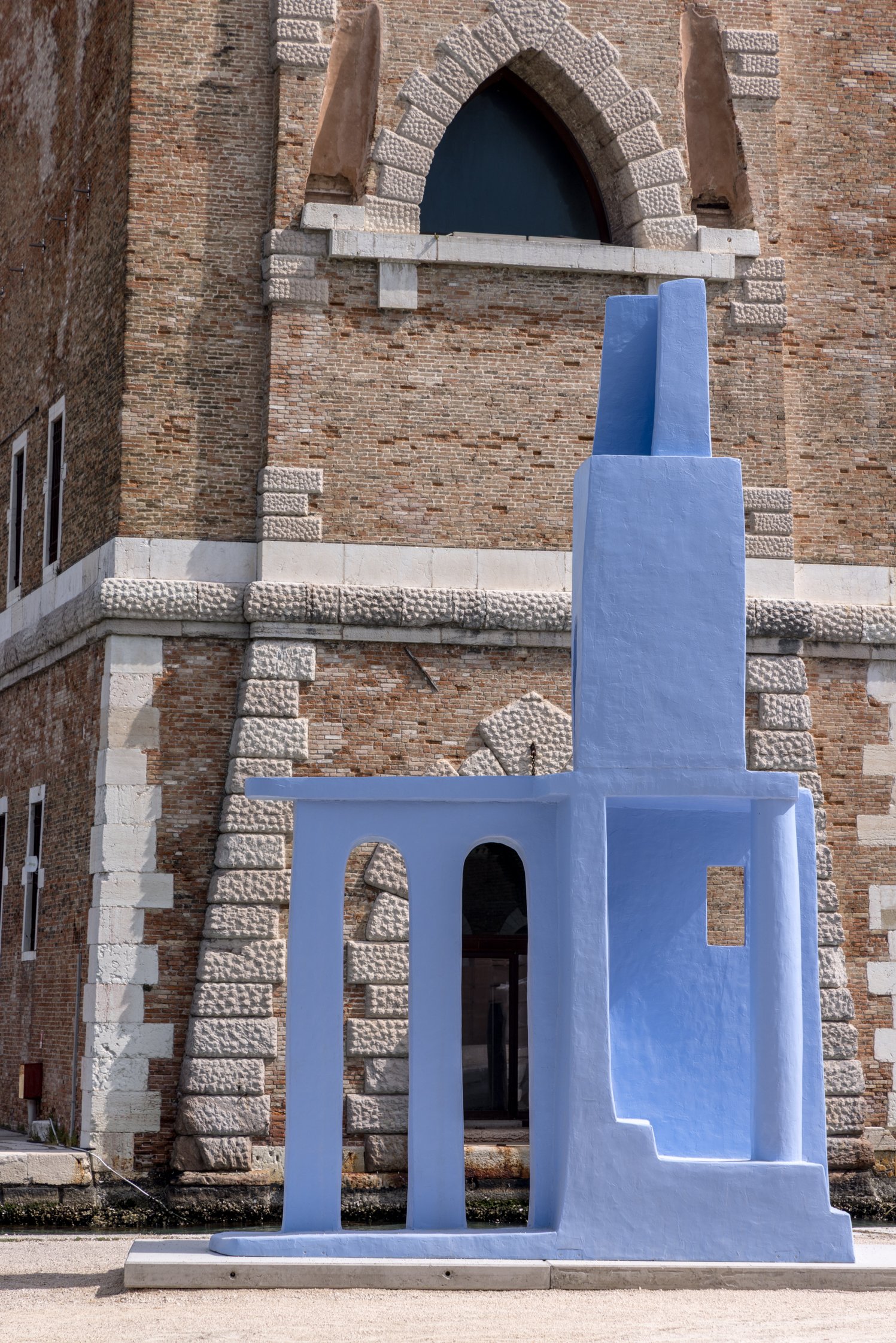
Philip Aguirre y Otegui, Gaalgui Shelter (2026). Sculpture, polyester. 575×157×367cm. 61 Esposizione Internazionale d’Arte -La Biennale di Venezia, In Minor Keys. Photo by Marco Zorzanello. Courtesy: La Biennale di Venezia.
Author: Michela Cheruti
Published Wednesday, June 3, 2026
The 61st Venice Biennale, “In Minor Keys,” opened under the sign of interruption. Long before the first previews began, before the vaporetto stops were filled with critics balancing espresso cups and folded maps of the Giardini, the exhibition already became intolerable from a sequence of absences, cancellations, and institutional fractures materializing from every direction. The most devastating of these was, of course, the death of curator Koyo Kouoh in May 2025, less than a year before the Biennale’s opening. What remains is therefore a curatorial vision realised through collective continuation: an exhibition completed by Kouoh’s collaborators in the difficult space between fidelity and reconstruction. The result carries a strange temporal tension. “In Minor Keys” often feels haunted by its own incompleteness, as though it still is searching for the shape it might have once taken.
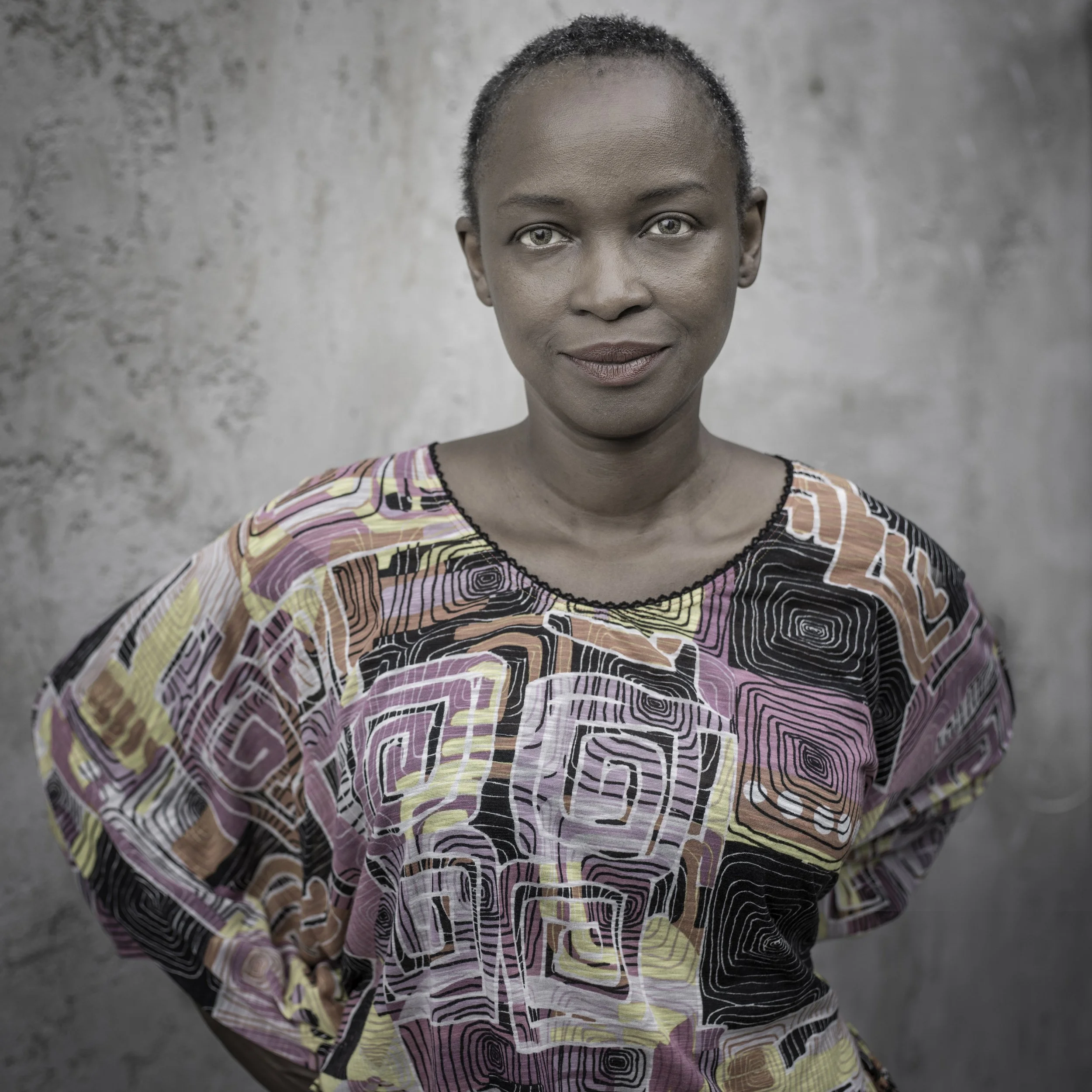
Koyo Kouoh, photo courtesy: La Biennale di Venezia.
But Kouoh’s death was only a beginning in a long season of instability. The controversies surrounding the Israeli and Russian pavilions remained unresolved into the opening weeks; internal disputes emerged around the Australian Pavilion; and the planned pavilion for South Africa collapsed, with Gabrielle Goliath’s presentation, Elegy, becoming widely criticized as emblematic of political censorship. Goliath ultimately presented the work independently in Castello, while the South African Pavilion remained empty. Shortly before the Biennale opened, the jury itself resigned in an extraordinary public rupture. By Friday of vernissage week, strikes organized by ANGA caused the closing of multiple pavilions entirely, while many art workers withdrew their labour in solidarity with Palestine. Venice –– always a city of delays, closures, and detours –– became newly defined by locked gates and missing presences. The fiction of the Biennale as a seamless international exhibition had perhaps never looked more fragile.
It is fitting, then, that one of the most moving works in the city emerged precisely from this atmosphere of institutional breakdown. Goliath’s Elegy, installed in the Chiesa di Sant’Antonino, transformed mourning into a durational structure of listening. Voices moved slowly through the church architecture without climax or resolution, unfolding through repetition and collective breath. The work resisted spectacle almost completely. Instead, it insisted on attention as an ethical form – attention to grief, to historical violence, to the labour of sustaining presence after rupture. In many ways, Elegy became a motivational key for understanding the Biennale itself, not as a coherent statement but as a dispersed field of fragile continuities.
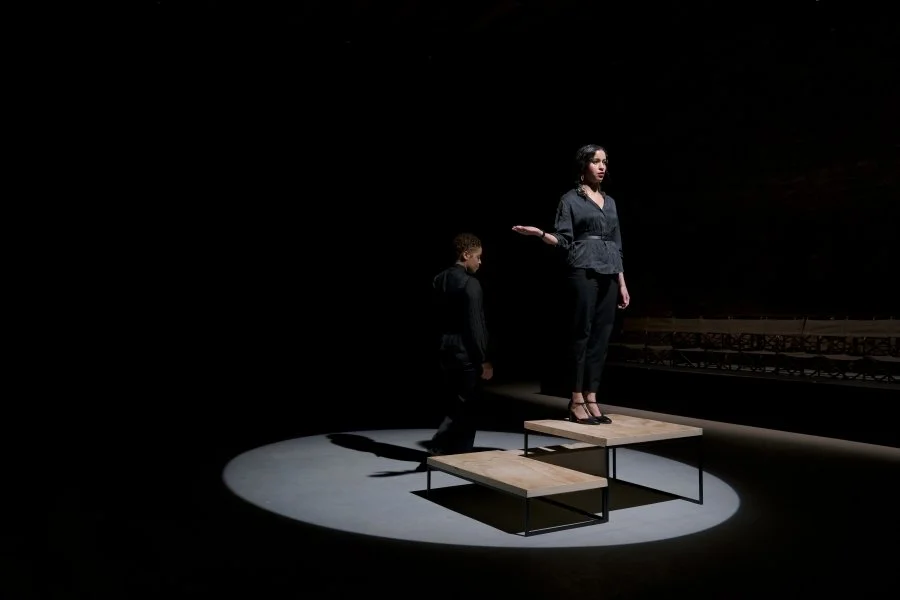
Gabrielle Goliath, Elegy, 2026. 61 Esposizione Internazionale d’Arte -La Biennale di Venezia, In Minor Keys. Photo by Luca Zambelli.Courtesy: La Biennale di Venezia.
This sense of dispersal defines the central exhibition at the Arsenale. Monumental even by Biennale standards, “In Minor Keys” gathers an enormous number of artists into an exhibitionary structure so large that individual works often struggle to maintain distinction. The exhibition unfolds through accumulation, over a vast sequence of installations following one another through the industrial spine of the Arsenale. There are undeniably powerful moments throughout, but the scale frequently overwhelms any curatorial precision. The title promises attunement to quieter frequencies, to subtler emotional and political registers, yet the exhibition often remains trapped within the familiar monumental logic of the Biennale itself: exhaustive, overloaded, architecturally domineering. Space is occupied continuously, but not always meaningfully. One clearly senses the difficulty of producing intimacy at this scale.
As so often happens in Venice, it is the national pavilions and collateral events where the exhibition’s tonalities merge more convincingly. Lotus L. Kang’s The face of desire is loss, present in the Bvlgari Pavilion at the Giardini, extends many of the emotional frequencies opened by Goliath’s Elegy. Dang’s suspended photographic membranes and chemically altered surfaces seemed to hover between disappearance and preservation, as though memory itself had become material. Light passed through translucent fabrics with almost painful delicacy. Nothing in the installation announced itself loudly; instead, the work unfolded through gradual atmospheric shifts, asking viewers to remain with uncertainty rather than interpret it. Loss here was not represented but metabolized into texture, humidity, and light.
A similarly understated sensitivity characterized Marina Xenofontos’s It Rests to the Bone, presented for Cyprus in Castello. Xenofontos works through fragments, residues, and gestures of care so minimal they almost evade visibility altogether. Her installation felt composed from the exhausted remains of intimacy: objects feel smooth when touched, materials carrying traces of dependency and neglect simultaneously. Like King, Xenofontos resists an explanatory structure. Meaning emerges through proximity. In a Biennale so dominated by informational overload, her work created one of the rare spaces where hesitation itself felt politically significant.
Questions of environment and atmosphere appeared again in Jenna Sutela’s Aeolian Suite at the Finnish Pavilion, where systems of wind, vibration, microbial intelligence, and synthetic sound transformed the pavilion into a porous sensory organism. Sutela’s work has long explored forms of nonhuman communication, but here the emphasis seems less technological than elemental. The pavilion functioned almost as an instrument for registering invisible relations between bodies, climates, and machine perception. Importantly, the work avoided the inflated rhetoric that often accompanies technologically oriented installations. Its intelligence remained quiet, dispersed, meteorological.
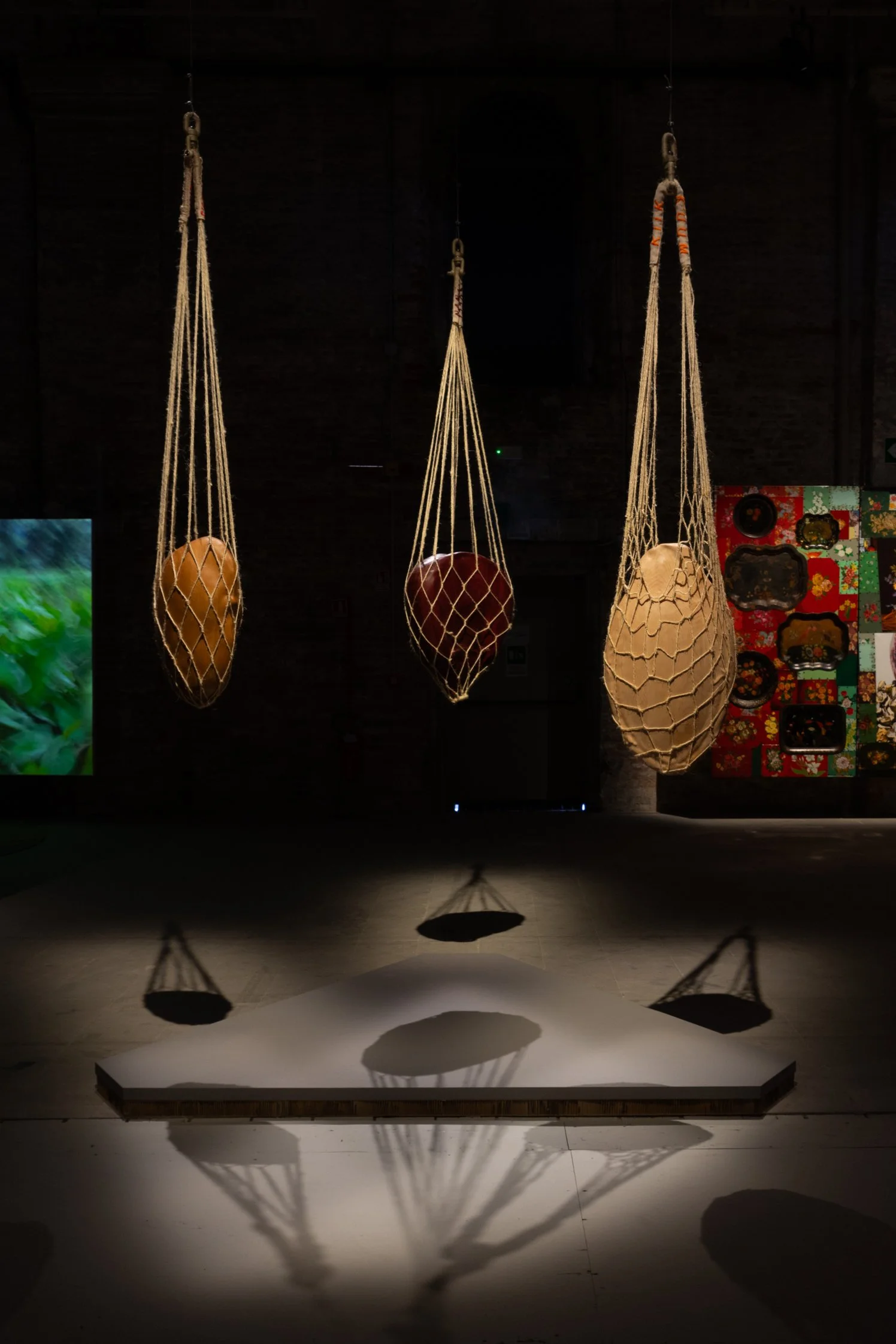
Carolina Caycedo, Ñañay Kculli ~ S’oam Bawi Wenag ~ Kiik K’úum (2024).61 Esposizione Internazionale d’Arte -La Biennale di Venezia, In Minor Keys. Photo by Luca Zambelli.Courtesy: La Biennale di Venezia.
This concern with systems –– ecological, architectural, emotional –– connected several of the Biannale’s strongest pavilions. In the Korean Pavilion, Liberation Space: Fortress / Nest explored the unstable line between refuge and containment through nested architectural structures that visitors navigated. Spaces of protection gradually revealed themselves as spaces of isolation and surveillance. The project’s spatial logic resonated strongly with the Biennale’s own geopolitical structure, where national pavilions continue to operate through carefully managed borders and exclusions even while speaking the language of openness and exchange.
Maja Malou Lyse’s Things to Come in the Danish Pavilion approached similar anxieties through a far stranger and more ambivalent register. Drawing together pornography, speculative fiction, biotechnology, and collapsing fantasies of futurity, the pavilion unfolded as a synthetic environment where erotic imagery and reproductive anxiety became increasingly indistinguishable. Large-scale video installations, immersive interfaces, and hyper-designed interiors transformed the space into something between a fertility clinic, sci-fi set, and adult entertainment platform. Yet the work resisted easy provocation. Rather than simply aestheticising digital excess, Lyse examined how contemporary image culture now penetrates biological and emotional life itself — how desire, reproduction, and technological mediation have become inseparable systems. The result was simultaneously seductive and deeply unsettling: a pavilion haunted less by dystopian spectacle than by the quiet exhaustion of imagining a future at all.
Li Yi-Fan Screen Melancholy at the Taiwan Pavilion extended this atmosphere into the domain of digital spectatorship itself. Installed in the Palazzo delle Prigioni, the video work examined contemporary screen culture less through critique than through immersion. Images circulated endlessly through interfaces that generated a low, persistent emotional fatigue. Melancholy emerged infrastructurally, embedded within the systems of repetition and attention extraction. The historical weight of the prison architecture only intensified this sensation of soft captivity.
Elsewhere, several artists responded to the instability of the present through forces of narrative fragmentation and speculative play. Yto Barrada Comme Saturne in the French Pavilion unfolded through layered temporalities of labour, mythology, and inheritance, transforming the pavilion into something between an archaeological dig and a theatrical stage set. Barrada’s installations often possess a deceptive lightness, and here too humour and melancholy remained tightly interwoven. History appeared not as a stable narrative but as a cyclical accumulation: repetition without resolution.
Ei Arakawa-Nash’s Grass Babies, Moon Babies in the Japanese Pavilion, similarly embraced instability, though in a far more exuberant register. Performance, animation, vegetal imagery, and absurdist choreography collided within a deliberately chaotic environment that resisted coherent interpretation altogether. Yet unlike many immersive installations that confuse excess with vitality, Arakawa-Nash’s disorder remained deeply generous. The pavilion invited viewers into forms of collectivity built through digression, contingency, and play.
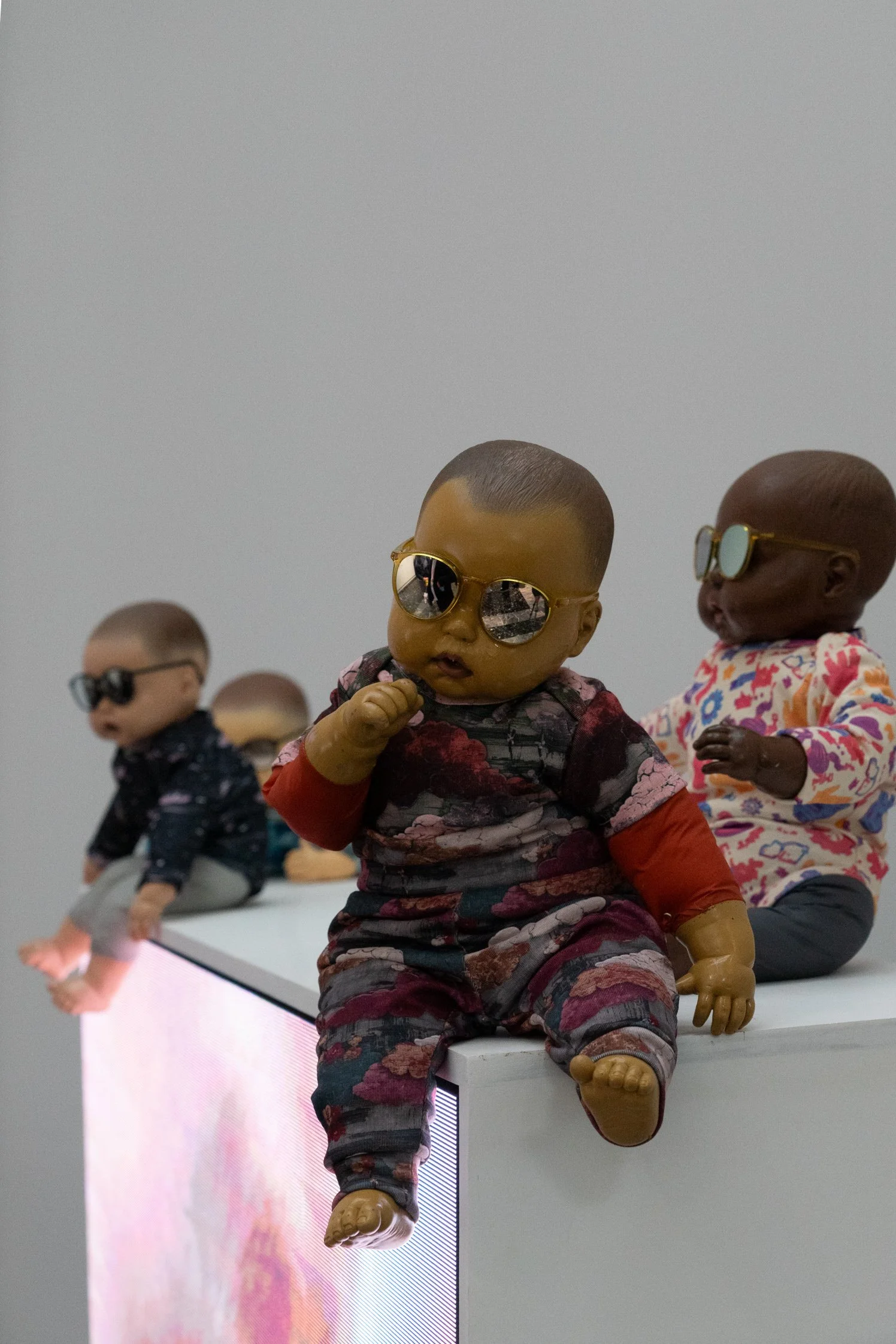
Pavillion of Japan. Ei Arakawa-Nash, Grass Babies, Moon Babies,2026. 61 Esposizione Internazionale d’Arte -La Biennale di Venezia, In Minor Keys. Photo by Luca Zambelli Bais.Courtesy: La Biennale di Venezia.
Even some of the more excessive projects this year revealed a productive tension between spectacle and collapse. Henrike Naumann and Sung Rieu’s Ruin in the German Pavilion examined post-unification memory through interiors sutured with bureaucratic violence and nationalist residue, while Florentina Holzinger’s SEAWORLD VENICE at the Austrian Pavilion pushed bodily endurance and operatic grotesque into overwhelming territory. Both projects, in very different ways, staged the instability of contemporary Europe as something simultaneously theatrical and deeply material.
Outside the official Biennale, several exhibitions achieved a clarity and coherence often missing from the central exhibition. “Canicula,” organized by Fondazione In Between Art Film at the Complesso dell’Ospedaletto, brought together works orbiting ecological exhaustion, heat, and bodily transformation with remarkable precision. Janis Rafa’s contribution lingered particularly strongly in its fusion of animality and nocturnal desire, while P. Staff transformed infrastructural violence into a cold, bodily poetics of dysregulation.
Outside the official Biennale, several exhibitions achieved a level of formal coherence and conceptual precision often missing from the sprawling central exhibition. “Canicula,” organised by Fondazione In Between Art Film at the Complesso dell’Ospedaletto, approached ecological exhaustion not through didacticism but through atmospheres of bodily disorientation, heat, and slow transformation. Moving through the exhibition felt like inhabiting a suspended climatic condition: a world overheated both environmentally and psychologically. The works gathered there shared a sensitivity to altered states — sleeplessness, hormonal instability, animal proximity, infrastructural stress — without ever collapsing into a singular thesis. Janis Rafa’s contribution lingered particularly strongly in its fusion of nocturnal eroticism and animality, where desire appeared inseparable from predation, vulnerability, and ritual repetition. Nearby, P. Staff transformed systems of technological and institutional control into a cold corporeal poetics of dysregulation. Bodies in “Canicula” were never stable entities but porous surfaces continuously shaped by chemical, ecological, and political forces. What distinguished the exhibition overall was its refusal of catastrophe as image. Ecological crisis emerged less as an event than as an atmosphere: ambient, intimate, and already metabolized into everyday life.
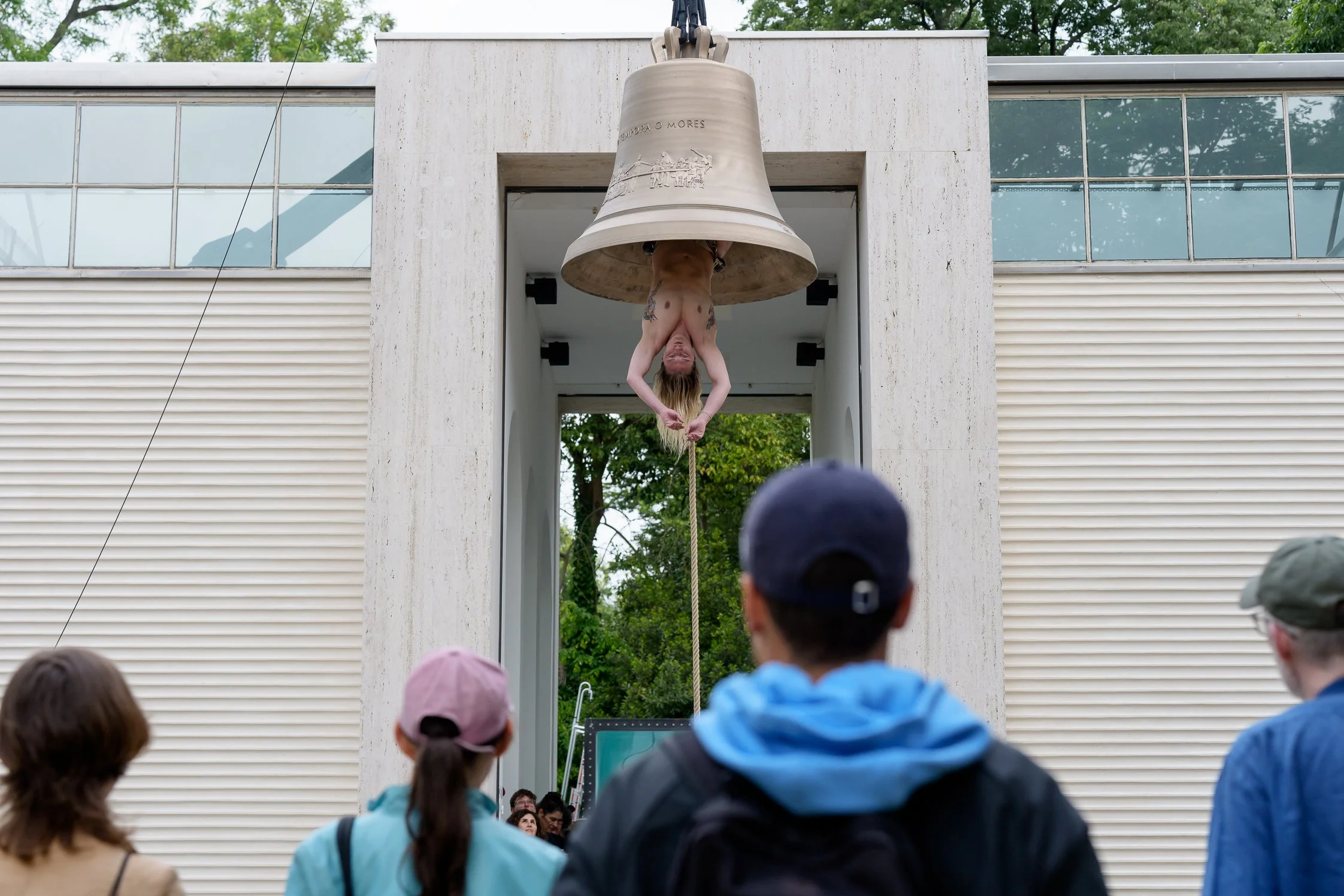
Pavillon of Austria, SEAWORLD VENICE, 61 Esposizione Internazionale d’Arte -La Biennale di Venezia, In Minor Keys. Photo by Andrea Avezzù.Courtesy: La Biennale di Venezia.
At Fondazione Prada, Arthur Jafa and Richard Prince’s “Helter Skelter” confronted image circulation itself as a condition of contemporary political consciousness. Rather than offering a stable curatorial argument, the exhibition unfolded through collisions between appropriation, spectacle, racial violence, celebrity culture, and digital excess. Jafa’s work in particular retained its extraordinary capacity to move between historical archive and affective rupture, producing sequences of images that felt simultaneously overwhelming and painfully lucid. Prince’s appropriative strategies, by contrast, introduced a more corrosive ambiguity around authorship, repetition, and cultural exhaustion. Together, the exhibition often felt sharper — and considerably more dangerous — than much of the Biennale proper precisely because it refused the moral stabilization that large institutional exhibitions increasingly seek. Elsewhere in the city, Lydia Ourahmane’s “5 Works” at the Nicoletta Fiorucci Foundation moved almost radically in the opposite direction. Sparse, restrained, and quietly devastating, the exhibition embraced withdrawal and material absence as conditions of historical experience rather than symbolic gestures. Objects appeared burdened by logistics, displacement, and the invisible infrastructures of migration and state violence. And at Palazzo Nervi, “If All Time Is Eternally Present” — bringing together Kandis Williams, Meriem Bennani & Oriane Barki, and Tai Shani — approached history as a psychic and aesthetic residue that could no longer be organized into linear chronology. Myth, digital debris, esotericism, and speculative fiction circulated through the exhibition in layered temporal loops, producing a sense not of historical progression but of recursive accumulation. If many exhibitions this year struggled to articulate the present without collapsing into overload, these projects instead embraced fragmentation itself as a viable aesthetic condition.
Ultimately, what “In Minor Keys” reveals — perhaps despite itself — is the exhaustion of the Biennale form as a fantasy of global coherence. Again and again, the most compelling works this year emerged not through monumentality or curatorial synthesis, but through fracture: through absences, interruptions, dispersed temporalities, and fragile structures of attention. Rather than producing a unified statement about the contemporary condition, the Biennale unfolded as a series of unstable atmospheres in which grief, ecological anxiety, technological fatigue, and geopolitical collapse circulated without resolution. Yet this incompletion also generated unexpected possibilities. Across Venice, many artists rejected the demand for spectacle in favor of quieter forms of persistence: gestures of listening, hesitation, maintenance, and embodied vulnerability that resisted both institutional clarity and narrative closure. If previous Biennales often imagined art as a space capable of organizing the world symbolically, “In Minor Keys” instead seemed to accept disorientation as its central condition. What remained was not coherence but attunement — a scattered sensibility attentive to the minor frequencies through which contemporary life is now most acutely experienced: exhaustion, latency, repetition, and the difficult labour of continuing after rupture.
Venice Biennale 61 is on view from May 9 through November 22.
About the author: Michela Ceruti is a writer based in Milan. She is the managing editor of Flash Art Magazine.