Andrea Martinucci & Aurelio Di Virgilio at Fondazione Giuliani, Rome
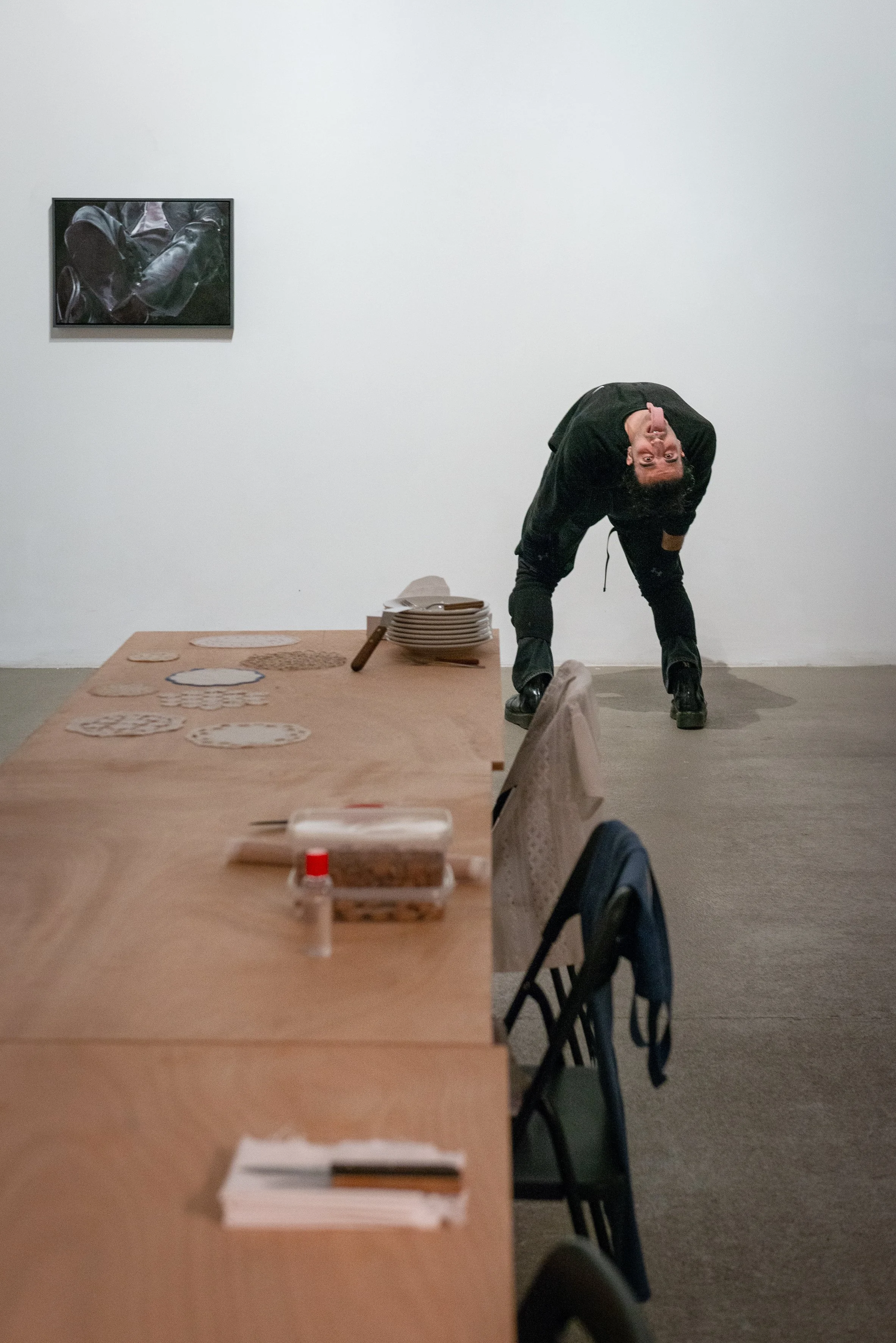
To be is to be in relation, Installation view, Fondazione Giuliani per l’Arte Contemporanea, Rome, IT, 2026. Photo by Roberto Apa.
Author: Michela Ceruti
Published Thursday, March 29, 2026.
A wall had cut me off from the rest of the world.
Marlen Haushofer, The Wall
Before anything begins, it may be helpful to clarify the ground on which this text unfolds. It takes its cue from an event, though such occasions dissolve almost as soon as they arise. What remains are two practices that briefly intersect at that point of time and space. A single question gathers around them: disappearance, and the subtle relations that emerge in its wake.
In medieval bestiaries, there exists an animal called the perfumed panther. After feeding, this panther falls asleep for three days, and when it wakes up, it releases a breath so sweet that every animal in the forest begins to follow it, drawn by a scent that moves through the air like a promise. Only the hunters – the humans– cannot perceive it. The panther recurs as an allegory of poetry: a force that draws others near while eluding those who would seek to capture it.
For some time, Milan-based performer and dancemaker Aurelio Di Virgilio has been thinking about this animal. Not only of its sweetness, but of its particular authority – the way it leads without appearing to lead. The panther is seductive yet elusive—a guide, but also a mirage.
During Di Virgilio’s residency at Pollinaria in Civitella Casanova, in the hills of Abruzzo, another animal entered the scene. This time, not fully mythical, but ambiguous in a different way: the Apennine lynx. The lynx exists in a strange temporal condition. In Abruzzo, there have been no confirmed traces of these animals for more than a decade, yet their extinction has never been declared either. It occupies an unstable space between a rumor and a fact. People speak about it as one speaks about something glimpsed briefly at the periphery of one’s vision. It may still be there, or perhaps it has already disappeared.
Di Virgilio’s performance LYNX LYNX (2025) develops somewhere within this uncertainty. The animal is less than a subject but rather a pressure exerted on the body; something that disturbs posture, movement, and scale. What returns from the residency is not the image of the lynx, but the sensation of proximity to something that resists being seen.
At Fondazione Giuliani in Rome, this pressure takes form for a brief moment. The performance begins almost imperceptibly: a gesture toward the face, a substance sprayed onto skin and hair, as if preparing the body for a shift that is not yet visible. Only later, after turning away, the body reappears altered – a long tongue emerging from the mouth, displacing rhetorical human figure into something less stable, less identifiable. From that point onward, the performance unfolds as a tentative negotiation with this new condition: not a display, but a kind of inquiry, as though the body itself tries to understand what it has become. The movement does not assert control but circles around it, testing its limits, staying close to the threshold where recognition begins to fail. Notably, this emergence takes place in proximity to one of Andrea Martinucci’s paintings, as if the pictorial and the corporeal were momentarily caught in the same transformative field, each registering -in its own language -a form of appearance inseparable from disappearance.
Disappearance has long haunted Di Virgilio’s work; the term ‘haunted’ here is not used randomly. Here it takes the form of animal extinction, though the idea exceeds that frame quite fast. Literature has often imagined sudden and mysterious disappearances – entire populations gone, landscapes emptied of their inhabitants. In Marlene Haushofer’s 1963 novel The Wall, for example, the catastrophe is never explained. What remains is simply a woman, a forest, and a handful of animals with whom she must learn to share a world that has suddenly contracted. We might even think of the great disappearance, as described by Mark Fisher.
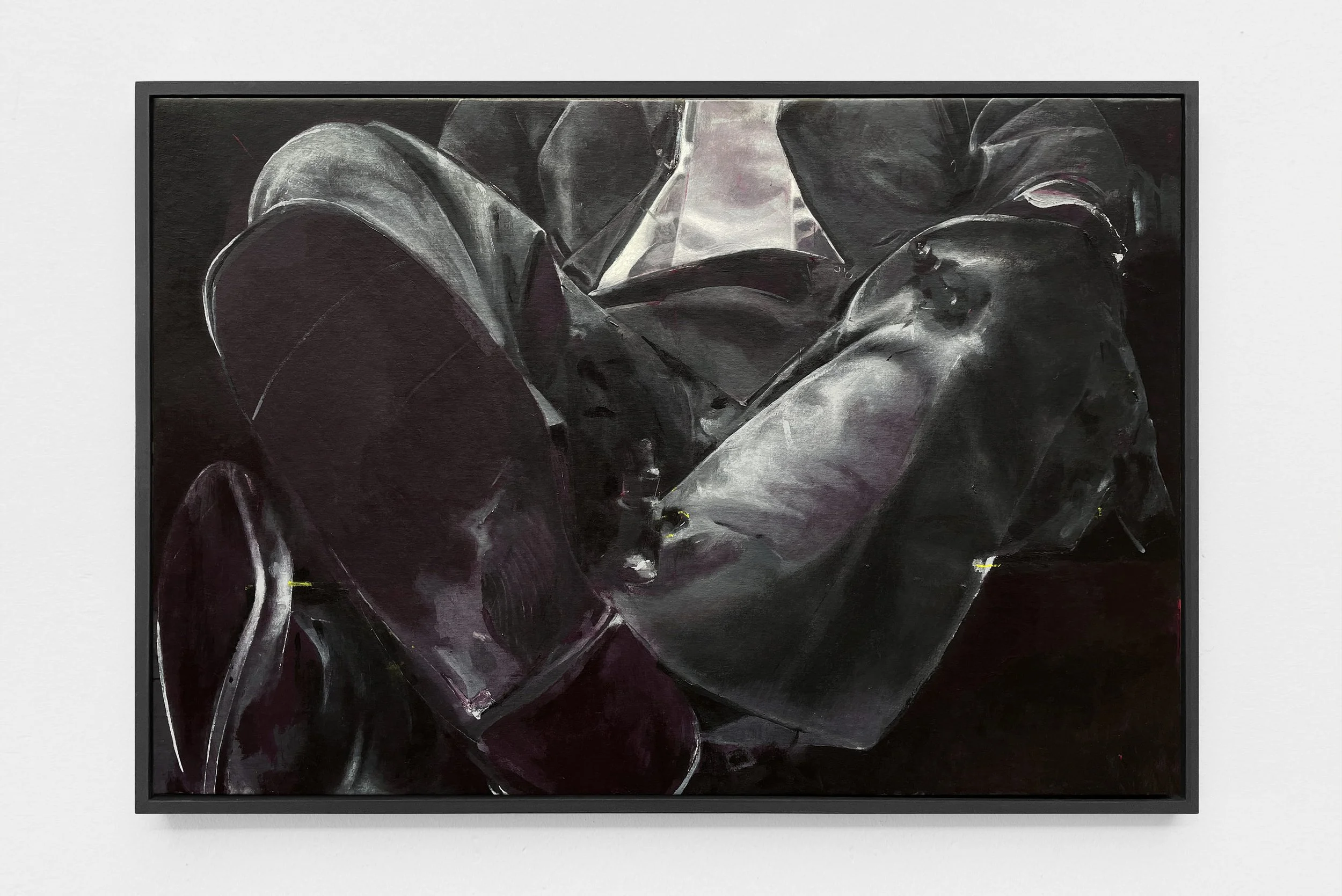
Andrea Martinucci; Guardaroba (Wardobre), 2025 Oil on linen, 68 x 48 x 5,5 cm. Image courtesy of the artist.
In his book The Weird and the Eerie (2016), Fisher explores what he calls the eerie – the sense of being haunted by something that should not be there, a presence that refuses to make itself fully known. The disappearance that Fisher theorizes, especially in the context of the eerie, is a condition of being overwhelmed by a very specific kind of absence. It’s not simply that things vanish, but that their absence leaves a trace: a tension that disrupts our understanding of what should be there. Drawing on the Gothic tradition and the uncanny, Fisher treats disappearance not as a narrative conclusion but as a symptom of a deeper, more unsettling reality. The concept of disappearance in this sense evokes a haunting tone, where what is absent is never fully gone, and the loss itself becomes a form of presence.
These stories rarely concern disappearance alone. They emphasize a more general condition. Every living being moves towards its own disappearance. Humans are unusual only in that they know it. This knowledge is difficult to live with, and therefore it is constantly pushed aside, displaced into other narratives: ecological collapse, extinction, catastrophe. But somewhere beneath these stories lies a simpler fact.
Perhaps this is why a disappearing animal carries such a peculiar charge: it is at once itself and something else.
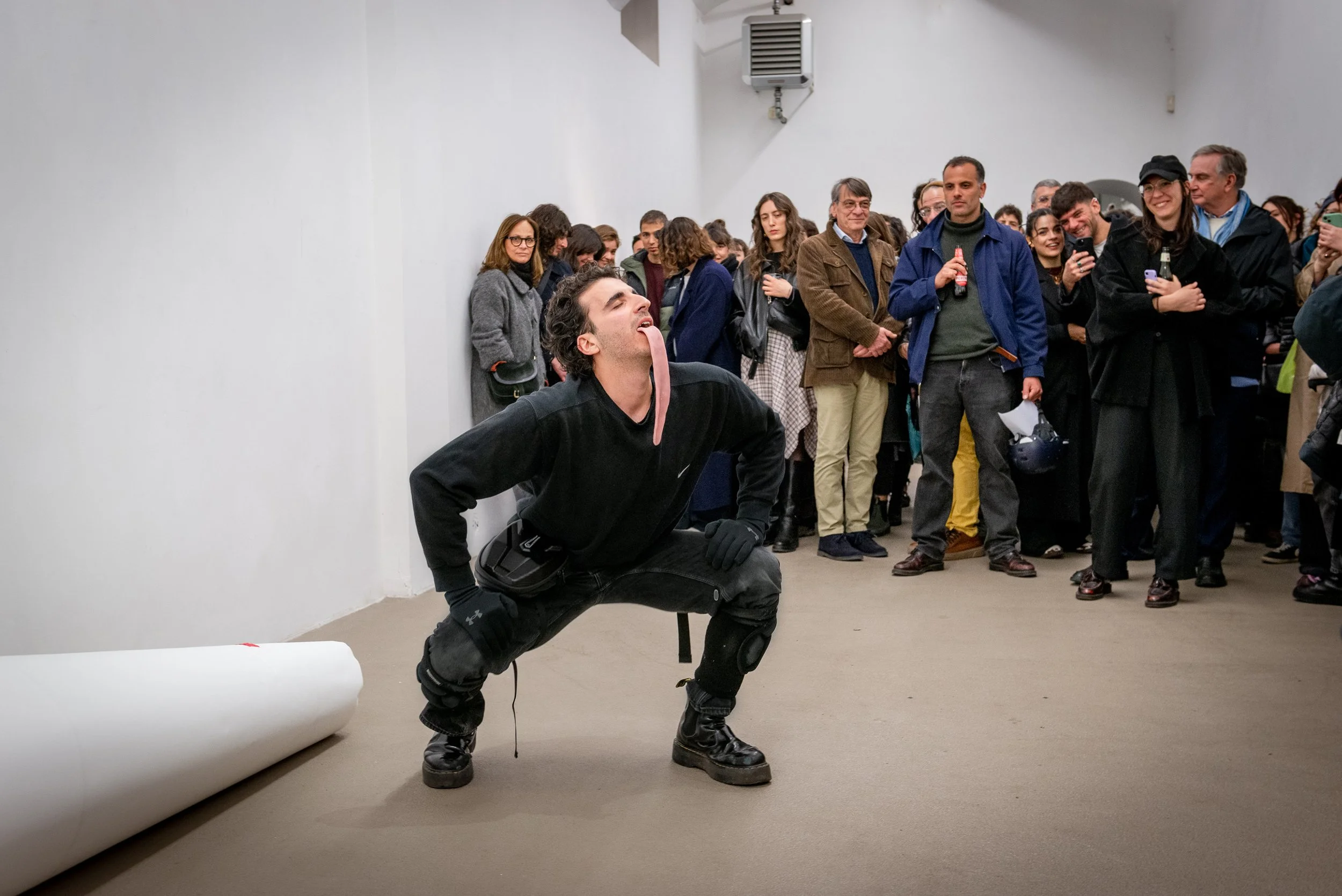
Aurelio Di Virgilio; Lynx Lynx, 2025, performance, 20’, Courtesy the artist and Pollinaria.
Photo by Roberto Apa.
* * *
It is only at this point that the occasion for these reflections becomes visible. The performance took place during To be is to be in relation, a day-long activation at Fondazione Giuliani in Rome curated by Adrienne Drake, Ilaria Gianni, and Pier Paolo Pancotto. Alongside Di Virgilio’s LYNX LYNX, the program included interventions by Sara Basta, Paolo Canevari, Bruna Esposito, Fabio Giorgio Alberti, margaretha jünglin, and LU.PA, as well as contributions from Gaia Di Lorenzo, Nan Goldin, Paul Maheke, Andrea Martinucci, and Fiamma Montezemolo. The title for the day is borrowed from a philosophical proposition: existence does not occur in isolation but only through relation.
There is a certain quiet resonance between the practices of Di Virgilio and Andrea Martinucci, one that subtly echoes through their work. Though their approaches are distinct –one rooted in the body, the other in painting –there is a shared undercurrent linking them. It’s not that their practices are similar, but that they almost by chance seem to arrive at certain convergence points. This is not a matter of conscious intention, but rather of how two people, working from corresponding starting points, end up touching upon similar themes. Relationships, after all, often leave their marks in ways that are not immediately visible, yet can shape the work in profound ways, even when they are unspoken.
When discussing their practices, both noted that it can be difficult to identify a clear point of contact between them. One works with the body in time, the other with painting; one unfolds through movement, the other through surface. Yet, the idea of relation does not necessarily depend on similarity. In Olga Tokarczuk’s novel Drive Your Plow Over the Bones of the Dead (2009), the narrator, an elderly woman named Janina Duszejko, proposes that the world must be read as a network of correspondences: events unfolding simultaneously across different levels, fragments connected through patterns that ordinary reason struggles to perceive. “One must keep one’s eyes and ears open,” she writes, “see resemblance where others see only difference… the world is a great network, a totality.”[1] What matters then is not whether two practices resemble each other, but whether they vibrate within the same field of forces.
If the lynx hovers over the performance as a kind of ghost, the two recent paintings by Martinucci, Guardaroba, and Tele Trance (both 2025) introduce yet another shift. The palette has darkened considerably –black is now spreading across much of the pictorial surface –and for the first time, the human body appears. Or rather, it almost appears.
Martinucci never truly depicts the body directly. Instead, it emerges through fragments, multiple perspectives, and traces. In one painting, a pair of legs is seen from a vertiginous angle, as if the viewer has been reduced to the scale of an insect standing somewhere by the feet of the figure. Elsewhere, a piece of clothing lies across the canvas, implying the presence of a body that has either just left or has not yet arrived.
[1] Olga Tokarczuk, Drive Your Plow Over the Bones of the Dead, trans. by Antonia Lloyd-Jones (London: Fitzcarraldo Editions, 2018)
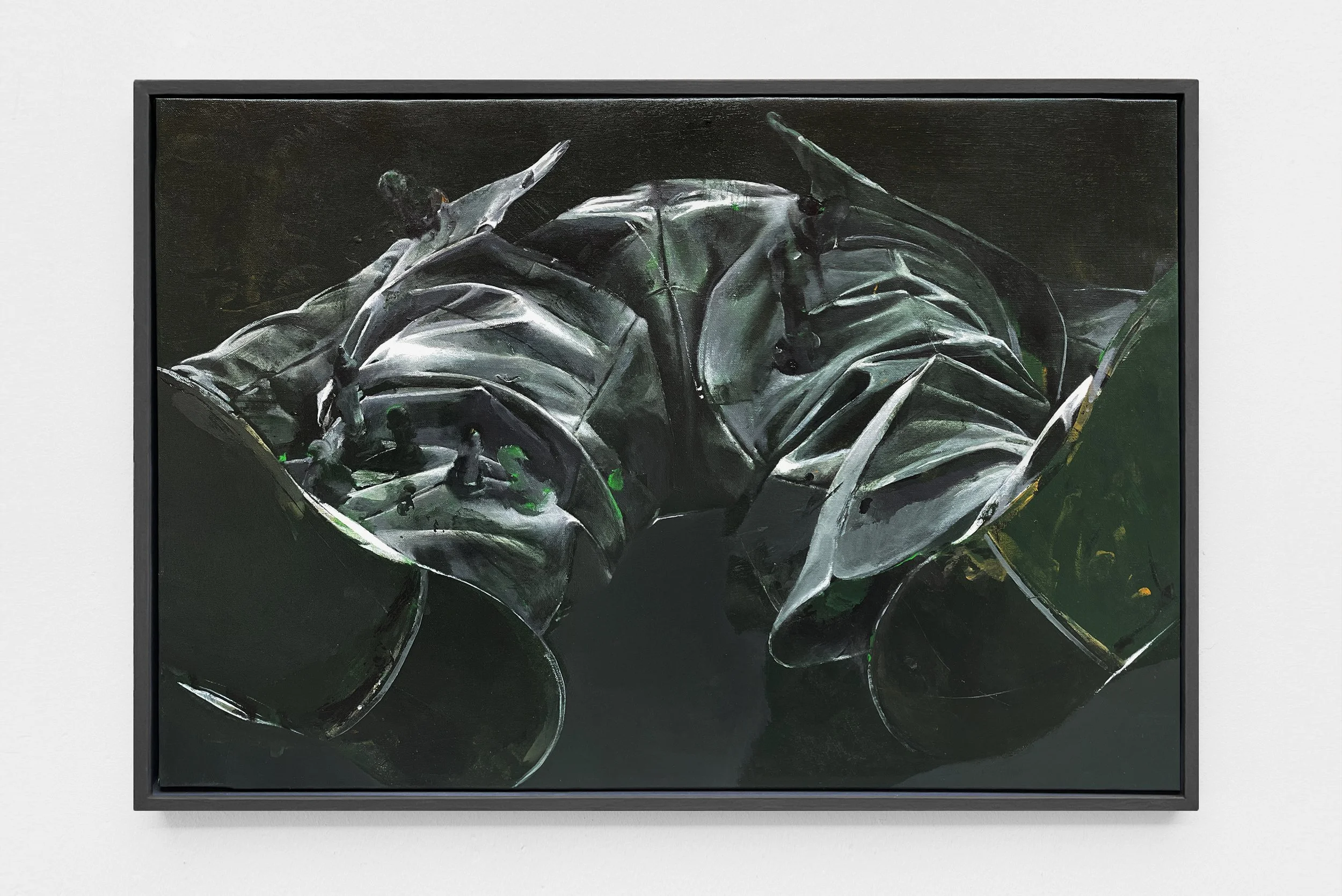
Andrea Martinucci; Tele Trance, 2025 Oil on linen, 68 x 48 x 5,5 cm. Image courtesy of the artist.
In Guardaroba, the figure seems suspended between sitting and lying down, hovering in an uncertainty, a kind of void that suggests both presence and absence, as though darkness itself is the very condition that allows things to appear. On the figure’s elegant clothes, small silhouettes appear near the left ankle and around the knee. Their identities are unclear, but they are undeniably present, as though summoned by some invisible force.
The same eerie encounter occurs in Tele Trance. It is important to note that these new works were conceived after Martinucci began practicing hypnosis. And what is hypnosis, if not the momentary stripping away of something, the loss of conscious awareness? The body, after all, is the site of speculation. It is both real and imagined, a medium through which stories unfold, possibilities emerge, and disappearances are enacted. Perhaps these paintings, as the hypnosis that inspired them, are a kind of speculative fiction: they offer glimpses into the potentiality of the body and its layered realities.
These garments begin to behave like landscapes. Their folds open into small territories where other events seem to unfold: proliferations of form, a minute system continuing its existence undisturbed. One looks closely, almost involuntarily, as if through a magnifying glass. Entire worlds appear to be taking share there, indifferent to the scale of the body that once inhabited them.
Perhaps this is where the two practices come closest: not in resemblance, but in the way both stage a condition in which something withdraws for something else to become perceptible. In one instance, the body turns toward opacity, testing the limits of its own recognizability; in another, it disperses across surfaces, reappearing only in fragments, in traces, and displaced signs. What persists is neither the figure nor its absence, but a field of relations that remains active precisely because it cannot be fully resolved.
In a way, Martinucci’s paintings make the very force of disappearance visible. What once was human is now fragmented, broken into smaller pieces of something that is still there, yet no longer fully visible.
In The Tanners (1907), Robert Walser wrote that “Everything is always on the verge of disappearing.”[1] Perhaps disappearance is not an event but a condition: something that does not happen once and for all, but continues to unfold at the periphery of perception, where things begin to loosen their contours without fully departing.
[1] Robert Walser, The Tanners, trans. Susan Bernofsky (New York: New Directions, 2012)
Andrea Martinucci & Aurelio Di Virgilio presented at Fondazione Giuliani, Rome, on March 21, 2026
About the author: Michela Ceruti is a writer based in Milan. She is the managing editor of Flash Art Magazine.