No One Fully Arrives: Cathleen Clarke’s Episodes at Margot Samel,New York
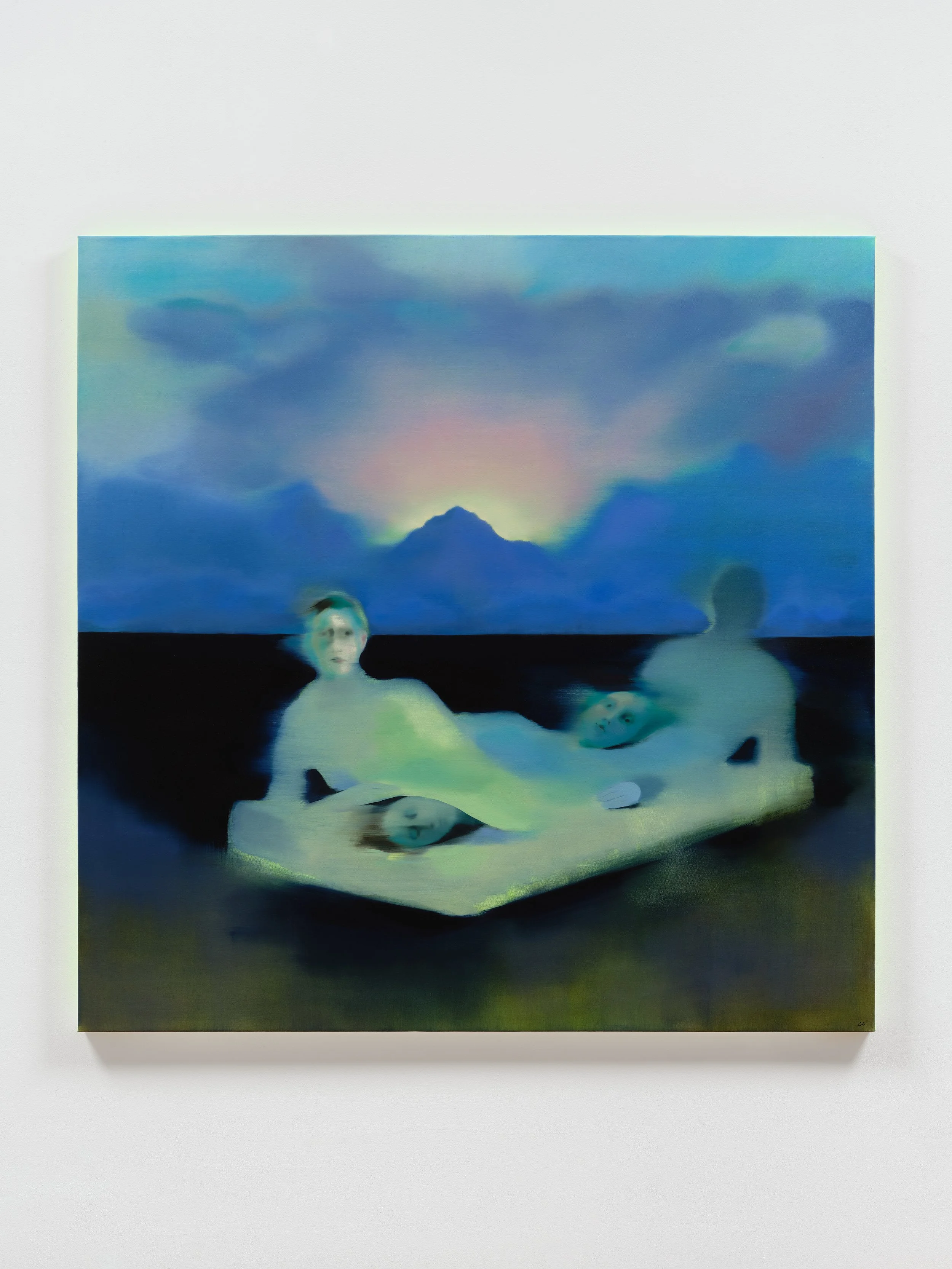
Cathleen Clarke, Ebb Tide, 2025. Courtesy of the artist and Margot Samel, New York. Photo by Matthew Sherman.
Author: Kun Sok
Published Thursday, March 19, 2026.
Cathleen Clarke’s Episodes feels haunted. Bodies, objects, and openings never quite settle into the world they occupy. Figures blur into darkness, faces appear half-erased, limbs drift away from stable bodies, and even ordinary interiors seem to loosen at the edges. What makes the exhibition so unsettling is not simply its ghostliness, but the way vivid, saturated color holds the eye even as form begins to dissolve. Again and again, Clarke presents doors, windows, beds, curtains, and horizons that seem to promise passage while quietly undermining the possibility of arrival.
This tension is most concentrated in The Exit. A hot pink figure lunges toward a narrow vertical opening on the right side of the canvas. The title suggests escape, but the image refuses to be so clear. What initially reads as a door never fully behaves like one: there is no convincing handle, no secure frame, no stable architecture of passage. Beyond it lies not another room or even a recognizable exterior, but a bluish zone suspended somewhere between air, water, and emptiness. The figure reaches toward it, yet her body is already splitting apart. Several faces seem to gather where one should be, as if she were being pulled in different directions at once. Her movement does not resolve into action. It disperses. Escape here feels less like release than disintegration. What Clarke makes visible is not only the instability of form, but the fear that crossing into the space beyond may require becoming less fully oneself.
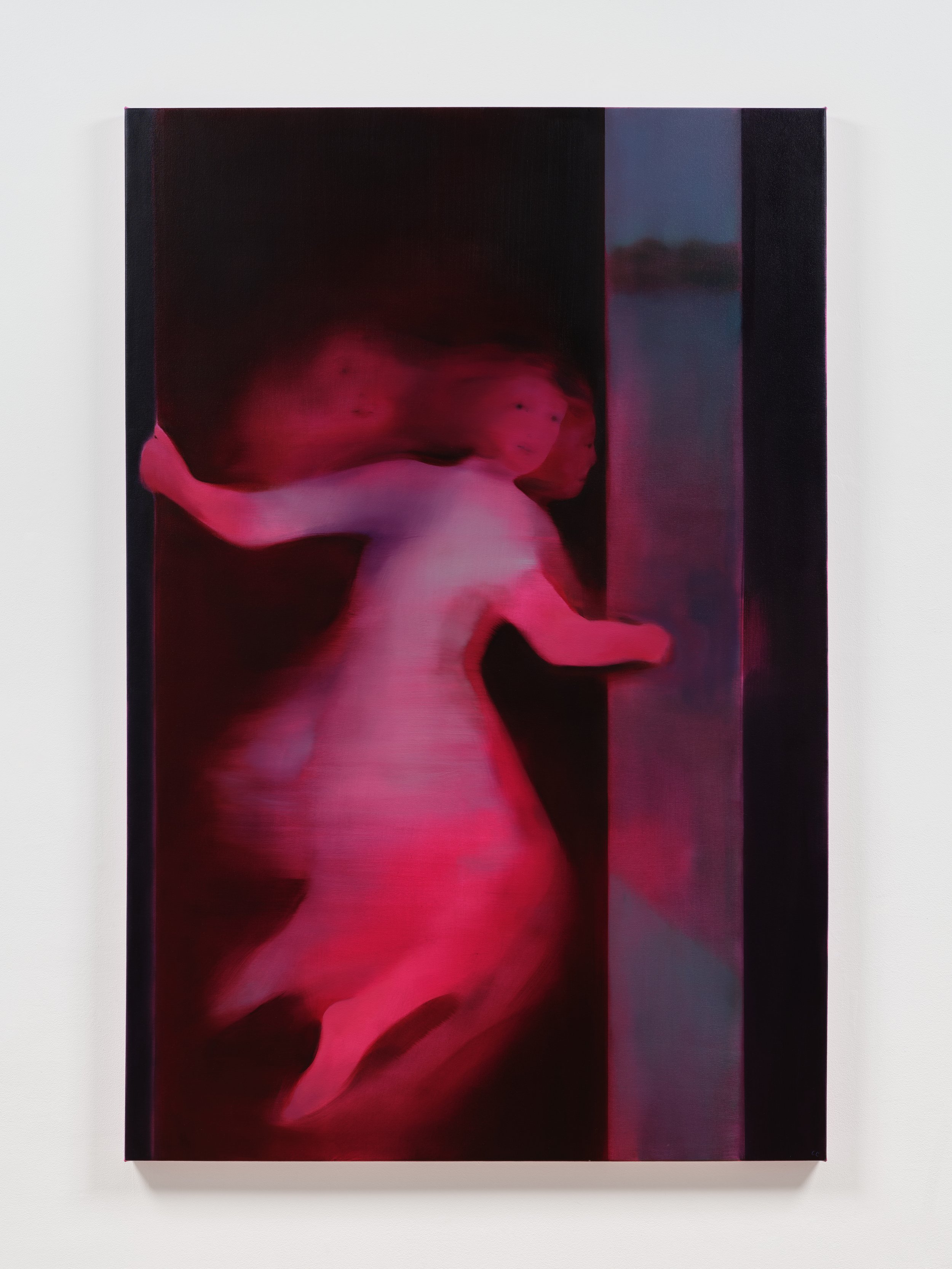
Cathleen Clarke, The Exit, 2025.Courtesy of the artist and Margot Samel, New York. Photo by Matthew Sherman.
The power of The Exit lies partly in color. The figure’s electric pink should make her more solid, more immediate, more present. Instead, it intensifies the strangeness of a body that cannot hold together. Clarke’s color does not stabilize form; it exposes its fragility. Throughout the exhibition, saturated pinks, blues, greens, and purples refuse the softness usually associated with dream imagery. They do not blur the paintings into the atmosphere. They sharpen their instability.
That instability runs through the rest of the exhibition. Clarke’s figures rarely occupy space as fully grounded presences. They hover between states: waking and drifting, standing and falling, appearing and fading. In Deja Vu, the body is inverted, its head near the lower edge of the painting, its limbs extended in a posture that suggests less control than disorientation. The painting loosens the ordinary coordinates by which a body knows where it is. Up and down no longer feel reliable.
The Dance I and The Dance II continue this logic. Despite their titles, these works do not present dance as freedom or release. Their figures seem caught in transition, as though movement had become too fluid to settle into form. One appears suspended between fabric and darkness; the other bends toward the ground in a pose that could suggest choreography, collapse, or metamorphosis. Clarke never settles the distinction. The body is not simply moving through space; it is becoming difficult to locate within it.
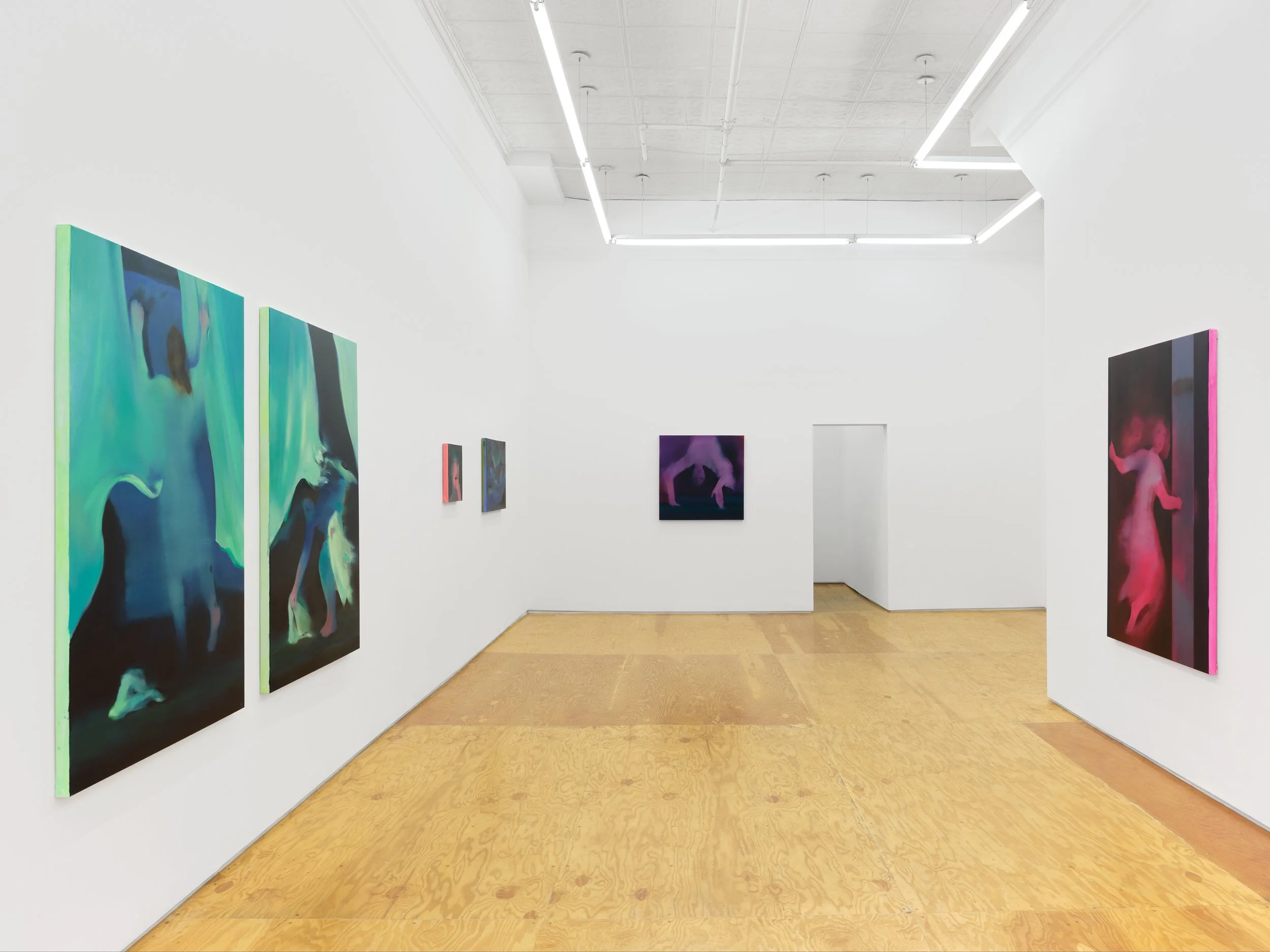
Installation view, Cathleen Clarke, Episodes, 2026.Courtesy of the artist and Margot Samel, New York. Photo by Matthew Sherman.
This uncertainty extends to the exhibition’s treatment of interior and exterior space. The Open Window sounds, by title alone, like a promise of access. Yet the faces gathered at the edge of its luminous landscape do not enter the world before them. They remain pressed against the threshold, as though the outside were visible but not available. A similar tension shapes Ebb Tide, where pale figures lie on what looks like a mattress or raft before a distant horizon. The support beneath them does not feel grounded. It seems to drift. Even repose becomes provisional. In Devotion, a reclining figure reaches outward under an aurora-like sweep of color, and the gesture feels less like rest than the beginning of separation.
What makes Episodes especially compelling is that this condition is not limited to human figures. In Recurring Dream, a face and hand emerge from darkness but never arrive at full clarity. In Lapse, cups and tabletop forms soften into one another until still life loses its practical solidity. Clarke allows uncertainty to spread across the entire field of experience. Bodies, objects, and spaces are all drawn into the same wavering state.

Cathleen Clarke, The Meteor (After Frederic Edwin Church) 2025. Courtesy of the artist and Margot Samel, New York. Photo by Matthew Sherman.
Color plays a crucial role in making that wavering visible. Luminous greens and blues open onto spaces that seem less inhabitable than suspended; pinks and purples press bodies forward even as their contours loosen. In painting after painting, color insists while form slips away. The result is a productive contradiction: these images feel intensely present, yet never fully secure.
That contradiction is what gives Episodes its force. Clarke does not simply paint ghosts or dream images. She paints a world in which no opening can be trusted to carry the body safely across. Access does not guarantee arrival. Rest does not guarantee stillness. Movement does not guarantee passage. What lingers after the exhibition is not the question of who these figures are, but why no one here can fully enter the world before them. In Clarke’s paintings, the threshold is less a passage than a place where the self begins to lose its certainty.
Cathleen Clarke Episodes is on view at Margot Samel through March 28, 2026.
About the author: Kun Sok is a Brooklyn-based visual artist and writer interested in relationships and collaboration. She creates rule-based participatory projects that invite non-artists to participate in making through small, direct encounters. Her writing has appeared in Two Coats of Paint and Tussle Magazine.