Undertaking the Difficult. About Fotografiska Berlin and „Father“ by Diana Markosian
Father by Diana Markosian at Fotografiska Berlin © Diana Markosian.
Author: Carolin Kralapp
Published Thursday, April 16, 2026
What should you do when you have deliberately avoided a heavily criticised venue, but a particular photography exhibition ultimately draws you in? I was faced with this question when I learnt that the exhibition “Father” by Diana Markosian, which had previously been shown at FOAM in Amsterdam, was now on view at Fotografiska Berlin. This privately run “museum” of photography is located in a luxury neighbourhood on Oranienburger Straße. It is a place I had avoided since its opening during Berlin Art Week 2023, despite being a huge photography fan. About three years later, I went inside to see what it was really like. Taking the Markosian exhibition as my starting point, I decided to write about the venue, which has repeatedly been criticised in the Berlin press and within the cultural community, and which has stirred up mixed feelings in me ever since. Fotografiska Berlin is located in the listed premises of the former Tacheles, a self-managed art and club space that represented a significant venue for Berlin’s independent art scene. Berlin is the fourth location for Fotografiska, following Stockholm, where it was founded in 2010, and Tallinn and New York. As well as spacious exhibition areas where several exhibitions are shown simultaneously, the venue offers a variety of food and drink options, a shop, and event spaces. Fotografiska blends into a Berlin‑Mitte that has long undergone gentrification.
Father by Diana Markosian at Fotografiska Berlin © Diana Markosian
Today, only the graffiti, for which Berlin is world-famous and which is listed as a historic monument, serves as a reminder of the Tacheles era. There is no explanation of the site’s history or of the reasons Fotografiska was established here. I avoid calling it a “museum” because, by my understanding, Fotografiska does not meet the internationally recognised definition of one: according to ICOM, a museum is a non-profit, permanent institution that researches, collects, conserves, interprets, and exhibits heritage, and serves the public in an open, inclusive, and ethical way. Fotografiska Berlin, by contrast, is profit-driven and neither maintains its own collection nor functions as an academic institution. My reservations about the place are therefore probably clear – but let us turn to the exhibition that prompted this article.
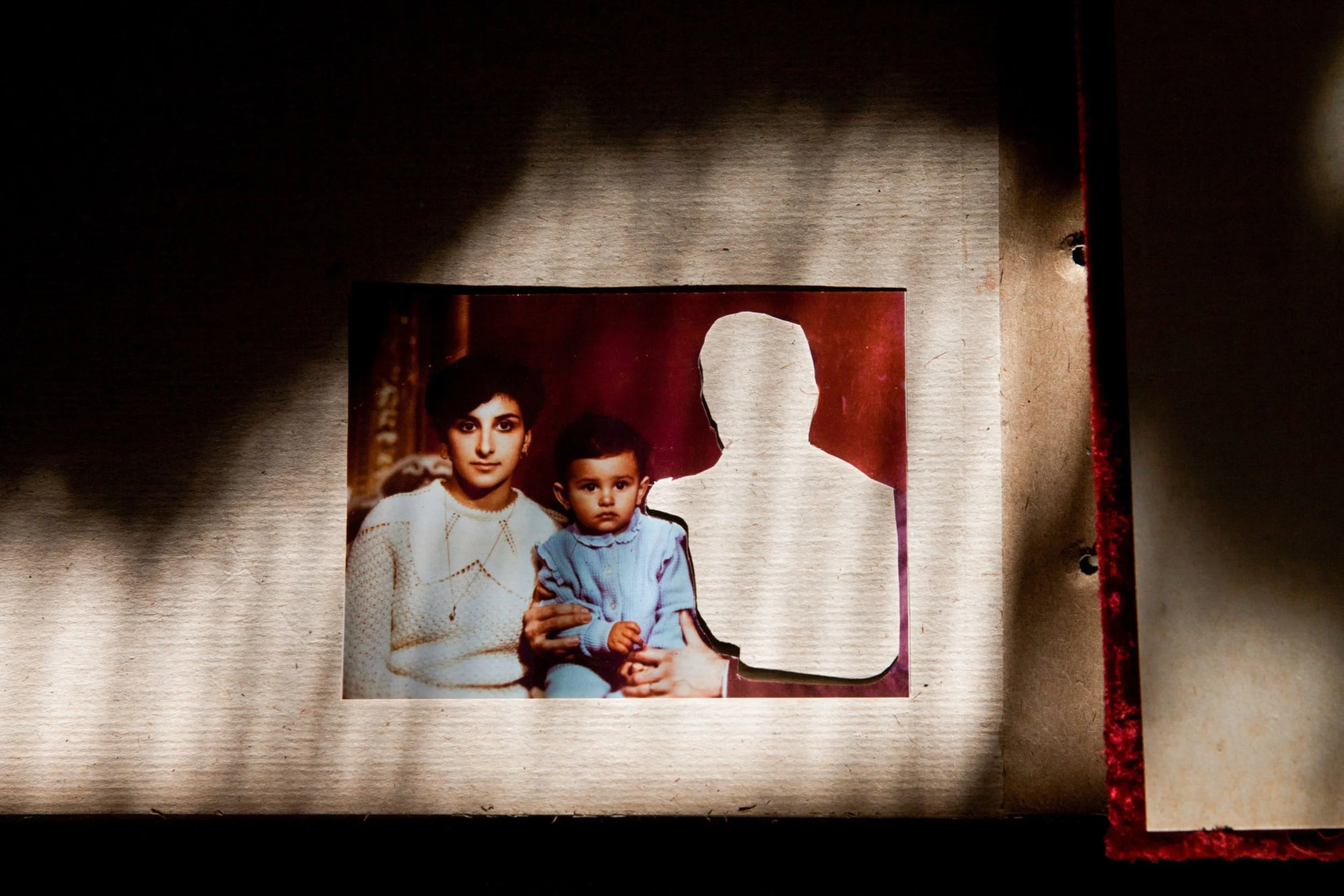
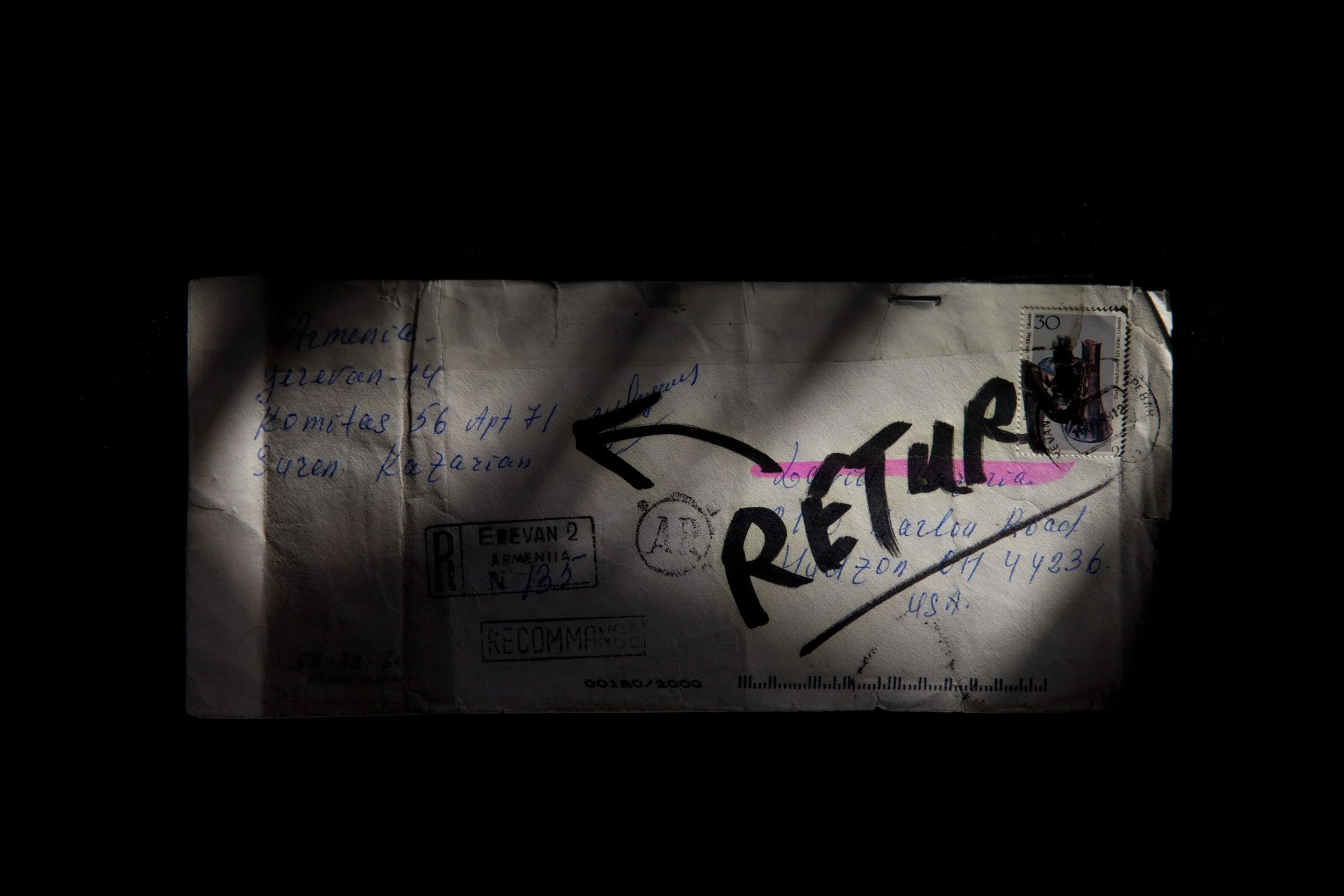
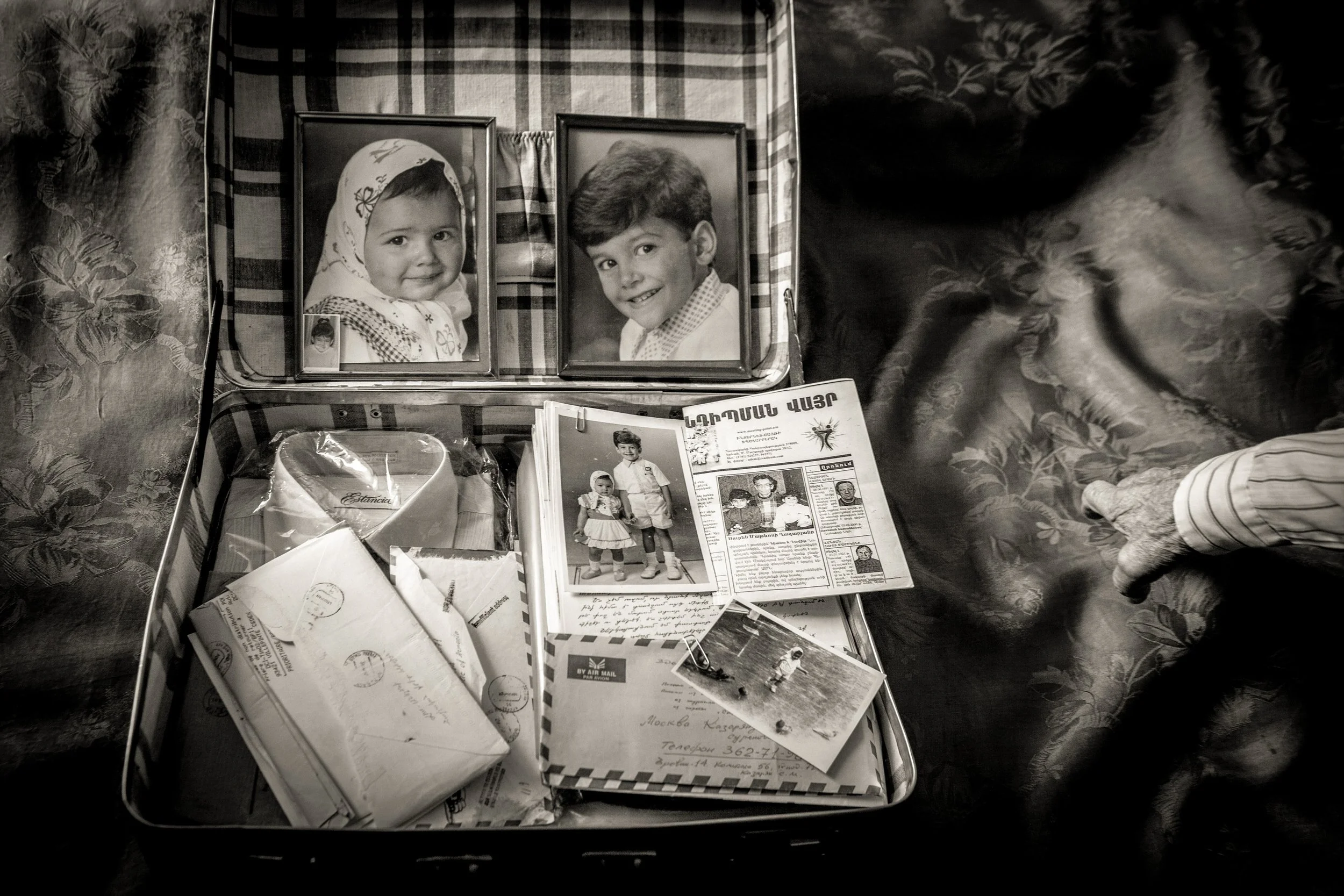
In “Father”, New York-based artist Diana Markosian embarks on a personal exploration of her search for her father, presenting photographs, films, and an archive of personal documents and artefacts. These are shown in dimly lit exhibition spaces, bathed in the glow of numerous spotlights. When she was seven, she and her brother were taken by their mother from Moscow to California, unable to say goodbye to their father. Her parents’ relationship had already ended before she was born. In their new home, her father disappeared not only physically from the family’s life but also from their memories, as her mother carefully cut him out of every family photograph. The exhibition opens similarly, with a large family portrait from which the father has been removed, leaving an obviously empty space. Around fifteen years after moving to the US, Markosian began searching for her father. It later emerged that he had also searched for his children and had spent years struggling with organisations and authorities to gain clarity. To him, his children remained missing. One wall of the exhibition displays a multitude of official letters and documents charting the father’s years-long journey in search of his children. These documents symbolise the difficult path he took in search of answers.
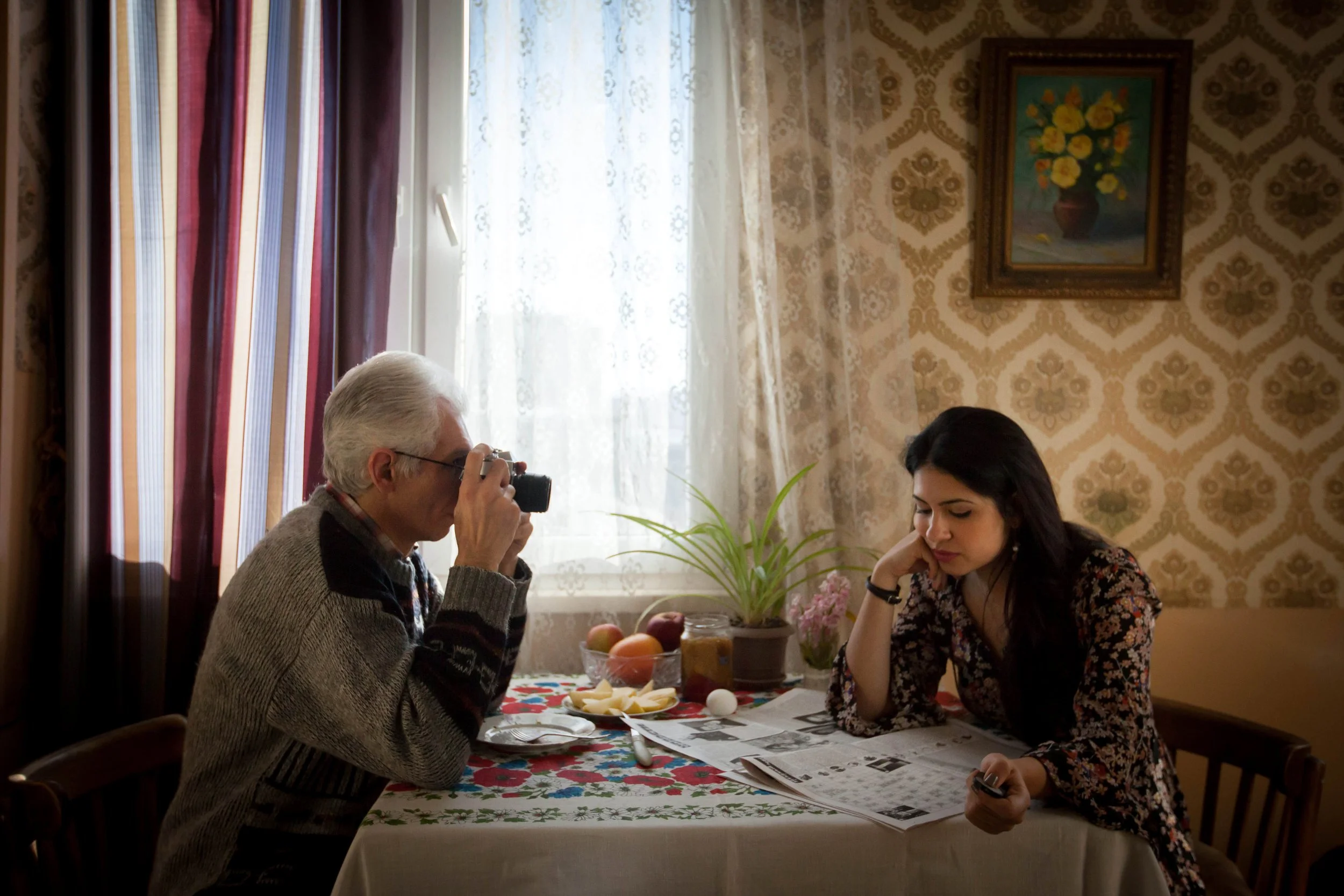
The exhibition presents the artist’s work, which consistently takes an intimate approach, in a highly accessible manner. Rather than presenting a linear narrative, “Father” offers numerous fragments, some of which contain individual storylines. Yet these are always imbued with deep emotion, oscillating between closeness and distance. In the eponymous series, we see Markosian with her father at the dining table, sharing breakfast or playing cards. Elements from these images have been incorporated into the exhibition space, which has been clad in the same wallpaper and features the floral still life seen in the photographs. The boundaries between the pictorial and exhibition spaces are fluid. At an interactive writing station, visitors can reach out to people they miss in their lives.
Father by Diana Markosian at Fotografiska Berlin © Diana Markosian.
Overall, the exhibition is compact and feels slightly smaller in scale than the one in Amsterdam. Yet seeing the works remains a similarly moving experience. The only accompanying text is the introductory panel at the beginning, so the audience must interpret everything else through the visuals alone. Through its visual language and subject matter, the exhibition uses emotion as a universal language that everyone can understand. This is not necessarily a bad thing, as art should be accessible to everyone, including those outside the art world. Returning to the venue, Fotografiska Berlin, the other exhibitions follow a similar structure: dim lighting, spotlights on framed works, and major, rather “heavy” themes presented in an easily digestible way with an introductory text. For the most part, however, it does not go much deeper than that. It merely scratches the surface. According to Berlin’s press, the programme is accused of “virtue signalling”: appearing progressive and diverse at first, but ultimately serving as branding to distract from the fact that the business model is primarily about one thing – money. For me, this raises a question: shouldn’t museums use their income to preserve and acquire knowledge and share it, rather than creating incentives to buy at every turn that simply line the pockets of individual stakeholders?
Despite being profoundly affected by Diana Markosian's artistic practice, encompassing both her personal narrative and photographic vision, my second encounter with this exhibition in Berlin did not match the intensity of my initial experience. I could not shake the feeling that this place is about profit and that a venue of great significance to Berlin’s independent art scene was sacrificed for it. Although traces of the venue’s history are still visible thanks to its listed status, the history itself is being kept under wraps. I do not think it is very helpful to single out the individual artists exhibiting here for criticism, nor do I wish to criticise the staff. I have worked in the art world for ten years, often in insecure roles, so I understand why people are drawn to places where there is a chance of earning more money than usual. Critics often highlight precisely this point: profit-driven, commercial institutions such as Fotografiska offer little transparency regarding whether artists’ fees are “fair” in comparison to ticket prices and shop takings. In the end, it is the system surrounding Fotografiska that makes me feel doubtful: a polished, high-gloss luxury complex with flats that most of Berlin’s population simply cannot afford, and an exhibition space that presents itself as a “museum”, charges high admission fees, offers extended opening hours until almost midnight, and operates an expensive shop. It stages itself as a cool lifestyle experience, and that leaves me with an uneasy feeling even days after visiting the exhibition.
“Father” by Diana Markosian is on view at Fotografiska Berlin through April 19, 2026.
About the author: Carolin Kralapp is a Berlin-based art historian and writer. She writes for magazines and online platforms, creating accessible and contemporary text formats that communicate complex ideas from the worlds of art and culture. Her work has appeared in publications such as Berlin Art Link and gallertalk.net, among others. Her particular interest lies in photography and conceptual art, focusing on themes of human relationships, social and societal issues, and personal experiences.
Father by Diana Markosian at Fotografiska Berlin © Diana Markosian.