Within the Minimum Range. On The Gesture and the Invisible at Museo Tamayo, Ciudad de México
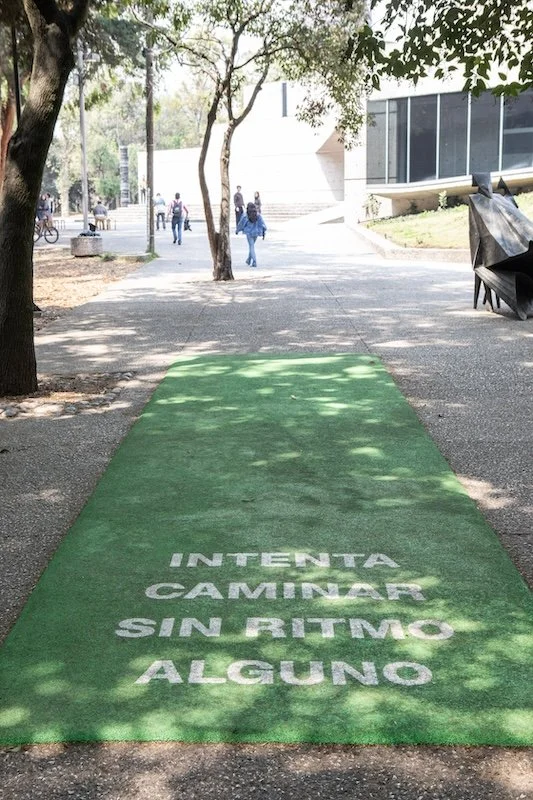
Installation view, El gesto y lo invisible, February 6-July 26,2026, Museo Tamayo, CDMX, Mexico. Image courtesy of Museo Tamayo. Photo by Diego Berrucos.
Author: Bruno Enciso
Published Tuesday, April 14, 2026
“The Gesture and the Invisible” is the latest exhibition at the Tamayo Museum, inaugurated during Mexico City’s Art Week and the first show curated by its new Chief Curator, Abril Zales. Recent group exhibitions at the museum have included the Tamayo Biennale, focused on local contemporary painting, and Otr^s Mund^s, foregrounding a younger generation of artists in dialogue with the institutional and historical aspect of the museum. In that sense, The Gesture and the Invisible is the first show that could present a new direction for the curatorial trajectory of the museum, which is known among the Mexican state-supported museums for its global perspective, site-specific exhibitions, and usage of a wide range of artistic languages.
On The Gesture and the Invisible features an exceptional selection of twelve artists—six men and six women—from different latitudes and artistic genealogies. Their generational scope is also broad; American Bruce Nauman, born in 1941, is shown alongside young Mexican painter Samara Colina, born in 1992. The selection of works already makes a statement, as it explicitly demonstrates the curatorial intent and the possibilities a public museum can have with exhibiting artists and suggesting connections among the works.
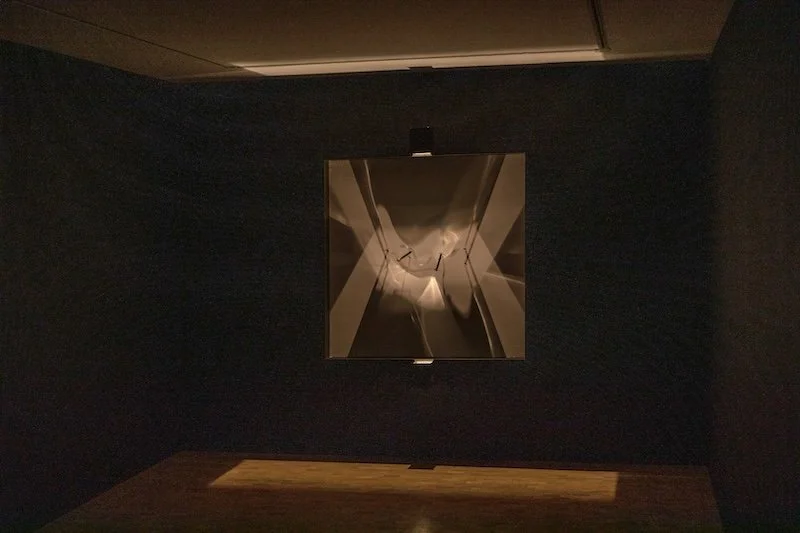
Installation view, El gesto y lo invisible, February 6-July 26,2026, Museo Tamayo, CDMX, Mexico. Image courtesy of Museo Tamayo. Photo by Diego Berrucos.
Even so, the credit lies not only in the selection of artists but also in their postulation within a distinct conceptual framework of a particular connecting thread - the idea of movement as a minimal gesture and a vital impulse. The atmosphere feels quite sparse, with the visible works sharing a demure visual economy. Light is dimmed softly just enough to present the projection of Reneé Rhodes’ Moving Clock Changes Rhythm, as some kind of epigraph, just above the curatorial text. This work presents an overhead shot of two miniaturized bodies performing a minimal choreography over a circular white surface, playfully evoking a clock’s pointers. This video work immediately sets a tone for the whole exhibition: precise and gesture-centered.
The curatorial text highlights the ephemeral and transparent nature of the minimal movements we organically perform as living bodies to the point of becoming invisible, such as walking or even getting settled in a chair. There’s a certain clarity in becoming aware of these gestures, even if only for a minute. The text also retrieves one of the essential qualities of movement as a unit of artistic interest: the potential for significant movement/rearrangement —contained yet always latent—within a seemingly minor gesture. As Dutch theorist Mieke Bal wrote in her article on Visual Essentialism for the Journal of Visual Culture back in 2003, about the implications of the concept of movement: “(...) it can die quickly or, quite the opposite, enjoy a long and productive life” (1)
(1) Quoted from Mieke Bal’s “Visual Essentialism and the object of visual studies,” Spanish translation for Estudios Visuales Magazine Vol. 2, page 12, December 2004. Originally published by Mieke Bal for the Journal of Visual Culture Vol. 2 #1, April 2003.
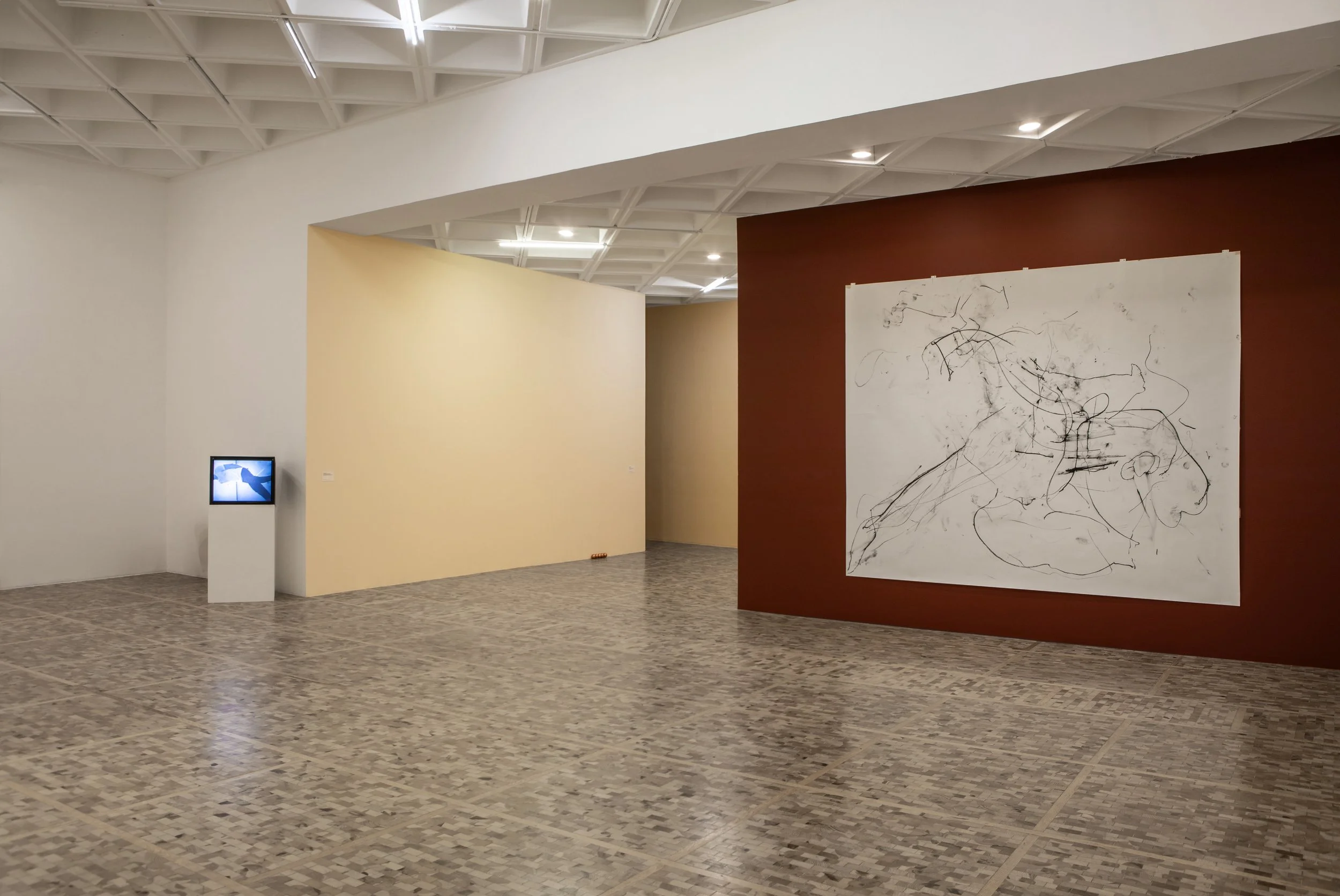
Installation view, El gesto y lo invisible, February 6-July 26,2026, Museo Tamayo, CDMX, Mexico. Image courtesy of Museo Tamayo. Photo by Diego Berrucos.
The exhibition feels minimal, the works seek to articulate a range where an individual movement —attuned to a body rather than to a subjectivity — is inevitably tied to something larger than itself: another body, an event, or another movement that ultimately provokes deeper agitation. As a curatorial strategy, this wide range of possible connections helps to formulate the thesis of merging from the micro and the macro levels, sharpening the focus while preventing the artists’ heterogeneity from appearing scattered. On the contrary, each work plays an active and important role within the overall approach. It feels especially refreshing given the exhaustion of other strategies derived from “the speculative” perception, in which works are easily treated as variations from different ready-made imaginaries in a silent —at times unintentional— quest for primacy.
Large-scale drawings/ traces on paper by artist and choreographer Trisha Brown present a primary sense of registering movement sequence. The charcoal used by the performer in these works is a medium sensitive enough to record the smallest variations of intensity between gestures. Focusing on each of these panels allows us to discern which specific lines and marks stem from improvisation or intention, from arbitrariness or repetition.
In Screen Test for the Psoas Muscle, the artist Cally Spooner carries out a pictorial action on one of the museum’s walls connecting two galleries, entirely covering it. Conceived as a site-specific intervention, the work results from a dancer painting a white layer over a wall previously painted flesh-like pink. The dancer systematically repeats horizontal, vertical, and circular strokes, while focusing on her psoas as the movement origin; this layer of color lacks uniformity and consistency. The psoas is the name of an internal muscle located on either side of the lumbar spine, spanning from the lower back to the hip joint, enabling movements simultaneously linked to the hips and legs. In counterpoint to Brown’s experimentation, Spooner’s rigorous instruction presents another way of approaching the body as both a perpetuum mobile and an encompassing instrument. The formalistic differences between the two works play against one another while offering two very distinct readings of space: one in which space appears as an abstract, open extension ready to be occupied by the artist’s force of action, and another in which space functions as a concrete surface regulated by architecture, capable of encompassing the bodily action.
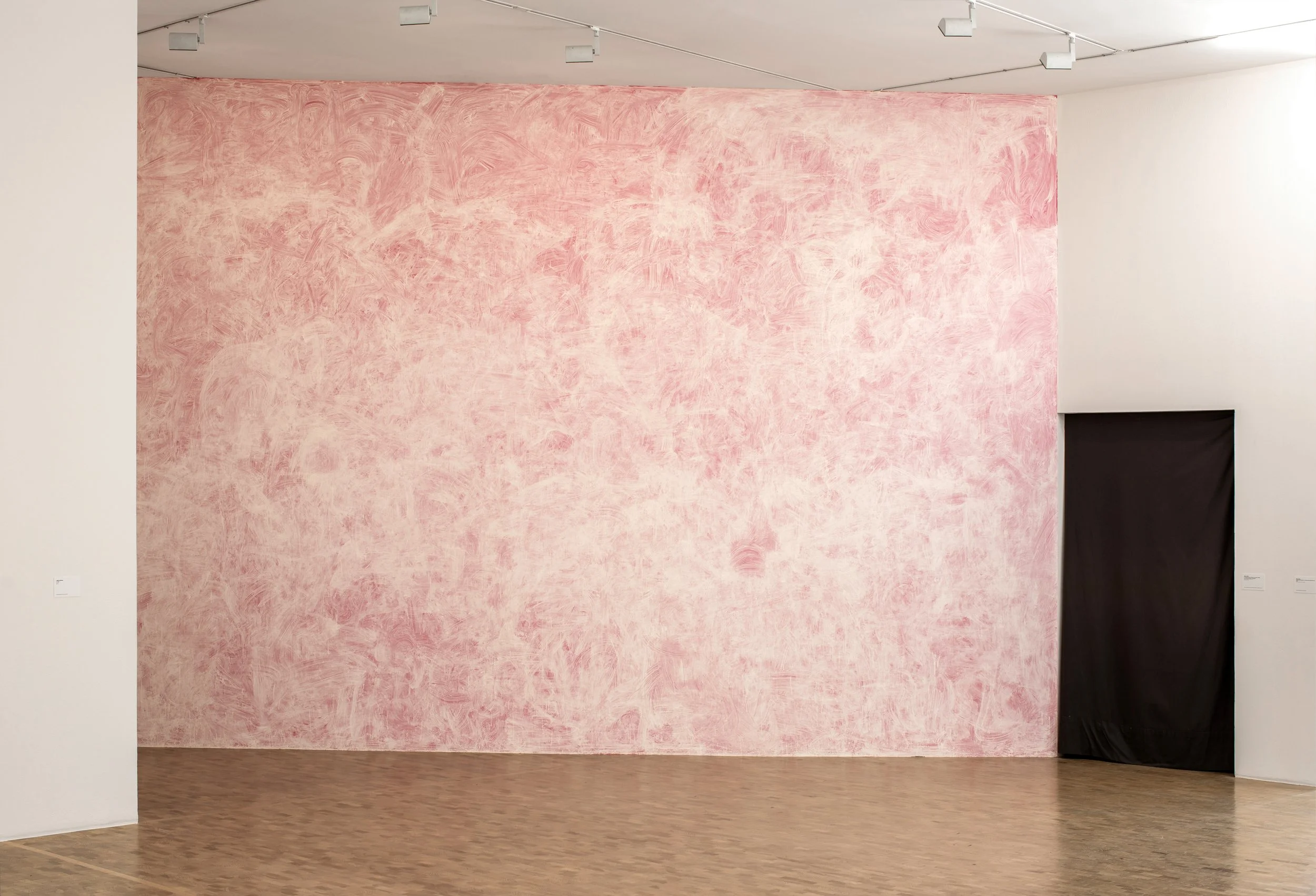
Installation view, El gesto y lo invisible, February 6-July 26,2026, Museo Tamayo, CDMX, Mexico. Image courtesy of Museo Tamayo. Photo by Diego Berrucos.
Brendan Fernandes presents a three-channel video installation. We are looking at an anonymous body here: each screen shows a specific area of a performer’s torso, framed in such a way that the image accentuates a degree of abstraction, favoring elements such as light and form over portraying someone specific. These bodies move without a visible displacement; it is difficult to determine what type of premise they are following or whether the movement, rather than projecting, is instead directed inward. Eventually, one of these channels reveals one of the torsos pressing against a wall while holding what appears to be a foam ball. This produces a profoundly erotic connotation sustained by the tension of volumes concentrating all of their weight upon a single point of contact: an intense mutual massage that leaves the flesh vibrating.
An interesting counterpoint, still with the body as the main character, is a short video by Bruce Nauman in which he just slowly walks. It is not a slow-motion movement, but a sequence in which the articulation required to take a step comes from a highly pronounced gesture that is held for a few seconds, as if it were performed to illustrate a diagram of how to walk, step by step. Here, rather than an erotic form of poetics, we find a mechanical one that, with ironic intent, prevents us from taking for granted a minor effort of the simple notion of walking.
This exhibition is remarkable because it unfolds a series of artistic languages that, while not immediately decipherable, are not severely cryptic either; in their simplicity, they remain available. The works require a diverse and intergenerational reading of the curatorial intention while also engaging with a current aesthetic problem, one no longer related to a discourse, but instead to self-observation and perceptual systems. I consider this individualistic aspect of group exhibitions in public museums to be relevant and necessary, countering the negative connotation that equates this kind of curatorial approach to a lack of historical commentary or to a lack of conceptual rigor. Considering the importance of the Tamayo Museum as a communicative bridge between Mexican contemporary art and international scenes, I hope this marks the beginning of a renewed and incisive curatorial agenda there.
El gesto y lo invisible is on view at Museo Tamayo through July 26, 2026.
About the author: Bruno Enciso is an independent curator and art writer based in Mexico City. Primarily focused on contemporary painting, he’s interested in the beyond-discourse effects of art and the role it takes as part of everyday perception. He’s a regular contributor to the magazine section of ONDAmx, an art-radar platform covering Mexico’s art scene, including different cities across the country and working with both institutional and independent spaces.
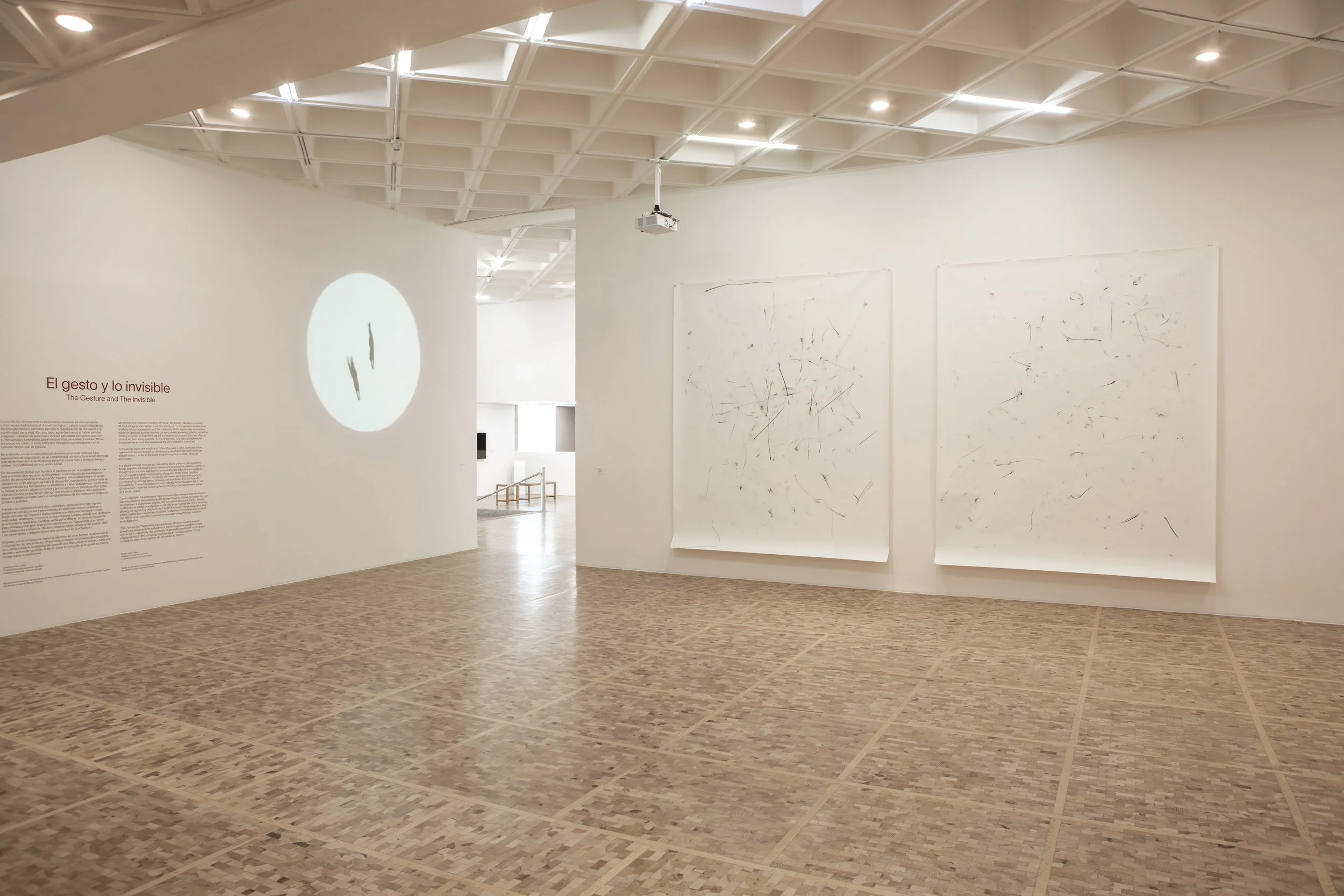
Installation view, El gesto y lo invisible, February 6-July 26,2026, Museo Tamayo, CDMX, Mexico. Image courtesy of Museo Tamayo. Photo by Diego Berrucos.