Cafeteria as Interface, Judy Chung at RAINRAIN, New York
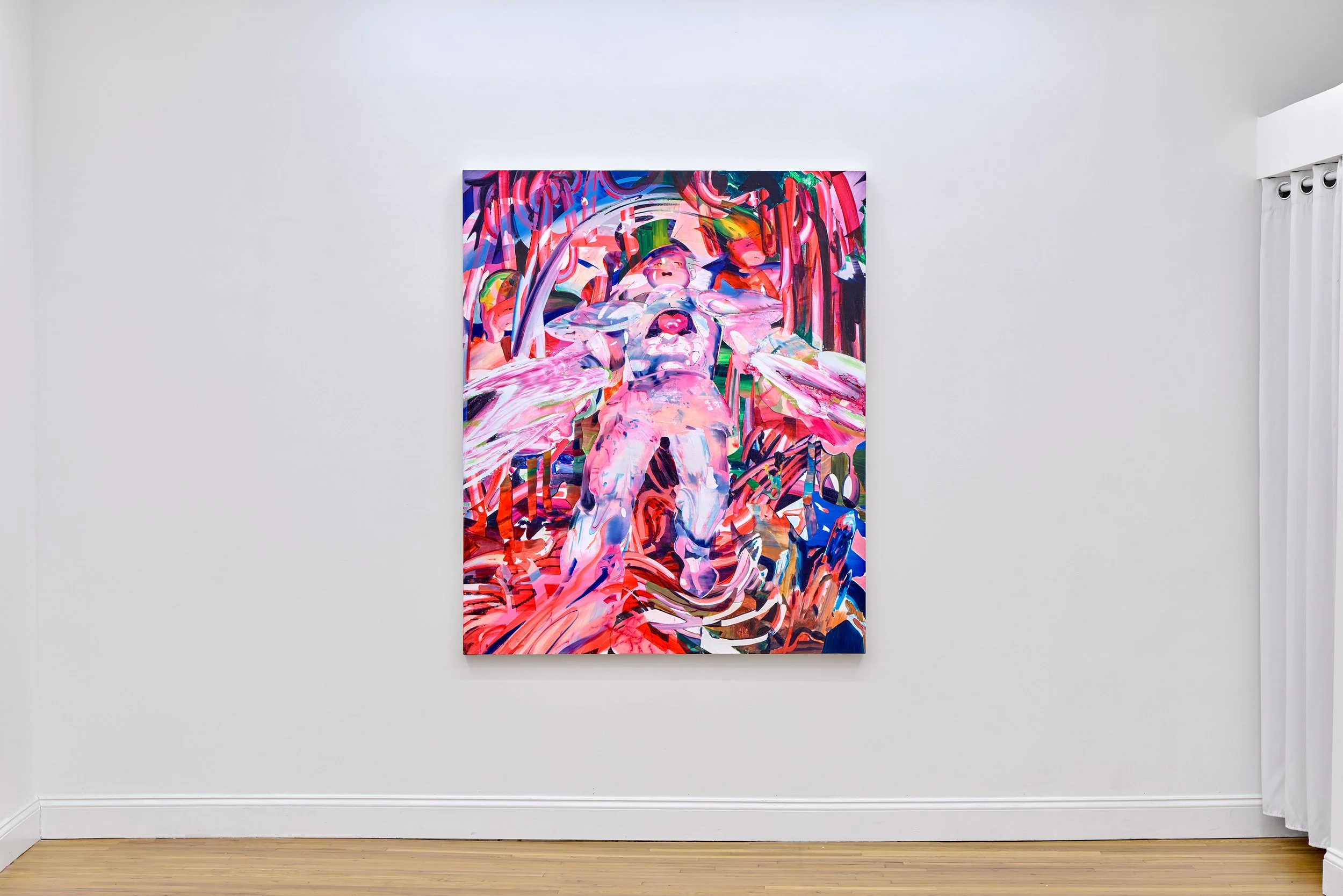
Installation view, Judy Chung Cafeteria, RAINRAIN, New York. Image courtesy of RAINRAIN and the artist. Photo by Judy Chung and Marc Tatti.
Author: Kun Sok
Published Tuesday, March 3, 2026
A cafeteria teaches a particular kind of freedom: the freedom to choose from options someone else has already decided. You pick a tray. You select your items. You find a seat. It feels autonomous. But the menu is fixed, the line keeps moving, and your selection is never private. Choice becomes display.
In Judy Chung’s Cafeteria, the most precise expression of this logic isn’t the large paintings—it’s the tray-like mylar works in 3D-printed frames. They don’t merely illustrate the theme; they enact its structure. The frames feel less like neutral borders and more like containers—bezels, cases, cafeteria trays. The image arrives already handled, already formatted. Before the narrative begins, format takes over.
The tray is an interface. It defines how much you can carry, how your choices are arranged, and how they are seen. It gives you space—but measured space. Even holding it becomes choreography: move through the line, assemble your selection, place it down as evidence. The autonomy is real. But it exists inside a pre-set architecture. “I chose this” disguises the fact that the menu was never yours.
This is where Chung’s reading diverges from a simple social allegory. A school cafeteria is often shorthand for hierarchy—cliques, popularity, exclusion. But here the cafeteria operates less as drama and more as design. It functions as a social interface: a surface that organizes bodies into legible forms. Interfaces promise clarity. They offer options and feedback. But they also set the limits of what can be chosen and how those choices appear.
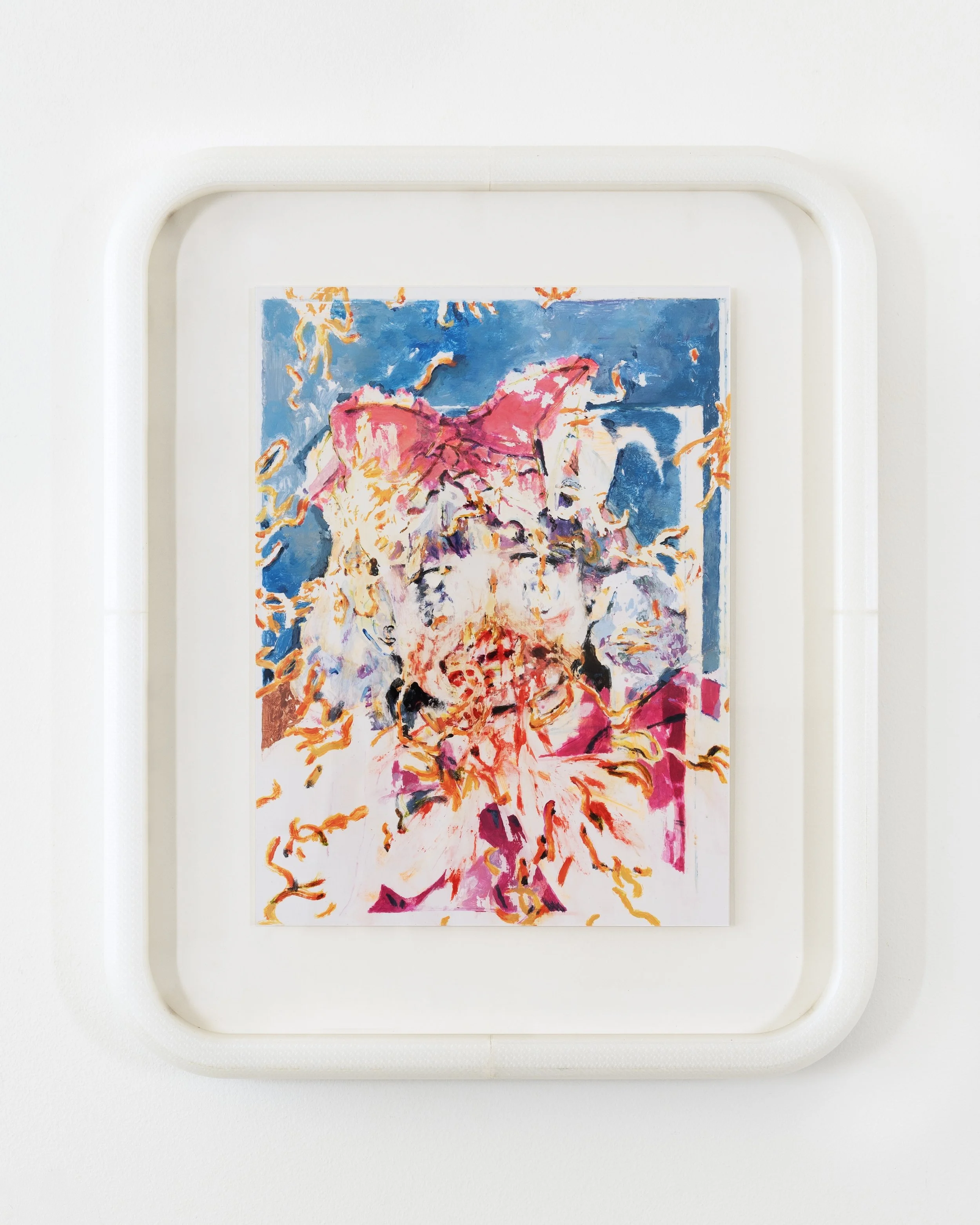
Judy Chung, Say “fuzzy pickles!”, 2025. Acrylic on mylar in a 3D-printed frame, 17 1/4 x 14 1/2 x 1 3/4 in (43.8 × 36.8 × 4.4 cm), framed. Image courtesy of RAINRAIN and the artist. Photo by Judy Chung and Marc Tatti.
The anime-inflected visual language—bright, elastic, seductive—initially reads as playful. Yet the longer you look, the more it feels constrictive. In person, the first impression is not warmth or chatter or the sensory buzz of a lunchroom. The color and brushwork register as agitation, almost a flailing against containment. What looks inviting becomes pressurized. The cafeteria shifts from nostalgic site to pressure chamber.
Several framed works sharpen this point. In Tactical Maneuvers, RPG logic enters the school setting. The cafeteria becomes an inventory screen. You equip the right persona. You manage your position. You optimize under observation. Gamification here isn’t decorative—it describes a real social training. Taste becomes moralized. Popularity feels measurable. A small miscalculation can read as failure. The interface doesn’t simply record these judgments; it makes them inevitable by forcing them into visibility.
If the tray works articulate the thesis with clarity, the large canvases show what happens when that interface overloads. Symbiosis (Cafeteria) expands outward into a dense field of figures, reactions, and crowded compositions. The press materials describe a three-headed student caught in an ambiguous act of consumption or expulsion. Whether or not you follow that narrative precisely, the structural tension is unmistakable: a body asked to resolve too many demands at once.
An interface is designed for legibility. But sustained exposure produces noise. The more the scene insists on clarity, the more unstable it becomes. The brightness doesn’t soothe—it amplifies.
Spaghetti threads through this instability. Often read as comfort or disgust, here it behaves more like wiring. It stretches, tangles, binds. It resembles infrastructure—the mess hidden behind a clean screen. Social connection becomes entanglement. Desire becomes constraint. Choice becomes knot. In Spaghetti Lariat, where the recurring heroine appears bound mid-air, the interface turns inward. External observation is no longer required; self-management takes over. The system functions best when you believe you are simply adjusting yourself.
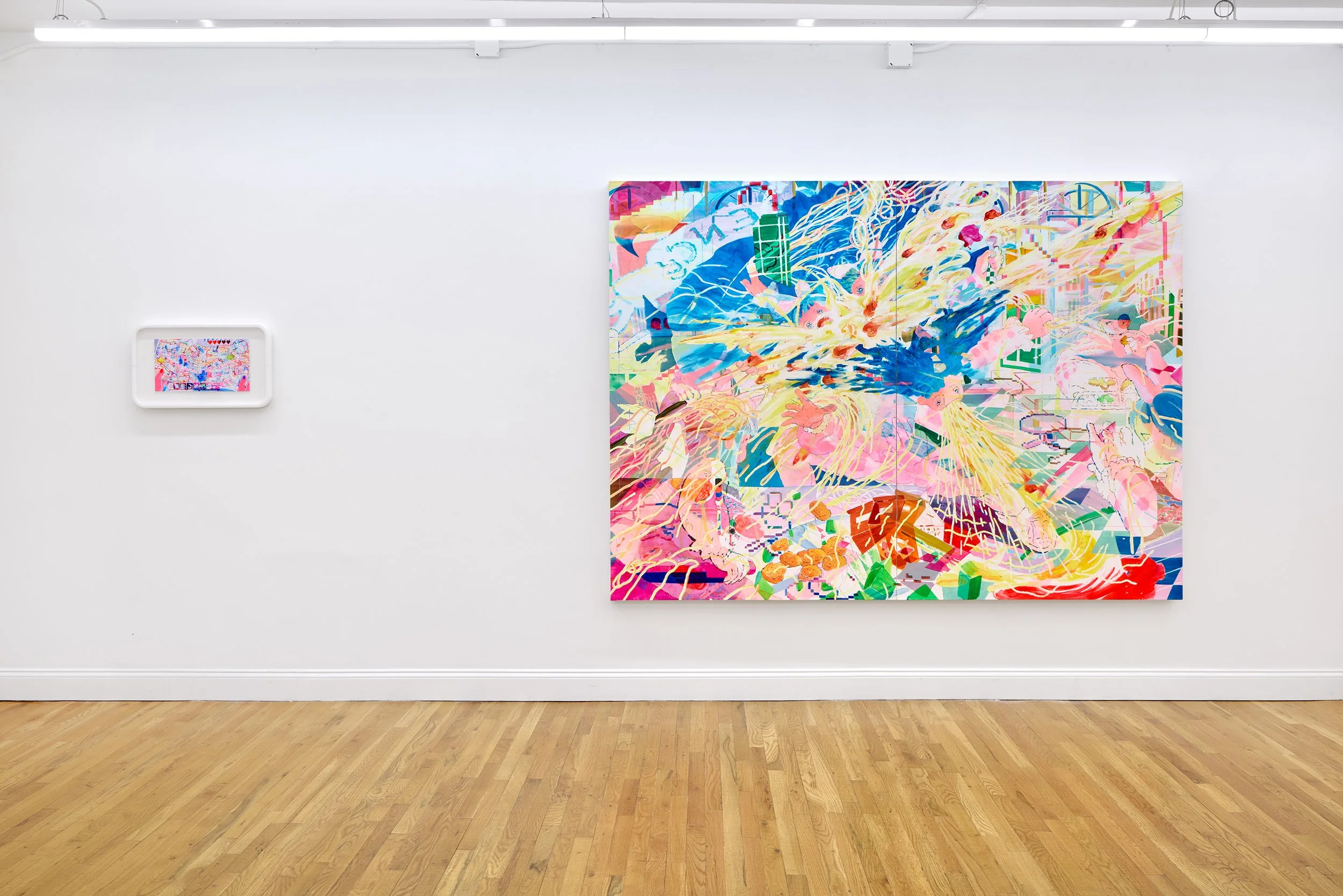
Installation view, Judy Chung Cafeteria, RAINRAIN, New York. Image courtesy of RAINRAIN and the artist. Photo by Judy Chung and Marc Tatti.
Throughout the exhibition, Chung returns to objects that format identity: certificates, menus, picture-day portraits, and framed artifacts. These are not sentimental memories. They are templates. In interface terms, they read like screenshots—moments when a life is compressed into categories and made reviewable.
What Cafeteria ultimately captures is how contemporary pressure operates through design rather than overt force. The speed of judgment. The demand to remain readable. The subtle instruction to optimize yourself within a bounded choice. The cafeteria becomes a training ground for this logic. It teaches you to mistake selection for freedom, visibility for belonging, optimization for selfhood.
A cafeteria is never just a place to eat. It is a place where your choices become a story others can read. In Chung’s hands, the tray—the simplest object in the room—becomes philosophical. A portable surface where autonomy is offered, and control is quietly disguised.
Judy Chung Cafeteria is on view at RAINRAIN, New York, through March 14, 2026.
About the author: Kun Sok is a Brooklyn-based visual artist and writer interested in relationships and collaboration. She creates rule-based participatory projects that invite non-artists to participate in making through small, direct encounters. Her writing has appeared in Two Coats of Paint and Tussle Magazine.
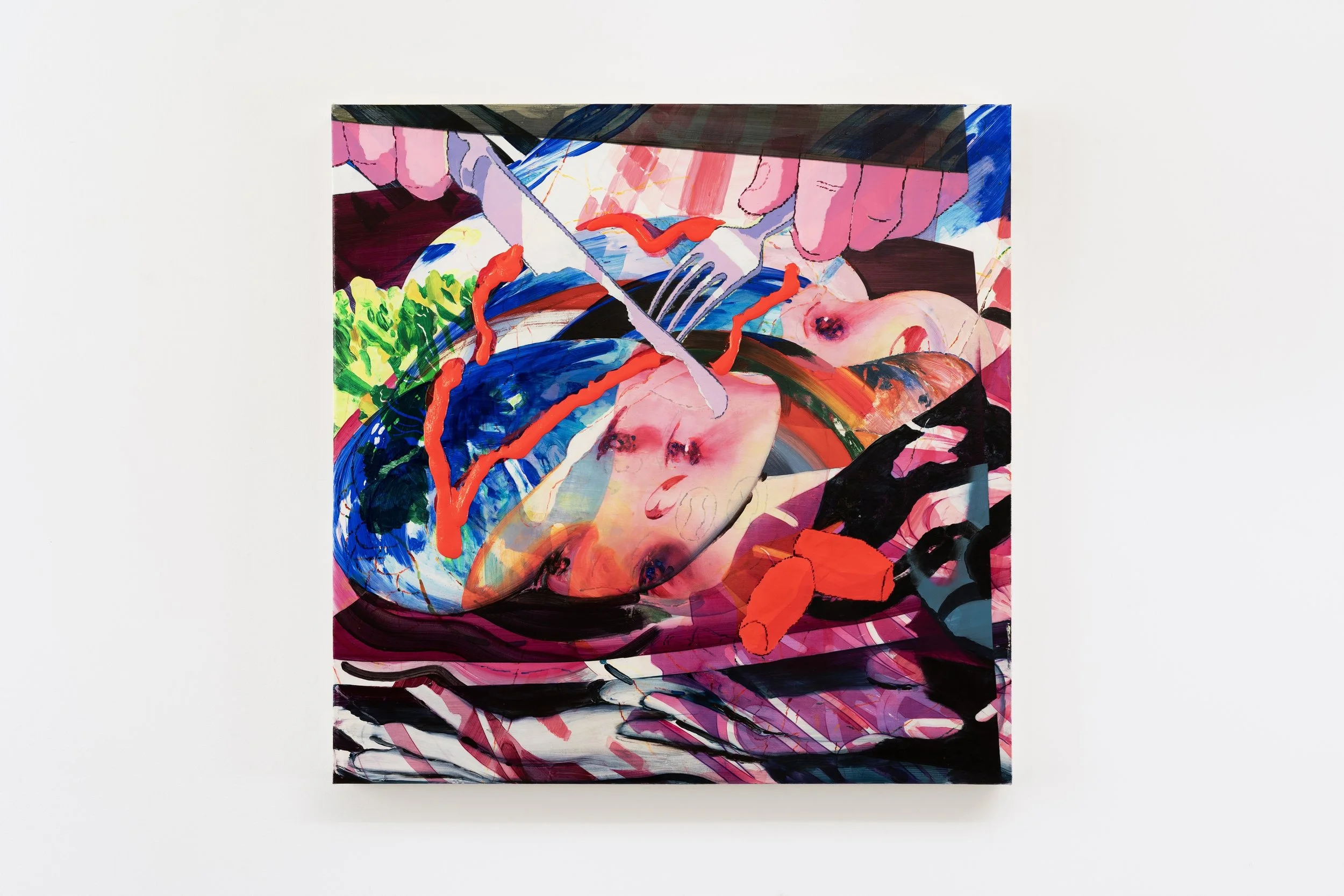
Judy Chung, Communion, 2025. Acrylic on canvas, 30 x 30 in (76 × 76 cm). Image courtesy of RAINRAIN and the artist. Photo by Judy Chung and Marc Tatti.