Richard Hunt: Pressure, at the Institute of Contemporary Art, Miami
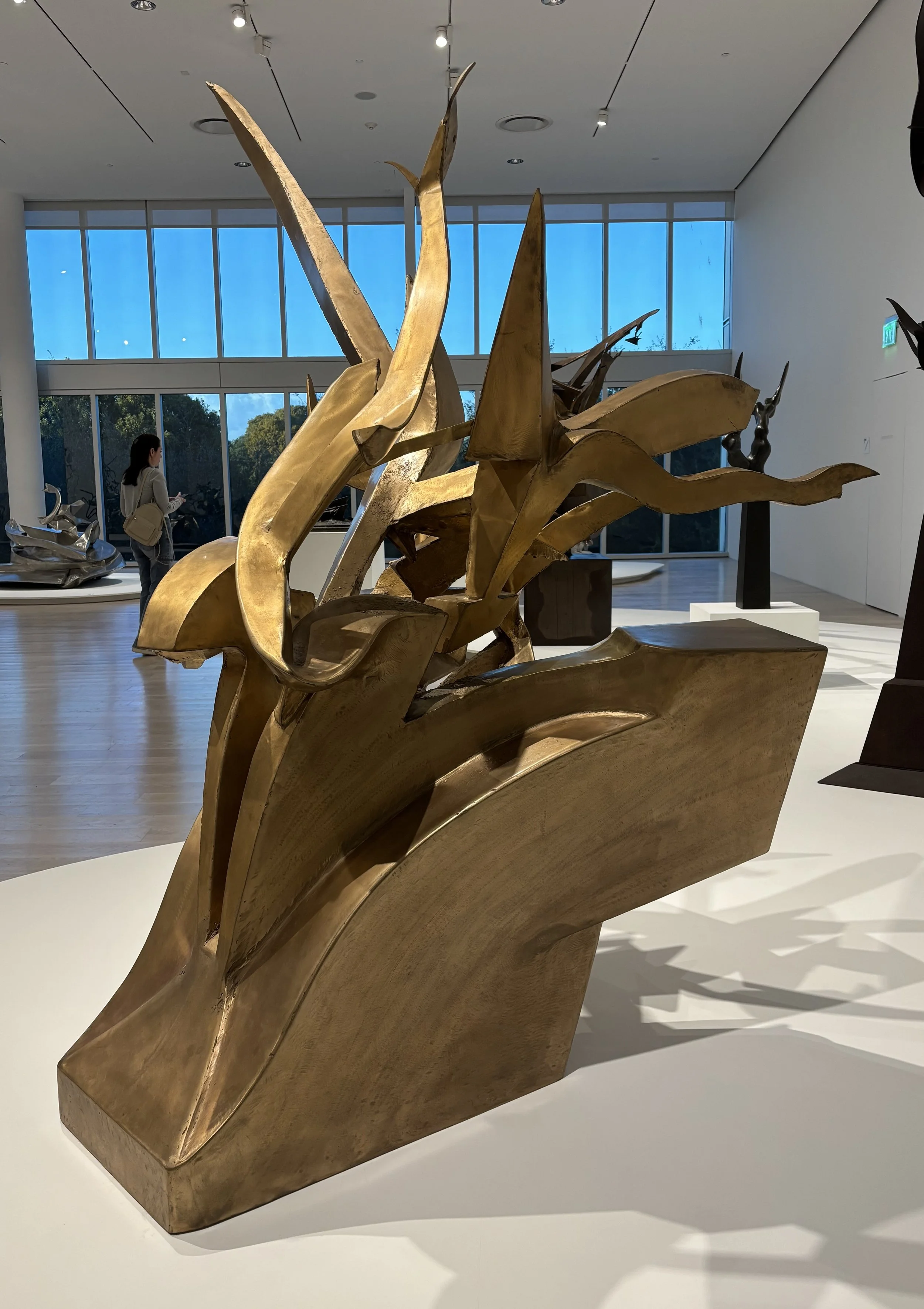
Richard Hunt,From the Ground Up, 1989, cast and welded bronze. Photo by William Corwin.
Author: William Corwin
Published Saturday, February 28, 2026
Seeing the scope of Hunt’s career in one voluminous space exposes his fascination with metal and its capabilities: bulky, hulking masses juxtaposed with spindly creeping things, juxtaposed with accumulations of form. The works inhabit globular islands, and we navigate around them on circuitous paths, growing familiar with the artist’s different approaches to his medium. One of the earliest is also the most gripping—a welded metal piece entitled Hero’s Head (1956); a portrait of Emmett Till reframed as John the Baptist. The murdered boy’s head is a shell of seemingly delicate steel components, contradictorily creating a solid mass of mostly void, a small rough sphere sits in the ring of an eye socket, cantilevering over nothingness. Hunt would continue to play with this sense of emptiness, generating space or absorbing it, throughout his long career.
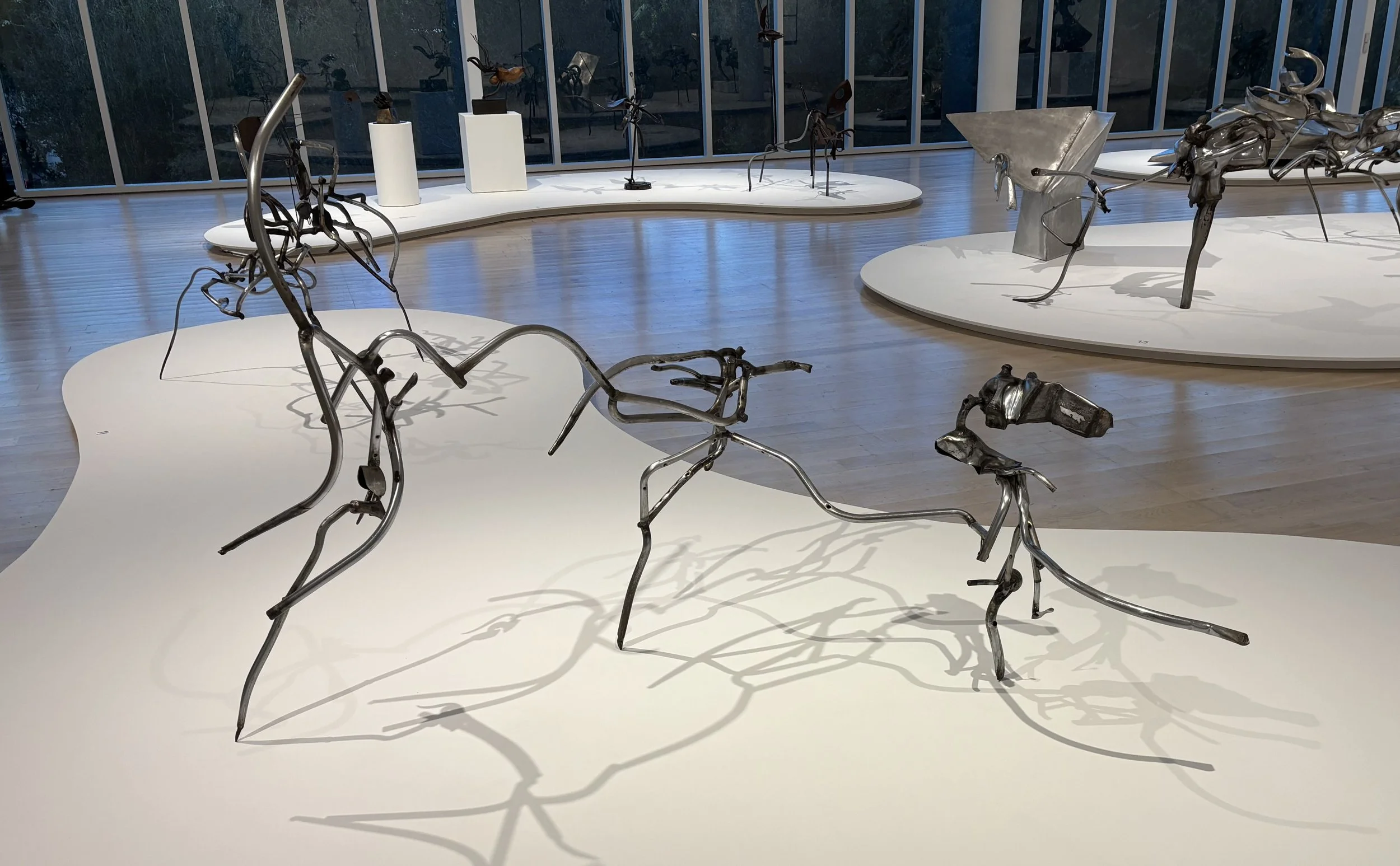
Linear Peregrination, 1962. Welded chromed steel. Photo by William Corwin.
The portrait of Till is recumbent tragedy, but for the most part, Hunt’s forms are sharp and cagey, with an awareness of the viewer and a latent ability to protect themselves, and perhaps even attack. From The Ground Up (1989) is a cast and welded bronze, bristles with long golden curving spines. It is both heavy and light: the solid body of the sculpture has the abstract angular, but curving, movement of a Boccioni, while the upper half of West’s form dissolves into a cloud of metal nettles. The pieces are frequently transparent in this way—they encompass much more with a limited mass, utilizing sinews and tentacles to hold their ground. Linear Peregrination (1962) and Opposed Linear Forms (1961) deliver a punch much higher than their weight class: both are line drawings made of welded steel tubing. They creep on long pin-like segmented legs (and share a lot in common with Bourgeois’s Maman pieces) and have no bodies to speak of save the airspace captured by the twisted thread—like lines that connect the legs and flare up, ribbon-like, over their extremities. A key aspects of Hunt’s creations are the shadows that they cast, adding almost an entire phantom sculpture into the mix.
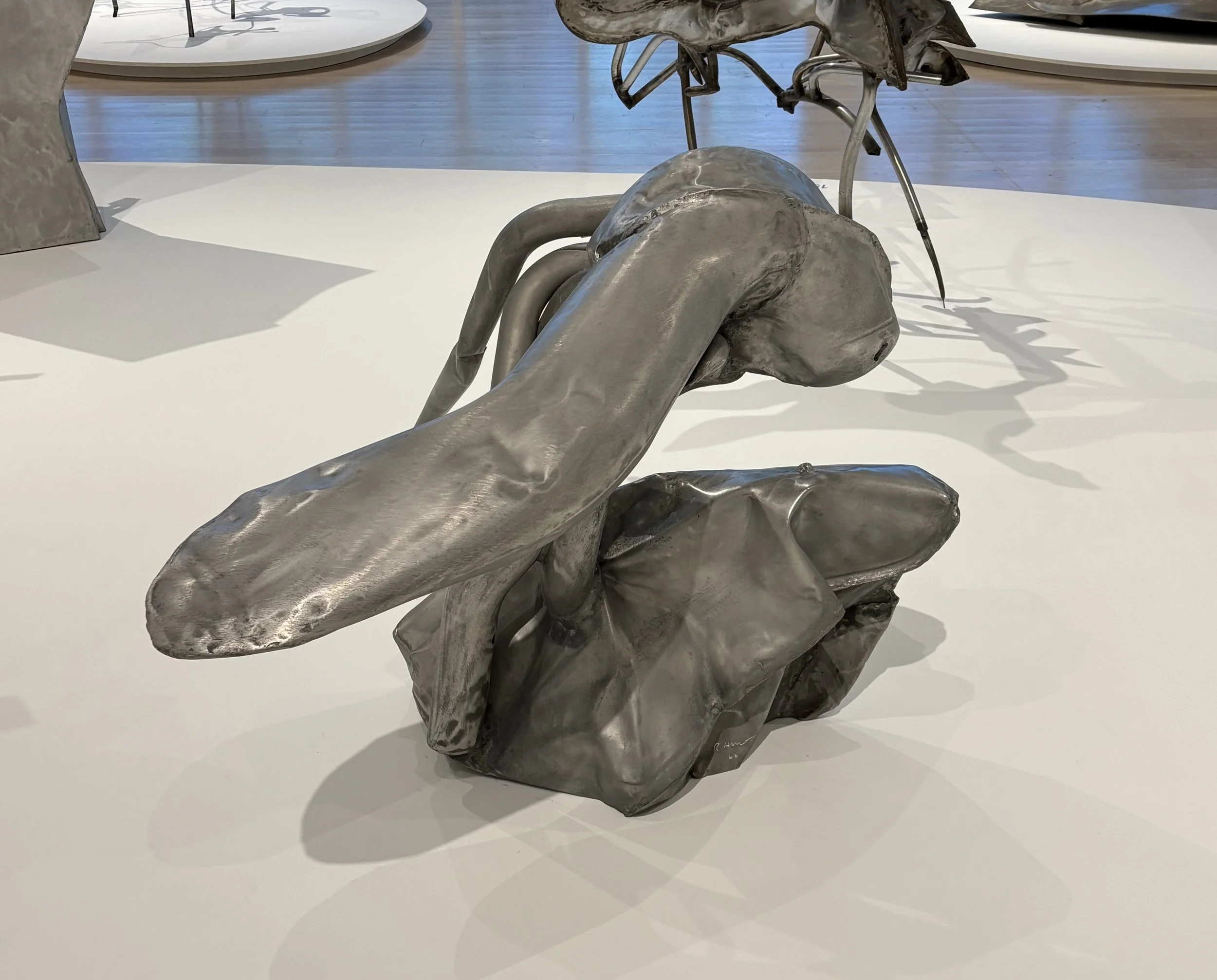
Richard Hunt, Tube Form, 1966. Welded aluminum. Photo by William Coriwn.
Tube Form (1966) uses metal’s (in this case, aluminum) tensile proclivities to toy with the viewers’ visual impressions of balance: a thick, sinuous form seems to levitate, supported by slender tendrils apparently far too diminutive to shoulder the weight. The same is true in Opposed Forms (1965), where a mass of steel stands precariously on two spindly legs, further supported by a very casual assemblage of jerry-rigged narrow tubes. The sculptures themselves are ingeniously balanced, but the spectator is thrown off-kilter, also adding to the vaguely threatening sensibility of Hunt’s pieces. But, balance, or lack of balance, can go both ways, so a piece like the cast bronze maquette for I Have Been to the Mountain(1977) is so firmly planted on the ground, vis-à-vis its length to height ratio, that it has that deceptive geology of a gently ascending slope that distorts the magnitude of the actual magnitude of a mountain. Low Flight (1998) is an inverted tornado—it swirls up from a wide base to an impossibly narrow apex—again much like Boccioni, his Development of a Bottle in Space (1913), but while the weight seems evenly distributed, the fact that the flanges of the base of Hunt’s sculpture don’t evenly touch the ground, make this conical shape seem to whirl and wobble.
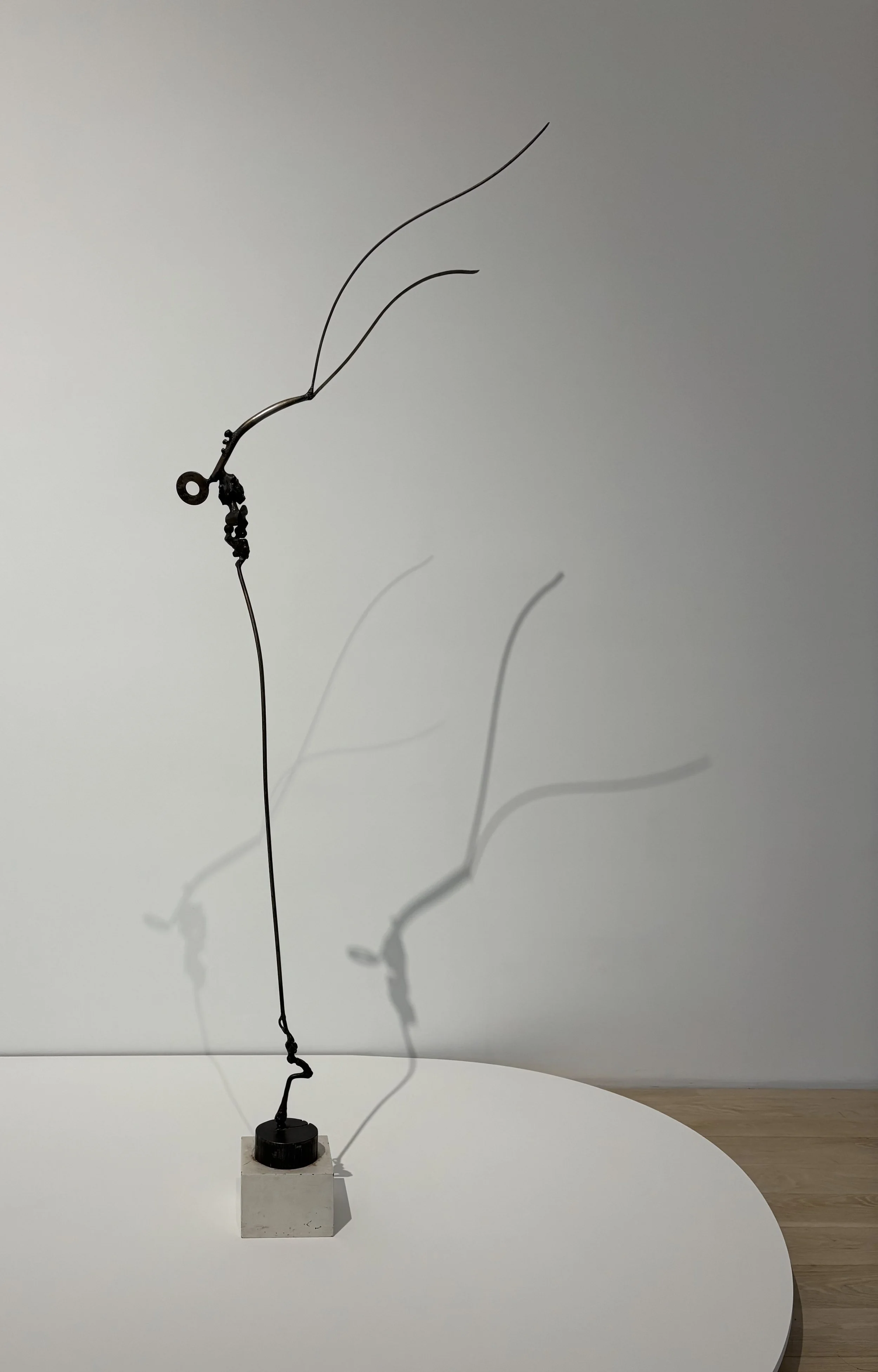
Richard Hunt, Branching Construction, 1961.Steel and bronze on a painted wood base. Photo by William Corwin.
At his extreme and perhaps most enticing, Hunt can dispense with all the rules of sculpture entirely. Branching Construction (1961) is a slightly twisting vertical which grows into a node of complication—a ring and several bumpy irregular forms, and then splits into two branches/antennae. It hovers between animal and vegetable, incontrovertibly alive and simultaneously completely alien and true to its steel and bronze construction, and also contradictorily filled with either life or potential energy, like a spring. Materially, it is hardly there, and yet it has almost as much presence in the space as we do.
About the author: William Corwin is a sculptor and writer based in New York. He writes for The Brooklyn Rail and ArtPapers and previously for Frieze, Canvas, Art & Antiques, and ArtCritical.